Showing posts with label GHG. Show all posts

Wednesday, December 6, 2023

Moving with the EV

This article provides some data to support the fact that EVs are better for the environment in Nova Scotia.


Energy Options for Automobiles


Yes! The electricity generated to power EVs is generally cleaner than gasoline and it’s getting cleaner over time as we integrate more renewable energy on the grid. Even if an electrical grid was powered entirely by coal, EVs would still only produce 88% of the emissions of gasoline powered vehicles. While it’s also true that producing the battery in an EV can sometimes result in higher emissions during the manufacturing process, that gap is closed within 18 months of driving. With our current electricity mix in Nova Scotia, at the end of its lifecycle, an EV cuts the emissions of gas-powered alternatives in half. (Ev Basics, n.d.)


The CAA Driving Cost Calculator for Sustainable Transportation compares the estimated total annual driving costs for the 2023 Hyundai Kona EV Ultimate 4D Utility EV ($7,803.96/year) and the 2023 Hyundai Kona Preferred 4D Utility AWD ($8,366.97/year). (Based on owning the vehicle for 5 years)


CAA Driving Cost Calculator. (2023, June 16). Canadian Automobile Association. Retrieved December 6, 2023, from https://carcosts.caa.ca/en/compare


The Schumpeter business column, at the Economist, asks how green is your electric vehicle, really? It reports that EVs are in the middle of an obesity epidemic that shows itself in even though some manufacturers claim sustainability as a founding principle, they are building bigger, burlier cars, even when they are electric.


For now, carmakers can argue that however big the electric rigs, they have a positive impact on the planet. Though manufacturing evs—including sourcing the metals and minerals that go into them—generates more greenhouse gases than a conventional car, they quickly compensate for that through the absence of tailpipe emissions. Lucien Mathieu of Transport and Environment, a European ngo, says that even the biggest evs have lower lifetime carbon emissions than the average conventional car. That is true even in places with plenty of coal-fired electricity, such as China.


Ultimately, the industry is almost sure to realise the folly of pursuing size for its own sake. The penny is starting to drop. Ford’s ceo, Jim Farley, recently said carmakers could not make money with the longest-range batteries. His opposite number at General Motors, Mary Barra, has taken the unexpected step of reversing a plan to retire the affordable Chevy Bolt ev. In Europe, carmakers like Volkswagen are building smaller, cheaper evs. Tesla is said to be planning a compact model made in Mexico.


The pressure is partly coming from competition. Felipe Munoz of Jato Dynamics, a car consultancy, says China prizes battery efficiency above bigness and is hoping to muscle in on overseas markets with lighter, cheaper brands, such as byd. Innovation in batteries based on solid-state or sodium-ion chemistry may also make evs more efficient. For the time being, drivers with money to splurge will no doubt relish flaunting their low-carbon credentials from the vantage point of a large suv or monster truck. And so they should—until they realise that they may be making electrification less accessible to the rest of humanity. (How Green Is Your Electric Vehicle, Really?, 2023)


The absence of tailpipe emissions in EV’s results in lower greenhouse gas lifetime output than the average conventional ICE car. As battery technology improves to solid state and sodium-ion designs, the efficiency will improve and the number of charging stations will grow.


References

CAA Driving Cost Calculator. (2023, June 16). Canadian Automobile Association. Retrieved December 6, 2023, from https://carcosts.caa.ca/en/compare 

Ev Basics. (n.d.). EV Assist. Retrieved December 6, 2023, from https://evassist.ca/ev-basics/ 

How green is your electric vehicle, really? (2023, June 16). the Economist. Retrieved December 6, 2023, from https://www.economist.com/business/2023/08/10/how-green-is-your-electric-vehicle-really? 


Sunday, June 25, 2023

Focus on EV’s may not be top Climate Priority

Efforts to transition personal vehicles to BEV (Battery Electric Vehicles), or HEV (Hybrid Electric Vehicles) from ICEV (Internal Combustion Engine Vehicles) may be a diversion from focus on more effective government action to mitigate the effects of the climate emergency.


graphic designed by Sam Parker

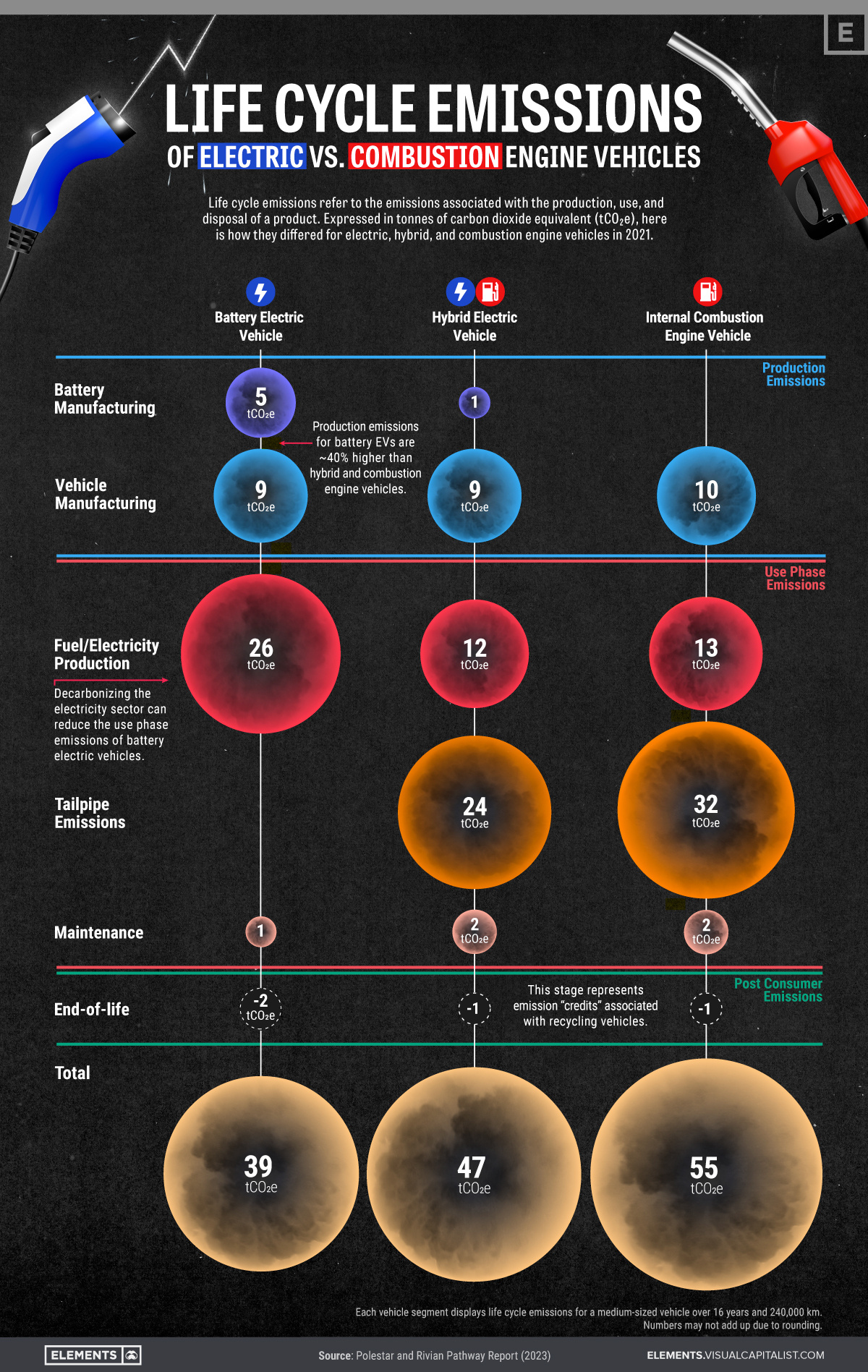
Selin Oğuz reports for Visualcapitialist that the International Energy Agency concludes the transportation sector is more reliant on fossil fuels than any other sector in the economy. In 2021, it accounted for 37% of all CO2 emissions from end‐use sectors. The graphic above, designed by Sam Parker, visualizes the life cycle emissions of battery electric, hybrid, and internal combustion engine (ICE) vehicles.


The Elements Visual Capitalist web page offers some other insights from the data that may not be as obvious at first. These insights help to identify areas of scientific and engineering efforts to further reduce emissions.


  • The production emissions for BEVs are approximately 40% higher than those of hybrid and ICE vehicles. According to a McKinsey & Company study, this high emission intensity can be attributed to the extraction and refining of raw materials like lithium, cobalt, and nickel that are needed for batteries, as well as the energy-intensive manufacturing process of BEVs.

  • Electricity production is by far the most emission-intensive stage in a BEVs life cycle. Decarbonizing the electricity sector by implementing renewable and nuclear energy sources can significantly reduce these vehicles’ use phase emissions.

  • By recycling materials and components in their end-of-life stages, all vehicle segments can offset a portion of their earlier life cycle emissions. (Oguz, 2020)


The International Energy Agency found that using energy more efficiently was the single largest potential contributor to reaching net zero greenhouse gas emissions. Fiona Harvey, Environment editor at the Guardian, writes that the latest IPCC report highlights key measures countries must take to avoid climate catastrophe.


Renewable energy in the form of wind and solar power is now cheaper than fossil fuels across most of the world and the IPCC found that solar power, wind power and reducing the conversion of land to agriculture were the three measures with the strongest potential for reducing greenhouse gas emissions globally.


  • Reduce methane

  • Stop deforestation

  • Restore other degraded land, and stop it being turned to agriculture

  • Change agriculture, and change the way we eat

  • Solar and wind power

  • Energy efficiency

  • Stop burning coal

  • Put climate at the heart of all decision-making (Harvey, 2023)


The key measures identified in the latest IPCC report do not put transition to electric vehicles in the top eight necessary measures to avoid catastrophe.  Personal action may not be as effective in meeting net zero goals as transformation of the way we use our natural resources, generate electricity with solar and wind, increase energy efficiency, and put climate change at the core of government decisions.


References

Harvey, F. (2023, March 22). Eight things the world must do to avoid the worst of climate change. The Guardian. Retrieved June 25, 2023, from https://www.theguardian.com/environment/2023/mar/21/methane-to-food-waste-eight-ways-to-attempt-to-stay-within-15c?CMP=share_btn_tw 

Oguz, S. (2020, May 20). Life Cycle Emissions: EVs vs. Combustion Engine Vehicles. Elements Visual Capitalist. Retrieved June 25, 2023, from https://elements.visualcapitalist.com/life-cycle-emissions-of-electric-hybrid-and-combuston-engine-vehicles/  


Saturday, June 17, 2023

Head Butting Climate Emergency

Recent public pronouncements from the Premier of Nova Scotia, Tim Houston, concerning policy to reduce GHG emissions, mitigate the effect of sea level rise on the Chignecto isthmus, and a proposed energy link connecting the Atlantic provinces to hydroelectricity from Quebec and Labrador seem to prioritize political head butting over necessary and urgent joint federal/provincial action to save money and provide mitigation of climate disaster. 

|

Essential Component for the 21st Century


NDP Leader Claudia Chender comments that  the Houston government didn’t do the work on behalf of Nova Scotians to come up with a carbon pricing option other than the pending tax.


“When the deadline came and went for the Houston government to present their own price on carbon and plan for how to get there and they failed to do that, this is the outcome of the government choosing partisan fights over constructive conversations," Chender said. (Campbell, 2023)


Keith Doucette of The Canadian Press comments that Houston seemed unmoved when asked whether the Isthmus of Chignecto risked being damaged by extreme weather while governments haggled over who will pay to protect it.


"We're not the ones risking it, the federal government is the one that's trying to get away from their responsibility," the premier said. (Doucette, 2023)


Sarah Smellie of the Canadian Press  reports that Premier Tim Houston says he’s lost confidence in the feasibility of a proposed energy link connecting the Atlantic provinces to hydroelectricity from Quebec and Labrador.


Federal Infrastructure Minister Dominic LeBlanc has previously said he hoped the Atlantic Loop could come online by 2030, but today, Houston signaled some concern without a firm financial commitment from the feds. (Smellie, 2023)


Seth Klein, in the National Observer, asks where are the campaigns urging us to switch to public transit? Where are the promo ads inviting young people to train as renewable electricity technicians and installers, building retrofitters, high-speed rail designers, community planners or electric vehicle manufacturers?


First, the good news: In the wake of the Intergovernmental Panel on Climate Change reports and extreme weather events, we are witnessing a shift in the public opinion terrain. Canadians are increasingly anxious about climate change. They understand it to be an emergency and a major threat to their children and grandchildren. And importantly, a solid majority of Canadians are prepared to accept significant and bold policy responses.*


The bad news? Many Canadians are confused and ambivalent. They could be convinced to embrace speedy and transformative action, or not. A sizable chunk of the public is simply unsure of how ambitious we can be. Moreover, people’s prioritization of climate wanes when economic anxieties and affordability challenges are heightened. And so, we need leadership that seeks to link these issues and animate the ambition in us all. (Klein & Logan, 2023)


It is difficult to find a policy championed by the conservative provincial governments or the Conservative Party of Canada that defines action necessary now to mitigate the impact of GHG emissions and lays out a plan to adapt to a low carbon economy.


References

Campbell, F. (2023, June 16). Premier acknowledges carbon tax will punish Nova Scotians at the pumps, places full blame on Ottawa. SaltWire. Retrieved June 16, 2023, from https://www.saltwire.com/atlantic-canada/news/premier-acknowledges-carbon-tax-will-punish-nova-scotians-at-the-pumps-places-full-blame-on-ottawa-100865039/ 

Doucette, K. (2023, June 15). N.S. premier says Ottawa must pay entire bill to protect land link from flooding risk. CBC. Retrieved June 16, 2023, from https://www.cbc.ca/news/canada/nova-scotia/n-s-premier-ottawa-must-pay-protect-isthmus-from-flooding-risk-1.6877811 

Klein, S., & Logan, C. (2023, February 23). Crisis, what crisis? We need a climate emergency information agency. National Observer. Retrieved June 16, 2023, from https://www.nationalobserver.com/2023/02/23/opinion/crisis-what-crisis-we-need-climate-emergency-information-agency 

Smellie, S. (2023, June 16). Nova Scotia, Ottawa butt heads over Atlantic Loop as feds look for summer agreement | Globalnews.ca. Global News. Retrieved June 16, 2023, from https://globalnews.ca/news/9774122/nova-scotia-ottawa-butt-heads-over-atlantic-loop/ 


Friday, April 14, 2023

Health Homes and Climate

The relationships between health services, housing needs, and the climate crisis are many. The tension between market based action and government control in these areas compels us to carefully analyze trends and progress.


Health and Housing in Climate Crisis


The Ottawa Citizen reports on privatization of orthopedic surgery that may be impacting staffing for hospital health care. Elizabeth Payne reports:


“We are not able to provide the service we want for oncology patients because nurses are working in a higher paid environment,” said the unnamed source. “My view is that this is confirming the concerns that we are limited in terms of the service we can provide in the public system because nurses are obviously being poached by this private clinic.” (Payne, 2023)


Nicole Munro, at Saltwire, contributes an article on West End Mall redevelopment in Halifax.


By the time the master plan is finished, Coun. Shawn Cleary (Halifax West Armdale) said, the inclusionary zoning bylaw should be in place at about the same time, giving HRM the power to ensure there is a percentage of affordable units included.


While Cleary suspects most of the units will be market-based rents, he said the inclusionary zoning bylaw would allow some affordable units.


“We’ll have the power to actually say, ‘No, no, you don’t have a choice. You’re going to have this per cent of those units that have to be affordable.’” (Halifax's West End Mall Redevelopment Will Go on Despite Pushback, Councillor Says, 2023)


Matt McGrath, environment correspondent for BBC News, contributes an article about fossil fuel emissions falling in worldwide electricity generation.


One significant player impacting the overall trend is China. Around 50% of the global addition of wind power came from China and about 40% of the world's new solar came from from the country that's also the world's biggest use of coal power.


"There is a chance that at the rate that China is building wind and solar and all types of clean generation, that they achieve that peak in coal generation earlier than 2025, which would be significant," said Mr Jones.


Energy experts acknowledge that curbing fossil fuels in power generation could well be a "turning point", but much more remains to be done. (McGrath, 2023)


We monitor important trends as we ponder the best economic approach to address these serious concerns that impact the common good.


References


Halifax's West End Mall redevelopment will go on despite pushback, councillor says. (2023, April 12). SaltWire. Retrieved April 14, 2023, from https://www.saltwire.com/nova-scotia/business/halifaxs-west-end-mall-redevelopment-will-go-on-despite-pushback-councillor-says-100843479/ 


McGrath, M. (2023, April 11). Climate change: Fossil fuel emissions from electricity set to fall - report. BBC. Retrieved April 14, 2023, from https://www.bbc.com/news/science-environment-65240094 

Payne, E. (2023, March 21). Surgeries at for-profit orthopedic clinic already impacting hospital staffing, some insiders say. Ottawa Citizen. Retrieved April 14, 2023, from https://ottawacitizen.com/news/surgeries-at-for-profit-orthopedic-clinic-already-impacting-hospital-staffing-some-insiders-say 


Saturday, February 25, 2023

Life Cycle Emissions ICE or EV

Gasoline car emissions have been reduced in the UK and Norway. Barry Saxifrage reports that their most effective single policy has been a "polluter pays" tax added to new cars. Specifically, they calculate the purchase tax for new cars based on car weight, CO2 emissions and NOx emissions.


Barry Saxifrage's first chart shows the relative climate emissions from fuelling our cars with gasoline and electricity.


Research shows that making a gasoline car is currently a bit less climate-polluting than making an electric car. Around 2 tCO2 less. But this small advantage gets wiped out many times over by the extra emissions from fuelling the car.


A chart showing the latest vehicle registration numbers from Statistics Canada shows that electric cars are a thin green frosting on top of an ever-expanding fleet of burnermobiles. For every new electric car added to our roads over the last five years, we've added 10 more gasoline cars.


The trend in Canada is an increase in purchases of gasoline cars, SUV’s, and trucks as contrasted by decreases in these purchases in Norway, UK, France, Germany, Sweden, and Japan. Barry Saxifrage notes that the most effective single policy in Norway has been a "polluter pays" tax added to new cars. Specifically, they calculate the purchase tax for new cars based on car weight, CO2 emissions and NOx emissions. This can nearly double the cost of buying a polluting gas guzzler. Imagine Canada bringing in an 80 per cent sales tax on big, new gas-guzzling SUVs and you've got the basic idea.


As Canadians switch to electric vehicles in response to the increasing cost of gasoline and concern for the effect of greenhouse gas emission on the increasing frequency and severity of climate events in our country, we may find “polluter pay” taxation to be an effective strategy


References


Saxifrage, B., & Woodside, J. (2023, February 24). Gasoline versus electric cars? Here's how their life cycle emissions compare in Canada. National Observer. Retrieved February 24, 2023, from https://www.nationalobserver.com/2023/02/24/analysis/gasoline-versus-electric-cars-life-cycle-emissions-compared-canada

Tuesday, December 6, 2022

Opportunity or Imperative to Change

Cloe Logan, writing for the National Observer, analyses a new report assessing climate risks across Nova Scotia from the provincial Department of Environment and Climate Change, entitled, Weathering What’s Ahead: Climate Change Risk and Nova Scotia’s Well-being. 


Will Balser, coastal adaptation co-ordinator at Ecology Action Centre in Halifax, notes that there are some important risks acknowledged in the report. He stresses the important next step of seeing how the province plans to address those risks.


Timothy Halman, minister of environment and climate change, said the report shows the vulnerability of the area, setting the groundwork for action. “Together, we have an opportunity to make positive change and work to protect each other and all that we value,"


Will Balser said the minister’s sentiment should go further. “I see it as if he's talking about an opportunity to make a positive gain. Rather, I see it as more of an imperative to change, rather than just an opportunity,” he said. (Logan & Ottenhof, 2022)


Opportunity or Imperative


The report identifies top climate concerns for Nova Scotia.

Top Climate Concerns NS


The province’s climate plan, expected on Dec 7 2022, needs to clarify the already stated objectives:


Clarify Objectives


The province needs to


The report notes that “using oil, coal, and natural gas to heat homes, generate electricity, and fuel vehicles” contributes to climate change and will worsen climate impacts. As of now, over half of the electricity generation in Nova Scotia comes from coal. (Logan & Ottenhof, 2022)


Electricity needs in Canada


The Department of Environment and Climate Change has produced this report as a resource for all levels of government to set priorities, business to alter practices and plans, and people to use in conversations that will direct our collaboration with the measures necessary to weather what is ahead.


References

Logan, C., & Ottenhof, L. (2022, December 5). Sea levels in Nova Scotia set to rise by a metre this century. National Observer. Retrieved December 6, 2022, from https://www.nationalobserver.com/2022/12/05/news/sea-levels-nova-scotia-rise-metre-century