Showing posts with label IPCC. Show all posts

Sunday, June 25, 2023

Focus on EV’s may not be top Climate Priority

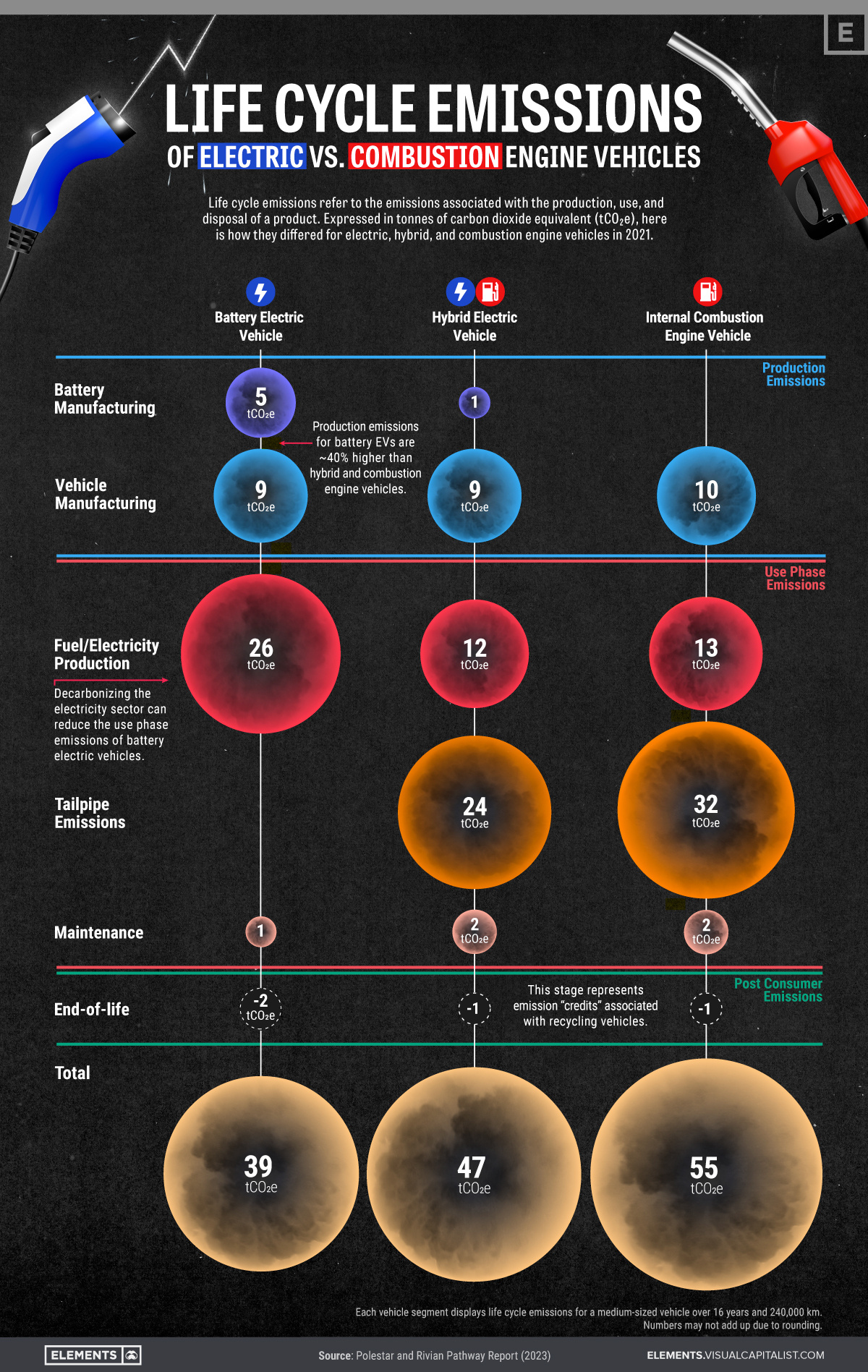
Efforts to transition personal vehicles to BEV (Battery Electric Vehicles), or HEV (Hybrid Electric Vehicles) from ICEV (Internal Combustion Engine Vehicles) may be a diversion from focus on more effective government action to mitigate the effects of the climate emergency.


graphic designed by Sam Parker

Selin Oğuz reports for Visualcapitialist that the International Energy Agency concludes the transportation sector is more reliant on fossil fuels than any other sector in the economy. In 2021, it accounted for 37% of all CO2 emissions from end‐use sectors. The graphic above, designed by Sam Parker, visualizes the life cycle emissions of battery electric, hybrid, and internal combustion engine (ICE) vehicles.


The Elements Visual Capitalist web page offers some other insights from the data that may not be as obvious at first. These insights help to identify areas of scientific and engineering efforts to further reduce emissions.


  • The production emissions for BEVs are approximately 40% higher than those of hybrid and ICE vehicles. According to a McKinsey & Company study, this high emission intensity can be attributed to the extraction and refining of raw materials like lithium, cobalt, and nickel that are needed for batteries, as well as the energy-intensive manufacturing process of BEVs.

  • Electricity production is by far the most emission-intensive stage in a BEVs life cycle. Decarbonizing the electricity sector by implementing renewable and nuclear energy sources can significantly reduce these vehicles’ use phase emissions.

  • By recycling materials and components in their end-of-life stages, all vehicle segments can offset a portion of their earlier life cycle emissions. (Oguz, 2020)


The International Energy Agency found that using energy more efficiently was the single largest potential contributor to reaching net zero greenhouse gas emissions. Fiona Harvey, Environment editor at the Guardian, writes that the latest IPCC report highlights key measures countries must take to avoid climate catastrophe.


Renewable energy in the form of wind and solar power is now cheaper than fossil fuels across most of the world and the IPCC found that solar power, wind power and reducing the conversion of land to agriculture were the three measures with the strongest potential for reducing greenhouse gas emissions globally.


  • Reduce methane

  • Stop deforestation

  • Restore other degraded land, and stop it being turned to agriculture

  • Change agriculture, and change the way we eat

  • Solar and wind power

  • Energy efficiency

  • Stop burning coal

  • Put climate at the heart of all decision-making (Harvey, 2023)


The key measures identified in the latest IPCC report do not put transition to electric vehicles in the top eight necessary measures to avoid catastrophe.  Personal action may not be as effective in meeting net zero goals as transformation of the way we use our natural resources, generate electricity with solar and wind, increase energy efficiency, and put climate change at the core of government decisions.


References

Harvey, F. (2023, March 22). Eight things the world must do to avoid the worst of climate change. The Guardian. Retrieved June 25, 2023, from https://www.theguardian.com/environment/2023/mar/21/methane-to-food-waste-eight-ways-to-attempt-to-stay-within-15c?CMP=share_btn_tw 

Oguz, S. (2020, May 20). Life Cycle Emissions: EVs vs. Combustion Engine Vehicles. Elements Visual Capitalist. Retrieved June 25, 2023, from https://elements.visualcapitalist.com/life-cycle-emissions-of-electric-hybrid-and-combuston-engine-vehicles/  


Saturday, June 17, 2023

Head Butting Climate Emergency

Recent public pronouncements from the Premier of Nova Scotia, Tim Houston, concerning policy to reduce GHG emissions, mitigate the effect of sea level rise on the Chignecto isthmus, and a proposed energy link connecting the Atlantic provinces to hydroelectricity from Quebec and Labrador seem to prioritize political head butting over necessary and urgent joint federal/provincial action to save money and provide mitigation of climate disaster. 

|

Essential Component for the 21st Century


NDP Leader Claudia Chender comments that  the Houston government didn’t do the work on behalf of Nova Scotians to come up with a carbon pricing option other than the pending tax.


“When the deadline came and went for the Houston government to present their own price on carbon and plan for how to get there and they failed to do that, this is the outcome of the government choosing partisan fights over constructive conversations," Chender said. (Campbell, 2023)


Keith Doucette of The Canadian Press comments that Houston seemed unmoved when asked whether the Isthmus of Chignecto risked being damaged by extreme weather while governments haggled over who will pay to protect it.


"We're not the ones risking it, the federal government is the one that's trying to get away from their responsibility," the premier said. (Doucette, 2023)


Sarah Smellie of the Canadian Press  reports that Premier Tim Houston says he’s lost confidence in the feasibility of a proposed energy link connecting the Atlantic provinces to hydroelectricity from Quebec and Labrador.


Federal Infrastructure Minister Dominic LeBlanc has previously said he hoped the Atlantic Loop could come online by 2030, but today, Houston signaled some concern without a firm financial commitment from the feds. (Smellie, 2023)


Seth Klein, in the National Observer, asks where are the campaigns urging us to switch to public transit? Where are the promo ads inviting young people to train as renewable electricity technicians and installers, building retrofitters, high-speed rail designers, community planners or electric vehicle manufacturers?


First, the good news: In the wake of the Intergovernmental Panel on Climate Change reports and extreme weather events, we are witnessing a shift in the public opinion terrain. Canadians are increasingly anxious about climate change. They understand it to be an emergency and a major threat to their children and grandchildren. And importantly, a solid majority of Canadians are prepared to accept significant and bold policy responses.*


The bad news? Many Canadians are confused and ambivalent. They could be convinced to embrace speedy and transformative action, or not. A sizable chunk of the public is simply unsure of how ambitious we can be. Moreover, people’s prioritization of climate wanes when economic anxieties and affordability challenges are heightened. And so, we need leadership that seeks to link these issues and animate the ambition in us all. (Klein & Logan, 2023)


It is difficult to find a policy championed by the conservative provincial governments or the Conservative Party of Canada that defines action necessary now to mitigate the impact of GHG emissions and lays out a plan to adapt to a low carbon economy.


References

Campbell, F. (2023, June 16). Premier acknowledges carbon tax will punish Nova Scotians at the pumps, places full blame on Ottawa. SaltWire. Retrieved June 16, 2023, from https://www.saltwire.com/atlantic-canada/news/premier-acknowledges-carbon-tax-will-punish-nova-scotians-at-the-pumps-places-full-blame-on-ottawa-100865039/ 

Doucette, K. (2023, June 15). N.S. premier says Ottawa must pay entire bill to protect land link from flooding risk. CBC. Retrieved June 16, 2023, from https://www.cbc.ca/news/canada/nova-scotia/n-s-premier-ottawa-must-pay-protect-isthmus-from-flooding-risk-1.6877811 

Klein, S., & Logan, C. (2023, February 23). Crisis, what crisis? We need a climate emergency information agency. National Observer. Retrieved June 16, 2023, from https://www.nationalobserver.com/2023/02/23/opinion/crisis-what-crisis-we-need-climate-emergency-information-agency 

Smellie, S. (2023, June 16). Nova Scotia, Ottawa butt heads over Atlantic Loop as feds look for summer agreement | Globalnews.ca. Global News. Retrieved June 16, 2023, from https://globalnews.ca/news/9774122/nova-scotia-ottawa-butt-heads-over-atlantic-loop/ 


Monday, August 30, 2021

Update on Policy for Emission Reduction

NDC Commitments Canada


As Canadian Federal Election #44 comes closer, the policy of the political parties concerning meeting GHG reduction goals set by the IPCC needs to be examined and critically evaluated.


Stephanie Taylor of The Canadian Press reports to Global News that Conservative Leader Erin O’Toole rejects the Liberals’ higher emission reduction goal but vows to still meet the Paris target. O’Toole is facing criticism after rejecting Canada’s new target for reducing greenhouse gas emissions in favour of a lower one first set by Stephen Harper.


His pledge comes as Canada prepares to attend the United Nations Climate Change conference this fall where countries are expected to commit more ways to tackle the issue. In anticipation of the meeting, the Liberal government recently increased its targets for reducing greenhouse gas emissions to between 40 to 45 per cent below 2005 levels by 2030, up from 30 per cent. The 30 per cent goal was set by former Conservative prime minister Stephen Harper and was the commitment the country was held to under the 2015 Paris Agreement. O’Toole says the Conservatives’ climate change plan “will meet the Paris objectives” of 30 per cent, despite the United Nations specifying the agreement works by countries coming up with “increasingly ambitious climate action” every five years.1


Mitchell Beer has compiled a report in the The Energy Mix noting that Conservative Leader Erin O’Toole pledged to move boldly backwards on Canada’s emissions reduction target, and the fossil lobby has published its campaign wish list, and the climate crisis held its spot as a top concern for Canadian voters as the federal election moved into its third week.


Speaking in Newfoundland on Friday, Conservative Leader Erin O’Toole said he would jettison the Trudeau government’s international commitment to cut Canada’s greenhouse gas emissions 40 to 45% by 2030, and return to the Harper-era target of 30%, in search of a carbon target the country can achieve without “crippling” the economy.


If Canada were to [act on O’Toole’s promise], it would not violate an obligation, because the NDC itself is not legally binding,” University of Toronto law professor Jutta Brunnée explained. “But it would be contrary to the spirit of the Paris Agreement,” and “a challenge to the entire logic of the Paris Agreement, because the logic is progression over time. So it’s not something that one should take lightly.” New Democrats are campaigning on a 50% GHG reduction target by 2030, while the Green Party is talking about 60%..2


The fossil lobby has published its campaign wish list and CAPP President and CEO Tim McMillan says “To be resilient and sustainable, recovery will be a multi-year process based on robust economic activity.”


 McMillan says continues “ It is crucially important for the incoming federal government to make policy decisions that position Canada for success in an ultra-competitive international investment market. Investment supports industry growth and is vital to developing and commercializing technologies that reduce emissions, water use, and more.” Cenovus Energy CEO Alex Pourbaix let it be known—apparently without a hint of irony—that he expects Canadian taxpayers to shell out up to C$52.5 billion to help his industry get the carbon out of its operations. “It’s going to take tens of billions of dollars over 30 years to decarbonize [our oil] industry,” Pourbaix said2


Angela Carter, associate professor of political science at the University of Waterloo, noted that climate was already a top priority in the 2019 election.


“But this year, there’s a difference.“ There is a growing awareness that the climate crisis is, of course, also a health crisis,” Carter told the CBC. “And we have leaders, international leaders, Mark Carney is one of these, at the United Nations who said that the climate crisis in 50 years is going to look like a COVID pandemic every single year.”2


Sussex Strategy Group Senior Counsel Shawn McCarthy says climate change will show up as a “wedge issue” on the campaign trail, even if it didn’t much look that way in the first two weeks.


Though Conservative Leader O’Toole has made an effort to close the gap between his party’s 2019 climate platform and its position today, there are still “yawning differences among the parties with regard to climate ambition,” McCarthy writes. “There continue to be deep cleavages in terms of how they would treat the oil and gas sector, which is responsible for 25% of Canada’s greenhouse gas (GHG) emissions.” While the Trudeau government is vulnerable on its continuing support for the fossil industry, not least its decision to buy the Trans Mountain pipeline with taxpayers’ dollars, O’Toole’s carbon target “is clearly insufficient to put the country on course for achieving net-zero status by 2050,” McCarthy says. “The Liberals will no doubt remind climate-conscious voters that the Conservatives have not endorsed the net-zero target.”.2


The commitment of the Government we elect on September 20 to aggressively cooperate with the industrial nations of the world to reduce GHG emissions is essential to mitigate the effects in storms, fires, biodiversity, and public health of the climate emergency.


References

1

2021, August 27). O'Toole rejects Liberals' higher emission reduction ... - Global News. Retrieved August 30, 2021, from https://globalnews.ca/news/8146328/conservative-party-climate-target-canada-election/ 


2


(n.d.). The Energy Mix: Home. Retrieved August 30, 2021, from https://www.theenergymix.com/ 


Tuesday, August 24, 2021

An Emergency Response is Needed

The latest report from the IPCC indicates that imminent action to address the climate crisis will be required by the Canadian government after the September 2021 election. Seth Klein, an adjunct professor with Simon Fraser University’s urban studies program and the former BC director of the Canadian Centre for Policy Alternatives, reviews his markers to know some signs one would expect to see when a government shifts to a wartime footing to attack the climate crisis


  (His book A Good War: Mobilizing Canada for the Climate Emergency (ECW Press) was published in September 2020.)


So here we sit, facing down the climate emergency, with a B.C. government climate plan that is zero for four when it comes to a convincing emergency response. There are things this provincial government is doing with respect to social and economic justice, housing and homelessness, and tax fairness for which I am grateful. The advancements with respect to child care are especially noteworthy. But the future of those children is now under threat. Decisive action is needed to protect them, as well as other vulnerable populations who are more likely to experience the worst ravages of the climate crisis. The Horgan government needs to hear a resounding wake-up call: Reboot your climate plan and transform it into a real emergency plan. Invite us to join in a grand societal undertaking, one that leaves no one behind and banishes unemployment as we undertake this task of our lives.1


1. Adopt an emergency mindset.


2. Shift from voluntary measures to mandatory policies. 


3. Rally the public at every turn.


4. Create the economic institutions needed to get the job done. 


5. Spend what it takes to win.


6. Stop trying to appease those who seek to block necessary action.1


The Climate Emergency Unit believe it is time for Canada to enter true #ClimateEmergency mode. They have produced a new video ( https://youtu.be/XUJw5cLyfEk ) to show what that would look like.


We all know that climate change is real and we need to dramatically reduce our greenhouse gases as soon as possible, but Canada's emissions have only stagnated since the world agreed to work together on this climate emergency. Using these lessons from WW2, we can envision what true climate action looks like.2


Our ballot box decision will be influenced by the need for the next government to act forcefully in the war against the GHG emissions increasing the temperature of the planet.


References

1

(2021, July 19). BC is in a state of climate emergency with no emergency plan. Retrieved August 24, 2021, from https://www.nationalobserver.com/2021/07/19/opinion/bc-climate-emergency-no-plan 

2

(2021, June 23). 4 Hopeful Lessons from WW2 to Confront Climate Change - YouTube. Retrieved August 24, 2021, from https://www.youtube.com/watch?v=XUJw5cLyfEk