Showing posts with label Economist. Show all posts

Wednesday, July 23, 2025

Truth: the First Casualty

An article in the Economist takes a first-hand look at Gaza’s controversial food-distribution sites where Gazans keep dying and Israel says they are working as intended.


Hunger and First Casualty


International aid organisations, including the UN, deny their supplies were controlled by Hamas and have refused to co-operate with the GHF, which they say violates basic humanitarian principles. Israel has also allowed local clans, some of which are also criminal groups, to receive their own food supplies. It claims these groups “challenge Hamas control”. (A First-Hand Look at Gaza's Controversial Food-Distribution Sites, 2025)


CNN's Catherine Nicholls, Gul Tuysuz, Jeremy Diamond, Sarah Dean and Antoinette Radford report that the UN secretary-general  António Guterres, calls starvation in Gaza a "horror show."


As the humanitarian situation in Gaza continues to spiral, the United Nations’ human rights office had a clear message: “Palestinians in Gaza are starving to death,” a statement read today.


In the past 24 hours, 15 people including four children, died of starvation across the territory according to the enclave’s health ministry.


Separately, at least 1,054 Palestinians have been killed by the Israeli military while trying to access food aid in Gaza, the UN human rights office added in its statement. (Nicholls et al., n.d.)


We ponder the cliche  “Truth is the first casualty of war” as we advocate for a permanent truce that will enable the peaceful resolution of a conflict that has imposed serious atrocities on civilian populations.


References

A first-hand look at Gaza's controversial food-distribution sites. (2025, July 17). The Economist. Retrieved July 23, 2025, from https://www.economist.com/middle-east-and-africa/2025/07/17/a-first-hand-look-at-gazas-controversial-food-distribution-sites 

Nicholls, C., Tuysuz, G., & Diamond, J. (n.d.). UN secretary-general calls starvation in Gaza a "horror show. CNN. Retrieved July 23, 2025, from https://www.cnn.com/world/ 


Thursday, June 6, 2024

Netanyahu Running Out of Options

Bethan McKernan in Jerusalem reports for the Guardian that there is a growing sense in Israel – not for the first time – that Netanyahu is running out of options.


“day after” plan for Gaza now!


“He is world champion at stalling, making all sides sick of him and ultimately evading paying the bill when it comes due,” the commentator Ben Caspit wrote in the centrist Israeli daily Ma’ariv on Tuesday. But even a political master such as Netanyahu couldn’t hold off much longer on making a decision on a deal, Caspit said. “He has to make a real decision. Not a sort-of decision, not a pretend decision, not an on-condition decision and not a temporary decision. A decision.”


Far-right members of the prime minister’s coalition have threatened to quit the coalition if Israel “surrenders” before “total victory” over Hamas, while his leading rival, the centrist Benny Gantz, has said he will resign from the emergency unity government if Netanyahu does not commit to a deal and “day after” plan for Gaza by 8 June. (McKernan, n.d.)


Staying in office is Netanyahu’s best chance of evading prosecution for corruption on charges he denies. But the longtime leader was forced into a corner when Joe Biden unveiled a new truce and hostage release plan, which he said was an Israeli proposal.


The Middle East and Africa section of the Economist reports on the revolt against Prime Minister Binyamin Netanyahu from his war cabinet and generals in the Israel-Hamas war who want a new plan—and a new boss.


Besides the generals, two key figures have flipped from being reluctant partners of Mr Netanytahu, as ministers in his war cabinet, into open opponents. On May 15th Yoav Gallant, the defence minister, who is also the subject of a request from the ICC, stated in public that his plans to create a new governing entity in Gaza, with heavy Palestinian representation, “had not been discussed and worse, no alternative has been proposed instead”. Three days later, Benny Gantz, Mr Netanyahu’s most powerful rival, said that “crucial decisions have not been made,” and accused a “small minority” of “taking control of the bridge of the Israeli ship and steering it to the rocks”. He said he would quit the war cabinet if there was no change of course by June 8th. (The Revolt Against Binyamin Netanyahu, 2024)


If Mr Netanyahu bends to the demands of his more centrist critics, or is toppled, the second question is what a new policy on Gaza would look like.


The likes of Mr Gantz and Mr Gallant agree that Israel should not run Gaza’s affairs; all implicitly think, however, that the IDF should retain a strong security presence in the strip. There is less agreement on the end-game that follows any de-escalation of the war. The Biden administration wants a pathway to an eventual Palestinian state. Mr Gallant and Mr Gantz are reluctant to endorse this, not least because it would be unpopular in Israel.


References

McKernan, B. (n.d.). Pressure grows on Benjamin Netanyahu to back Gaza ceasefire plan. the Guardian. Retrieved June 6, 2024, from https://www.theguardian.com/world/article/2024/jun/04/pressure-grows-on-benjamin-netanyahu-to-back-gaza-ceasefire-plan 

The revolt against Binyamin Netanyahu. (2024, May 19). The Economist. Retrieved June 6, 2024, from https://www.economist.com/middle-east-and-africa/2024/05/19/the-revolt-against-binyamin-netanyahu 


Tuesday, May 7, 2024

Avoiding Humanitarian Atrocity in Rafah

Jake Johnson reports in Salon, one of the first entirely digital major media outlets, with journalism distributed across Salon.com, Salon TV, social media, news platforms, email newsletters and mobile apps, that the United States, Israel's top arms supplier, has said it would oppose a Rafah assault without a credible plan to evacuate civilians from the city. Humanitarian groups and analysts have said such a plan is impossible because there is no genuinely safe place for Gazans to go. Israeli forces have repeatedly attacked so-called "safe zones" and designated routes Palestinians have used to flee in compliance with past IDF orders.


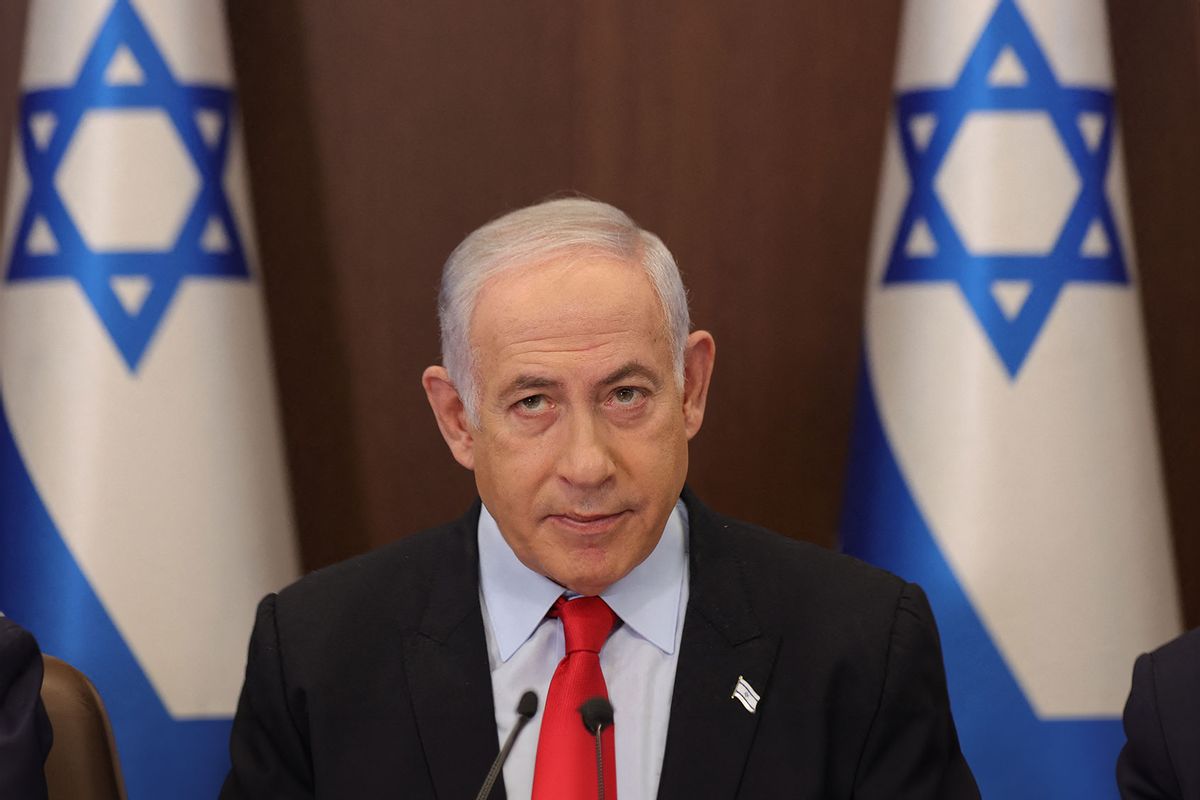
Israeli Prime Minister Benjamin Netanyahu (ABIR SULTAN/POOL/AFP via Getty Images)


Jan Egeland, secretary-general of the Norwegian Refugee Council, comments on Israel's military offensive in Rafah.


"Israel's military offensive in Rafah could lead to the deadliest phase of this conflict, inflicting horrific suffering on approximately 1.4 million displaced civilians in the area," 


"The relocation orders issued by Israel today to thousands of Gazans, directing them to move to Al-Mawasi, are beyond alarming. The area is already overstretched and devoid of vital services. It lacks the capacity to house the number of people currently seeking refuge in Rafah, with no assurances of safety, proper accommodation, or return once hostilities end for those forced to relocate."


"The absence of these fundamental guarantees of safety and return, as required by international humanitarian law, qualifies Israel's relocation directives as forcible transfer, amounting to a serious violation of international law," Egeland said. "Any Israeli military operation in Rafah—which has become the largest cluster of displacement camps in the world—will cause potential mass atrocities." (Johnson, n.d.)


An article in the Economist raises questions of war crimes that may be committed by Israel in areas of discrimination between civilians and combatants and the proportionate use of force.


Those appalled by the suffering in Gaza may argue that genocide was the only charge that could be brought, because the ICJ has no jurisdiction over other war crimes. Yet the focus on an implausible crime diverts attention from the possibility that Israel is breaching the laws of war. These require Israel to distinguish between civilians and combatants and to minimise civilian casualties by being proportionate in the use of force.


The death toll of women and children raises grave doubts over whether Israel is meeting these obligations. It may also be failing to meet its duty under the Geneva Convention to provide medicine and food to civilians in the areas it occupies. As Gaza nears famine, its people do not need grandstanding, they need food. Israel’s leaders need to realise that if they block supplies, they will be held accountable by the court of public opinion—the only court available. (Charging Israel With Genocide Makes a Mockery of the ICJ, 2024)


Alexander Ward, Lara Seligman, and Erin Banco report for Politico that the US fears Israel is speeding up the Rafah invasion timeline.


The events present a precarious moment for Biden, who has repeatedly urged Israel to refrain from a full-scale invasion of Rafah without a comprehensive civilian protection plan in place. He faces the possibility of having to more openly break with Netanyahu, which would involve insisting he pull back from sending thousands of Israeli soldiers into a treacherous war zone where about 3,000 Hamas fighters hide in a sprawling tunnel network.


Defense Secretary Lloyd Austin spoke with his Israeli counterpart, Minister of Defense Yoav Gallant, on Sunday after Hamas fired 10 projectiles from the area adjacent to the Rafah crossing, toward the Kerem Shalom humanitarian crossing, according to an Israeli readout of the call.


President Joe Biden spoke with Prime Minister Benjamin Netanyahu on Monday in a quickly scheduled call, National Security Council spokesperson Adrienne Watson confirmed, a sign the White House moved swiftly to get a grasp of the situation.


“We continue to believe that a hostage deal is the best way to preserve the lives of the hostages, and avoid an invasion of Rafah, where more than a million people are sheltering. Those talks are ongoing now,” NSC spokesperson Watson said.


Prime Minister Benjamin Netanyahu delivered a fiery address Sunday marking Israel’s Holocaust memorial day, vowing that his nation would move forward with plans to militarily defeat Hamas with or without international support: “If Israel is forced to stand alone, Israel will stand alone.” (Ward et al., n.d.)


If Israel is dangerously close to violations of humanitarian law and demonstrations in the United States, in an election year, raise concerns about Biden’s policy on the war, the restriction of military and financial aid to Israel may be a necessary political and humanitarian option especially if the Rafah incursion risks allied support for Israel.


References


Charging Israel with genocide makes a mockery of the ICJ. (2024, January 18). The Economist. Retrieved May 6, 2024, from https://www.economist.com/leaders/2024/01/18/charging-israel-with-genocide-makes-a-mockery-of-the-icj 


Johnson, J. (n.d.). Israel defies US, begins forced evacuation of Rafah as advocates warn there’s “nowhere safe to go”. Salon. Retrieved May 7, 2024, from https://www.salon.com/2024/05/06/israel-defies-us-begins-forced-evacuation-of-rafah-as-advocates-warn-theres-nowhere-safe-to-go_partner/ 


Ward, A., Seligman, L., & Banoc, E. (n.d.). US fears Israel speeding up Rafah invasion timeline after deadly Hamas attack. Politico. Retrieved May 7, 2024, from https://www.politico.com/news/2024/05/06/us-israel-rafah-invasion-hamas-attack-00156256 


Tuesday, March 19, 2024

Writing on the Wall around Gaza

As the War in Gaza against Hamas continues, resolutions and political speeches in North America and the UK indicate increasing dissatisfaction with how Prime Minister Netanyahu is directing the IDF activities.


Separate Directions


A Reuters report in The Jerusalem Post outlines the resolution passed in the Canadian Parliament on March 18, 2024 that calls on the international community to work toward a two-state solution to resolve the conflict between Israel and the Palestinians, in line with government policy.


Canada's parliament passed a non-binding motion late Monday calling on the international community to work toward a two-state solution to resolve the conflict between Israel and the Palestinians, in line with government policy.


The original motion was drawn up by the minority left-leaning New Democrats (NDP), who are helping keep Prime Minister Justin Trudeau's Liberal Party in power and are unhappy with what they see as his failure to do enough to protect civilians in Gaza.


The amended motion, which also adopted stronger language against the Palestinian militant group Hamas, passed by 204 votes to 117 after most of the Liberal cabinet - including Ya’ara Saks, who is Jewish - and caucus voted in favor.


It was opposed by some Liberal members of parliament -- Anthony Housefather, Ben Carr and Marco Mendicino, a former federal minister. (Canada's Parliament Passes Vote After Language on Palestinian Statehood Dropped, n.d.)


The Guardian reports that in recent weeks, there have been signs of a shift in messaging from the Biden administration. 


The US, UK and Israel, unlike nearly 140 other UN member states, have not formally recognized Palestine. The US has long stressed that Palestinian statehood should be achieved through direct negotiations between Israel and the Palestinian Authority, which oversees parts of the Israeli-occupied West Bank, while Hamas controls Gaza. Earlier this month, however, the state department spokesperson, Matthew Miller, told reporters that the US was “actively pursuing the establishment of an independent Palestinian state” after the war in Gaza.


His remarks came amid reports that the US secretary of state, Antony Blinken, has asked the state department to conduct a review and present policy options on possible future recognition of a Palestinian state. (Chao, 2024)


Britain’s foreign secretary, David Cameron, has floated the idea of the UK recognizing a Palestinian state in combination with allies as a means to make the process of negotiating a two-state solution “irreversible”. “It could be something that we consider as this process, as this advance to a solution, becomes more real,” Cameron said during a visit last week to Lebanon.


Netanyahu has dismissed US calls for a path to a Palestinian state, insisting that he would not “compromise on full Israeli security control over all territory west of the Jordan River ''. The Israeli prime minister, who has boasted that he was instrumental in preventing Palestinian statehood, is trying to cling to power and elude the threat of prison by appeasing the far-right members of his coalition government. (Chao, 2024)


The Economist notes that Chuck Schumer, the majority leader of the US Senate and America’s highest-ranking Jewish official, is fond of noting that his surname derives from the Hebrew word shomer, or guardian. His remarks on the Senate floor about Binyamin Netanyahu were anything but ordinary. Mr Biden initially kept his criticism of how Israel has conducted this war private. Recently he has been openly critical while refusing to use his leverage, such as by withholding military support, or backing UN resolutions condemning Israel.


“Prime Minister Netanyahu has lost his way by allowing his political survival to take precedence over the best interests of Israel,” Mr Schumer said during a 44-minute speech. “I believe a new election is the only way to allow for a healthy and open decision-making process about the future of Israel.” (Chuck Schumer and Joe Biden Pile Pressure on Binyamin Netanyahu, n.d.)


Mr Biden initially kept his criticism of how Israel has conducted this war private. Recently he has been openly critical while refusing to use his leverage, such as by withholding military support, or backing UN resolutions condemning Israel.


Mr Schumer’s comments have given Mr Biden cover to take a tougher stance. But Aaron David Miller, of the Carnegie Endowment for International Peace, another think-tank (and a veteran negotiator of would-be Middle East peace deals), does not expect major changes to Mr Biden’s “passive-aggressive” approach just yet. The only way for Mr Biden to resolve the political, moral and policy conundrums that Israel’s assault on Gaza has produced, Mr Miller reckons, is for the images coming out of Gaza to change. Mr Biden may get tougher, “but I don’t see it happening now, particularly given the fact that for the first time in weeks, there may be some openings on the ground” as Israel permits more humanitarian assistance and sends negotiators to Qatar.


However, if an Israeli assault on Rafah, where some 1.4m Palestinian civilians are sheltering, produces massive casualties, Mr Biden’s tone could become much more critical, much faster. “Whatever happens,” adds Mr Indyk, “pressure is now an overt part of the us-Israel relationship.” (Chuck Schumer and Joe Biden Pile Pressure on Binyamin Netanyahu, n.d.)


Jacob Magid Follow reports in The Times of Israel that after long indicating the US could back an offensive if IDF ensures civilians’ safety, President Biden says he wants a more targeted approach. The White House says Prime Minister Netanyahu agreed to send a team to Washington to discuss this change.


“A major ground operation there would be a mistake. It would lead to more innocent civilian deaths, worsen the already dire humanitarian crisis, deepen the anarchy in Gaza and further isolate Israel internationally,” US National Security Adviser Jake Sullivan said, offering a readout on the 45-minute call in his opening remarks at a White House press briefing. (Follow, n.d.)


US officials speaking on condition of anonymity to The Times of Israel in recent weeks increasingly expressed their skepticism that such a large-scale evacuation would be possible.


“The key goals Israel wants to achieve in Rafah can be done by other means,” Sullivan asserted, revealing that Biden asked Netanyahu during the call to send an interagency team to Washington “to lay out an alternative approach that would target key Hamas elements in Rafah and secure the Egypt-Gaza border without a major ground invasion.” Sullivan said Netanyahu agreed to the president’s request to send a delegation. (Follow, n.d.)


The defiance of Prime Minister Netanyahu to align prosecution of the war in Gaza with direction proposed by Israel’s traditional allies risks greater death and destruction that violates international humanitarian law particularity in the concepts of discrimination and proportionality.


References

Canada's parliament passes vote after language on Palestinian statehood dropped. (n.d.). The Jerusalem Post. Retrieved March 19, 2024, from https://www.jpost.com/breaking-news/article-792697 

Chao, L. (2024, February 10). Two-state solution: Biden's fresh push to solve the Israel-Gaza conflict. The Guardian. Retrieved March 19, 2024, from https://www.theguardian.com/world/2024/feb/10/us-biden-two-state-solution-explained-israel-palestine 

Chuck Schumer and Joe Biden pile pressure on Binyamin Netanyahu. (n.d.). The Economist. Retrieved March 19, 2024, from https://www.economist.com/united-states/2024/03/16/chuck-schumer-and-joe-biden-pile-pressure-on-binyamin-netanyahu 

Follow, J. (n.d.). Times of Israel. : ISRAEL INTRUDES MORE IN US POLITICS THAN VICE VERSA. Retrieved March 19, 2024, from https://www.timesofisrael.com/biden-rules-out-support-for-major-rafah-op-in-first-call-with-pm-in-over-a-month/ 


Friday, March 8, 2024

Evidence for Support

As the war in Gaza continues, divisions are intensifying in many countries around the nature of support that should be given to the combatants by the government. International humanitarian law and the principle of the rule of law are morally acceptable guidelines for action by states that desire to support the combatants.


Image: the Economist


Hussein Ibish, a senior resident scholar at the Arab Gulf States Institute in Washington, a weekly columnist for The National (UAE) and Now Media, and a monthly contributing writer for The International New York Times in an interview with Matt Galloway on CBC The Current defines Hamas in this way. 


This is a religiously millenarian group, that it is apocalyptic and that it believes that it's doing the will of God. And so all of this is divinely mandated and there's a kind of religious imperative here. So I think there is also an irrational belief on the part of Hamas that in the end, if they are sufficiently fervent that there will be some kind of divine aid as well. (Monday October 16, 2023 Full Transcript, 2023) (Galloway, 2023)


The attack on Israel by Hamas on October 7, 2023 and the capture of hostages is evidence that the Hamas combatants are not observant of International Humanitarian Law and religious zealotry is not consistent with observance of the Rule of Law.


Israel, as a nation that adheres to the Rule of Law, and has one of the most sophisticated and capable military and intelligence organizations in the world is obligated by these abilities to observe the principles of Discrimination and Proportionality in the conduct of hostilities against Hamas.


“Jus in Bello” is Latin for Justice in War. Michelle Maiese has published an article identifying the two central principles of jus in bello, discrimination and proportionality, that establish rules of just and fair conduct during warfare. The principle of discrimination concerns who are legitimate targets in war, while the principle of proportionality concerns how much force is morally appropriate.


The doctrine of double effect suggests that civilian casualties are justifiable so long as their deaths are not intended and merely accidental.[13] Targeting a munitions factory, for example, aims to destroy military capabilities and not to kill munitions workers. This is a way of "reconciling the absolute prohibition against attacking noncombatants with the legitimate conduct of military activity."[14] Any harm to noncombatants must be a secondary result, indirect and unintentional.[15]


Some just war theorists have added the further stipulation that the foreseeable threat posed to civilian lives be reduced as far as possible and every effort taken to avoid killing them.[16] Most agree that the deaths of civilians are justified only if they are unavoidable victims of a deliberate attack on a military target. Thus, munitions workers, or others employed in industries associated with the war effort, are legitimate targets while at work in the factory. But they are not liable to attack when in their homes. (Maiese, n.d.)


The principle of proportionality deals with what kind of force is morally permissible in warfare. 


It suggests that the injury caused should be proportional to the objective desired, and that the extent and violence of warfare must be tempered to minimize destruction and casualties.[21]


Central to proportionality is the notion that parties should oppose force with similar force, and "thwart the assailant's purpose using the minimum force necessary to do so."[23] One may not kill the opponent if it is possible to achieve the desired end by only injuring him. In addition, "the evil produced by the war must not be greater than the good done or the evil averted by it."[24] Costs must not outweigh benefits.


Just as the jus ad bellum principle of right intention suggests that wars must be fought for limited objectives, the notion of limited war suggests that there must be restraint with regard to the quantity and quality of weaponry used during warfare.[25] First, weapons that do not discriminate between combatants and non-combatants cannot be used. The use of asphyxiating or poisonous gases, the starvation of civilians as a method of warfare, and the destruction of objects that are indispensable to the civilian population are prohibited.[26] In addition, weapons that cause long-term environmental damage are prohibited.[27] This includes destruction or contamination of foodstuffs, crops, livestock, and drinking water. (Maiese, n.d.)


The Economist reports that the Gaza Strip could see 58,000 excess deaths over the next six months if fighting continues.


Since Israel’s ground offensive began in October last year, medical facilities have been a key battlefield. Tens of thousands of Gazans have sought shelter in hospital compounds, many of which have been attacked by Israeli forces who say that Hamas operatives are sheltering there. According to the who, 85% of the nearly 800 health workers and hospital patients killed in conflicts around the world in the past year died in the occupied Palestinian territories, most of them in the ten-mile-wide Gaza strip. Some 60% of the 1,500 attacks on health-care facilities in all conflict zones occurred there, too. (The Wrecking of Gaza's Health System Goes Beyond Its Hospitals, 2024)


CP 24 reports that Canada's future funding for UN relief organization in Gaza Strip still in limbo.


Foreign Affairs Minister Melanie Joly is in the Middle East to discuss the Israel-Gaza conflict with her counterparts in Saudi Arabia, the United Arab Emirates, Kuwait and Israel.


Joly's office said Wednesday it could not speak to the Hussen plan.


Canada's discussions come after the European Union opted late last week to proceed with a partial delivery of its UNRWA funding.


In a statement, the European Commission said it had reached an agreement with the agency that includes allowing the EU to audit it and “review the control systems to prevent the possible involvement of its staff and assets in terrorist activities.”


The EU said it would initially disperse 60 per cent of its funding - about US$54 million - and hold back another US$32 million pending the implementation of the terms of the agreement.


Norwegian Foreign Minister Espen Barth Eide told Reuters in an interview Wednesday he thought the countries that had pulled their funding were going to restore it soon.


Eide said he felt most countries were having second thoughts about punishing all Palestinians in Gaza as a result of the allegations against a small number of them.


Norway, the agency's fifth biggest donor, did not cancel its funding and was among several countries, including Portugal and Spain, that increased their donations after the Israeli allegations emerged. (Canada's Future Funding for UN Relief Organization in Gaza Strip Still in Limbo, 2017)


An article in the Guardian, Friday, March 1, 2024, is summarized in the post Update on Evidence against UNRWA. The policy of neutrality within UNRWA certainly makes it highly improbable that the terrorist activity of Hamas can be supported in any way.


Canada’s Minister of Foreign, Affairs Mélanie Joly, is reported as being increasingly concerned about the role of Canada in supplying arms to Israel in the wake of the recent Interim Ruling by the International Court of Justice on the accusation by South Africa of genocide by Israel in the war against Hamas in Gaza.


John Ivison, writes in an opinion piece in the National Post that Canada has stopped issuing export permits for selling military equipment to Israel.


There has been intense pressure on the government from civil society groups to join the Netherlands, Belgium, Japan, Italy and Spain in suspending all shipments of export-controlled items to Israel. Belgium cited the International Court of Justice’s interim ruling in January which found that it was “plausible” that there was genocide in Gaza, although the court did not confirm it and did not order Israel to stop fighting. The ruling has apparently spooked other governments, including Canada’s.


Heather McPherson, the NDP’s foreign affairs critic, has called for a ban on all Canadian military exports to Israel, citing the Arms Trade Treaty (to which Canada is a party) that forbids the export of military goods and technology where there is risk of human rights abuses. “Canada…may be complicit in serious crimes because of ongoing arms sales,” she said.


Joly may be starting to feel the heat from her own lawyers. Earlier this month, Nicaragua said that it will take Canada, the U.K., Germany and the Netherlands (which only recently stopped supplying arms) to the International Court of Justice over the Gaza war, claiming that the four countries have violated the Genocide Convention by supplying ammunition and technology to Israel.


The foreign affairs minister has repeatedly expressed her own concerns about Israel’s conduct in Gaza, particularly with regard to the impending assault on Rafah near the Egyptian border. She said the Israeli government’s demand that the population move again is “unacceptable, because they have nowhere to go.”


Speaking to reporters last week, she called for a “sustainable ceasefire” and a hostage deal. (Ivison, 2024)


Increased caution and investigation are prudent for governments that are trying to be observant to International Humanitarian Law and increase the professional delivery of aid to the starving people of Gaza.


References

Canada's future funding for UN relief organization in Gaza Strip still in limbo. (2017, November 9). CP24. Retrieved March 8, 2024, from https://www.cp24.com/news/canada-s-future-funding-for-un-relief-organization-in-gaza-strip-still-in-limbo-1 

Galloway, M. (2023, October 16). Monday October 16, 2023 Full Transcript. CBC. Retrieved March 8, 2024, from https://www.cbc.ca/radio/thecurrent/monday-october-16-2023-full-transcript-1.6998168 

Ivison, J. (2024, February 22). John Ivison: Liberals don’t deny blocking military exports to Israel. National Post. Retrieved March 8, 2024, from https://nationalpost.com/opinion/canada-wavers-on-military-exports-to-israel 

Maiese, M. (n.d.). Jus in Bello. Beyond Intractability. Retrieved March 8, 2024, from https://www.beyondintractability.org/essay/jus-in-bello 

The wrecking of Gaza's health system goes beyond its hospitals. (2024, February 22). The Economist. Retrieved March 8, 2024, from https://www.economist.com/middle-east-and-africa/2024/02/22/the-wrecking-of-gazas-health-system-goes-beyond-its-hospitals