Showing posts with label climate emergency. Show all posts

Sunday, June 25, 2023

Focus on EV’s may not be top Climate Priority

Efforts to transition personal vehicles to BEV (Battery Electric Vehicles), or HEV (Hybrid Electric Vehicles) from ICEV (Internal Combustion Engine Vehicles) may be a diversion from focus on more effective government action to mitigate the effects of the climate emergency.
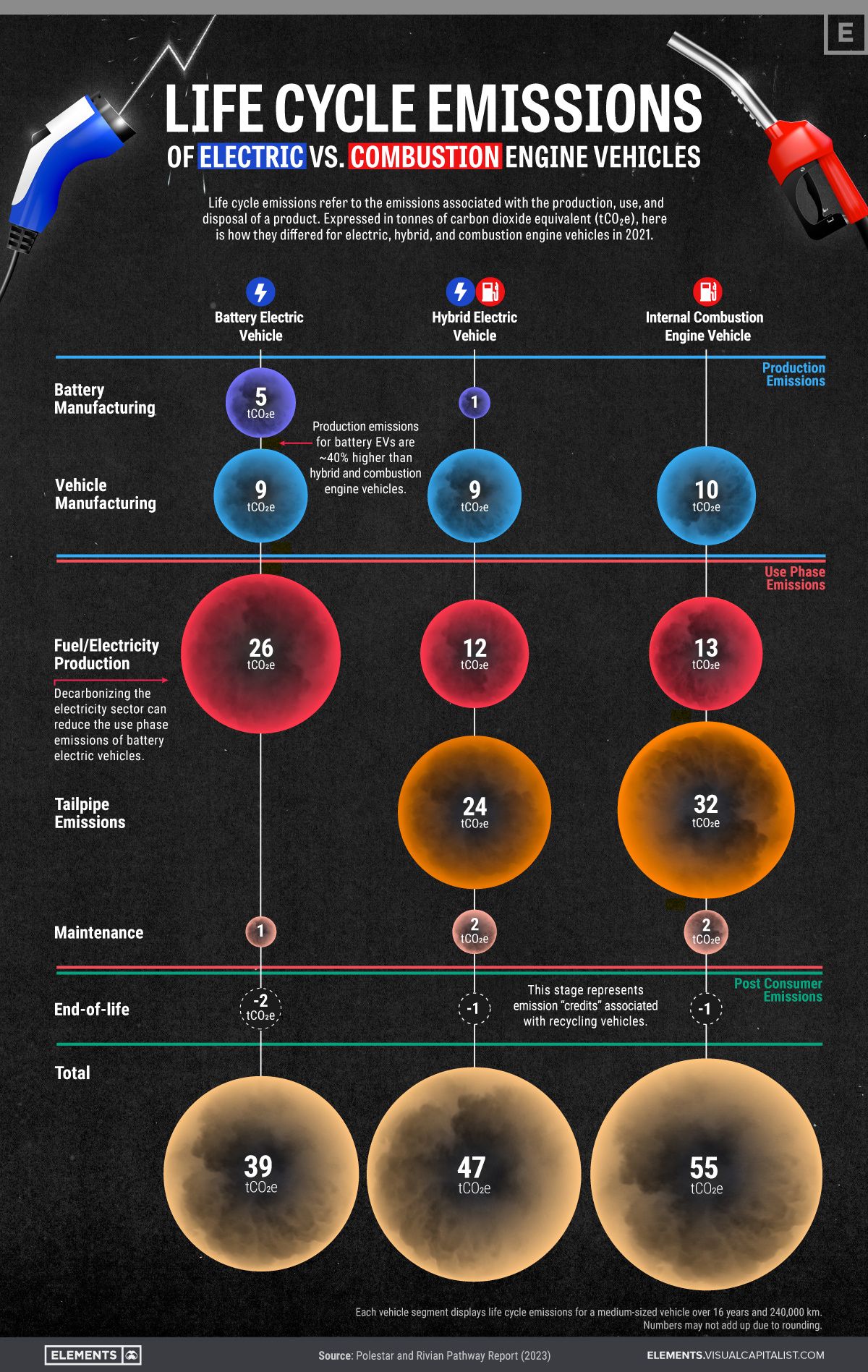


graphic designed by Sam Parker

Selin Oğuz reports for Visualcapitialist that the International Energy Agency concludes the transportation sector is more reliant on fossil fuels than any other sector in the economy. In 2021, it accounted for 37% of all CO2 emissions from end‐use sectors. The graphic above, designed by Sam Parker, visualizes the life cycle emissions of battery electric, hybrid, and internal combustion engine (ICE) vehicles.


The Elements Visual Capitalist web page offers some other insights from the data that may not be as obvious at first. These insights help to identify areas of scientific and engineering efforts to further reduce emissions.


  • The production emissions for BEVs are approximately 40% higher than those of hybrid and ICE vehicles. According to a McKinsey & Company study, this high emission intensity can be attributed to the extraction and refining of raw materials like lithium, cobalt, and nickel that are needed for batteries, as well as the energy-intensive manufacturing process of BEVs.

  • Electricity production is by far the most emission-intensive stage in a BEVs life cycle. Decarbonizing the electricity sector by implementing renewable and nuclear energy sources can significantly reduce these vehicles’ use phase emissions.

  • By recycling materials and components in their end-of-life stages, all vehicle segments can offset a portion of their earlier life cycle emissions. (Oguz, 2020)


The International Energy Agency found that using energy more efficiently was the single largest potential contributor to reaching net zero greenhouse gas emissions. Fiona Harvey, Environment editor at the Guardian, writes that the latest IPCC report highlights key measures countries must take to avoid climate catastrophe.


Renewable energy in the form of wind and solar power is now cheaper than fossil fuels across most of the world and the IPCC found that solar power, wind power and reducing the conversion of land to agriculture were the three measures with the strongest potential for reducing greenhouse gas emissions globally.


  • Reduce methane

  • Stop deforestation

  • Restore other degraded land, and stop it being turned to agriculture

  • Change agriculture, and change the way we eat

  • Solar and wind power

  • Energy efficiency

  • Stop burning coal

  • Put climate at the heart of all decision-making (Harvey, 2023)


The key measures identified in the latest IPCC report do not put transition to electric vehicles in the top eight necessary measures to avoid catastrophe.  Personal action may not be as effective in meeting net zero goals as transformation of the way we use our natural resources, generate electricity with solar and wind, increase energy efficiency, and put climate change at the core of government decisions.


References

Harvey, F. (2023, March 22). Eight things the world must do to avoid the worst of climate change. The Guardian. Retrieved June 25, 2023, from https://www.theguardian.com/environment/2023/mar/21/methane-to-food-waste-eight-ways-to-attempt-to-stay-within-15c?CMP=share_btn_tw 

Oguz, S. (2020, May 20). Life Cycle Emissions: EVs vs. Combustion Engine Vehicles. Elements Visual Capitalist. Retrieved June 25, 2023, from https://elements.visualcapitalist.com/life-cycle-emissions-of-electric-hybrid-and-combuston-engine-vehicles/  


Saturday, June 17, 2023

Head Butting Climate Emergency

Recent public pronouncements from the Premier of Nova Scotia, Tim Houston, concerning policy to reduce GHG emissions, mitigate the effect of sea level rise on the Chignecto isthmus, and a proposed energy link connecting the Atlantic provinces to hydroelectricity from Quebec and Labrador seem to prioritize political head butting over necessary and urgent joint federal/provincial action to save money and provide mitigation of climate disaster. 

|

Essential Component for the 21st Century


NDP Leader Claudia Chender comments that  the Houston government didn’t do the work on behalf of Nova Scotians to come up with a carbon pricing option other than the pending tax.


“When the deadline came and went for the Houston government to present their own price on carbon and plan for how to get there and they failed to do that, this is the outcome of the government choosing partisan fights over constructive conversations," Chender said. (Campbell, 2023)


Keith Doucette of The Canadian Press comments that Houston seemed unmoved when asked whether the Isthmus of Chignecto risked being damaged by extreme weather while governments haggled over who will pay to protect it.


"We're not the ones risking it, the federal government is the one that's trying to get away from their responsibility," the premier said. (Doucette, 2023)


Sarah Smellie of the Canadian Press  reports that Premier Tim Houston says he’s lost confidence in the feasibility of a proposed energy link connecting the Atlantic provinces to hydroelectricity from Quebec and Labrador.


Federal Infrastructure Minister Dominic LeBlanc has previously said he hoped the Atlantic Loop could come online by 2030, but today, Houston signaled some concern without a firm financial commitment from the feds. (Smellie, 2023)


Seth Klein, in the National Observer, asks where are the campaigns urging us to switch to public transit? Where are the promo ads inviting young people to train as renewable electricity technicians and installers, building retrofitters, high-speed rail designers, community planners or electric vehicle manufacturers?


First, the good news: In the wake of the Intergovernmental Panel on Climate Change reports and extreme weather events, we are witnessing a shift in the public opinion terrain. Canadians are increasingly anxious about climate change. They understand it to be an emergency and a major threat to their children and grandchildren. And importantly, a solid majority of Canadians are prepared to accept significant and bold policy responses.*


The bad news? Many Canadians are confused and ambivalent. They could be convinced to embrace speedy and transformative action, or not. A sizable chunk of the public is simply unsure of how ambitious we can be. Moreover, people’s prioritization of climate wanes when economic anxieties and affordability challenges are heightened. And so, we need leadership that seeks to link these issues and animate the ambition in us all. (Klein & Logan, 2023)


It is difficult to find a policy championed by the conservative provincial governments or the Conservative Party of Canada that defines action necessary now to mitigate the impact of GHG emissions and lays out a plan to adapt to a low carbon economy.


References

Campbell, F. (2023, June 16). Premier acknowledges carbon tax will punish Nova Scotians at the pumps, places full blame on Ottawa. SaltWire. Retrieved June 16, 2023, from https://www.saltwire.com/atlantic-canada/news/premier-acknowledges-carbon-tax-will-punish-nova-scotians-at-the-pumps-places-full-blame-on-ottawa-100865039/ 

Doucette, K. (2023, June 15). N.S. premier says Ottawa must pay entire bill to protect land link from flooding risk. CBC. Retrieved June 16, 2023, from https://www.cbc.ca/news/canada/nova-scotia/n-s-premier-ottawa-must-pay-protect-isthmus-from-flooding-risk-1.6877811 

Klein, S., & Logan, C. (2023, February 23). Crisis, what crisis? We need a climate emergency information agency. National Observer. Retrieved June 16, 2023, from https://www.nationalobserver.com/2023/02/23/opinion/crisis-what-crisis-we-need-climate-emergency-information-agency 

Smellie, S. (2023, June 16). Nova Scotia, Ottawa butt heads over Atlantic Loop as feds look for summer agreement | Globalnews.ca. Global News. Retrieved June 16, 2023, from https://globalnews.ca/news/9774122/nova-scotia-ottawa-butt-heads-over-atlantic-loop/ 


Thursday, November 17, 2022

Nova Scotia Hydrogen Boom or Bust

The transition from fossil fuel generation of electricity for Nova Scotia has to be planned and executed with an eye to developments in other parts of the world that may be able to serve energy markets with greener solutions than LNG or hydrogen produced in Atlantic Canada.


Green Energy for the Grid


Joan Baxter reports that the Nova Scotia government is going all-in on “green hydrogen,” but a leading analyst says hydrogen is “starting to look like an economic bubble.” Leigh Collins, reporting for Hydrogen Insight on the speech of Bloomberg New Energy Finance founder Michael Liebreichto to hundreds of hydrogen professionals. 


He [Liebreich] then read out recent “hyperbolic” quotes from both German Chancellor Olaf Scholz — who said that hydrogen will create a “huge boom” and replace the natural gas used today for industry, heating and fuels — and UK energy secretary Jacob Rees-Mogg, who described H2 [hydrogen] as a “silver bullet” that can use excess wind power to produce green hydrogen that will heat Britain’s homes.


The view that hydrogen is a silver bullet or a Swiss Army knife capable of decarbonising everything from heating to transport to heavy industry and power generation is “dangerous,” Liebreich said. “This leads us into bubbles.” (Baxter, 2022)


Joan Baxter reports, in The Guardian, that the EverWind project in Point Tupper, Nova Scotia, involves two phases. The EverWind website claims it will use local wind power supply for carbon neutral fuel production. But asked where those supplies would come from, company founder and CEO, Trent Vichie answered in mixed messages.


NSPC spokesperson Jacqueline Foster said five new wind projects will go into operation in Nova Scotia by 2025. At that point, she said wind energy will account for about 30% of the province’s electricity supply.


Vichie said EverWind’s supply would not come from any of those projects. Other wind developments “didn’t make the cut”, and some suppliers “didn’t bother to bid” on the province’s recent call for proposals. “So there are projects that are ready that aren’t being built,” he said.


But even by 2030, NSPC’s deadline to eliminate coal, the utility still expects only 80% of its supply to come from renewables. In 2025, hydrogen and ammonia produced with NSPC grid power would rely on an electricity mix that includes coal and 30% wind energy.


EverWind environmental affairs advisor Ken Summers said the Point Tupper operation will be “powered off the grid” in the “immediate term and for quite a while”. He noted that environmental assessments for wind projects are a long process, so the project would not be powered initially by wind farms.


The hydrogen from the EverWind plant won’t be “really 100% green until it’s all renewable power”, he added. (Baxter, 2022)


A recent briefing in The Economist, advises that India, one of the world’s most polluting countries. is investing heavily in clean tech. Prime Minister Modi has declared it a “national mission” to develop “green hydrogen”, a clean fuel made using renewables which could help decarbonise industries that remain stubborn polluters the world over.


India’s entire generation capacity, both clean and dirty, is currently only 400gw. So Mr Modi wants to build a whole second grid’s-worth of green power in just eight years. To reach that goal, India will need to invest some $500bn in clean energy and improvements to the grid, according to an estimate by Bloomberg New Energy Finance (bnef), a research firm. (Will India Become a Green Superpower?, 2022)


Vijay Vaitheeswaran, global energy and climate innovation editor, for The Economist, reports the global hydrogen race is hotting up, and 2023 looks to be a make-or-break year.


Environmentalists love that “green” hydrogen can be made with renewable energy in electrolysers—devices that use electricity to split water into oxygen and hydrogen. This has sparked a global rush to manufacture them, with around 600 proposed projects, about half of them in Europe….

Just how durable this latest wave of enthusiasm for hydrogen will prove to be should become clear in 2023. A global recession could slash funding for novel technologies as companies cut capital expenditure and investors grow risk-averse. Supply-chain disruptions could also spoil things. They have already forced itm Power, a pioneering British firm, to roll back plans to scale up its production of electrolysers. And as countries respond to the energy shock they may prioritise security of supply, from dirty sources such as coal, over new technologies that can help tackle climate change. The biggest force pushing hydrogen forward will be government money in America


One telltale sign will be how many of those electrolyser projects actually go ahead. Andy Marsh, chief executive of America’s Plug Power, a pace-setter in the industry, predicts that global electrolyser sales will shoot up from almost zero a few years ago to $15bn in 2023. Bernd Heid of McKinsey, a consultancy, believes the first gigawatt-scale green-hydrogen project will get the go-ahead next year. Bloombergnef (bnef), a research firm, reckons electrolyser shipments will rise from 1gw now to 2.4-3.8gw in 2023, mostly in Asia.


But there is much enthusiasm about green hydrogen in Europe too. “Europe has been pregnant with a lot of projects but will finally give birth in 2023,” says Daryl Wilson of the Hydrogen Council, an industry body. (Vaitheeswaran, 2022)


The climate emergency has accelerated projects that use “clean hydrogen” to transition electrical generation from fossil fuels. Nova Scotia may risk investment in “stranded assets” as legitimately “green” hydrogen from India may be the best choice for Europe and the planet.


References

Baxter, J. (2022, October 19). Analyst: “green hydrogen” is a bunch of hot air. Halifax Examiner. Retrieved October 19, 2022, from https://www.halifaxexaminer.ca/province-house/analyst-green-hydrogen-is-a-bunch-of-hot-air/ 

Baxter, J. (2022, October 26). Nova Scotia touted its huge 'green' energy plant. Turns out it's powered by coal. The Guardian. Retrieved October 28, 2022, from https://www.theguardian.com/world/2022/oct/26/nova-scotia-green-energy-plant-coal-powered 


Vaitheeswaran, V. (2022, November 14). Hydrogen hype is rising again—will this time be different? The Economist. Retrieved November 17, 2022, from https://www.economist.com/the-world-ahead/2022/11/14/hydrogen-hype-is-rising-again-will-this-time-be-different?utm_campaign=a.23worldahead_fy2223_q3_conversion-cb-dr_prospecting_global-global_auction_na&utm_medium=social-media.content.pd&utm_source=faceboo 

Will India become a green superpower? (2022, October 20). The Economist. Retrieved November 5, 2022, from https://www.economist.com/briefing/2022/10/20/will-india-become-a-green-superpower 


Tuesday, May 3, 2022

Electrify Now

This post begins a series of articles that present an optimistic playbook to combat the consequences of climate change being experienced by the world today.

A Playbook for Decarbonization


  Saul Griffith, inventor, entrepreneur, and engineer is the founder of Rewiring America, a nonprofit dedicated to decarbonizing America by electrifying everything. He was the recipient of a MacArthur Fellowship “Genius Grant'' in 2007. He offers an optimistic plan to address climate change. 


Saul Griffith, an engineer and inventor, calls for grid neutrality, ensuring that households, businesses, and utilities operate as equals; we will have to rewrite regulations that were created for a fossil-fueled world, mobilize industry as we did in World War II, and offer low interest “climate loans.” Griffith’s plan doesn’t rely on big, not yet invented innovations, but on thousands of little inventions and cost reductions. We can still have our cars and our houses - but the cars will be electric and solar panels will cover our roofs. For a world trying to bounce back from a pandemic and economic crisis, there is no other project that would create as many jobs - up to 25 million, according to one economic analysis. Is this politically possible? We can change politics along with everything else. (Griffith #)


The cost of electrifying everything will be large but it will be less than the cost of mitigation of the effects of increasing temperature of the planet. A game plan that is based in science, engineering, and entrepreneurship connects with the disciplines that have improved life on the planet in modern history.


Work Cited

Griffith, Saul. Electrify: An Optimist's Playbook for Our Clean Energy Future. MIT Press, 2021.

Sunday, December 19, 2021

Climate Priorities for Capitalist and Socialist

Climate mitigation and adaptation strategies will need to be adopted by both capitalist, centrist, and socialist governments in the next decades.
Taking action in our community


Iman Ghosh reports on the Visual Capitalist website that greenhouse gases (GHGs)—chiefly in the form of CO₂ emissions—have risen at unprecedented rates as a result of global growth and resource consumption.

Billions of people rely on petrol and diesel-powered vehicles to get around. As a result, they contribute to almost 12% of global emissions. But this challenge is also an opportunity: the consumer adoption of electric vehicles (EVs) could significantly help shift the world away from fossil fuel use, both for passenger travel and for freight—although there are still speedbumps to overcome. Meanwhile, buildings contribute 17.5% of energy-related emissions overall—which makes sense when you realize the stunning fact that cities use 60-80% of the world’s annual energy needs. With megacities (home to 10+ million people) ballooning every day to house the growing urban population, these shares may rise even further. Agriculture, Forestry & Land Use


Sub-sector

GHG Emissions Share

Further breakdown

Transport

16.2%

• Road 11.9%

• Aviation 1.9%

• Rail 0.4%

• Pipeline 0.3%

• Ship 1.7%

Buildings

17.5%

• Residential 10.9%

• Commercial 6.6%

Industry energy

24.2%

• Iron & Steel 7.2%

• Non-ferrous metals 0.7%

• Machinery 0.5%

• Food and tobacco 1.0%

• Paper, pulp & printing 0.6%

• Chemical & petrochemical (energy) 3.6%

• Other industry 10.6%

Agriculture & Fishing energy

1.7%

-

Unallocated fuel combustion

7.8%

-

Fugitive emissions from energy production

5.8%

• Coal 1.9%

• Oil & Natural Gas 3.9%

Total

73.2%


The second biggest category of emissions is the sector that we rely on daily for the food we eat. Perhaps unsurprisingly, methane from cows and other livestock contribute the most to emissions, at 5.8% total. These foods also have some of the highest carbon footprints, from farm to table.1


Seth Klein, writing for the National Observer, states from the outset that, without question, a truly successful climate plan requires collective action at the political/policy level . Any plan that relies on individual households voluntarily doing what he spells out here will see us fry.
Reducing our carbon footprint


He owns his home, which provides him with privileges, opportunities and obligations to act that do not exist for most renters.

As stated up front, the path to victory on the climate emergency will not be won by encouraging and incentivizing households to voluntarily do what we did. While individual households all have their part to play, confronting the climate crisis requires collective and state-led action. As my family’s conversion journey makes clear, the process can be complicated and it is costly, and if we are hoping everyone will do this on their own, we’re going to lose the climate fight… Under any future scenario, as we confront the climate crisis, energy costs are going up, and thus, issues of energy poverty and cost stress for lower and middle-income households is an issue that needs to be mitigated. And that’s something we can only do together… while all this encouragement and financial assistance is needed (policy carrots), fuel swapping can’t be left to voluntary goodwill. We also need the state to set clear near-term dates by which fuel-swapping will be mandatory (the policy sticks). Tackling the climate crisis and eliminating GHGs from our homes isn’t optional. We need to get this done.2 

Ultimately, however, a comprehensive climate program does require that all our homes cease using fossil fuels.


  • Induction electric stove: $2,000 plus tax
  • Electric hot water heater and tank, including installation: $3,400 plus tax
  • Heat pump system, including installation: $17,000 plus tax (minus $9,000 in rebates)


This article walks us through how that can be done. On twitter, the Earth carer called Angie, user (@lifelearner47) shares some statistics from the Climate Action Tracker on emission reduction goals and projected achievements of the leading industrial countries. The numbers in these reports identify the priority we need to place on transition from fossil fuels as our major source of energy for industry, transportation, and energy in our built environment.


References


1

(2021, December 15). A Global Breakdown of Greenhouse Gas Emissions by Sector. Retrieved December 19, 2021, from https://www.visualcapitalist.com/cp/a-global-breakdown-of-greenhouse-gas-emissions-by-sector/ 

2

(2021, December 10). Getting off gas: A how-to guide to get fossil fuels out of your home. Retrieved December 19, 2021, from https://www.nationalobserver.com/2021/12/10/opinion/getting-gas-how-guide-get-fossil-fuels-out-your-home 

3

Earth carer called Angie. [@lifelearner47]. 18 Dec 2021. Which countries think it's perfectly OK to aim for >4°C extra climate heating ? #Fossilfuel countries! What a surprise.Tweet.[tweetdeck].https://twitter.com/lifelearner47/status/1472504740051361794