Showing posts with label wind energy. Show all posts

Sunday, June 25, 2023

Focus on EV’s may not be top Climate Priority

Efforts to transition personal vehicles to BEV (Battery Electric Vehicles), or HEV (Hybrid Electric Vehicles) from ICEV (Internal Combustion Engine Vehicles) may be a diversion from focus on more effective government action to mitigate the effects of the climate emergency.
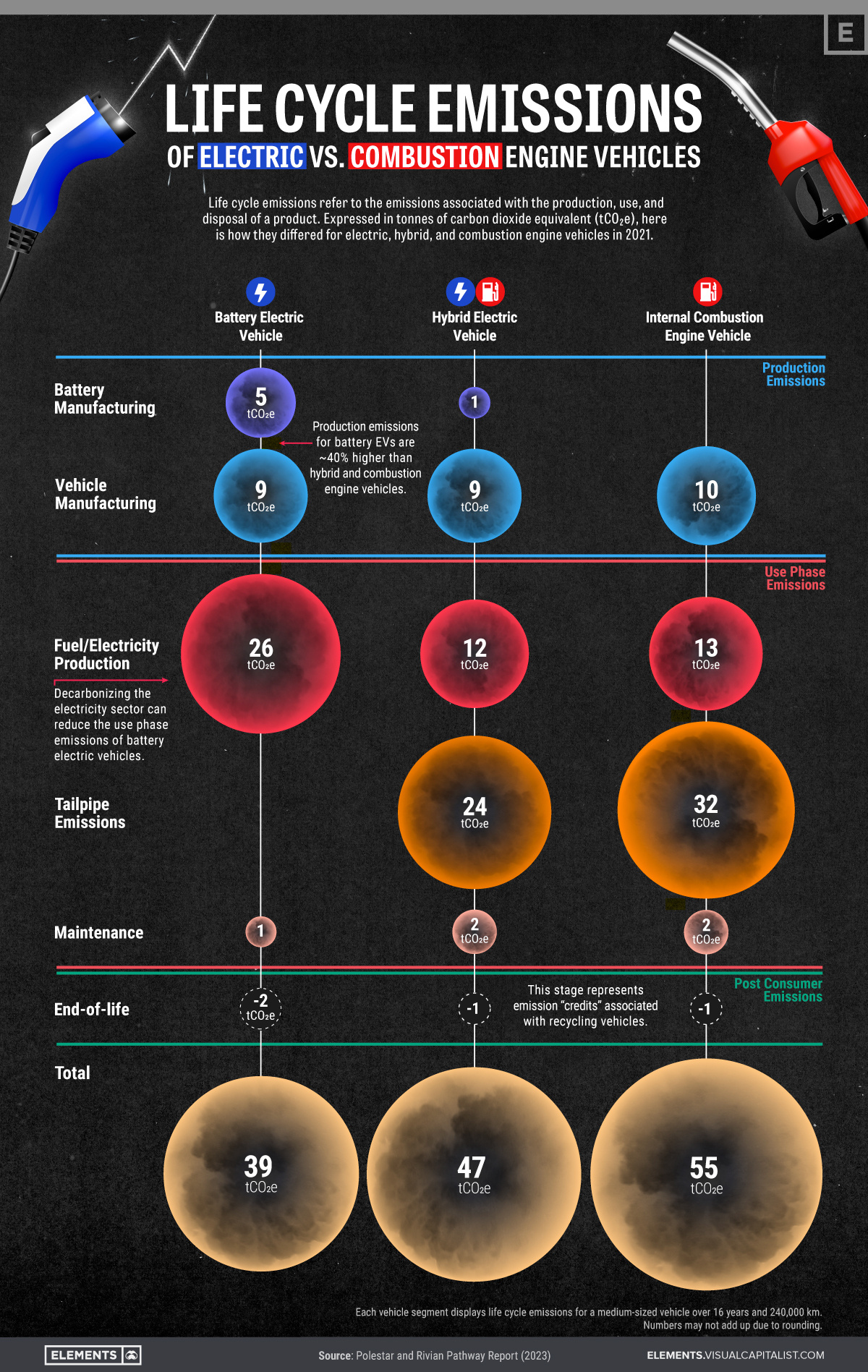


graphic designed by Sam Parker

Selin Oğuz reports for Visualcapitialist that the International Energy Agency concludes the transportation sector is more reliant on fossil fuels than any other sector in the economy. In 2021, it accounted for 37% of all CO2 emissions from end‐use sectors. The graphic above, designed by Sam Parker, visualizes the life cycle emissions of battery electric, hybrid, and internal combustion engine (ICE) vehicles.


The Elements Visual Capitalist web page offers some other insights from the data that may not be as obvious at first. These insights help to identify areas of scientific and engineering efforts to further reduce emissions.


  • The production emissions for BEVs are approximately 40% higher than those of hybrid and ICE vehicles. According to a McKinsey & Company study, this high emission intensity can be attributed to the extraction and refining of raw materials like lithium, cobalt, and nickel that are needed for batteries, as well as the energy-intensive manufacturing process of BEVs.

  • Electricity production is by far the most emission-intensive stage in a BEVs life cycle. Decarbonizing the electricity sector by implementing renewable and nuclear energy sources can significantly reduce these vehicles’ use phase emissions.

  • By recycling materials and components in their end-of-life stages, all vehicle segments can offset a portion of their earlier life cycle emissions. (Oguz, 2020)


The International Energy Agency found that using energy more efficiently was the single largest potential contributor to reaching net zero greenhouse gas emissions. Fiona Harvey, Environment editor at the Guardian, writes that the latest IPCC report highlights key measures countries must take to avoid climate catastrophe.


Renewable energy in the form of wind and solar power is now cheaper than fossil fuels across most of the world and the IPCC found that solar power, wind power and reducing the conversion of land to agriculture were the three measures with the strongest potential for reducing greenhouse gas emissions globally.


  • Reduce methane

  • Stop deforestation

  • Restore other degraded land, and stop it being turned to agriculture

  • Change agriculture, and change the way we eat

  • Solar and wind power

  • Energy efficiency

  • Stop burning coal

  • Put climate at the heart of all decision-making (Harvey, 2023)


The key measures identified in the latest IPCC report do not put transition to electric vehicles in the top eight necessary measures to avoid catastrophe.  Personal action may not be as effective in meeting net zero goals as transformation of the way we use our natural resources, generate electricity with solar and wind, increase energy efficiency, and put climate change at the core of government decisions.


References

Harvey, F. (2023, March 22). Eight things the world must do to avoid the worst of climate change. The Guardian. Retrieved June 25, 2023, from https://www.theguardian.com/environment/2023/mar/21/methane-to-food-waste-eight-ways-to-attempt-to-stay-within-15c?CMP=share_btn_tw 

Oguz, S. (2020, May 20). Life Cycle Emissions: EVs vs. Combustion Engine Vehicles. Elements Visual Capitalist. Retrieved June 25, 2023, from https://elements.visualcapitalist.com/life-cycle-emissions-of-electric-hybrid-and-combuston-engine-vehicles/  


Monday, October 24, 2022

Climate change is expanding wind and solar quickly enough for 1.5C.

Lead author Olivier Bois von Kursk of the report, from the International Institute for Sustainable Development (IISD), based on a comprehensive review of all “feasible” routes to staying below 1.5C, concludes that developing new oil and gas fields is not compatible with this goal.


Solar and wind energy needs support


Returning to the IISD report, it concludes that developing new oil and gas fields would be “incompatible” with 1.5C. This is not quite true, as the report itself explains.


The IISD report says it is possible that new oil and gas could be compatible with 1.5C, if old fields were also retired early. Bois von Kursk tells Carbon Brief this is rare, however:


“Early closure of fields already in production are extremely rare and we don’t see that happening unless the economics becomes unfavourable for fields with high extraction costs. Accordingly, since fields are almost never closed before the end of their economic lifetime, we advocate for preventing any new fields from opening up to avoid stranded assets or the risk of busting the carbon budget for 1.5C.”


More fundamentally, the energy from new oil and gas development would be needed to meet rising global demand unless alternative energy sources are available in sufficient quantities.


As the report notes, wind and solar are not currently expanding quickly enough for 1.5C. Similarly, the IEA said low-carbon energy investment needed to triple to get on track. (Evans, 2022)


Government policy to encourage and provide financial support for continued exploration for and production from Canadian gas and oil properties is in opposition to policy to limit global warming at 1.5C. Financial support is needed to accelerate the development of wind and solar energy sources in Canada.


References


Evans, S. (2022, October 23). New fossil fuels 'incompatible’ with 1.5C goal, comprehensive analysis finds. Carbon Brief. Retrieved October 24, 2022, from https://www.carbonbrief.org/new-fossil-fuels-incompatible-with-1-5c-goal-comprehensive-analysis-finds/ 

Friday, October 21, 2022

Climate change is the most costly weather event to ever hit Atlantic Canada.

Climate change is the most costly weather event to ever hit Atlantic Canada.


Some Fiona consequences


Those of us who remember the advice of the “Fram man” in the 1972 commercial have witnessed many storms in Atlantic Canada. Some of the damage from recent storms is covered by insurance. Unfortunately, most of the cost of restoration will be borne by government. In both cases, individual people have to pay through taxes and insurance premiums. As we reflect on the “pay me now or pay me later” declaration, we understand that preparing for climate change and water, wind, fire, and erosion events will be less expensive than the costs of recovery and restoration.


The Insurance Bureau of Canada said Wednesday the storm was the most costly extreme weather event ever recorded in Atlantic Canada in terms of insured damages based on the estimate provided by CatIQ.


IBC added that many of those affected by the storm were located in high-risk flood areas and floodplains where residential flood insurance coverage is not available.


As a result, the bureau said the overwhelming majority of costs for the disaster will be borne by government.


The storm made landfall in Nova Scotia on Sept. 24 and ripped through the region, knocking out power to more than 500,000 customers in the Maritimes.


The hurricane caused violent winds exceeding 100 kilometres per hour, torrential rainfall, flooding and downed trees, and resulted in several deaths, the IBC said.


The bureau said the storm also washed at least 20 homes into the ocean, primarily in Port aux Basques, N.L.


More than half of the insured damages were in Nova Scotia, said the IBC, at more than $385 million, with Prince Edward Island following with more than $220 million in insured damages. 


The second most expensive extreme weather event in Atlantic Canada was Hurricane Juan in 2003 at $192 million, according to the IBC. (Post-Tropical Storm Fiona Most Costly Weather Event to Ever Hit Atlantic Canada, New Estimate Says, 2022)


We need to encourage the government to press ahead with programs to reduce GHG emissions and thereby reduce average earth temperature rise and severity and frequency of the storms related to that temperature rise.


References


Post-tropical storm Fiona most costly weather event to ever hit Atlantic Canada, new estimate says. (2022, October 19). CBC. Retrieved October 21, 2022, from https://www.cbc.ca/news/canada/nova-scotia/fiona-atlantic-canada-insured-damages-660-million-1.6621583?__vfz=medium%3Dsharebar 

Tuesday, September 20, 2022

Direction for Climate Action

The enormous expense to recover from fires, floods, powerful storms, and coastal erosion should be an incentive for government action to accelerate its phase-out of coal and greatly reduce its greenhouse gas emissions.


Emission Reduction Now

Recent articles in the press indicate proposals that will move us toward net zero emissions and take us further away from the benefits of achieving this goal.


Cloe Logan, writing for the National Observer, reports on Canada’s only underground coal mine coming back into production in Cape Breton.


After one full year, the mine is expected to produce enough coal to spew about eight million tonnes of carbon dioxide into the atmosphere when it is burned. The three million tonnes of coal the mine will produce a year will create as many greenhouse gas emissions as the yearly energy use of over a million homes — more than the entire population of Nova Scotia. When Marshall hears those statistics, she thinks of the extraction of natural resources by large corporations coupled with the restriction of Indigenous Peoples’ access to traditional food sources, medicine and land. It’s the “continued poisoning of the people of Unama'ki, which is Cape Breton,” she said. (Logan, 2022)


A NS Government Press Release quotes Premier Tim Houston.“Setting this target sends a clear signal to the world that Nova Scotia is open for business and becoming an international leader in offshore wind and green hydrogen development.”


The most promising use for offshore wind energy is generating renewable electricity to produce green hydrogen for use in the province and for export. Green hydrogen is a clean alternative to fossil fuels because it does not create greenhouse gas emissions. Offshore wind is also another option to help Nova Scotia and Canada meet future clean electricity needs.


The Province also announced that it is developing a green hydrogen action plan to be released in 2023. The plan will outline the role green hydrogen can play in the transition to clean energy and the steps the government will take to build this industry, which will help Nova Scotia reach net-zero emissions by 2050. (Province Sets Offshore Wind Target, 2022)


Joan Baxter reports on EverWind Fuels’ 'green hydrogen' project that may depend on sketchy carbon calculations and an enormous public subsidy.


Ralph Torrie, research director at Corporate Knights, has co-authored two recent reports on how Nova Scotia can accelerate its phase-out of coal and greatly reduce its greenhouse gas emissions throughout its electricity and energy systems to tackle the climate emergency and reach net zero by 2050. Torrie prepared one report for the Ecology Action Centre in 2020, and the second was a white paper he co-authored with EfficiencyOne in 2021.

Both reports found that the most immediate and effective steps Nova Scotia could take on a “net-zero pathway” were in energy efficiency, electrification, and decarbonisation. They also stressed the importance of a just energy transition to eliminate energy poverty in the province. (Baxter, 2022)

Antonio Guterres, the Secretary General of the United Nations, has recently expressed the opinion that our world is in big trouble. He urges the nations of the world to develop common solutions to common problems — grounded in goodwill, trust, and the rights shared by every human being.


This goal can be translated to action in Nova Scotia that addresses the climate change mitigation that we can begin now based on available technology for electrification, energy efficiency, and decarbonization.


References

Baxter, J. (2022, September 20). The 'hydrogen hyperbole epidemic' comes to Nova Scotia. Halifax Examiner. Retrieved September 20, 2022, from https://www.halifaxexaminer.ca/province-house/the-hydrogen-hyperbole-epidemic-comes-to-nova-scotia/ 

Logan, C. (2022, September 16). Canada's only underground coal mine is back in business — and emissions rules don't apply. National Observer. Retrieved September 20, 2022, from https://www.nationalobserver.com/2022/09/16/investigations/canadas-only-underground-coal-mine-back-business-emissions 

Province Sets Offshore Wind Target. (2022, September 20). Government of Nova Scotia. Retrieved September 20, 2022, from https://novascotia.ca/news/release/?id=20220920003 


Friday, May 13, 2022

Engineering Calculation for Ready to Go Technology

This post continues a series of articles that present an optimistic playbook to combat the consequences of climate change being experienced by the world today.


Needed Engineering Analysis and Calculation
 

  Saul Griffith, inventor, entrepreneur, and engineer is the founder of Rewiring America, a nonprofit dedicated to decarbonizing America by electrifying everything. He was the recipient of a MacArthur Fellowship “Genius Grant'' in 2007. He offers an optimistic plan to address climate change.

Engineering the Decarbonized Energy World


Some of the benefits of an engineering analysis of the climate crisis, like that offered by Saul Griffin in his 2021 book, Electrify: An Optimist's Playbook for Our Clean Energy Future, include experience differentiating efficiency benefits and transformation benefits using calculations of energy use.


  • It’s not the 1970’s anymore and we are not facing a 70’s energy problem that can be solved with efficiency. We need transformation.

  • 70’s thinking focuses on lots of small decisions and distracts us from the big picture.

  • 70’s thinking muddles thermodynamic efficiency with energy saved through behavior change.

  • 70’s thinking leads to a narrative of deprivation.

  • 70’s thinking is about doing less bad, not about doing more good and building good into the way we do everything (Griffith, 2021, p47)


 Comparisons of electrical transportation and heating/cooling systems to existing fossil fuel technologies require engineering quality efficiency calculations.


In an electric car, we take electricity, store it in a battery, (approx 90% efficient), and then pass it through a drivetrain (approx 80% efficient).

Total efficiency = 1x0.9x0.8=0.72

We get 0.72 units of transportation for one unit of electricity.

If we use the same electricity to make hydrogen (via electrolysis, approx 65% efficient), then compress it into a tank and decompress it back out, (approx 75% efficient), then run it through a fuel cell (approx 50% efficient), 

Total efficiency = 1x0.65x0.75x0.5=0.24

We get only 0.24 units of transportation for the same one unit of electricity (Griffith, 2021, p52)


 Proposals to supply fossil fuel free energy and use innovative technology to capture and sequester carbon dioxide need to be assessed with the engineering calculation of EROI, Energy Returned on Energy Invested.


One unit of fossil fuel in gets you 7 or 8 units back… Estimates vary but wind and solar provide approximately twice the EROI of fossil fuel power plants. As manufacturers reduce the energy input of producing wind and solar technology, and as engineers extend the useful lifetime of this green machinery, the advantage will only improve. (Griffith, 2021, p59) 


Griffin estimates that when we add up all the energy savings of electrification we will find that we only need approximately 42% of the primary energy we use today.


Winning the war against the climate crisis will also mean a cleaner, more positive future. Our homes will be more comfortable when we shift to heat pumps and radiant heating systems that can also store energy. While it may be desirable to downsize our homes and cars, this isn’t absolutely necessary, at least in the US. Our cars can be sportier when they are electric. Household air quality will improve, as will public health, since gas stoves raise the risk of asthma and respiratory illnesses. We don’t need to switch to mass rail and public transit, nor mandate changing the settings on consumers' thermostats, nor ask all red-meat loving Americans to turn vegetarian… And if we successfully employ biofuels, we don’t have to ban flying. (Griffith, 2021, p61)


The engineering analysis of “Is it ready to go to scale today?” is crucial to avoid using resources on solutions that will come too late.


There will be trade-offs. More nuclear means fewer batteries but more public resistance and, most likely, higher costs. More solar and wind means more land use. What we cannot afford are plans that make no progress because we are wasting time arguing over these issues before we begin, or because we are over-investing in technologies that can’t scale up sufficiently. The real test, given the urgency of our climate situation, should be, “Is it ready to go to scale today?” We need to act now. (Griffith, 2021, p73)


Time to project completion is a key engineering parameter that must be considered in this decade for action to mitigate the worst impacts of climate emergency. 


References

Griffith, S. (2021). Electrify: An Optimist's Playbook for Our Clean Energy Future. MIT Press.


Tuesday, March 9, 2021

Renewables path to RBE


Mobilizing for the Climate Emergency in Canada will uncover that changes in the way we plan for a green resource based economy have been in the works for decades.
Changes in the works


Connie Vitello reports on a solar energy milestone in Antigonish Nova Scotia that marks generation of a megawatt of renewable power. It began with a pair of community meetings, in the fall of 2014 and again the following spring, at which a hundred or so people from Antigonish took a long, hard look at Nova Scotia’s energy mix. Recognizing the dominance of coal, oil and natural gas, residents decided they could do better. A Co-op was formed in the summer of 2015 to advance the cause of renewable power.


The Co-op was formed in the summer of 2015 to advance the cause of renewable power. “We’re entirely independent, entirely volunteer” said David Morgan, who became president that June. They settled on the “buyers co-op” business model, wherein they bring together members interested in purchasing rooftop solar arrays every year and make one large group purchase rather than several smaller ones. This allows them to secure discounts on the shipping of solar panels and on labour costs from partnering solar installers, specifically Appleseed Energy in West Arichat and Nova Sun Power in Pictou. The savings are modest, said Morgan, averaging 5-7 per cent, but they’re not insignificant, and far from the Co-op’s only benefit. As Morgan described it, the Co-op has offered free property assessments to its members to gauge solar potential, organized several public information sessions on the power of renewables, led walkthroughs of solar homes to showcase the technology, and pulled off their group solar purchases every year for five years running. To date, they’ve empowered 123 households to install rooftop solar, from Tatamagouche in the west to Sydney in the east and Musquodoboit Harbour in the south. The Co-op boasts a membership of 500 or so people with only a $5 entry fee, their cumulative investments in solar totaling just shy of $3 million.1

Steve Cohen writes that the movement away from fossil fuels is not without victims. The decline in Wyoming’s coal industry and the simultaneous rise of that state’s wind business is an example. The number of jobs in wind business is smaller and the skill base is different. These transitions are inevitable in a capitalist society, government programs and policies are needed to ensure that the victims of this transition receive the help they need to find meaningful employment as we move toward a Renewable Resource Based Economy.


While the need to maintain the planet’s resources may have begun the move toward sustainability, the new set of constraints posed by ecosystem needs is also generating business opportunity. Recently a group of businesses in Minnesota started to work together to push for the development of a circular economy. According to Jessica Lyons Hardcastle, writing in Environmental Leader: “Dow, 3M and Target are among the 25 major companies and organizations that have launched an initiative to promote the circular economy. The Minnesota Sustainable Growth Coalition says adopting circular economy principles — where raw materials are extracted and made into products that are designed and manufactured for reuse and remanufacturing or recycling — will uncover business growth opportunities and drive innovation. Circular economy principles also promote better waste management by sending less material to landfills.”2

In his book, “A Good War: Mobilizing Canada for the Climate Emergency”, Seth Klein writes to encourage people to reject the harmful notion that only the profit seeking sector undertakes real job and wealth creation.

 “wealth is created whenever natural resources, human ingenuity, human labour and finance capital are combined to add value (including the production of services, not only goods). The for-profit private sector is certainly effective at doing this (although not always in the most socially and environmentally helpful ways), but it does not hold a monopoly on such activity. The public sector does it, as do the co-op sector, Indigenous nations, municipalities, -owned businesses, crown corporations and credit unions " - 3

The transition to an economy that involves cooperative action by people to accumulate resources that circulate renewable products and services is likely to be part of an evolution from a market based to a resource based economy.


References


1

(2021, February 26). The Making of a Megawatt : Antigonish Solar Energy Milestone - The .... Retrieved March 9, 2021, from https://environmentjournal.ca/the-making-of-a-megawatt-antigonish-solar-energy-milestone/ 

2

(2020, March 9). A Renewable Resource-Based Economy Requires Public-Private .... Retrieved March 9, 2021, from https://blogs.ei.columbia.edu/2020/03/09/renewable-resource-based-economy-requires-public-private/ 

3

Klein, Seth. (2020) A Good War: Mobilizing Canada for the Climate Emergency. Toronto, ON:ECW Press.