Showing posts with label solar. Show all posts

Tuesday, September 15, 2026

Lower Cost Living

Lower Cost Living


How can we plan and build communities where energy is available at a lower cost?


Site for Lower Cost Energy Trial


The Bedford Sackville Connector Greenway Trail is one of many opportunities in HRM to take a walk for exercise or, in my case, to activate the link between moving, breathing, and my imagination. Along the trail, I look across the interchange in Lower Sackville between the 101 Highway and the 102 Highway to a newer housing development with many square meters of roof top suitable for solar panels.


Across the 101 and 102 Highway newer housing development


As I continue along the trail to the baseball fields, I realize the housing development is at a higher elevation than the ball field and the Sackville River. This is an opportunity to use the surplus electricity generated by solar panels on the roof of these houses, on the roof of the DND Bedford Rifle Range, on the roof of the Nova Scotia DOT facility and perhaps in the future after the necessary and planned redesign of the 101/102 interchange over the new bridges and the ramps.


The work of my son to use solar panels on the roof of his travel trailer to provide electrical power for lighting and heat pump heating and cooling, with some on board battery storage, and some excess capacity in his 3Kwatt design has encouraged my exploration of starting by building extra capacity at the dwelling level in solar arrays, after supporting heating and cooling to store in area batteries or to pump local water to storage for use in hydro generation to maintain the community battery capacity.


Net Positive Travel Trailer


Look around. Are you able to identify similar opportunities in the geography around you to use roof mounted solar, community battery storage, and nearby pumped water storage to reduce your heating and cooling costs and charge your EV?



Sunday, June 25, 2023

Focus on EV’s may not be top Climate Priority

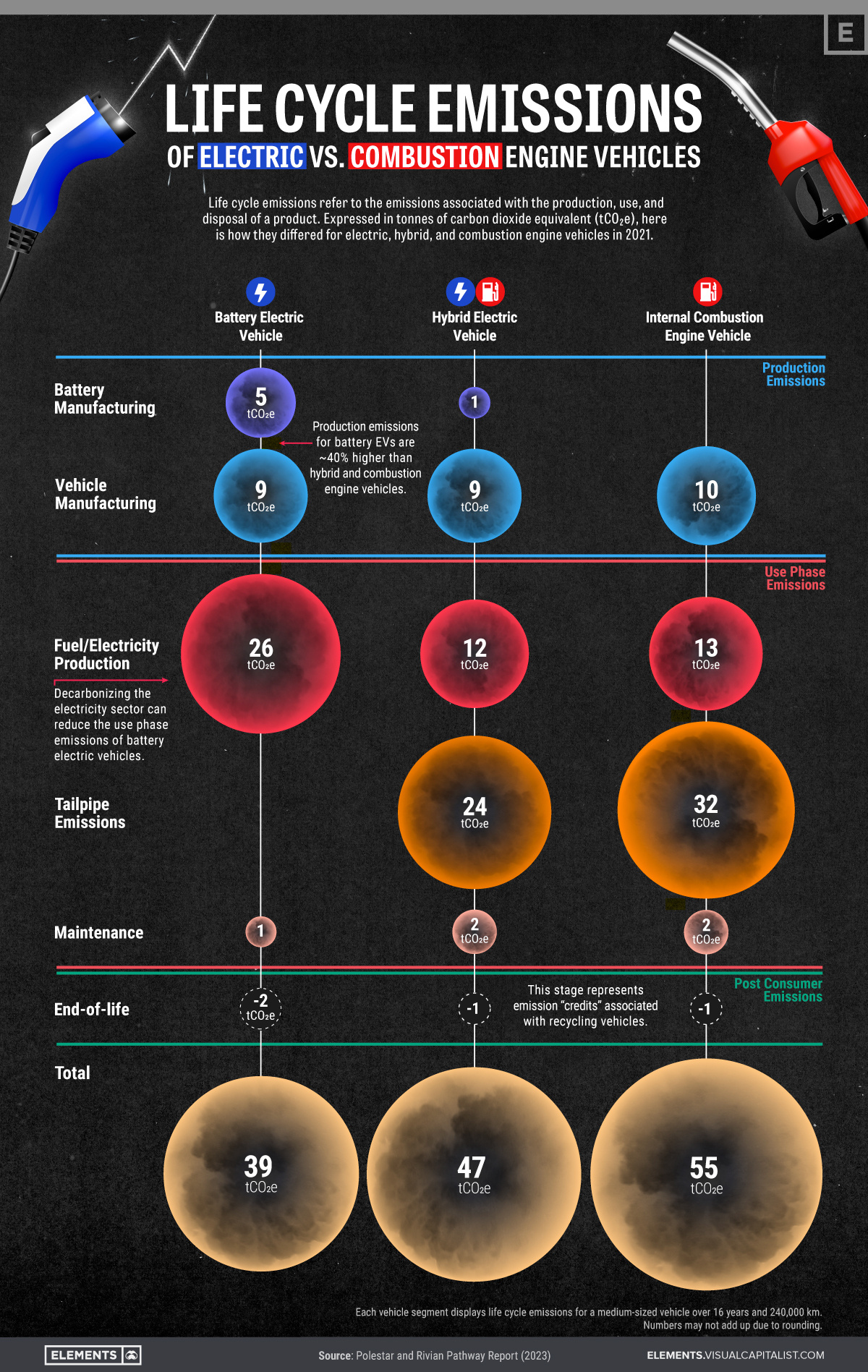
Efforts to transition personal vehicles to BEV (Battery Electric Vehicles), or HEV (Hybrid Electric Vehicles) from ICEV (Internal Combustion Engine Vehicles) may be a diversion from focus on more effective government action to mitigate the effects of the climate emergency.


graphic designed by Sam Parker

Selin Oğuz reports for Visualcapitialist that the International Energy Agency concludes the transportation sector is more reliant on fossil fuels than any other sector in the economy. In 2021, it accounted for 37% of all CO2 emissions from end‐use sectors. The graphic above, designed by Sam Parker, visualizes the life cycle emissions of battery electric, hybrid, and internal combustion engine (ICE) vehicles.


The Elements Visual Capitalist web page offers some other insights from the data that may not be as obvious at first. These insights help to identify areas of scientific and engineering efforts to further reduce emissions.


  • The production emissions for BEVs are approximately 40% higher than those of hybrid and ICE vehicles. According to a McKinsey & Company study, this high emission intensity can be attributed to the extraction and refining of raw materials like lithium, cobalt, and nickel that are needed for batteries, as well as the energy-intensive manufacturing process of BEVs.

  • Electricity production is by far the most emission-intensive stage in a BEVs life cycle. Decarbonizing the electricity sector by implementing renewable and nuclear energy sources can significantly reduce these vehicles’ use phase emissions.

  • By recycling materials and components in their end-of-life stages, all vehicle segments can offset a portion of their earlier life cycle emissions. (Oguz, 2020)


The International Energy Agency found that using energy more efficiently was the single largest potential contributor to reaching net zero greenhouse gas emissions. Fiona Harvey, Environment editor at the Guardian, writes that the latest IPCC report highlights key measures countries must take to avoid climate catastrophe.


Renewable energy in the form of wind and solar power is now cheaper than fossil fuels across most of the world and the IPCC found that solar power, wind power and reducing the conversion of land to agriculture were the three measures with the strongest potential for reducing greenhouse gas emissions globally.


  • Reduce methane

  • Stop deforestation

  • Restore other degraded land, and stop it being turned to agriculture

  • Change agriculture, and change the way we eat

  • Solar and wind power

  • Energy efficiency

  • Stop burning coal

  • Put climate at the heart of all decision-making (Harvey, 2023)


The key measures identified in the latest IPCC report do not put transition to electric vehicles in the top eight necessary measures to avoid catastrophe.  Personal action may not be as effective in meeting net zero goals as transformation of the way we use our natural resources, generate electricity with solar and wind, increase energy efficiency, and put climate change at the core of government decisions.


References

Harvey, F. (2023, March 22). Eight things the world must do to avoid the worst of climate change. The Guardian. Retrieved June 25, 2023, from https://www.theguardian.com/environment/2023/mar/21/methane-to-food-waste-eight-ways-to-attempt-to-stay-within-15c?CMP=share_btn_tw 

Oguz, S. (2020, May 20). Life Cycle Emissions: EVs vs. Combustion Engine Vehicles. Elements Visual Capitalist. Retrieved June 25, 2023, from https://elements.visualcapitalist.com/life-cycle-emissions-of-electric-hybrid-and-combuston-engine-vehicles/  


Monday, October 24, 2022

Climate change is expanding wind and solar quickly enough for 1.5C.

Lead author Olivier Bois von Kursk of the report, from the International Institute for Sustainable Development (IISD), based on a comprehensive review of all “feasible” routes to staying below 1.5C, concludes that developing new oil and gas fields is not compatible with this goal.


Solar and wind energy needs support


Returning to the IISD report, it concludes that developing new oil and gas fields would be “incompatible” with 1.5C. This is not quite true, as the report itself explains.


The IISD report says it is possible that new oil and gas could be compatible with 1.5C, if old fields were also retired early. Bois von Kursk tells Carbon Brief this is rare, however:


“Early closure of fields already in production are extremely rare and we don’t see that happening unless the economics becomes unfavourable for fields with high extraction costs. Accordingly, since fields are almost never closed before the end of their economic lifetime, we advocate for preventing any new fields from opening up to avoid stranded assets or the risk of busting the carbon budget for 1.5C.”


More fundamentally, the energy from new oil and gas development would be needed to meet rising global demand unless alternative energy sources are available in sufficient quantities.


As the report notes, wind and solar are not currently expanding quickly enough for 1.5C. Similarly, the IEA said low-carbon energy investment needed to triple to get on track. (Evans, 2022)


Government policy to encourage and provide financial support for continued exploration for and production from Canadian gas and oil properties is in opposition to policy to limit global warming at 1.5C. Financial support is needed to accelerate the development of wind and solar energy sources in Canada.


References


Evans, S. (2022, October 23). New fossil fuels 'incompatible’ with 1.5C goal, comprehensive analysis finds. Carbon Brief. Retrieved October 24, 2022, from https://www.carbonbrief.org/new-fossil-fuels-incompatible-with-1-5c-goal-comprehensive-analysis-finds/ 

Friday, May 13, 2022

Engineering Calculation for Ready to Go Technology

This post continues a series of articles that present an optimistic playbook to combat the consequences of climate change being experienced by the world today.


Needed Engineering Analysis and Calculation
 

  Saul Griffith, inventor, entrepreneur, and engineer is the founder of Rewiring America, a nonprofit dedicated to decarbonizing America by electrifying everything. He was the recipient of a MacArthur Fellowship “Genius Grant'' in 2007. He offers an optimistic plan to address climate change.

Engineering the Decarbonized Energy World


Some of the benefits of an engineering analysis of the climate crisis, like that offered by Saul Griffin in his 2021 book, Electrify: An Optimist's Playbook for Our Clean Energy Future, include experience differentiating efficiency benefits and transformation benefits using calculations of energy use.


  • It’s not the 1970’s anymore and we are not facing a 70’s energy problem that can be solved with efficiency. We need transformation.

  • 70’s thinking focuses on lots of small decisions and distracts us from the big picture.

  • 70’s thinking muddles thermodynamic efficiency with energy saved through behavior change.

  • 70’s thinking leads to a narrative of deprivation.

  • 70’s thinking is about doing less bad, not about doing more good and building good into the way we do everything (Griffith, 2021, p47)


 Comparisons of electrical transportation and heating/cooling systems to existing fossil fuel technologies require engineering quality efficiency calculations.


In an electric car, we take electricity, store it in a battery, (approx 90% efficient), and then pass it through a drivetrain (approx 80% efficient).

Total efficiency = 1x0.9x0.8=0.72

We get 0.72 units of transportation for one unit of electricity.

If we use the same electricity to make hydrogen (via electrolysis, approx 65% efficient), then compress it into a tank and decompress it back out, (approx 75% efficient), then run it through a fuel cell (approx 50% efficient), 

Total efficiency = 1x0.65x0.75x0.5=0.24

We get only 0.24 units of transportation for the same one unit of electricity (Griffith, 2021, p52)


 Proposals to supply fossil fuel free energy and use innovative technology to capture and sequester carbon dioxide need to be assessed with the engineering calculation of EROI, Energy Returned on Energy Invested.


One unit of fossil fuel in gets you 7 or 8 units back… Estimates vary but wind and solar provide approximately twice the EROI of fossil fuel power plants. As manufacturers reduce the energy input of producing wind and solar technology, and as engineers extend the useful lifetime of this green machinery, the advantage will only improve. (Griffith, 2021, p59) 


Griffin estimates that when we add up all the energy savings of electrification we will find that we only need approximately 42% of the primary energy we use today.


Winning the war against the climate crisis will also mean a cleaner, more positive future. Our homes will be more comfortable when we shift to heat pumps and radiant heating systems that can also store energy. While it may be desirable to downsize our homes and cars, this isn’t absolutely necessary, at least in the US. Our cars can be sportier when they are electric. Household air quality will improve, as will public health, since gas stoves raise the risk of asthma and respiratory illnesses. We don’t need to switch to mass rail and public transit, nor mandate changing the settings on consumers' thermostats, nor ask all red-meat loving Americans to turn vegetarian… And if we successfully employ biofuels, we don’t have to ban flying. (Griffith, 2021, p61)


The engineering analysis of “Is it ready to go to scale today?” is crucial to avoid using resources on solutions that will come too late.


There will be trade-offs. More nuclear means fewer batteries but more public resistance and, most likely, higher costs. More solar and wind means more land use. What we cannot afford are plans that make no progress because we are wasting time arguing over these issues before we begin, or because we are over-investing in technologies that can’t scale up sufficiently. The real test, given the urgency of our climate situation, should be, “Is it ready to go to scale today?” We need to act now. (Griffith, 2021, p73)


Time to project completion is a key engineering parameter that must be considered in this decade for action to mitigate the worst impacts of climate emergency. 


References

Griffith, S. (2021). Electrify: An Optimist's Playbook for Our Clean Energy Future. MIT Press.


Sunday, January 30, 2022

Energy Democracy Action for Nova Scotia

In the online discussion of the role of residential solar power in the transition to reduce GHG emissions in energy generation in Nova Scotia the idea of organizing around the concept of Energy Democracy has been suggested.


Consider Energy Democracy
 

The International Energy Democracy alliance hopes different groups over the world can be connected in the fight for energy democracy. They have created an open knowledge platform (Energy-democracy.net) maintained by the International Energy Democracy Alliance.


Over 300 groups and persons from across the world exchange via the energy democracy mailing list key developments and materials to advance the struggle for a just transition towards energy democracy. The website and mailing list are open spaces in which we welcome your contributions and participation. Let us know your stories on (fights for) energy democracy and relevant resources.1


Image source: https://energy-democracy.net/ 

The Climate Justice Alliance addresses the question of “What is Energy Democracy?” 


Energy Democracy represents a shift from the corporate, centralized fossil fuel economy to one that is governed by communities, is designed on the principle of no harm to the environment, supports local economies, and contributes to the health and well-being for all peoples. CJA is committed to the goal of maintaining global temperatures at a 1.5 Celsius increase above pre-industrial levels. At the same time, we are committed to the principles that protect workers, communities, the rights of nature, and the rights of future generations.2


Scientists, economists, and scholars in public policy and community development report on the challenges and opportunities of operationalizing Energy Democracy in Vermont.


The transition away from fossil fuels toward more renewable-based energy systems is underway taking shape differently in different communities, states, and countries throughout the world (Brown et al., 2015; Princen et al., 2015). Although there is a common tendency to view the renewable transition in technical and economic terms, current energy system changes involve much more than a technical substitution from fossil fuels to renewable electricity generation; this transition also involves social, institutional, and cultural innovations (Stephens et al., 2015). Energy democracy is an emergent social movement focused on advancing renewable energy transitions by resisting the dominant energy agenda while reclaiming and democratically restructuring energy regimes (Burke and Stephens, 2017; Van Veelen and Van Der Horst, 2018). By integrating technological change with the potential for socioeconomic and political change, the movement links social justice and equity with all kinds of innovation in energy (both social and technical innovations). The energy democracy movement seeks to create opportunities for destabilizing power relations (Angel, 2016a), reversing histories of dispossession, marginalization (Duda, 2015; Farrell, 2016) and social and environmental injustices (EDANY, 2016), and replacing monopolized fossil fuel energy systems with democratic and renewable structures (Kunze, 2014). Above all, energy democracy offers a set of visionary organizing principles that provide guidance for democratically restructuring the energy and electricity sectors through the processes of shifting from fossil fuel-based systems to renewable energy systems (Sweeney, 2014; Angel, 2016b).3


Review and analysis of energy innovations in the state of Vermont provides valuable insights on operationalizing energy democracy principles and policies as part of the renewable energy transition. Vermont is one of the smallest states in the United States with a total population of only 626,560 people. It has integrated social and technical innovation in its efforts to move toward the climate-justified goal of achieving 90% renewable energy by 2050. The unique innovative environment in Vermont with respect to energy transitions and energy democracy may be a model that fits well with the demographics and tradition of cooperation in Nova Scotia.


References

1

(n.d.). ENERGY DEMOCRACY. Retrieved January 30, 2022, from https://energy-democracy.net/ 

2

(n.d.). Energy Democracy - Climate Justice Alliance. Retrieved January 30, 2022, from https://climatejusticealliance.org/workgroup/energy-democracy/ 

3

(2018, October 3). Operationalizing Energy Democracy: Challenges and Opportunities .... Retrieved January 30, 2022, from https://www.frontiersin.org/articles/10.3389/fcomm.2018.00043/full