Showing posts with label fossil fuel. Show all posts

Saturday, October 3, 2026

Government to subsidize pipeline

 Rachel Doran, president and executive director of Clean Energy Canada, a think tank at Simon Fraser University, asks in an article in the Globe and Mail: “Is it really a good idea for the government to subsidize a pipeline?”


Decreasing Investment in Fossil Fuel in 2026

But while the share of private energy investment going into fossil fuels has slumped from 50 per cent to 28 per cent over the past decade, fossil fuels now receive about as much money from taxpayers through subsidies as they do from private investors, keeping their costs artificially lower.


Yes, oil is our biggest export, but its contribution to Canada’s GDP combined with gas was 3.8 per cent in 2025. All told, 56,000 Canadians worked directly in oil and gas extraction in 2025, compared with 108,000 in electric power generation, transmission and distribution, according to Statistics Canada. (Doran & Keller, 2026)


When the Government finances economic development there seem to be many mouths to feed. The trade-offs in seeking political support and voters before the next election call may sometimes fall into the category of “short term gain for long term pain”.


References

Doran, R., & Keller, T. (2026, October 1). Opinion: Is it really a good idea for the government to subsidize a pipeline? The Globe and Mail. Retrieved October 3, 2026, from https://www.theglobeandmail.com/business/commentary/article-is-it-a-good-idea-to-subsidize-the-west-coast-pipeline/? 


Thursday, July 6, 2023

Science concerned about Record Breaking Temperatures

July 2023 is bringing record breaking temperatures to North America even as we deal with smoke from hundreds of wildfires burning across Canada. At a time when we need drastic action to change our economic system and adapt our communities, the Liberal government continues to “subsidize Big Oil and praise Big Oil for their wonderful contribution to the building of their so-called green economy,” says Green Party deputy leader Jonathan Pedneault.


Reduced Visibility


One of the main drivers of climate change is the burning of fossil fuels, like coal, oil and gas. The fires that are destroying the homes, livelihoods and health of Canadians are intrinsically linked to the continued expansion of oil and gas production, said Canadian climate activist Tzeporah Berman in a phone interview with Canada’s National Observer. (Bulowski & Brown, 2023)


Burning Fossil Fuel


Dmitry Zhdannikov, Ron Bousso, and Shadia Nasralla report for Reuters from Vienna that climate activists and some investors have placed pressure on oil and gas producers to shift their portfolios towards zero-carbon renewable energy to tackle global warming.


But record profits from oil and gas last year and relatively low returns from renewable energy prompted some investors to demand companies renew their focus on oil and gas to raise profits.


Companies, such as Shell and BP, have slowed plans to reduce fossil fuels output.


In an interview with the BBC published on Thursday, Shell CEO Wael Sawan said cutting oil and gas production would be “dangerous and irresponsible,” given the likely impact on prices when inflation is already high.


Simon Stiell, the executive secretary of the United Nation’s climate change body (UNFCCC), in turn described Sawan’s comments as “irresponsible” at the OPEC event, according to a source present.


The burning of fossil fuels accounts for the majority of planet-warming emissions, which scientists say need to be reduced to net zero by 2050 to avoid the most extreme effects of climate change. (Zhdannikov, et al., 2023)


Research shows heat domes, wildfires and vanishing polar ice are the symptoms; unabated greenhouse gas emissions are the cause.


Bob Berwyn, an Austria-based reporter who has covered climate science and international climate policy for more than a decade, reports for Inside Climate News that June 2023 may be remembered as the start of a big change in the climate system, with many key global indicators flashing red warning lights amid signs that some systems are tipping toward a new state from which they may not recover. Included in this article are comments from scientists that use technical language that communicates efficiently to other scientists the details that highlight their concern about our warming planet.


  • Earth’s critical reflective polar ice caps
  • early warning of tipping points towards different weather or sea ice or fire regimes
  • shifting into the warm El NiƱo phase
  • “I expect a step change to higher global mean temperatures starting this year,”
  • next year will be the warmest on record, either 1.4 or 1.5C above pre-industrial.” “I expect it then to oscillate about that value and not come down again,”
  • record-high carbon dioxide concentrations in the atmosphere, he said, adding that the rate of increase is as high as it has ever been and continues to accelerate.
  • negative Antarctic sea ice anomaly has continued to widen
  • what appears to be another resonance event,” he said, referencing research that shows how the warming climate favors planetary atmospheric wave patterns that “can give rise to persistent summer weather extremes.
  • the hypothesis that changes in the Arctic can lead to a wavier jet stream that can trap heat domes in place.
  • could be a symptom of disruption to the Atlantic Meridional Overturning Circulation, a critical part of the global climate system that transports cold and warm ocean water between the poles.
  • that global energy imbalance, building steadily since the start of the fossil-fueled industrial age, is the best measure of how humans have affected the climate
  • “It is not global temperature that matters but Earth’s energy imbalance. (Berwyn & Green, 2023)

When our financial transactions become too complicated, we trust the accountants to keep our books. The medical diagnosis we attend to for health reflects our trust in the science and practice of health care. The need to mitigate the effects of global warming by reduction of emissions from oil and gas is underlined by the concerns of scientists about the consequences of the changes in the scientific parameters that impact the energy response of the Earth that is so critical to the life of species in the biosphere. It is past time to heed their advice!


References

Berwyn, B., & Green, A. (2023, July 4). June Extremes Suggest Parts of the Climate System Are Reaching Tipping Points. Inside Climate News. Retrieved July 6, 2023, from https://insideclimatenews.org/news/04072023/june-extremes-climate-tipping-points/ 

Bulowski, N., & Brown, V. (2023, July 6). If you're not terrified, 'you're not paying attention': Politicians, activist urge action amid record-breaking temperatures. National Observer. Retrieved July 6, 2023, from https://www.nationalobserver.com/2023/07/06/news/if-youre-not-terrified-youre-not-paying-attention-politicians-activist-urge-action 

Zhdannikov,, D., Bousso, R., & Nasralla, S. (2023, July 6). Oil bosses urge governments to tackle demand, not supply, in bid to cut emissions. The Globe and Mail. Retrieved July 6, 2023, from https://www.theglobeandmail.com/business/industry-news/energy-and-resources/article-oil-bosses-urge-governments-to-tackle-demand-not-supply-in-bid-to-cut/?utm_source=dlvr.it&utm_medium=twitter 


Friday, April 14, 2023

Health Homes and Climate

The relationships between health services, housing needs, and the climate crisis are many. The tension between market based action and government control in these areas compels us to carefully analyze trends and progress.


Health and Housing in Climate Crisis


The Ottawa Citizen reports on privatization of orthopedic surgery that may be impacting staffing for hospital health care. Elizabeth Payne reports:


“We are not able to provide the service we want for oncology patients because nurses are working in a higher paid environment,” said the unnamed source. “My view is that this is confirming the concerns that we are limited in terms of the service we can provide in the public system because nurses are obviously being poached by this private clinic.” (Payne, 2023)


Nicole Munro, at Saltwire, contributes an article on West End Mall redevelopment in Halifax.


By the time the master plan is finished, Coun. Shawn Cleary (Halifax West Armdale) said, the inclusionary zoning bylaw should be in place at about the same time, giving HRM the power to ensure there is a percentage of affordable units included.


While Cleary suspects most of the units will be market-based rents, he said the inclusionary zoning bylaw would allow some affordable units.


“We’ll have the power to actually say, ‘No, no, you don’t have a choice. You’re going to have this per cent of those units that have to be affordable.’” (Halifax's West End Mall Redevelopment Will Go on Despite Pushback, Councillor Says, 2023)


Matt McGrath, environment correspondent for BBC News, contributes an article about fossil fuel emissions falling in worldwide electricity generation.


One significant player impacting the overall trend is China. Around 50% of the global addition of wind power came from China and about 40% of the world's new solar came from from the country that's also the world's biggest use of coal power.


"There is a chance that at the rate that China is building wind and solar and all types of clean generation, that they achieve that peak in coal generation earlier than 2025, which would be significant," said Mr Jones.


Energy experts acknowledge that curbing fossil fuels in power generation could well be a "turning point", but much more remains to be done. (McGrath, 2023)


We monitor important trends as we ponder the best economic approach to address these serious concerns that impact the common good.


References


Halifax's West End Mall redevelopment will go on despite pushback, councillor says. (2023, April 12). SaltWire. Retrieved April 14, 2023, from https://www.saltwire.com/nova-scotia/business/halifaxs-west-end-mall-redevelopment-will-go-on-despite-pushback-councillor-says-100843479/ 


McGrath, M. (2023, April 11). Climate change: Fossil fuel emissions from electricity set to fall - report. BBC. Retrieved April 14, 2023, from https://www.bbc.com/news/science-environment-65240094 

Payne, E. (2023, March 21). Surgeries at for-profit orthopedic clinic already impacting hospital staffing, some insiders say. Ottawa Citizen. Retrieved April 14, 2023, from https://ottawacitizen.com/news/surgeries-at-for-profit-orthopedic-clinic-already-impacting-hospital-staffing-some-insiders-say 


Friday, January 20, 2023

It’s all over except the shouting

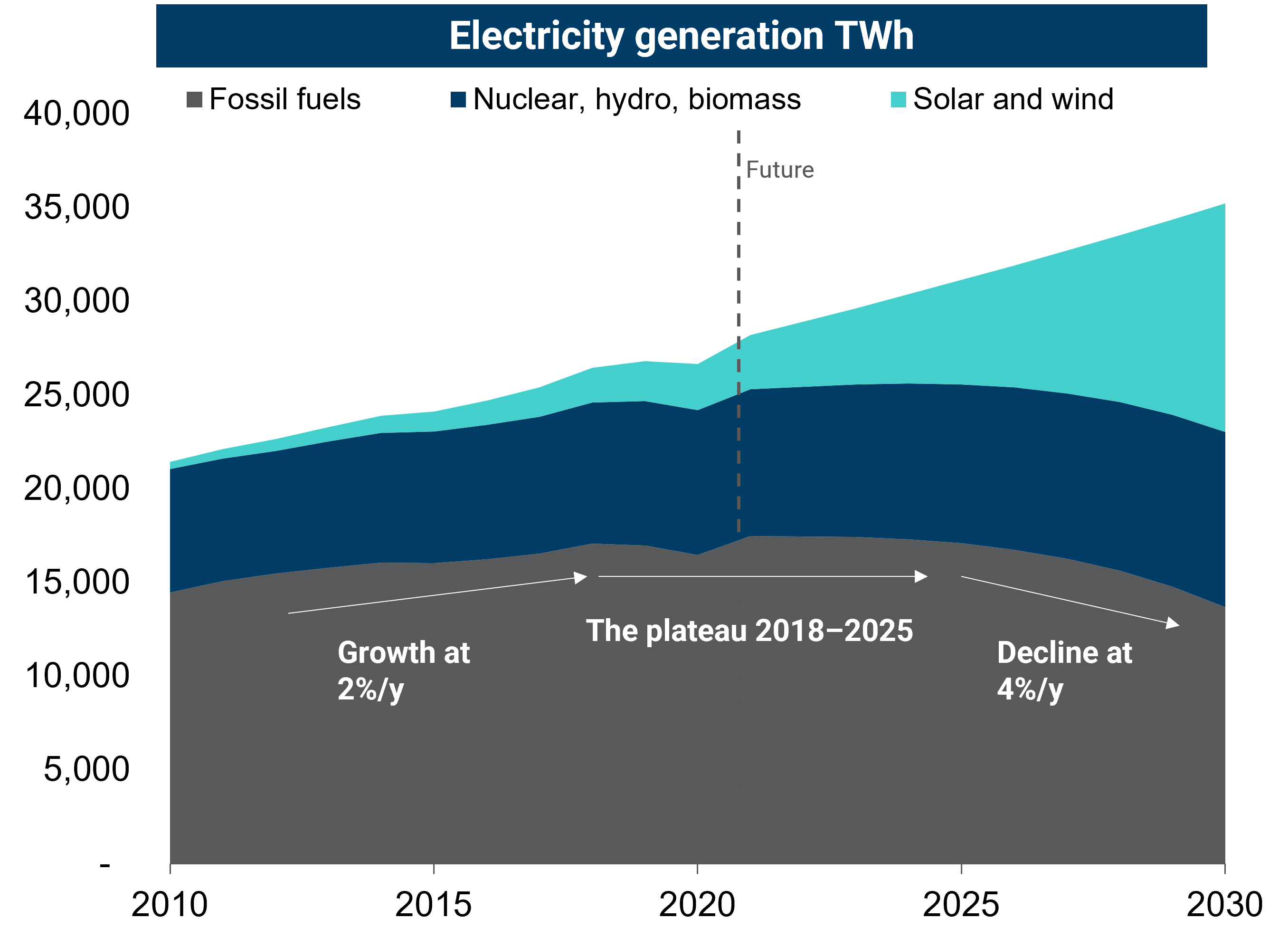
Kingsmill Bond,  Sam Butler-Sloss,  Genevieve Lillis,  and Matt Sugihara highlight a report in the latest installment of The Peaking Series that shows demand for fossil fuels has peaked in the electricity sector. It will plateau for a few years and be in clear decline by the second half of the decade.


Peak of fossil fuel


The key driver of change is the rapid growth of solar and wind electricity generation on typical S-curves, driven by low costs, a shift of global capital, and the rising ceiling of what is possible.


In 2022, solar and wind will produce 600–700 TWh of new electricity. Added to the 100–200 TWh from other clean sources makes it enough to meet projected global electricity demand growth of around 700 TWh. (Bond et al., 2023)


References

Bond, K., Butler, S., Lillis, G., & Sugihara, M. (2023, January 19). Peak Fossil Fuel Demand for Electricity. RMI. Retrieved January 20, 2023, from https://rmi.org/insight/peak-fossil-fuel-demand-for-electricity/ 


Thursday, December 29, 2022

Catholic Social Teaching and Climate

The Steering Committee and the International Support Team, behind the campaign for a Fossil Fuel Non-Proliferation Treaty comments that just like fifty years ago, when the world used international treaties to defuse the threats posed by nuclear weapons, today, the world needs a Fossil Fuel Non-Proliferation Treaty to phase out fossil fuels, support dependent economies, workers and communities to diversify away from fossil fuels, ensure 100% access to renewable energy globally and promote a just transition that leaves no-one behind.

Protecting the Environment


On 21 July 2022, a Senior Vatican Cardinal called for an international treaty that tackles the climate crisis at its source: fossil fuels. The call builds on the Vatican’s calls for fossil fuel divestment and new policies for investments in “a more just and sustainable world”.

Cardinal Michael Czerny, Prefect of the Dicastery for Promoting Integral Human Development, said: “Regarding COP27, Pope Francis again joins scientists in holding to the Paris Agreement’s temperature increase goal of 1.5°C. The planet already is 1.2°C hotter, yet new fossil fuel projects every day accelerate our race towards the precipice. Enough is enough. All new exploration and production of coal, oil, and gas must immediately end, and existing production of fossil fuels must be urgently phased out. This must be a just transition for impacted workers into environmentally sound alternatives. The proposed Fossil Fuel Non-Proliferation Treaty holds great promise to complement and enhance the Paris Agreement.” (The Vatican Calls for a Fossil Fuel Non-Proliferation Treaty to Protect People and Planet, 2022)

Tony Annett tweets concerning Pope Francis' moral priorities that includes protecting the environment.


Thomas Reese, a Senior Analyst at Religion News Service, writes that Advent should be a time of hope. As a social scientist, he has little hope. As a Christian, he must have hope. This Advent he will be praying for the conversion of hearts to an environmental mindset. He will pray that those being born in the coming year will experience the coming of Christ and not the environmental catastrophe that scientists are predicting.

“Climate change will not wait for us,” said Cardinal Pietro Parolin, the Vatican secretary of state. “Our world is now far too interdependent and cannot permit itself to be structured into unsustainable isolated blocks of countries. This is a time for international and intergenerational solidarity. We need to be responsible, courageous and forward-looking not just for ourselves, but for our children.”


“Our political will,” said the Vatican’s top official, “should be guided by the awareness that either we win together or we lose together.”


Pope Francis was outspoken about environmental issues in his encyclical “Laudato Si.” He was not the first pope to have these concerns. Pope Benedict XVI was referred to as the “green pope” after he had solar panels installed on the roof of the papal audience hall. Both liberal and conservative Catholics should unite in following these popes’ directions in responding to climate change.(Reese, 2022).

The global momentum around the proposed Fossil Fuel Non-Proliferation Treaty means that three pillars of the policy proposal are now supported by 101 Nobel laureates, 3,000 academics, a growing interfaith group of religious leaders, 320 parliamentarians, thousands of youth activists, more than 1,500 civil society organizations and over 60 cities including London, Paris, Amsterdam, Sydney, Los Angeles, Barcelona, Toronto and Geneva. Let’s join Pope Francis in the assertion that “enough is enough” and respond to the cry of the earth and the cry of the poor presented in the Laudato Si encyclical. 


References


Reese, T. (2022, November 28). In Advent, we hope and wait. Climate change doesn't lend itself to either. Religion News Service. Retrieved December 29, 2022, from https://religionnews.com/2022/11/28/advent-and-global-warming/ 


The Vatican calls for a Fossil Fuel Non-Proliferation Treaty to protect people and planet. (2022, July 21). The Fossil Fuel Non-Proliferation Treaty. Retrieved July 22, 2022, from https://fossilfueltreaty.org/vatican 

Tuesday, August 17, 2021

Engineering Climate Change and Planning Skilled Work

Engineering professionals are experienced in energy system calculations, ROI economic calculations, determining skilled worker requirements for projects, and analysing scientific reports on climate changes.

Engineering Climate Change Mitigation


Many articles appear in social media suggesting changes and transformation in our energy production and use, transportation infrastructure, and building design and construction to reduce the warming effect these systems are having on the planet. Techniques to reduce our carbon footprint are particularly important in the light of the recent “red alert” from the IPCC. How are we to decide on which of these many transformation and transition projects we should prioritize to achieve the greatest temperature reduction in the shortest period of time? The experts best able to plan and organize this massive effort are engineers. These professionals work with science, technology, skilled workers, and economics as daily components of their practice. “Following science” with “practical and economical” solutions is the path that requires engineering expertise. Some recent ideas from social media underline the large engineering role to achieve the benefits we need.


An article in The Economist explains why curbing methane emissions will help fight climate change. It is a more powerful greenhouse gas than carbon dioxide, and should be easier to control. 


Carbon dioxide remains the heart of the climate problem. Exploring the possibilities, practicalities and dangers of solar geoengineering remains a good idea. But it is on methane emissions that progress can be made most quickly. And the world is getting ever hotter. Methane should be given priority on the agenda at the cop26 climate summit this November.1


Oliver Milman, writing in the National Observer, reports that  ‘Blue’ hydrogen may pollute more than coal according to new research at Cornell University and Stanford University.


This means that the production of this hydrogen actually creates 20 per cent more greenhouse gases than coal, commonly regarded the most polluting fossil fuel, when being burned for heat, and 60 per cent more than burning diesel, according to the new paper, published in the Energy Science & Engineering journal. “It’s pretty striking, I was surprised at the results,” said Robert Howarth, a scientist at Cornell University who authored the paper alongside Mark Jacobson, a Stanford University researcher. “Blue hydrogen is a nice marketing term that the oil and gas industry is keen to push but it’s far from carbon free. I don’t think we should be spending our funds this way, on these sort of false solutions.”2


Blaine Brownell reports in Architect Magazine on designing an air conditioner that doesn't heat the earth  thereby reducing the contribution of AC to the climate crisis.


For example, the engineers at Gradient, a San Francisco-based startup, want to revolutionize the window unit. Gradient’s founders aim to marry the high performance of heat pump technology with the installation convenience of a conventional window unit. The Gradient unit resembles a bench with two thick supports that you hang over a window sill. The clever design means the unit doesn't obstruct the view out the window and places the noisier components on the outside. The company claims a 75% reduction in carbon footprint compared to conventional A.C. systems when used year-round for cooling and heating. Furthermore, the device relies on a reduced-footprint refrigerant to generate more energy-efficient variable conditioning.3


The US Office of Nuclear Energy is suggesting three ways to make nuclear power plants faster and more affordable to build.


For advanced nuclear energy to realize its potential, we have to make it more affordable and scalable. Only then can it meaningfully contribute to our energy, security, and environmental imperatives. That’s why NRIC will be working with GE-Hitachi Nuclear (GEH) and other key stakeholders on the first project of the Advanced Construction Technology (ACT) initiative. The goal of this cost-shared public-private partnership is to help demonstrate several technologies that, when combined, could reduce the construction costs of building new reactors by more than 10% and significantly lower the scheduling risks and uncertainties associated with them.4


Zachary Shahan, reports on the CleanTechnica web site that carbon capture & storage (CCS) and hydrogen paradises are fossil fuel delay tactics.


The smoke screens of CCS and hydrogen create two big problems. First of all, they are money dumps, sucking up government funding that could be used for truly helpful improvements and solutions — faster deployment of solar power, wind power, and EV charging stations; procurement of electric vehicles for governmental fleets; greater incentives for consumers to install energy efficiency, renewable energy, or electric vehicle technologies. Secondly, both CCS and hydrogen hype tell people, “We don’t really have to change much. We can just capture the carbon and bury it. [No, it’s not that easy, and it’s also bloody expensive.] We can stick to a fuel-based transport system rather than switch to charging at home, work, and destination. [The latter is often actually more convenient, not less convenient, but don’t let that secret get out.]” The message with both is basically to not worry about anything, not do anything, and leave it to some obscure experts to solve all our problems for us in a few years. I can see why that’s tempting, but it is definitely misleading and counterproductive. Looking at it most cynically, the people who push so hard for CCS and hydrogen as our saviors could be specifically trying to delay the cleantech transition. Well, some of them no doubt are.5


The complexity of the claims by different sources about what is a priority in addressing the climate emergency is an opportunity for engineering analysis to plan a course of action that considers GHG effects, economics, skilled worker requirements, and relevance of scientific studies.


References


1

(2021, August 14). Why curbing methane emissions will help fight climate change | The .... Retrieved August 14, 2021, from https://www.economist.com/leaders/carbon-dioxide-is-by-far-the-most-important-driver-of-climate-change/21803535 

2

(2021, August 12). 'Blue' hydrogen may pollute more than coal, new research finds .... Retrieved August 14, 2021, from https://www.nationalobserver.com/2021/08/12/news/blue-hydrogen-may-pollute-more-coal-new-research-finds 

3

(n.d.). Designing an Air Conditioner That Doesn't Heat the Earth | Architect .... Retrieved August 15, 2021, from https://www.architectmagazine.com/technology/designing-an-air-conditioner-that-doesnt-heat-the-earth_o 

4

(2021, July 8). 3 Ways to Make Nuclear Power Plants Faster and More Affordable to .... Retrieved August 15, 2021, from https://www.energy.gov/ne/articles/3-ways-make-nuclear-power-plants-faster-and-more-affordable-build 

5

(2021, August 13). (CCS) And Hydrogen Paradises Are Fossil Fuel Delay Tactics. Retrieved August 17, 2021, from https://cleantechnica.com/2021/08/13/carbon-capture-storage-ccs-and-hydrogen-paradises-are-fossil-fuel-delay-tactics/