Showing posts with label EV's. Show all posts

Tuesday, April 2, 2024

Support for One in Five Canadians with tax rebate less than carbon tax.

The political firestorm in Canada to “Axe the Tax” appears to be aimed at repeal of the carbon pricing policy of the Trudeau government. The 20% of Canadians for whom the tax free Climate Action Incentive Payment (CAIP), as a carbon tax rebate, is less than the amount they will spend in carbon taxes may require a change in lifestyle. The concept that users of more carbon pay more carbon tax is operative in Canada.


Rebate > Tax :Tax > Rebate

Mia Rabson of The Canadian Press writing in an article reported by the Financial Post addresses the question of what the increase in carbon tax could cost in some Canadian households.

Gasoline: Going from $65 per tonne to $80, means the carbon price on a litre of gasoline will now be 17.6 cents per litre, up 3.3 cents per litre from before. That means filling a 50 litre tank from empty will cost about $8.80 in carbon price, about $1.65 more than before.

Diesel: As of today the price for a litre of diesel will include 21.39 cents in carbon price, up from 17.38 cents.


Propane: The price for propane will now include 12.38 cents a litre in carbon price, up from 10.08 cents. A standard 20-pound barbecue propane tank will cost about $2.20 in carbon price to fill, compared with $1.78 over the last year.


Natural gas: On average in Canada, households use about 2,280 cubic metres of natural gas in a year, mostly for heat. At $80 per tonne, the carbon price will add 15.3 cents to a cubic metre of natural gas, up from 12.4 cents previously. That amounts to an annual carbon price bill for natural gas of about $347 on average, compared with $282 over the last year.


Food and clothing and other goods: There are indirect costs of carbon pricing, as companies that pay the price themselves increase the cost of their goods and services to keep pace. The amounts vary by industry, but Statistics Canada estimated that carbon pricing increased the price of food by about 0.3 per cent and the price of clothes by two per cent since its inception. The effect of the latest increase has yet to be determined. (Rabson, 2017)

The price increase summary by the Financial Post shows that driving fuel efficient cars and trucks, perhaps EV’s or Hybrids, and electrifying with heat pumps will reduce the carbon tax assessment for the one in five not receiving a rebate.

Building large homes and flying to vacation get-a-ways are two choices that some of the 20% are encouraged to reconsider as the carbon rebate covers less of their tax burden.

Clutch, with mission is to deliver a delightful car⁠-⁠buying experience to Canadians, has a web page to learn more about the carbon tax rebate, including why it exists, variances among provinces, and how it can help our wallet and the planet. The one in five Canadians who have a rebate that does not cover their tax are reminded to consider the impact of provincial government policy on the levy they pay.

For example, Quebec and Nova Scotia (previously implemented) a cap-and-trade system allowing provincial (or municipal) governments to set caps for carbon emissions by industry. Companies can then buy and sell carbon credits in an open market when they are over or below the cap. Some provinces also attempted to limit the increase in fuel and heating costs through lower individual taxes on gas, oil, propane, and natural gas. This helps alleviate the financial burden on residents and puts it upon the government through lowered taxes. Carbon taxes vary between provinces because provincial governments, and to some degree, individual municipalities, can set their own carbon taxes as long as they meet the federal government's requirements. (A Quick Guide to the Carbon Tax Rebate in Canada, 2024)

Canadian economists have released an open letter to add professional knowledge to the important discussion of the role of carbon tax in reducing GHG emissions in our efforts to mitigate the effects of climate change. Five claims by carbon tax critics are addressed by presenting evidence.

Solutions for the one in five Canadians who pay more carbon tax than their Climate Action Incentive Payment (CAIP) covers may lie in decisions to decrease their transportation and heating costs and emissions.


References


A Quick Guide to the Carbon Tax Rebate in Canada. (2024, February 27). Clutch Blog. Retrieved April 2, 2024, from https://blog.clutch.ca/posts/carbon-tax-rebate-canada 

Rabson, M. (2017, November 9). Carbon tax 101: What the increase could cost you and your household. The Financial Post. Retrieved April 2, 2024, from https://financialpost.com/commodities/energy/oil-gas/carbon-tax-increases-april-1-2024 

Wednesday, December 6, 2023

Moving with the EV

This article provides some data to support the fact that EVs are better for the environment in Nova Scotia.


Energy Options for Automobiles


Yes! The electricity generated to power EVs is generally cleaner than gasoline and it’s getting cleaner over time as we integrate more renewable energy on the grid. Even if an electrical grid was powered entirely by coal, EVs would still only produce 88% of the emissions of gasoline powered vehicles. While it’s also true that producing the battery in an EV can sometimes result in higher emissions during the manufacturing process, that gap is closed within 18 months of driving. With our current electricity mix in Nova Scotia, at the end of its lifecycle, an EV cuts the emissions of gas-powered alternatives in half. (Ev Basics, n.d.)


The CAA Driving Cost Calculator for Sustainable Transportation compares the estimated total annual driving costs for the 2023 Hyundai Kona EV Ultimate 4D Utility EV ($7,803.96/year) and the 2023 Hyundai Kona Preferred 4D Utility AWD ($8,366.97/year). (Based on owning the vehicle for 5 years)


CAA Driving Cost Calculator. (2023, June 16). Canadian Automobile Association. Retrieved December 6, 2023, from https://carcosts.caa.ca/en/compare


The Schumpeter business column, at the Economist, asks how green is your electric vehicle, really? It reports that EVs are in the middle of an obesity epidemic that shows itself in even though some manufacturers claim sustainability as a founding principle, they are building bigger, burlier cars, even when they are electric.


For now, carmakers can argue that however big the electric rigs, they have a positive impact on the planet. Though manufacturing evs—including sourcing the metals and minerals that go into them—generates more greenhouse gases than a conventional car, they quickly compensate for that through the absence of tailpipe emissions. Lucien Mathieu of Transport and Environment, a European ngo, says that even the biggest evs have lower lifetime carbon emissions than the average conventional car. That is true even in places with plenty of coal-fired electricity, such as China.


Ultimately, the industry is almost sure to realise the folly of pursuing size for its own sake. The penny is starting to drop. Ford’s ceo, Jim Farley, recently said carmakers could not make money with the longest-range batteries. His opposite number at General Motors, Mary Barra, has taken the unexpected step of reversing a plan to retire the affordable Chevy Bolt ev. In Europe, carmakers like Volkswagen are building smaller, cheaper evs. Tesla is said to be planning a compact model made in Mexico.


The pressure is partly coming from competition. Felipe Munoz of Jato Dynamics, a car consultancy, says China prizes battery efficiency above bigness and is hoping to muscle in on overseas markets with lighter, cheaper brands, such as byd. Innovation in batteries based on solid-state or sodium-ion chemistry may also make evs more efficient. For the time being, drivers with money to splurge will no doubt relish flaunting their low-carbon credentials from the vantage point of a large suv or monster truck. And so they should—until they realise that they may be making electrification less accessible to the rest of humanity. (How Green Is Your Electric Vehicle, Really?, 2023)


The absence of tailpipe emissions in EV’s results in lower greenhouse gas lifetime output than the average conventional ICE car. As battery technology improves to solid state and sodium-ion designs, the efficiency will improve and the number of charging stations will grow.


References

CAA Driving Cost Calculator. (2023, June 16). Canadian Automobile Association. Retrieved December 6, 2023, from https://carcosts.caa.ca/en/compare 

Ev Basics. (n.d.). EV Assist. Retrieved December 6, 2023, from https://evassist.ca/ev-basics/ 

How green is your electric vehicle, really? (2023, June 16). the Economist. Retrieved December 6, 2023, from https://www.economist.com/business/2023/08/10/how-green-is-your-electric-vehicle-really? 


Saturday, February 25, 2023

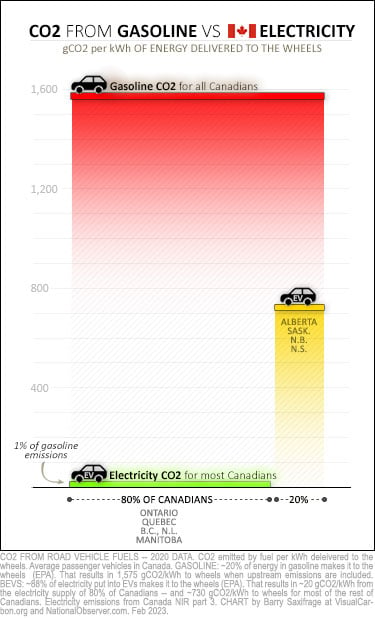
Life Cycle Emissions ICE or EV

Gasoline car emissions have been reduced in the UK and Norway. Barry Saxifrage reports that their most effective single policy has been a "polluter pays" tax added to new cars. Specifically, they calculate the purchase tax for new cars based on car weight, CO2 emissions and NOx emissions.


Barry Saxifrage's first chart shows the relative climate emissions from fuelling our cars with gasoline and electricity.


Research shows that making a gasoline car is currently a bit less climate-polluting than making an electric car. Around 2 tCO2 less. But this small advantage gets wiped out many times over by the extra emissions from fuelling the car.


A chart showing the latest vehicle registration numbers from Statistics Canada shows that electric cars are a thin green frosting on top of an ever-expanding fleet of burnermobiles. For every new electric car added to our roads over the last five years, we've added 10 more gasoline cars.


The trend in Canada is an increase in purchases of gasoline cars, SUV’s, and trucks as contrasted by decreases in these purchases in Norway, UK, France, Germany, Sweden, and Japan. Barry Saxifrage notes that the most effective single policy in Norway has been a "polluter pays" tax added to new cars. Specifically, they calculate the purchase tax for new cars based on car weight, CO2 emissions and NOx emissions. This can nearly double the cost of buying a polluting gas guzzler. Imagine Canada bringing in an 80 per cent sales tax on big, new gas-guzzling SUVs and you've got the basic idea.


As Canadians switch to electric vehicles in response to the increasing cost of gasoline and concern for the effect of greenhouse gas emission on the increasing frequency and severity of climate events in our country, we may find “polluter pay” taxation to be an effective strategy


References


Saxifrage, B., & Woodside, J. (2023, February 24). Gasoline versus electric cars? Here's how their life cycle emissions compare in Canada. National Observer. Retrieved February 24, 2023, from https://www.nationalobserver.com/2023/02/24/analysis/gasoline-versus-electric-cars-life-cycle-emissions-compared-canada

Saturday, April 2, 2022

Fact Check on EV Posts

Social media posts that pretend to offer true facts about electric vehicles often do not attribute the information they present to credible sources. The initial expense of electric vehicles (EV) needs to be compared to how their ongoing performance compares with internal combustion engine (ICE) vehicles.

EV or ICE?


  Bill Turpin discusses the energy efficiency and GHG emissions of his typical EV that uses the Nova Scotia electric grid for charging. His calculations indicate that using an EV in Nova Scotia produces less GHG emissions than internal combustion vehicles even as Nova Scotia Power Inc. burns coal to generate electricity.


According to Nova Scotia Power’s 2020 emission intensity report, the utility emitted 629.7 grams of carbon (strictly speaking, carbon dioxide) for each kilowatt-hour (kWh) it sold me.  This means my car indirectly emits 11,020 grams of carbon per 100 km (17.5 X 629.7). On average, a Canadian car burns nine litres of gasoline per 100 km and each burned litre creates 2,300 grams of human habitat-killing carbon dioxide. This means the average fossil-burner directly emits 20,700 grams of carbon every 100 km (9 X 2,300). Put another way, my average EV emits just 53% of the carbon emitted by a fossil-burner. Yep, right here in Nova Scotia. And that number will get better as more hydro from Muskrat Falls gets into the energy mix. Nova Scotia Power has cut its emissions intensity by 30 per cent over the past 15 years and electric motors are about two and a half times more efficient than internal combustion engines. The same amount of energy that moves an ICEV 100 km drives my EV for 250 km.1


Graham Readfearn writes, in the Guardian, about a cut-and-paste attack on electric vehicle batteries and renewables that is spanning the globe. Unattributed extracts from an essay decrying renewables and electric vehicles are being used to undermine their environmental credentials.


Across social media, internet forums and some climate science denier blogs, there has been furious cutting-and-pasting of chunks of common text attacking the environmental credentials of electric vehicles, solar panels and wind turbines. "About 200 tonnes of the “Earth’s crust” needs to be mined for each electric vehicle battery, and 11 tonnes of brine are needed just for the lithium, claims the text, which also says solar panels and wind turbine blades can’t be recycled." Some claims are made definitively and without context, and don’t try to compare electric vehicle batteries to the fossil fuelled cars they are replacing. Solar panels can be recycled and fully recyclable turbine blades are now being produced. The former resources minister and Queensland senator Matt Canavan was another to share some of the text that sat above a picture of a hollowed-out landscape. It took a few seconds to discover the scary but irrelevant image was of a diamond mine in Canada.2


PumpTalk, a blog created by Petro-Canada, a Suncor business, shares information and engages in discussion about a number of topics, such as fuel efficiency and product responsibility.

Fuel Costs?


In November 2021, it published an Interview with Paul Raszewski, a realtor and the co-founder of TEVA – the Toronto Electric Vehicle Association, and David Bennetta, Suncor employee in Fort McMurray and an EV enthusiast, about making the EV Switch. Pump Talk asked for tips for drivers who are considering making the switch to an EV.


First, don’t be scared off by the cost. Even though the up-front cost is more expensive, the long-term cost is much better. Gasoline vs. electricity – you’ll save. No oil change, not as frequent brake service – the long term servicing costs are better. And second, look for an EV community who can give you support – they’re out there.3


As we consider the need to reduce our carbon footprint by moving to electric vehicles, it is important to look for information from credible sources published in recognised media.


References

1

Turpin,B. (March 30, 2022). Eat my electrons, CBC!. And Now This….https://andnowthis.ca/2022/03/30/eat-my-electrons-cbc/ 

2

(2022, March 31). A cut-and-paste attack on electric vehicle batteries and renewables .... Retrieved April 2, 2022, from https://www.theguardian.com/environment/2022/mar/31/a-cut-and-paste-attack-on-electric-vehicle-batteries-and-renewables-is-spanning-the-globe-but-is-it-right 

3

(2021, November 4). Making the EV Switch – Interviews with Paul Raszewski and David .... Retrieved November 26, 2021, from https://www.pumptalk.ca/2021/11/making-the-ev-switch-interviews-with-paul-raszewski-and-david-bennett.html 


Thursday, March 31, 2022

EVs Homes and the Environment in NS

The initial expense of electric vehicles (EV) and buildings that are constructed and operated to minimize their carbon footprint needs to be compared to how their ongoing performance compares with internal combustion engine (ICE) vehicles and conventional building construction.

EV and ICE Vehicles


  Bill Turpin discusses the energy efficiency and GHG emissions of his typical EV that uses the Nova Scotia electric grid for charging. His calculations indicate that using an EV in Nova Scotia produces less GHG emissions than internal combustion vehicles even as Nova Scotia Power Inc. burns coal to generate electricity.


According to Nova Scotia Power’s 2020 emission intensity report, the utility emitted 629.7 grams of carbon (strictly speaking, carbon dioxide) for each kilowatt-hour (kWh) it sold me.  This means my car indirectly emits 11,020 grams of carbon per 100 km (17.5 X 629.7). On average, a Canadian car burns nine litres of gasoline per 100 km and each burned litre creates 2,300 grams of human habitat-killing carbon dioxide. This means the average fossil-burner directly emits 20,700 grams of carbon every 100 km (9 X 2,300). Put another way, my average EV emits just 53% of the carbon emitted by a fossil-burner. Yep, right here in Nova Scotia. And that number will get better as more hydro from Muskrat Falls gets into the energy mix. Nova Scotia Power has cut its emissions intensity by 30 per cent over the past 15 years and electric motors are about two and a half times more efficient than internal combustion engines. The same amount of energy that moves an ICEV 100 km drives my EV for 250 km.1


George MacPherson writes on LinkedIn about why building a luxury home may be good for the environment.

Luxury and Green too


He notes that even in eco-friendly designs, we externalize costs and with passive-built structures one of those external costs is the destruction of our natural life giving forests.


Unless we begin framing these homes with a different material, a sustainable recycled material, or we stop building homes to passive standards all together, this will always just be a Band-Aid solution… True eco-friendly means that you can stand with pride on the job site of your home being constructed, knowing that because it's being constructed it is helping the environment and if it weren't constructed then 600,000 bottles would still be in the ocean. That's our structure. That's our eco structure. It's not passive. It's better than passive. It's positive environmental impact… A JD Composites home uses half the energy of a standard wood framed home. That means if you net zero based on the consumption of a typical home, you have 50% of your production that you can devote to "luxury" energy costs. Things like electric vehicle charging, water pumps for irrigation, hydroponics, glycol heated concrete and driveway, and even a water feature.2


Adrienne Morgan Interior Design comments that there are many ways you can refresh and organize your luxury home to make it more sustainable.


The Leadership in Energy and Environmental Design (LEED) certificate has become almost like a buzzword in the world of eco-friendly home design. Namely, this certificate ensures that the home’s efficiency standards are in line with the principles of green building. LEED-certified projects have so far been responsible for removing 80 million tonnes of waste that results from unsustainable building. Also, it has been estimated that LEED buildings account for $1.2 billion in energy savings and $150 million in water savings. Around the world, about 430,000 homes are LEED-certified, most of them being in the US. Both residential, private, and commercial real estate experts recognize LEED certification as an accurate sustainability indicator.3


In the transition from transportation and building systems of today to the energy efficient low carbon footprint required in the next decade we need to rely on energy use and GHG emission calculations by engineers and others with experience in the technology required to meet the goals that will minimize the effects of a warming planet.


References

1

Turpin,B. (March 30, 2022). Eat my electrons, CBC!. And Now This….https://andnowthis.ca/2022/03/30/eat-my-electrons-cbc/ 

2

MacPherson,G. (March 30, 2022). Opulence for the Populous: Why Building A Luxury Home is GOOD for the Environment. Geo Net Zero. https://www.linkedin.com/pulse/opulence-populous-why-building-luxury-home-good-george-macpherson/?published=t&fbclid=IwAR02U32lsMPZqQwels8EaerHRufzl5NYbSomwaRp0LabMwH7HAYndOSfIdU 

3

(n.d.). Can Luxury Homes Be Environmentally Friendly Too? - Adrienne .... Retrieved March 31, 2022, from https://amorganinteriors.com/can-luxury-homes-be-environmentally-friendly-too/ 


Thursday, August 22, 2019

Net Zero housing decreasing demand for oil and gas

An article in Halifax Magazine quotes Energy Sustainability Engineering Technology graduate Jacob Woods describing the “living lab” known as the Pilikan House on the NSCC Middleton Campus.


The house has 10 solar panels, a Tesla Power Wall, and solar thermal array. He believes ”It will become difficult for people to see their neighbours with solar panels and watch their meters roll backward and not follow suit.1 
A MSN (Microsoft News) report by Daniel Coughlin explains why oil and gas-rich countries face a perilous future.
Countries that depend too heavily on unsustainable gas and oil to power their economies are facing a double whammy of dwindling supplies and plummeting demand as renewables increasingly replace fossil fuels. Adding to their woes, many of these nations are located in parts of the world that are likely to become unliveable for months at a time due to climate change. As the proverbial begins to hit the fan, here are 10 oil and gas-rich countries looking forward to an uncertain future.2 


These articles are complemented by an analysis for “professional investors” produced by BNP Paribas, the world’s eighth largest bank by total assets, that concludes the writing is on the wall for the oil industry. The economics of renewables are impossible for oil to compete with.
Writing on the wall

Plunging prices for batteries and renewables are driving an electric vehicle (EV) revolution so rapidly that the economics of oil “are now in relentless and irreversible decline.”
 “The clear conclusion of our analysis is that if we were building out the global energy system from scratch today,” Lewis explains, “economics alone would dictate that at a minimum the road-transportation infrastructure would be built up around EVs powered by wind- and solar-generated electricity.”But oil has a big head start. And, of course, Big Oil uses its vast current income to buy political power so that it can slow down investment and government policies aimed at advancing electric cars.3
The advantages for homeowners to have electricity and heat generated on their property include reduced utility bills and increased security of supply. The choice of these technologies supports the IPCC goal of eliminating electrical generation by coal to mitigate the effects of climate change.

References

1
(2019, August 20). A living lab | Halifax Magazine. Retrieved August 22, 2019, from https://halifaxmag.com/blog/a-living-lab/ 
2
(2019, August 20). Why oil and gas-rich countries face a perilous future - MSN.com. Retrieved August 22, 2019, from https://www.msn.com/en-au/money/financephotos/why-oil-and-gas-rich-countries-face-a-perilous-future/ss-AAG8vVf 
3
(2019, August 9). One of the world's largest banks thinks the writing is on the wall for the .... Retrieved August 20, 2019, from https://thinkprogress.org/oil-faces-irreversible-decline-thanks-to-electric-cars-and-solar-warns-worlds-8th-largest-bank-d128101ef4a8/