Showing posts with label electric vehicles. Show all posts

Sunday, June 25, 2023

Focus on EV’s may not be top Climate Priority

Efforts to transition personal vehicles to BEV (Battery Electric Vehicles), or HEV (Hybrid Electric Vehicles) from ICEV (Internal Combustion Engine Vehicles) may be a diversion from focus on more effective government action to mitigate the effects of the climate emergency.
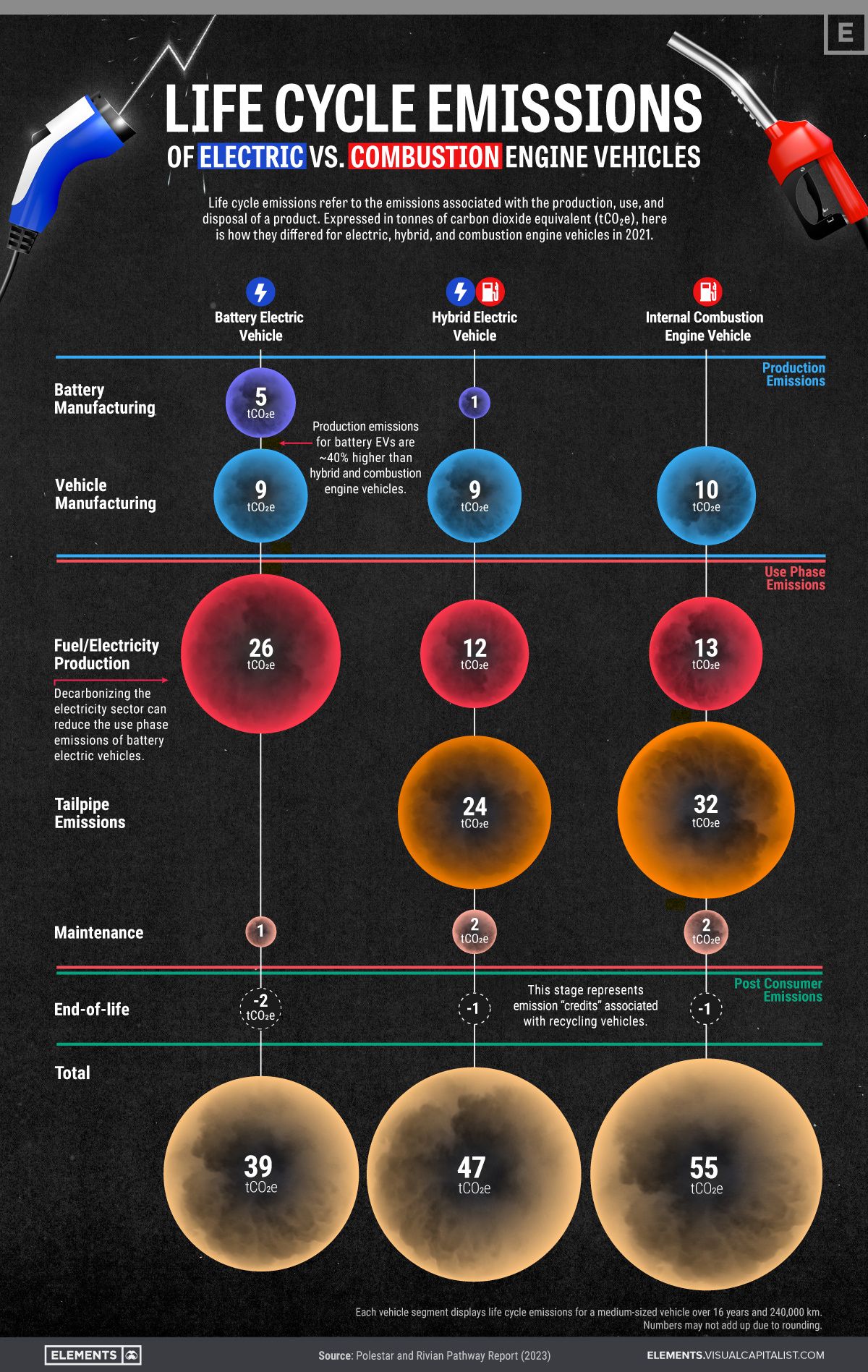


graphic designed by Sam Parker

Selin Oğuz reports for Visualcapitialist that the International Energy Agency concludes the transportation sector is more reliant on fossil fuels than any other sector in the economy. In 2021, it accounted for 37% of all CO2 emissions from end‐use sectors. The graphic above, designed by Sam Parker, visualizes the life cycle emissions of battery electric, hybrid, and internal combustion engine (ICE) vehicles.


The Elements Visual Capitalist web page offers some other insights from the data that may not be as obvious at first. These insights help to identify areas of scientific and engineering efforts to further reduce emissions.


  • The production emissions for BEVs are approximately 40% higher than those of hybrid and ICE vehicles. According to a McKinsey & Company study, this high emission intensity can be attributed to the extraction and refining of raw materials like lithium, cobalt, and nickel that are needed for batteries, as well as the energy-intensive manufacturing process of BEVs.

  • Electricity production is by far the most emission-intensive stage in a BEVs life cycle. Decarbonizing the electricity sector by implementing renewable and nuclear energy sources can significantly reduce these vehicles’ use phase emissions.

  • By recycling materials and components in their end-of-life stages, all vehicle segments can offset a portion of their earlier life cycle emissions. (Oguz, 2020)


The International Energy Agency found that using energy more efficiently was the single largest potential contributor to reaching net zero greenhouse gas emissions. Fiona Harvey, Environment editor at the Guardian, writes that the latest IPCC report highlights key measures countries must take to avoid climate catastrophe.


Renewable energy in the form of wind and solar power is now cheaper than fossil fuels across most of the world and the IPCC found that solar power, wind power and reducing the conversion of land to agriculture were the three measures with the strongest potential for reducing greenhouse gas emissions globally.


  • Reduce methane

  • Stop deforestation

  • Restore other degraded land, and stop it being turned to agriculture

  • Change agriculture, and change the way we eat

  • Solar and wind power

  • Energy efficiency

  • Stop burning coal

  • Put climate at the heart of all decision-making (Harvey, 2023)


The key measures identified in the latest IPCC report do not put transition to electric vehicles in the top eight necessary measures to avoid catastrophe.  Personal action may not be as effective in meeting net zero goals as transformation of the way we use our natural resources, generate electricity with solar and wind, increase energy efficiency, and put climate change at the core of government decisions.


References

Harvey, F. (2023, March 22). Eight things the world must do to avoid the worst of climate change. The Guardian. Retrieved June 25, 2023, from https://www.theguardian.com/environment/2023/mar/21/methane-to-food-waste-eight-ways-to-attempt-to-stay-within-15c?CMP=share_btn_tw 

Oguz, S. (2020, May 20). Life Cycle Emissions: EVs vs. Combustion Engine Vehicles. Elements Visual Capitalist. Retrieved June 25, 2023, from https://elements.visualcapitalist.com/life-cycle-emissions-of-electric-hybrid-and-combuston-engine-vehicles/  


Tuesday, May 3, 2022

Electrify Now

This post begins a series of articles that present an optimistic playbook to combat the consequences of climate change being experienced by the world today.

A Playbook for Decarbonization


  Saul Griffith, inventor, entrepreneur, and engineer is the founder of Rewiring America, a nonprofit dedicated to decarbonizing America by electrifying everything. He was the recipient of a MacArthur Fellowship “Genius Grant'' in 2007. He offers an optimistic plan to address climate change. 


Saul Griffith, an engineer and inventor, calls for grid neutrality, ensuring that households, businesses, and utilities operate as equals; we will have to rewrite regulations that were created for a fossil-fueled world, mobilize industry as we did in World War II, and offer low interest “climate loans.” Griffith’s plan doesn’t rely on big, not yet invented innovations, but on thousands of little inventions and cost reductions. We can still have our cars and our houses - but the cars will be electric and solar panels will cover our roofs. For a world trying to bounce back from a pandemic and economic crisis, there is no other project that would create as many jobs - up to 25 million, according to one economic analysis. Is this politically possible? We can change politics along with everything else. (Griffith #)


The cost of electrifying everything will be large but it will be less than the cost of mitigation of the effects of increasing temperature of the planet. A game plan that is based in science, engineering, and entrepreneurship connects with the disciplines that have improved life on the planet in modern history.


Work Cited

Griffith, Saul. Electrify: An Optimist's Playbook for Our Clean Energy Future. MIT Press, 2021.

Monday, November 8, 2021

Engineering and Implementing the Net Zero Grid

Binnu Jeyakumar and Jan Gorski offer an opinion in the National Observer that creating a net-zero emissions electricity grid by 2035 in line with International Energy Agency targets is essential for Net-Zero by 2050.
Net Zero Grid


They ask how will Canada deliver this bigger, cleaner, modernized grid to electrify our vehicles, buildings, and businesses, and take advantage of the opportunity to export in-demand clean electricity to our neighbours to the south?

We need to act quickly. Asset planning, development, and turnover can take decades. If we don’t move swiftly now, we will lose windows of opportunity. There are four key pieces of the puzzle: renewable energy to provide zero-carbon electricity; energy efficiency to reduce how much electricity is needed; demand response to match when electricity is needed with its availability; and, increased storage capacity… But there is a fifth piece that is critical to bringing it all together: Canada needs more transmission lines to connect provincial grids and allow us, as a nation, to play to our strengths. Unlike the first four pieces of the net-zero grid puzzle, transmission requires interprovincial co-operation. The rewards for succeeding should not be underestimated.1 

In 2019, Emily Chung of CBC News reported that the next wave of innovation are the nuclear reactors of the future that are small and modular.

Small nuclear reactors could make Alberta's oilsands cleaner, industry experts say Such reactors are considered "modular" because they're designed to work either independently or as modules in a bigger complex (as is already the case with traditional, larger reactors at most Canadian nuclear power plants.) A power plant could be expanded incrementally by adding additional modules.2 

Joanne Liou of the International Atomic Energy Agency (IAEA) Office of Public Information and Communication explains Small Modular Reactors (SMRs). Achieving the Net Zero electrical grid in Canada will require a great effort in power system engineering, construction and commissioning.

Today, nuclear power provides 10% of the world’s electricity. But to stem climate change, we’re going to need far greater amounts of clean and reliable energy. Thirty countries currently operate nuclear power plants. More than two dozen others are looking at nuclear energy to meet their power and climate needs. In the western United States, more than 30 towns and cities are also looking to the future. They want to go carbon free. And they’re betting on small modular reactors (SMRs) to get there.3
 

At this time, we urgently need to provide education and training to ensure we have the engineers, technologists, technicians, and tradespeople to get the job done on time.


References


1

(2021, November 8). No better time to invest in an electric future - National Observer. Retrieved November 8, 2021, from https://www.nationalobserver.com/node/28586 

2

(2019, June 25). 'The next wave of innovation': Nuclear reactors of the future are ... - CBC. Retrieved June 25, 2019, from https://www.cbc.ca/news/technology/small-modular-reactors-nuclear-smr-1.5187469 

3

(2020, January 8). Nuclear Power: The Road to a Carbon Free Future | IAEA. Retrieved November 7, 2021, from https://www.iaea.org/newscenter/multimedia/videos/nuclear-power-the-road-to-a-carbon-free-future 


Thursday, July 22, 2021

Climate Progress Update

As world leaders prepare to meet for the 26th UN Climate Change Conference of the Parties, or COP26, in November, a report by John Woodside in the National Observer comments that Quebec has rejected a $14B LNG project over environmental concerns.

Check on government action


It “was proposed on the premise of supplying fracked gas to the world as a climate solution, and Quebec's government showed a lot of leadership by saying that's completely untrue,” said Julia Levin, senior program manager for climate and energy at advocacy group Environmental Defence. “This will lock those countries into continued dependence on fossil fuels at a time when we have to be moving in the opposite direction.” After a groundswell of opposition to GNL Québec’s multibillion-dollar natural gas project, the provincial government has rejected the plan. Now advocates say it’s time for other governments to follow suit. #cdnpoli #LNG Levin called the rejection of the facility a “people-powered victory” against the notion fracked gas should be used as a bridge fuel. The idea “Canada can help global decarbonization by doubling down on fracked gas (is) a lie,” Levin said. “It's irresponsible for premiers in other parts of the country to continue to latch onto that lie.” Levin called it a form of climate denial by defining denialism as a failure to act at the scale required by the crisis, even when understanding the crisis is real. “So if you're continuing to approve LNG projects, like the premier of British Columbia, it's hard to not say you're a climate denier,” she said.1


A Post Media editorial comments on a recently published piece led by Joel Balyk that looked at what kind of mixes of EVs/mode switching/efficiency etc would be required to hit 2035 transport emissions targets in Canada. Sara Hastings- Simon thought the editorial was highly misleading. 


2


The study, “Driving Ambitions: The Implications of Decarbonizing the Transportation Sector by 2030” by four researchers notes, “this paper does not make any inference towards the new target as no material such as emissions modelling or reports have been published by the federal government as yet … “The federal government could facilitate understanding by the Canadian public and members of industry by publishing the more detailed projections (i.e., by sub-sector and province) that we assume underlie its sector-level projections.” But that’s not the purpose of Trudeau’s ever changing climate plans which from the beginning have treated Canadians like mushrooms — covering them with manure and keeping them in the dark — while making unrealistic promises which make no sense to anyone who can do math.3


Fiona Harvey Environment correspondent with the Guardian reports a new alliance urges governments to work together to deliver a just transition to a green economy


Ilhan Omar, a US congresswoman for Minnesota, said the recent extreme weather in the US and around the world should serve as a warning. “Climate change is here and it is an existential threat to humanity. We have already seen the horrifying repercussions of failing to act – wildfires raging across the west coast [of the US], extreme hurricanes, heatwaves in Australia, massive flooding around the world. Natural disasters like these will only get worse unless we act as a global community to counteract this devastation.” Paola Vega, Costa Rican congresswoman and president of the special permanent commission for the environment of the legislative assembly of the Republic of Costa Rica, said a green deal would require a transformation of the way governments treat ecological problems, and in the way people live. “Unless our countries, and the diverse alliances and range of powers that govern them, create enough pressure for collective action that changes the rules of the game, we will fall short of the urgent measures that we need to be able to address the massive challenges that we face today,” she said. “It’s important that we are clear that this means an absolute change of paradigm: a change in the way we live, the way we consume and produce.”4


These articles on the progress being made to treat the climate emergency as an existential threat to humanity indicate that the full engagement of Government and Private Enterprise is still lacking.


References


1

(2021, July 21). Quebec rejects $14B LNG project over ... - National Observer. Retrieved July 22, 2021, from https://www.nationalobserver.com/2021/07/21/news/climate-advocates-push-quebec-reject-14-billion-lng-project 

2

Hastings-Simon, S [@S_HastingsSimon]. (2021, July 21 ) I worked on a recently published piece led by Joel Balyk that looked at what kind of mixes of EVs/mode switching/efficiency etc would be required to hit 2035 transport emissions targets in Canada. 

Postmedia wrote a highly misleading editorial about it: https://cdhowe.org/public-policy-research/driving-ambitions-implications-decarbonizing-transportation-sector-2030 [tweet]. Twitter. https://twitter.com/S_HastingsSimon/status/1417974413509595138 

3

(2021, July 20). EDITORIAL: Study blows hole in PM's climate plan | Toronto Sun. Retrieved July 22, 2021, from https://torontosun.com/opinion/editorials/editorial-study-blows-hole-in-pms-climate-plan 

4

(2021, July 19). Politicians from across world call for 'global green deal' to tackle .... Retrieved July 22, 2021, from https://www.theguardian.com/environment/2021/jul/19/politicians-from-across-world-call-for-global-green-deal-to-tackle-climate-crisis 


Wednesday, June 5, 2019

Public good and private gain in vehicle standards

An article in The Economist from February of 2019 explores some facts about big oil and climate change.
A crucial blnce

The balance that some business leaders believe must exist between private gain and public good
Polluting capitalism

may be in danger of disruption. The resulting pollution of capitalism may hasten the collapse due to failure to address inequalities.
 Yet amid the clamour is a single, jarring truth. Demand for oil is rising and the energy industry, in America and globally, is planning multi-trillion-dollar investments to satisfy it. No firm embodies this strategy better than ExxonMobil, the giant that rivals admire and green activists love to hate. As our briefing explains, it plans to pump 25% more oil and gas in 2025 than in 2017. If the rest of the industry pursues even modest growth, the consequence for the climate could be disastrous.ExxonMobil shows that the market cannot solve climate change by itself. Muscular government action is needed. Contrary to the fears of many Republicans (and hopes of some Democrats), that need not involve a bloated role for the state.1
 National Public Radio (NPR) has asked What's The Future For Gas-Powered Transportation
 Going electric is not just an eco-friendly goal, an ambition that would help fight climate change. It's a business reality, according to industry analysts. But if the general path ahead is widely agreed on, the speed of the change — and the role that combustion vehicles will play during the transition — is far from clear.2


 Merran Smith & Joanna Kyriazis offer an opinion in the National Observer that Canadians will save money and reduce GHG production if Canada maintains the agreement, designed by the Obama administration, and adopted by former Prime Minister Stephen Harper, to require auto manufacturers to produce more fuel efficient vehicles.
These standards don’t just cut pollution, they also keep money in the pockets of Canadians by making cars less expensive to fill up. While more fuel-efficient vehicles have a slightly higher sticker price, this can be recouped in a few years, beyond which drivers come out ahead. The International Council on Clean Transportation predicts that the average car built to comply with 2025 standards, for instance, will save about $383 per year on fuel. That same analysis finds that pickup trucks and SUVs built to 2025 standards would see an annual savings of $662. Trump’s rollback would lead to higher fuel bills with higher polluting, less efficient vehicles.
In a recent public opinion survey conducted by Pollara on behalf of Clean Energy Canada, two-thirds of Canadians were supportive of the current vehicle emission standards. They frequently cited cutting pollution, improving public health, improving vehicle efficiency, and spending less on gas as reasons for their support.3 
The local CBC Maritime Noon radio program investigated the economics for Maritimers to choose electric vehicles (EV’s) now.
 June 4, 2019: ... Phone-in on electric cars4
When manufacturing more efficient vehicles, either ICE or EV, produces real public good for Canadians’ fight against the climate emergency, we have to question unregulated private gain by large companies that increase GHG emissions.

References

1
(2019, February 9). The truth about big oil and climate change - The Economist. Retrieved February 18, 2019, from https://www.economist.com/leaders/2019/02/09/the-truth-about-big-oil-and-climate-change
2
(2019, February 16). As More Electric Cars Arrive, What's The Future For Gas-Powered .... Retrieved February 18, 2019, from https://www.npr.org/2019/02/16/694303169/as-more-electric-cars-arrive-whats-the-future-for-gas-powered-engines
3
(2019, May 21). High gas prices? There's a policy for that, and it helps combat climate .... Retrieved June 5, 2019, from https://www.nationalobserver.com/2019/05/21/opinion/high-gas-prices-theres-policy-and-it-helps-combat-climate-change
4
(n.d.). Maritime Noon with Bob Murphy | Live Radio | CBC Listen. Retrieved June 5, 2019, from https://www.cbc.ca/listen/live-radio/1-38-maritime-noon