Showing posts with label electrify. Show all posts

Sunday, June 25, 2023

Focus on EV’s may not be top Climate Priority

Efforts to transition personal vehicles to BEV (Battery Electric Vehicles), or HEV (Hybrid Electric Vehicles) from ICEV (Internal Combustion Engine Vehicles) may be a diversion from focus on more effective government action to mitigate the effects of the climate emergency.
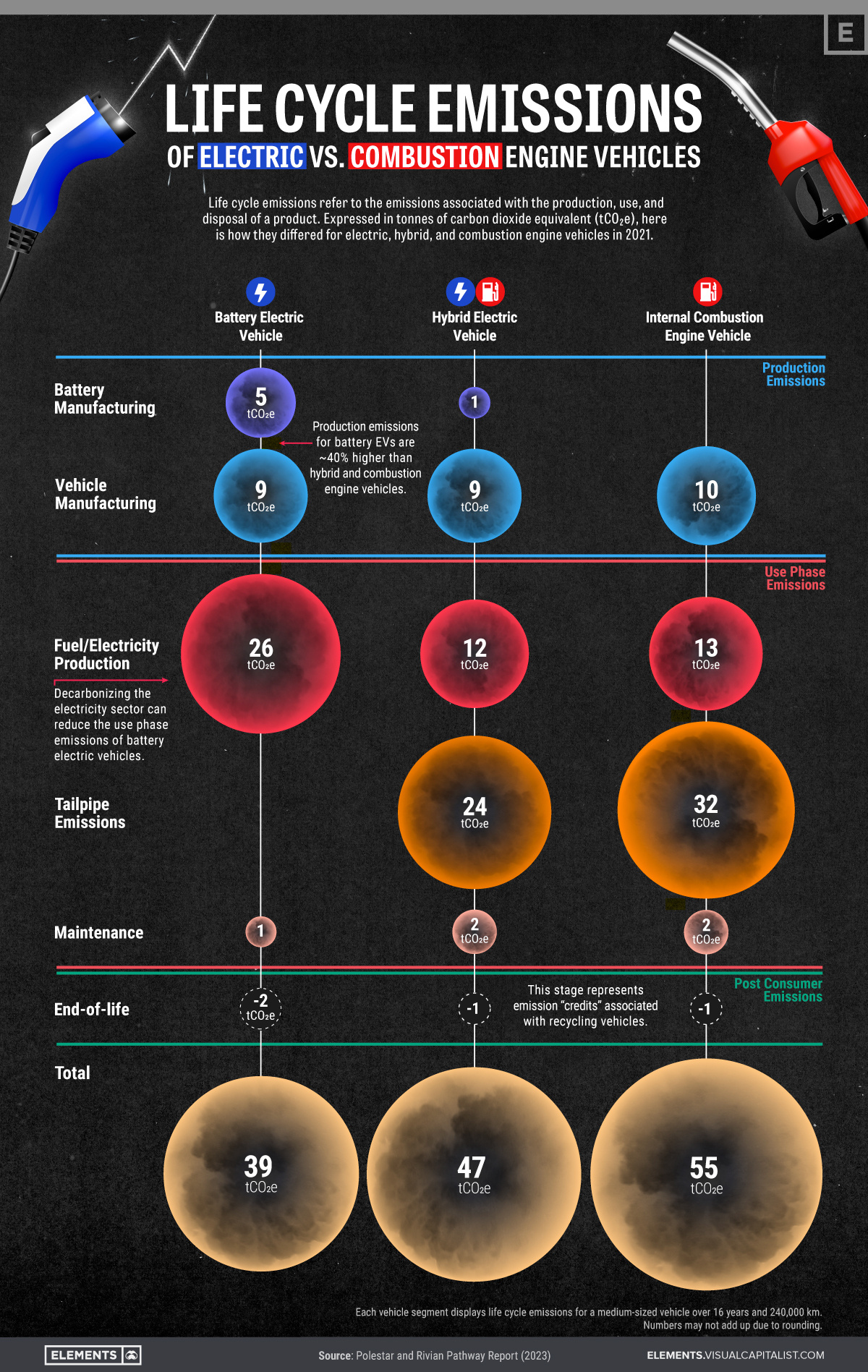


graphic designed by Sam Parker

Selin Oğuz reports for Visualcapitialist that the International Energy Agency concludes the transportation sector is more reliant on fossil fuels than any other sector in the economy. In 2021, it accounted for 37% of all CO2 emissions from end‐use sectors. The graphic above, designed by Sam Parker, visualizes the life cycle emissions of battery electric, hybrid, and internal combustion engine (ICE) vehicles.


The Elements Visual Capitalist web page offers some other insights from the data that may not be as obvious at first. These insights help to identify areas of scientific and engineering efforts to further reduce emissions.


  • The production emissions for BEVs are approximately 40% higher than those of hybrid and ICE vehicles. According to a McKinsey & Company study, this high emission intensity can be attributed to the extraction and refining of raw materials like lithium, cobalt, and nickel that are needed for batteries, as well as the energy-intensive manufacturing process of BEVs.

  • Electricity production is by far the most emission-intensive stage in a BEVs life cycle. Decarbonizing the electricity sector by implementing renewable and nuclear energy sources can significantly reduce these vehicles’ use phase emissions.

  • By recycling materials and components in their end-of-life stages, all vehicle segments can offset a portion of their earlier life cycle emissions. (Oguz, 2020)


The International Energy Agency found that using energy more efficiently was the single largest potential contributor to reaching net zero greenhouse gas emissions. Fiona Harvey, Environment editor at the Guardian, writes that the latest IPCC report highlights key measures countries must take to avoid climate catastrophe.


Renewable energy in the form of wind and solar power is now cheaper than fossil fuels across most of the world and the IPCC found that solar power, wind power and reducing the conversion of land to agriculture were the three measures with the strongest potential for reducing greenhouse gas emissions globally.


  • Reduce methane

  • Stop deforestation

  • Restore other degraded land, and stop it being turned to agriculture

  • Change agriculture, and change the way we eat

  • Solar and wind power

  • Energy efficiency

  • Stop burning coal

  • Put climate at the heart of all decision-making (Harvey, 2023)


The key measures identified in the latest IPCC report do not put transition to electric vehicles in the top eight necessary measures to avoid catastrophe.  Personal action may not be as effective in meeting net zero goals as transformation of the way we use our natural resources, generate electricity with solar and wind, increase energy efficiency, and put climate change at the core of government decisions.


References

Harvey, F. (2023, March 22). Eight things the world must do to avoid the worst of climate change. The Guardian. Retrieved June 25, 2023, from https://www.theguardian.com/environment/2023/mar/21/methane-to-food-waste-eight-ways-to-attempt-to-stay-within-15c?CMP=share_btn_tw 

Oguz, S. (2020, May 20). Life Cycle Emissions: EVs vs. Combustion Engine Vehicles. Elements Visual Capitalist. Retrieved June 25, 2023, from https://elements.visualcapitalist.com/life-cycle-emissions-of-electric-hybrid-and-combuston-engine-vehicles/  


Saturday, June 17, 2023

Head Butting Climate Emergency

Recent public pronouncements from the Premier of Nova Scotia, Tim Houston, concerning policy to reduce GHG emissions, mitigate the effect of sea level rise on the Chignecto isthmus, and a proposed energy link connecting the Atlantic provinces to hydroelectricity from Quebec and Labrador seem to prioritize political head butting over necessary and urgent joint federal/provincial action to save money and provide mitigation of climate disaster. 

|

Essential Component for the 21st Century


NDP Leader Claudia Chender comments that  the Houston government didn’t do the work on behalf of Nova Scotians to come up with a carbon pricing option other than the pending tax.


“When the deadline came and went for the Houston government to present their own price on carbon and plan for how to get there and they failed to do that, this is the outcome of the government choosing partisan fights over constructive conversations," Chender said. (Campbell, 2023)


Keith Doucette of The Canadian Press comments that Houston seemed unmoved when asked whether the Isthmus of Chignecto risked being damaged by extreme weather while governments haggled over who will pay to protect it.


"We're not the ones risking it, the federal government is the one that's trying to get away from their responsibility," the premier said. (Doucette, 2023)


Sarah Smellie of the Canadian Press  reports that Premier Tim Houston says he’s lost confidence in the feasibility of a proposed energy link connecting the Atlantic provinces to hydroelectricity from Quebec and Labrador.


Federal Infrastructure Minister Dominic LeBlanc has previously said he hoped the Atlantic Loop could come online by 2030, but today, Houston signaled some concern without a firm financial commitment from the feds. (Smellie, 2023)


Seth Klein, in the National Observer, asks where are the campaigns urging us to switch to public transit? Where are the promo ads inviting young people to train as renewable electricity technicians and installers, building retrofitters, high-speed rail designers, community planners or electric vehicle manufacturers?


First, the good news: In the wake of the Intergovernmental Panel on Climate Change reports and extreme weather events, we are witnessing a shift in the public opinion terrain. Canadians are increasingly anxious about climate change. They understand it to be an emergency and a major threat to their children and grandchildren. And importantly, a solid majority of Canadians are prepared to accept significant and bold policy responses.*


The bad news? Many Canadians are confused and ambivalent. They could be convinced to embrace speedy and transformative action, or not. A sizable chunk of the public is simply unsure of how ambitious we can be. Moreover, people’s prioritization of climate wanes when economic anxieties and affordability challenges are heightened. And so, we need leadership that seeks to link these issues and animate the ambition in us all. (Klein & Logan, 2023)


It is difficult to find a policy championed by the conservative provincial governments or the Conservative Party of Canada that defines action necessary now to mitigate the impact of GHG emissions and lays out a plan to adapt to a low carbon economy.


References

Campbell, F. (2023, June 16). Premier acknowledges carbon tax will punish Nova Scotians at the pumps, places full blame on Ottawa. SaltWire. Retrieved June 16, 2023, from https://www.saltwire.com/atlantic-canada/news/premier-acknowledges-carbon-tax-will-punish-nova-scotians-at-the-pumps-places-full-blame-on-ottawa-100865039/ 

Doucette, K. (2023, June 15). N.S. premier says Ottawa must pay entire bill to protect land link from flooding risk. CBC. Retrieved June 16, 2023, from https://www.cbc.ca/news/canada/nova-scotia/n-s-premier-ottawa-must-pay-protect-isthmus-from-flooding-risk-1.6877811 

Klein, S., & Logan, C. (2023, February 23). Crisis, what crisis? We need a climate emergency information agency. National Observer. Retrieved June 16, 2023, from https://www.nationalobserver.com/2023/02/23/opinion/crisis-what-crisis-we-need-climate-emergency-information-agency 

Smellie, S. (2023, June 16). Nova Scotia, Ottawa butt heads over Atlantic Loop as feds look for summer agreement | Globalnews.ca. Global News. Retrieved June 16, 2023, from https://globalnews.ca/news/9774122/nova-scotia-ottawa-butt-heads-over-atlantic-loop/ 


Friday, January 20, 2023

It’s all over except the shouting

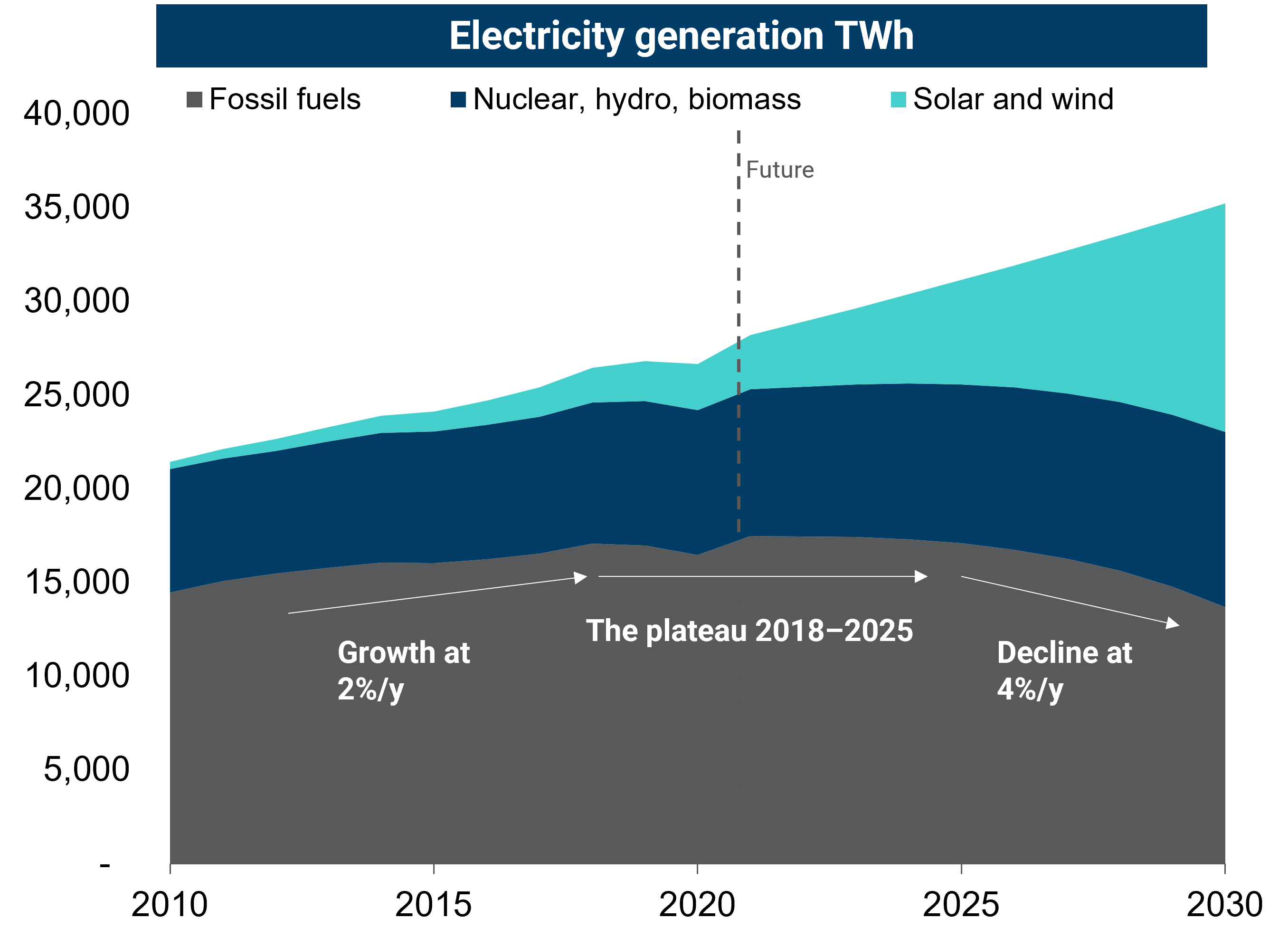
Kingsmill Bond,  Sam Butler-Sloss,  Genevieve Lillis,  and Matt Sugihara highlight a report in the latest installment of The Peaking Series that shows demand for fossil fuels has peaked in the electricity sector. It will plateau for a few years and be in clear decline by the second half of the decade.


Peak of fossil fuel


The key driver of change is the rapid growth of solar and wind electricity generation on typical S-curves, driven by low costs, a shift of global capital, and the rising ceiling of what is possible.


In 2022, solar and wind will produce 600–700 TWh of new electricity. Added to the 100–200 TWh from other clean sources makes it enough to meet projected global electricity demand growth of around 700 TWh. (Bond et al., 2023)


References

Bond, K., Butler, S., Lillis, G., & Sugihara, M. (2023, January 19). Peak Fossil Fuel Demand for Electricity. RMI. Retrieved January 20, 2023, from https://rmi.org/insight/peak-fossil-fuel-demand-for-electricity/ 


Tuesday, December 20, 2022

Power Politics Planet

The recent announcement by Nova Scotia Natural Resources Minister Tory Rushton concerning an increase in electricity generation by using biomass is being received as good news by members of Forest Nova Scotia and as a terrible decision by Ecology Action Centre personnel.


Common Ground in Biodiversity

Bob Bancroft, President, Nature Nova Scotia, writes that biomass is currently being used to produce electricity in two locations in Nova Scotia. Other biomass plants are also being planned or built. 

The laws of thermodynamics make the conversion of wood to electricity very inefficient – in the Point Tupper case, Nova Scotia Power Inc. (NSPI) projected a 21.5% electrical efficiency with relatively dry wood. In fact, their wood is kept outside, uncovered and wet, so efficiencies may be lower.


The Point Tupper biomass plant is too large. It is being fed by 50–60 tractor trailer loads of wood daily, for a total of about 650,000 tonnes annually, or roughly 100 “wet tonnes” per hour.


Operating the Point Tupper biomass plant is costing NSPI ratepayers an extra $6–8 million a year.1 This is due in part to “must run” stipulations that force NSPI to supply heat for operating the pulp mill next door. This amounts to another Port Hawkesbury Paper subsidy and a violation of the US-Canada trade agreement. NSPI is forced to operate the biomass plant when cheaper energy sources, like natural gas or Quebec hydro, are available and savings could be passed along to customers. (Bancroft, n.d.)

Michael Gorman of CBC News reports that Nova Scotia Power will use more biomass to generate electricity for the next three years, under regulatory changes by the province that are angering environmentalists and being lauded by the forestry industry.


Natural Resources Minister Tory Rushton said biomass is a resource that can be used at a time when fossil fuel prices remain volatile, until more wind and solar projects are ready to come online.


Rushton said sawmills around the province have lots of wood chips and other byproducts from forestry operations that can be used to meet the new requirements. It also provides a destination for waste wood still in forests following post-tropical storm Fiona, said Rushton.


The regulations prohibit cutting whole trees to generate electricity and only allow products left over from sustainable timber harvest and primary processing to be used.


"What I see is a renewable resource that we have sitting in our province right now, with biomass that can certainly assist Nova Scotia Power with meeting their renewable targets," Rushton said in an interview. (Gorman, 2022)


Jennifer Henderson, reporting for the Halifax Examiner, on a decision by the Houston government in Nova Scotia, to establish a new regulation that requires Nova Scotia Power to generate at least 153,000 megawatt hours of electricity a year from biomass for the next three years.


Renewable Energy Minister Tory Rushton defended the move to burn more biomass.


“For us, this is about putting more renewable energy on the system for a short period of time until we can establish more hydro and wind for the long-term,” said Rushton. “ I’m also the minister responsible for Natural Resources so I know there’s no longer a market for pulpwood since Northern Pulp closed. And the residual wood left on the ground after hurricane Fiona creates an opportunity to have money paid for that wood to stay in the province.” 


Ray Plourde, senior wilderness coordinator for the Ecology Action Centre, comments that “This is a really terrible announcement for the environment, a disaster for the atmosphere and for biodiversity,”

The government pretends that burning forest biomass is magically non-carbon emitting based on a fantasy theory that in 100 years, the carbon will be re-absorbed by future trees that may or may not grow, so they don’t need to count biomass emissions at all.


But we don’t have 100 years to wait for that to happen and there is no guarantee that it will.


Biomass is not a climate solution, but it’s being embraced by our government in policy and practice because it’s easy to do (burn trees instead of coal) and it helps the forestry sector with a glut of so called ‘waste wood.’ Its significant negative impacts on the climate and biodiversity are conveniently ignored. It’s a farce, a sick joke at a time when we need real climate solutions. (Henderson, 2022)


The demands of power, politics, and the planet are in tension again when biomass is used as a fuel to generate electricity.


References

Bancroft, B. (n.d.). Nova Scotia Biomass Power Generation. Nature Nova Scotia. Retrieved December 20, 2022, from https://naturens.ca/projects/biomass-energy/ 


Gorman, M. (2022, December 19). Province orders Nova Scotia Power to use biomass to generate electricity. CBC. Retrieved December 20, 2022, from https://www.cbc.ca/news/canada/nova-scotia/biomass-forestry-electricity-nova-scotia-power-tory-rushton-1.6691389 


Henderson, J. (2022, December 20). 'A farce, a sick joke': Nova Scotia amps up burning of biomass for electricity. Halifax Examiner. Retrieved December 20, 2022, from https://www.halifaxexaminer.ca/economy/natural-resources/forestry/a-farce-a-sick-joke-nova-scotia-amps-up-burning-of-biomass-for-electricity/ 


Tuesday, December 6, 2022

Opportunity or Imperative to Change

Cloe Logan, writing for the National Observer, analyses a new report assessing climate risks across Nova Scotia from the provincial Department of Environment and Climate Change, entitled, Weathering What’s Ahead: Climate Change Risk and Nova Scotia’s Well-being. 


Will Balser, coastal adaptation co-ordinator at Ecology Action Centre in Halifax, notes that there are some important risks acknowledged in the report. He stresses the important next step of seeing how the province plans to address those risks.


Timothy Halman, minister of environment and climate change, said the report shows the vulnerability of the area, setting the groundwork for action. “Together, we have an opportunity to make positive change and work to protect each other and all that we value,"


Will Balser said the minister’s sentiment should go further. “I see it as if he's talking about an opportunity to make a positive gain. Rather, I see it as more of an imperative to change, rather than just an opportunity,” he said. (Logan & Ottenhof, 2022)


Opportunity or Imperative


The report identifies top climate concerns for Nova Scotia.

Top Climate Concerns NS


The province’s climate plan, expected on Dec 7 2022, needs to clarify the already stated objectives:


Clarify Objectives


The province needs to


The report notes that “using oil, coal, and natural gas to heat homes, generate electricity, and fuel vehicles” contributes to climate change and will worsen climate impacts. As of now, over half of the electricity generation in Nova Scotia comes from coal. (Logan & Ottenhof, 2022)


Electricity needs in Canada


The Department of Environment and Climate Change has produced this report as a resource for all levels of government to set priorities, business to alter practices and plans, and people to use in conversations that will direct our collaboration with the measures necessary to weather what is ahead.


References

Logan, C., & Ottenhof, L. (2022, December 5). Sea levels in Nova Scotia set to rise by a metre this century. National Observer. Retrieved December 6, 2022, from https://www.nationalobserver.com/2022/12/05/news/sea-levels-nova-scotia-rise-metre-century