Showing posts with label emissions. Show all posts

Sunday, February 4, 2024

Facts and Four Points

The slogans “Axe the Tax” and “Build the Homes” resonate with major economic concerns of Canadians. The devil is in the details when we study the best way to implement effective taxation that accomplishes our need to address climate change and finance the building of the housing needed to address emergency homelessness in our country.


How to Action The Slogans 


Aaron Wherry of CBC News reports that beneath the back-and-forth over the Liberal government's carbon tax and the Conservative leader's agenda, Justin Trudeau and Pierre Poilievre are also duelling over very different theories of change.


Much of what's wrong with the way things are can be traced, Poilievre suggests, to higher levels of federal spending under Trudeau. For Poilievre, that spending marked a particularly dramatic break with the past and with a historic consensus.


"Balancing the budget to keep inflation and interest rates low was the unanimous policy of all the major political parties at all levels of government for 30 years, right up to the radical departure [in 2015]," he said. 


Wherry points out that if the way things were in 2015 is to be a point of reference, it's equally fair to note how much higher greenhouse gas emissions were projected to be back then, how many more Indigenous communities lacked access to clean drinking water, how many more children were living in poverty and how much higher child care fees were. (Wherry, 2024)


Things are changing — the planet's climate certainly is. And Trudeau can argue that significant parts of his government's agenda have been about meeting the need for change and preparing Canadians for the future.


But it's on his ability to "tackle" the problems of today that he is being challenged — and earlier action on housing would have put him in a better place now, even if provincial and municipal governments deserve significant amounts of blame for the current situation.


Opposite Trudeau, Poilievre is laying the rhetorical groundwork to do things very differently — even if he frames it in terms of simply changing things back to way they were. The more he can convince people that the country is in terrible shape — and that everything currently wrong with it can be blamed on Trudeau — the easier it becomes for him to justify doing something close to the opposite. (Wherry, 2024)


Paul Kershaw, in a special article in the Globe and Mail, comments that if you make a mess, you should help clean it up. That’s a responsibility his Mom taught him.


As the House of Commons returned to session, Pierre Poilievre, the Conservative Leader, betrayed this family value by courting voters with his promise to eliminate responsibility to pay for our pollution.


Whether to pay for pollution isn’t about consumer preferences. It’s a duty we owe to our kids. We need our politicians to recognize as much if they are to identify real solutions to the affordability crisis, and to reduce risks from extreme weather.


A new Abacus poll signals Mr. Poilievre has convinced many Canadians that the price on pollution is a primary source of financial pain. Alas, research from the University of Calgary shows he is pulling the wool over our eyes. (Kershaw & Urback, 2024)


Professors Trevor Tombe and Jennifer Winter in a report for the School of Public Policy, University of Calgary, calculated the direct and indirect costs of the carbon tax to examine the entire financial impact of the tax relative to its absence. They use data from British Columbia, where the carbon price is the same as that levied by the federal plan. They found that carbon pricing adds 0.5 per cent to the cost of food and beverages; 0.29 per cent to rent; 0.2 per cent for clothing and footwear; and less than 0.13 per cent for insurance and financial services.


While some politicians and policymakers are blaming emissions pricing for high costs of living, the figure shows that the actual effect is quite modest for most items.


Emissions pricing is just one of many indirect taxes that households face. Other examples are sales taxes and alcohol levies. We estimate that the combined effect on Canadian consumer prices from all indirect tax increases between January 2015 and October 2023 was 0.6%.

Knowing that much of the present affordability crisis is due to factors other than emissions pricing, the elimination of the carbon tax is unlikely to solve the problem. As Canada slowly recovers from high inflation in 2021 and 2022, policy makers will need to consider alternative solutions. (Tombe & Winter, n.d.)


Geordie Dent, in an article for The Breach, concludes that cheap money and privatization made housing unaffordable, but organizing can reverse the tide


Canada used to build a decent amount of social housing. By ensuring that low-income renters had affordable options, the government kept the market honest and stopped housing speculation from spiraling into feedback loops.


Until around 1993, Canada funded the construction of 10,000 or more social housing units in a typical year. 


So what happened in 1993? That’s the year the federal Liberals were elected on a platform of progressive promises. But once in power, they pivoted to a policy of fiscal austerity. Finance Minister Paul Martin slashed housing spending to almost nothing. 


The construction of housing had been completely privatized. (Dent, 2023)


The recent climate disasters in Canada require a taxation strategy to incentivize transition to a carbon reduced economy. Research shows the additional tax burden adds less than 1% to most of the purchases of Canadians. Because we cannot expect the market to build below market housing, social housing for Canadians living in tents needs to be a Government responsibility.


References

Dent, G. (2023, February 2). The global money pool that soaked Canada's hope of affordable housing ⋆ The Breach. The Breach. Retrieved February 4, 2024, from https://breachmedia.ca/the-global-money-pool-that-soaked-canadas-hope-of-affordable-housing/? 

Kershaw, P., & Urback, R. (2024, February 2). Pushing to 'Axe the Tax' is unfair to our kids. The Globe and Mail. Retrieved February 4, 2024, from https://www.theglobeandmail.com/investing/personal-finance/young-money/article-pushing-to-axe-the-tax-is-unfair-to-our-kids/ 

Tombe, T., & Winter, J. (n.d.). ENERGY & ENVIRONMENTAL EMISSIONS PRICING AND AFFORDABILITY: LESSONS FROM BRITISH COLUMBIA. The School of Public Policy. Retrieved February 4, 2024, from https://www.policyschool.ca/wp-content/uploads/2023/12/EE-Trends-DEC.pdf 

Wherry, A. (2024, February 3). Trudeau and Poilievre have very different theories of change. CBC. Retrieved February 4, 2024, from https://www.cbc.ca/news/politics/trudeau-poilievre-election-1.7103710? 


Sunday, June 25, 2023

Focus on EV’s may not be top Climate Priority

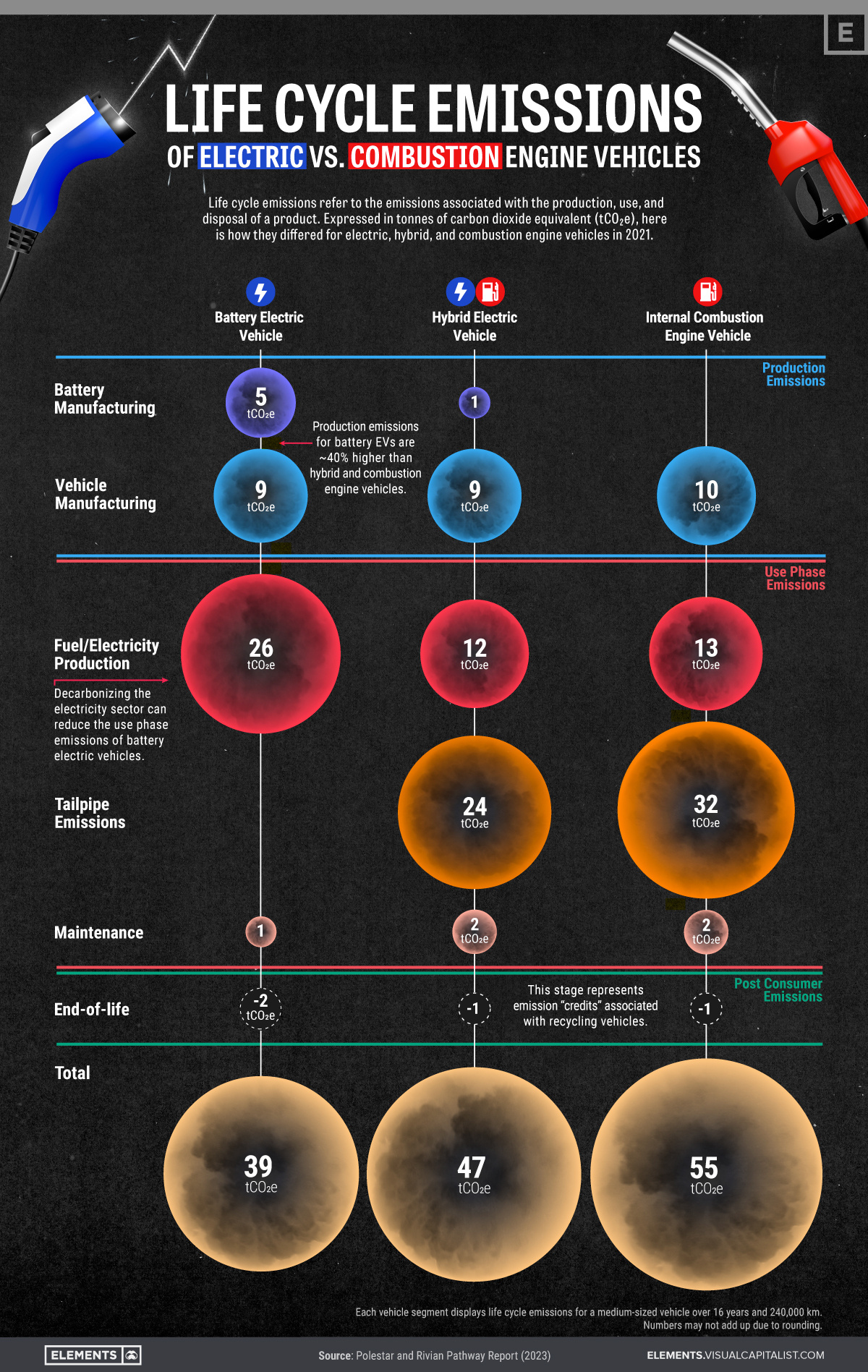
Efforts to transition personal vehicles to BEV (Battery Electric Vehicles), or HEV (Hybrid Electric Vehicles) from ICEV (Internal Combustion Engine Vehicles) may be a diversion from focus on more effective government action to mitigate the effects of the climate emergency.


graphic designed by Sam Parker

Selin OÄŸuz reports for Visualcapitialist that the International Energy Agency concludes the transportation sector is more reliant on fossil fuels than any other sector in the economy. In 2021, it accounted for 37% of all CO2 emissions from end‐use sectors. The graphic above, designed by Sam Parker, visualizes the life cycle emissions of battery electric, hybrid, and internal combustion engine (ICE) vehicles.


The Elements Visual Capitalist web page offers some other insights from the data that may not be as obvious at first. These insights help to identify areas of scientific and engineering efforts to further reduce emissions.


  • The production emissions for BEVs are approximately 40% higher than those of hybrid and ICE vehicles. According to a McKinsey & Company study, this high emission intensity can be attributed to the extraction and refining of raw materials like lithium, cobalt, and nickel that are needed for batteries, as well as the energy-intensive manufacturing process of BEVs.

  • Electricity production is by far the most emission-intensive stage in a BEVs life cycle. Decarbonizing the electricity sector by implementing renewable and nuclear energy sources can significantly reduce these vehicles’ use phase emissions.

  • By recycling materials and components in their end-of-life stages, all vehicle segments can offset a portion of their earlier life cycle emissions. (Oguz, 2020)


The International Energy Agency found that using energy more efficiently was the single largest potential contributor to reaching net zero greenhouse gas emissions. Fiona Harvey, Environment editor at the Guardian, writes that the latest IPCC report highlights key measures countries must take to avoid climate catastrophe.


Renewable energy in the form of wind and solar power is now cheaper than fossil fuels across most of the world and the IPCC found that solar power, wind power and reducing the conversion of land to agriculture were the three measures with the strongest potential for reducing greenhouse gas emissions globally.


  • Reduce methane

  • Stop deforestation

  • Restore other degraded land, and stop it being turned to agriculture

  • Change agriculture, and change the way we eat

  • Solar and wind power

  • Energy efficiency

  • Stop burning coal

  • Put climate at the heart of all decision-making (Harvey, 2023)


The key measures identified in the latest IPCC report do not put transition to electric vehicles in the top eight necessary measures to avoid catastrophe.  Personal action may not be as effective in meeting net zero goals as transformation of the way we use our natural resources, generate electricity with solar and wind, increase energy efficiency, and put climate change at the core of government decisions.


References

Harvey, F. (2023, March 22). Eight things the world must do to avoid the worst of climate change. The Guardian. Retrieved June 25, 2023, from https://www.theguardian.com/environment/2023/mar/21/methane-to-food-waste-eight-ways-to-attempt-to-stay-within-15c?CMP=share_btn_tw 

Oguz, S. (2020, May 20). Life Cycle Emissions: EVs vs. Combustion Engine Vehicles. Elements Visual Capitalist. Retrieved June 25, 2023, from https://elements.visualcapitalist.com/life-cycle-emissions-of-electric-hybrid-and-combuston-engine-vehicles/  


Thursday, December 8, 2022

Capitalism Coal and Carbon Emissions

Tynette Deveaux of the Sierra Club’s Beyond Coal Atlantic campaign, reporting to the National Observer, calls the approval to continue running until 2029 for Canada’s only underground coal mine  “a sad day for Nova Scotia” and she said it’s accentuated by a new employee of Kameron Coal — former Glace Bay MLA Geoff MacLellan.


Plan to stop using coal


In my youth in Glace Bay, in the 1950’s, “Coal was King” and in nearby Sydney, my grandfather was one of thousands working in the steel plant for one of the three daily shifts. The “black around the eye” (and in the lungs) showed the face of a steady job and the cloud of carcinogens that propelled skyward from the coke ovens as the coal was prepared to catalyze the production of steel emitted “the smell of money”.


The Nova Scotia Department of Labour, Skills and Immigration has recently approved the reopening plan of Kameron Coal, in Donkin, a 20 minute drive from Glace Bay. The Donkin coal mine got the industrial green light to continue running until 2029 from the provincial government’s Environment and Climate Change department.


A new report assessing climate risks across Nova Scotia from the provincial Department of Environment and Climate Change, entitled, Weathering What’s Ahead: Climate Change Risk and Nova Scotia’s Well-being notes that “using oil, coal, and natural gas to heat homes, generate electricity, and fuel vehicles” contributes to climate change and will worsen climate impacts. As of now, over half of the electricity generation in Nova Scotia comes from coal. (Logan & Ottenhof, 2022)


The former MLA for Glace Bay, Geoff MacLellan now works for the company, which he vocally supported during his time in government. 


Referring to coal from the Donkin mine, he told The Canadian Press in 2017 “we're going to produce it for as long as we can." (Logan & Ottenhof, 2022)


The product of Kameron Coal is metallurgical coal that is converted to coke for steel production. Carbon Clean's Dr James Hall discusses how the steel industry can prepare for net zero and reduce its CO2 emissions with CCUS technology.


The amount of CO2 emissions from steel manufacturing is almost double the amount of steel created: 1.85 tonnes of carbon per 1 tonne of steel. If steel were a nation, it would be the 5th largest producer of carbon emissions in the world! 


The future of the steel industry needs to include a plan that utilises carbon capture technology (CCUS) to reduce fossil fuel carbon emissions and cut the carbon footprint of steel. (Cleaning Up The Steel Industry: Reducing CO2 Emissions With CCUS, 2021)


As part of Our Climate, Our Future Nova Scotia’s Climate Change Plan for Clean Growth the Department of Environment and Climate Change has measured how the climate change plan will impact greenhouse gas emissions in Nova Scotia. The projected pathway to 2030 includes policies like phasing out coal-fired electricity generation, having 80 percent of electricity come from renewable sources, reducing our reliance on oil for home heating by at least 20 per cent, and having 30 percent of new vehicle sales be zero-emission vehicles by 2030.


Two serious problems associated with Kameron Coal remain. The majority of emissions caused by the coal mined at the Donkln mine will occur when the coal is used to manufacture steel. This will likely occur at a steel mill outside of Canada. This transfer of the GHG emission problem to the end user is a denial of the responsibility to put the welfare of the planet ahead of short term profit. The process of steelmaking will need to be transformed to reduce the demand for metallurgical coal and consequently reduce the market for Kameron Coal and lead to the abandonment of the operation and the layoff of people. The cycle of foreign owned companies exploiting Nova Scotian workers in sunset industries continues. The transformation of electricity generation and distribution, transportation and agriculture in Nova Scotia will require thousands of skilled workers. Investment now in the training for these careers is the plan that will provide a future that is not connected to an industry that is in decline.


References


Cleaning Up The Steel Industry: Reducing CO2 Emissions with CCUS. (2021, January 28). Carbon Clean. Retrieved December 7, 2022, from https://www.carbonclean.com/blog/steel-co2-emissions 

Logan, C., & Ottenhof, L. (2022, December 2). Kameron Coal hires former N.S. MLA and gets approval to operate Donkin mine until 2029. National Observer. Retrieved December 7, 2022, from https://www.nationalobserver.com/2022/12/02/news/kameron-coal-hires-former-ns-mla-approval-operate-donkin-mine-until-2029 


Logan, C., & Ottenhof, L. (2022, December 5). Sea levels in Nova Scotia set to rise by a metre this century. National Observer. Retrieved December 6, 2022, from https://www.nationalobserver.com/2022/12/05/news/sea-levels-nova-scotia-rise-metre-century 


Monday, August 30, 2021

Update on Policy for Emission Reduction

NDC Commitments Canada


As Canadian Federal Election #44 comes closer, the policy of the political parties concerning meeting GHG reduction goals set by the IPCC needs to be examined and critically evaluated.


Stephanie Taylor of The Canadian Press reports to Global News that Conservative Leader Erin O’Toole rejects the Liberals’ higher emission reduction goal but vows to still meet the Paris target. O’Toole is facing criticism after rejecting Canada’s new target for reducing greenhouse gas emissions in favour of a lower one first set by Stephen Harper.


His pledge comes as Canada prepares to attend the United Nations Climate Change conference this fall where countries are expected to commit more ways to tackle the issue. In anticipation of the meeting, the Liberal government recently increased its targets for reducing greenhouse gas emissions to between 40 to 45 per cent below 2005 levels by 2030, up from 30 per cent. The 30 per cent goal was set by former Conservative prime minister Stephen Harper and was the commitment the country was held to under the 2015 Paris Agreement. O’Toole says the Conservatives’ climate change plan “will meet the Paris objectives” of 30 per cent, despite the United Nations specifying the agreement works by countries coming up with “increasingly ambitious climate action” every five years.1


Mitchell Beer has compiled a report in the The Energy Mix noting that Conservative Leader Erin O’Toole pledged to move boldly backwards on Canada’s emissions reduction target, and the fossil lobby has published its campaign wish list, and the climate crisis held its spot as a top concern for Canadian voters as the federal election moved into its third week.


Speaking in Newfoundland on Friday, Conservative Leader Erin O’Toole said he would jettison the Trudeau government’s international commitment to cut Canada’s greenhouse gas emissions 40 to 45% by 2030, and return to the Harper-era target of 30%, in search of a carbon target the country can achieve without “crippling” the economy.


If Canada were to [act on O’Toole’s promise], it would not violate an obligation, because the NDC itself is not legally binding,” University of Toronto law professor Jutta Brunnée explained. “But it would be contrary to the spirit of the Paris Agreement,” and “a challenge to the entire logic of the Paris Agreement, because the logic is progression over time. So it’s not something that one should take lightly.” New Democrats are campaigning on a 50% GHG reduction target by 2030, while the Green Party is talking about 60%..2


The fossil lobby has published its campaign wish list and CAPP President and CEO Tim McMillan says “To be resilient and sustainable, recovery will be a multi-year process based on robust economic activity.”


 McMillan says continues “ It is crucially important for the incoming federal government to make policy decisions that position Canada for success in an ultra-competitive international investment market. Investment supports industry growth and is vital to developing and commercializing technologies that reduce emissions, water use, and more.” Cenovus Energy CEO Alex Pourbaix let it be known—apparently without a hint of irony—that he expects Canadian taxpayers to shell out up to C$52.5 billion to help his industry get the carbon out of its operations. “It’s going to take tens of billions of dollars over 30 years to decarbonize [our oil] industry,” Pourbaix said2


Angela Carter, associate professor of political science at the University of Waterloo, noted that climate was already a top priority in the 2019 election.


“But this year, there’s a difference.“ There is a growing awareness that the climate crisis is, of course, also a health crisis,” Carter told the CBC. “And we have leaders, international leaders, Mark Carney is one of these, at the United Nations who said that the climate crisis in 50 years is going to look like a COVID pandemic every single year.”2


Sussex Strategy Group Senior Counsel Shawn McCarthy says climate change will show up as a “wedge issue” on the campaign trail, even if it didn’t much look that way in the first two weeks.


Though Conservative Leader O’Toole has made an effort to close the gap between his party’s 2019 climate platform and its position today, there are still “yawning differences among the parties with regard to climate ambition,” McCarthy writes. “There continue to be deep cleavages in terms of how they would treat the oil and gas sector, which is responsible for 25% of Canada’s greenhouse gas (GHG) emissions.” While the Trudeau government is vulnerable on its continuing support for the fossil industry, not least its decision to buy the Trans Mountain pipeline with taxpayers’ dollars, O’Toole’s carbon target “is clearly insufficient to put the country on course for achieving net-zero status by 2050,” McCarthy says. “The Liberals will no doubt remind climate-conscious voters that the Conservatives have not endorsed the net-zero target.”.2


The commitment of the Government we elect on September 20 to aggressively cooperate with the industrial nations of the world to reduce GHG emissions is essential to mitigate the effects in storms, fires, biodiversity, and public health of the climate emergency.


References

1

2021, August 27). O'Toole rejects Liberals' higher emission reduction ... - Global News. Retrieved August 30, 2021, from https://globalnews.ca/news/8146328/conservative-party-climate-target-canada-election/ 


2


(n.d.). The Energy Mix: Home. Retrieved August 30, 2021, from https://www.theenergymix.com/