Monday, July 11, 2022

Rapid Transition of Electricity Grid Needed Now

In response to the challenge to act quickly to reduce the GreenHouse Gas emissions that are increasing temperatures on the planet and increasing the intensity and frequency of  storms, wildfires and floods, we need to begin to engineer a transition of the grids that supply electricity.

Electricity Engineering and Decarbonization


A series of articles in the Economist indicate the ability to use renewables for the lion’s share of a grid’s supply, coupled with the fact that renewables have been made cheap and are getting yet cheaper, is the basis of a decarbonisation strategy all but universally accepted by those determined to stabilise the climate.


Make the power on electric grids emissions-free, cheap and copious. Start electrifying all processes that now require fossil fuels—such as powering cars, or heating homes and steel foundries—where electrification is clearly possible. It does not deliver everything that is needed. But it delivers a lot. (Electrifying Everything Does Not Solve the Climate Crisis, but It Is a Great Start, 2022)


 Lithium-ion batteries, the cost of which has crashed due to a mixture of innovation and economies of scale, have provided by far the greatest recent advances in “grid scale” electric storage.


After a 90% decline in the cost of battery packs between 2010 and 2021, reckons Citi, a bank, America is now seeing more megawatts of capacity added to its grid in the form of batteries than in the form of natural-gas combined-cycle turbines. Enormous banks of such batteries already provide up to four hours of dispatchable power to California’s grid operator on demand. When Californian utilities asked companies to come up with technologies for an eight-hour buffer the winning bids all used lithium. (Decarbonisation of Electric Grids Reliant on Renewables Requires Long-Duration Energy Storage, 2022)


Saul Griffith offers an optimistic—but realistic and feasible—action plan for fighting climate change while creating new jobs and a healthier environment that is to electrify everything. His book, Electrify: An Optimist's Playbook for Our Clean Energy Future. Published by MIT Press, it makes the point that what we cannot afford are plans that make no progress because we are wasting time arguing over these issues before we begin, or because we are over-investing in technologies that can’t scale up sufficiently.


There will be trade-offs. More nuclear means fewer batteries but more public resistance and, most likely, higher costs. More solar and wind means more land use. What we cannot afford are plans that make no progress because we are wasting time arguing over these issues before we begin, or because we are over-investing in technologies that can’t scale up sufficiently. The real test, given the urgency of our climate situation, should be, “Is it ready to go to scale today?” We need to act now. (Griffith, 2021, p73) 


Fereidoon Sioshansi writes in a recent book, “Variable Generation, Flexible Demand” that “we need to automate things, essentially bypassing the customers.”


Solar Power and Storage


New der-enabled smart grids are an excellent way of doing this. Customers can set preferences as to what they need charged up and when.


as they do in a new scheme offered by Octopus Energy Group, a British provider. After that they let the system do as it wants—an approach the company says can, among other things, lower the cost of charging an electric vehicle (ev) by 75%. Such savings by consumers equate, at some point, with savings for the suppliers in terms of electricity they did not have to ship down congested transmission lines. (Getting the Most Out of Tomorrow's Grid Requires Digitisation and Demand Response, 2022)


Dr. Jonathan Foley, a climate & environmental scientist, writer, speaker, and the Executive Director of Project Drawdown, the world’s leading resource for climate solutions comments that “quick wins” can come from rapid and cost-effective improvements in efficiency.


Efficiency in Buildings


There are enormous opportunities to be more efficient with electricity.


(especially in buildings and industry), food (where ~30–40% is wasted globally), industrial processes, transportation (higher fuel efficiency, more alternative transportation), and buildings (improved building envelopes, building automation, and reduced refrigerant leaks). In addition, we will have to rapidly shut down fossil fuel energy sources and deploy renewable energy systems across the planet as quickly as possible. But given the enormous physical infrastructure and capital involved, this will inevitably take time. Even the most aggressive scenarios of this energy transition require the 2020s and 2030s to complete. (Foley, 2021)


Jackie Forrest, executive director of the ARC Energy Research Institute and co-host of the ARC Energy Ideas podcast comments that while the combined home solar and battery systems are still rare, sales are starting to increase in places such as Texas and California. These states have suffered from extended power outages from extreme weather. Instead of sitting in the dark, people with home solar and battery systems can reliably use their own electricity, day and night.


 While the two states have been experiencing most of the extreme weather-related power outages lately, climate change is expected to make these disruptive events more frequent and widespread over the coming decades. So to ensure safe, reliable and affordable power, it is likely that more homeowners will want to install solar panels and battery systems in the future. (Forrest, 2022)

ENGINEERING DESCRIPTION

ACRONYM

Distributed energy resources


PSH

electric vehicle

.

TW and TWHrs

long-duration energy storage


DERS

pumped-storage hydropower 


EV

The system needed to be able to deliver 1.5-2.5tw and store 85-140twhrs


LDES

 Can you Match the Description and the Acronym?

A quick look at the acronyms used in these articles indicates that the specialized knowledge of engineers, technologists, technicians, and trades people will be crucial to rapid implementation of these systems. 


References

Decarbonisation of electric grids reliant on renewables requires long-duration energy storage. (2022, June 23). The Economist. Retrieved July 2, 2022, from https://www.economist.com/technology-quarterly/2022/06/23/decarbonisation-of-electric-grids-reliant-on-renewables-requires-long-duration-energy-storage 

Electrifying everything does not solve the climate crisis, but it is a great start. (2022, June 23). The Economist. Retrieved July 2, 2022, from https://www.economist.com/technology-quarterly/2022/06/23/electrifying-everything-does-not-solve-the-climate-crisis-but-it-is-a-great-start 

Foley, J. (2021, February 20). To Stop Climate Change, Time is as Important as Tech. GlobalEcoGuy.org. Retrieved July 11, 2022, from https://globalecoguy.org/to-stop-climate-change-time-is-as-important-as-tech-1be4beb7094a 

Forrest, J. (2022, May 23). Opinion: Blackouts could drive a return to home solar. The Globe and Mail. Retrieved June 1, 2022, from https://www.theglobeandmail.com/business/commentary/article-blackouts-solar-panels-electricity/#_=_ 

Getting the most out of tomorrow's grid requires digitisation and demand response. (2022, June 23). The Economist. Retrieved July 2, 2022, from https://www.economist.com/technology-quarterly/2022/06/23/getting-the-most-out-of-tomorrows-grid-requires-digitisation-and-demand-response 

Griffith, S. (2021). Electrify: An Optimist's Playbook for Our Clean Energy Future. MIT Press.


Friday, July 1, 2022

Consistent Ethic of Life in COVID and Culture Wars

Some recent research has brought to mind that an ethical approach that offers the view of the individual as possessing inherent dignity and as inherently social with responsibilities to other individuals and to society was at play during our battle with the Covid epidemic.


Challenges in Health Care


People chose to wear masks, practice social distancing, and be vaccinated for self protection and more significantly for the health and safety of others, especially the most vulnerable in society. Attempts to foster this type of ethical behaviour in society include those of Cardinal Joseph Bernardin, who in a lecture at Fordham University, on Dec. 6, 1983, first articulated what he referred to as the "consistent ethic of life." 


The following statements attempt to present some non-controversial truths about life processes that concern people who consider making ethical decisions about human life and well being.


  • Abortion interupts a process that is very likely to result in birth.
  • A sentence of capital punishment initiates a process that is likely to end in an execution.
  • Medical Assistance in Death approval initiates a process that is likely to end in an early death.


Dr. Ron Hamel, senior director, ethics, Catholic Health Association, St. Louis writes about problematic personal and social attitudes in medical health that he feels the "consistent ethic of life" may help correct.


Fourth, the consistent ethic of life is corrective in that it brings to light problematic personal and social attitudes — individualism, a utilitarian assessment of persons, privatization of moral choices, excess autonomy, the commodification and commercialization of health care, the technological imperative, and the like — often associated with various technologies and aspects of the health care system. These attitudes are threats to human life and dignity and are, therefore, unacceptable. In their place, as an alternative, the consistent ethic offers a view of the individual as possessing inherent dignity and as inherently social with responsibilities to other individuals and to society.


In sum, Bernardin's consistent ethic of life as a moral vision underscores the fundamental importance of human dignity and human life, sensitizes to threats to human life and well-being, brings these threats to the foreground, inspires alternative attitudes, approaches and practices, and motivates for profound change. (HAMEL, n.d.)


During COVID, the individualism that declared “my body, my choice” around infection precautions and vaccination, fortunately, had less acceptance than the decision by the majority to protect society and reduce hospitalisation and death by adhering to COVID restrictions.


The most vulnerable in our society, thankfully, continue to remind us that an utilitarian assessment of persons, based perhaps on their usefulness to the maintenance and increase of our GNP, is a direction we have rejected in our condemnation of autocratic regimes and atrocities against human life.


We have wrestled with the impact of our moral choices more intensely in COVID times as we have moved to understanding the limits of our freedom and autonomy come into play when we negatively impact the life and health of others. 


An epidemic may also bring into view the economic costs of sustaining human life. The requirement that we try to base treatment on medical need rather than the ability of the patient to contribute to the cost of treatment mandated that money be injected by the government into the care of COVID patients.


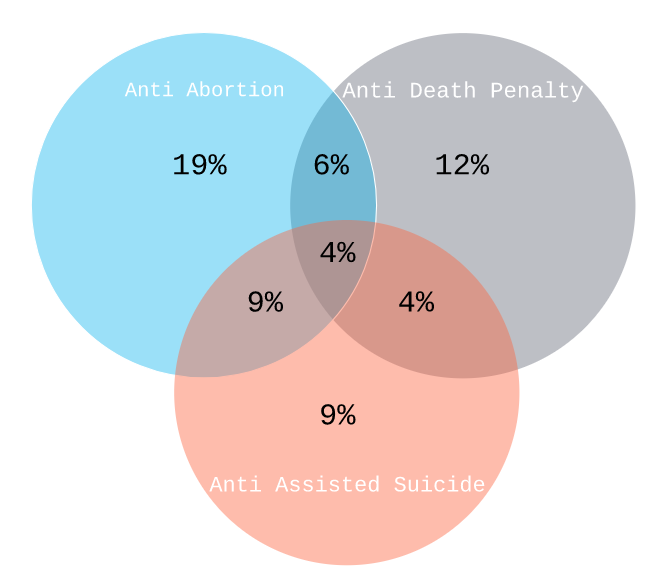
Prior to our societal and personal experience of COVID, Ryan P. Burge researched attitudes in the United States about social movements supporting anti-abortion, anti-death penalty, and anti-assisted suicide policies.


Public opinion has shifted over time. Opposition to the death penalty was relatively consistent over the last 30 years; since the early 2000s, it has reached almost 40 percent. The other two issues saw a significant shift between 1977 and 2000. Though opposition in both cases has been increasing again in the new millennium, overall the American public has become more supportive of allowing a woman to receive an abortion for any reason as well as allowing terminally ill individuals to end their lives (both by 20 to 25 points more). (Burge, 2017)


Survey of Attitudes in the United States


The overturning of Row v Wade by the Supreme Court of the United States has made “we” versus “them” conflicts more prominent as the “culture wars” challenge our attempts to discern courses of action that provide health care and social supports for women discerning a potential birth in their future.


Justice Systems deal in the three R’S, Retribution, Restitution, and Rehabilitation. The process initiated by a sentence of Capital Punishment needs to respond with ethical treatment respecting the dignity of the person and the benefits to society of recognizing rehabilitation.


Perhaps the utilitarian view of care for people approaching death has allowed loneliness, neglect, or lack of financial or comfort resources to outweigh the social and psychological benefits to the dying person and the people who care for them by fully experiencing the mystery of death.


Reducing the human experiences of birth, reconciliation, and death to individual decisions with utilitarian outcomes, in accord with “my truth”, denies the deeply social meaning of the connection of our lives to the lives of others and the opportunity of community to enrich our life. The “consistent ethic of life” emphasises our responsibilities to other individuals and to society. This emphasis has been essential in our progress against COVID in recent years and may introduce some common ground for support for people in search of a better life.


References


Burge, R. P. (2017, September 12). Almost No One in the US Believes in a 'Consistent Ethic of Life'. Christianity Today. Retrieved June 27, 2022, from https://www.christianitytoday.com/ct/2017/september-web-only/consistent-ethic-life-abortion-euthanasia-death-penalty-gss.html 


HAMEL, R. (n.d.). Twenty-Five Years Later: Cardinal Bernardin's Consistent Ethic of Life. Catholic Health Association. Retrieved June 27, 2022, from https://www.chausa.org/publications/health-progress/article/november-december-2008/twenty-five-years-later-cardinal-bernardin%27s-consistent-ethic-of-life 

Friday, May 13, 2022

Engineering Calculation for Ready to Go Technology

This post continues a series of articles that present an optimistic playbook to combat the consequences of climate change being experienced by the world today.


Needed Engineering Analysis and Calculation
 

  Saul Griffith, inventor, entrepreneur, and engineer is the founder of Rewiring America, a nonprofit dedicated to decarbonizing America by electrifying everything. He was the recipient of a MacArthur Fellowship “Genius Grant'' in 2007. He offers an optimistic plan to address climate change.

Engineering the Decarbonized Energy World


Some of the benefits of an engineering analysis of the climate crisis, like that offered by Saul Griffin in his 2021 book, Electrify: An Optimist's Playbook for Our Clean Energy Future, include experience differentiating efficiency benefits and transformation benefits using calculations of energy use.


  • It’s not the 1970’s anymore and we are not facing a 70’s energy problem that can be solved with efficiency. We need transformation.

  • 70’s thinking focuses on lots of small decisions and distracts us from the big picture.

  • 70’s thinking muddles thermodynamic efficiency with energy saved through behavior change.

  • 70’s thinking leads to a narrative of deprivation.

  • 70’s thinking is about doing less bad, not about doing more good and building good into the way we do everything (Griffith, 2021, p47)


 Comparisons of electrical transportation and heating/cooling systems to existing fossil fuel technologies require engineering quality efficiency calculations.


In an electric car, we take electricity, store it in a battery, (approx 90% efficient), and then pass it through a drivetrain (approx 80% efficient).

Total efficiency = 1x0.9x0.8=0.72

We get 0.72 units of transportation for one unit of electricity.

If we use the same electricity to make hydrogen (via electrolysis, approx 65% efficient), then compress it into a tank and decompress it back out, (approx 75% efficient), then run it through a fuel cell (approx 50% efficient), 

Total efficiency = 1x0.65x0.75x0.5=0.24

We get only 0.24 units of transportation for the same one unit of electricity (Griffith, 2021, p52)


 Proposals to supply fossil fuel free energy and use innovative technology to capture and sequester carbon dioxide need to be assessed with the engineering calculation of EROI, Energy Returned on Energy Invested.


One unit of fossil fuel in gets you 7 or 8 units back… Estimates vary but wind and solar provide approximately twice the EROI of fossil fuel power plants. As manufacturers reduce the energy input of producing wind and solar technology, and as engineers extend the useful lifetime of this green machinery, the advantage will only improve. (Griffith, 2021, p59) 


Griffin estimates that when we add up all the energy savings of electrification we will find that we only need approximately 42% of the primary energy we use today.


Winning the war against the climate crisis will also mean a cleaner, more positive future. Our homes will be more comfortable when we shift to heat pumps and radiant heating systems that can also store energy. While it may be desirable to downsize our homes and cars, this isn’t absolutely necessary, at least in the US. Our cars can be sportier when they are electric. Household air quality will improve, as will public health, since gas stoves raise the risk of asthma and respiratory illnesses. We don’t need to switch to mass rail and public transit, nor mandate changing the settings on consumers' thermostats, nor ask all red-meat loving Americans to turn vegetarian… And if we successfully employ biofuels, we don’t have to ban flying. (Griffith, 2021, p61)


The engineering analysis of “Is it ready to go to scale today?” is crucial to avoid using resources on solutions that will come too late.


There will be trade-offs. More nuclear means fewer batteries but more public resistance and, most likely, higher costs. More solar and wind means more land use. What we cannot afford are plans that make no progress because we are wasting time arguing over these issues before we begin, or because we are over-investing in technologies that can’t scale up sufficiently. The real test, given the urgency of our climate situation, should be, “Is it ready to go to scale today?” We need to act now. (Griffith, 2021, p73)


Time to project completion is a key engineering parameter that must be considered in this decade for action to mitigate the worst impacts of climate emergency. 


References

Griffith, S. (2021). Electrify: An Optimist's Playbook for Our Clean Energy Future. MIT Press.


Friday, May 6, 2022

Overturning Roe isn't the answer

Madison Chastain comes from a place of intense nuance that she believes undergirds a truly consistent life ethic.


Agenda for Change
 

She does not think criminalizing abortions will stop them, because having access to abortions isn't what causes them.


Things that cause abortions: lack of comprehensive sex education, inaccessible health care, violence against women, religious shame and exclusion, familial rejection or coercion, and workplace inequalities including but not limited to barriers for advancement, disparities in pay and lack of paid parental leave or child care. (Chastain, 2022)


She comments that making abortion illegal before addressing these injustices is going to kill women, because women will continue to have abortions, secretively and unsafely.


References

Chastain, M. (2022, May 6). I'm an anti-abortion disability advocate. Overturning Roe isn't the answer. National Catholic Reporter. Retrieved May 6, 2022, from https://www.ncronline.org/news/opinion/im-anti-abortion-disability-advocate-overturning-roe-isnt-answer

Wednesday, May 4, 2022

Consistent Life Ethic, Nuance, and Mercy

An article by John Gehring, Catholic program director at Faith in Public Life and author of The Francis Effect: A Radical Pope's Challenge to the American Catholic Church, caught my eye recently as I pondered the problems, moral, political, and social that surround attempts to overturn Roe vs Wade in the Supreme Court of the United States. (SCOTUS).


Gehring quotes professors of theology and bioethics and a "pro-life ethicist," to present the point of view that Catholic moral tradition is more nuanced than anti-abortion slogans or extreme bills. M.T. Dávila, a visiting associate professor of practice at Merrimack College and a past president of the Academy of Catholic Hispanic Theologians of the United States, argues that something fundamental is often lost in Catholic discussions of abortion.


"Human dignity in Catholic social teaching often seems not to include respect for the autonomy and personhood of women," she said. "We have failed to build in the Catholic and pro-life tradition a robust understanding of the personhood of women. It's a failure of thought and imagination."... 'You can be pro-life and also highlight the way these measures are very clearly anti-woman.'... Dávila finds it telling that none of the most restrictive anti-abortion legislation includes social supports for women and children such as child care funding or prenatal and postnatal health care. (Gehring, 2022)


In the past few years I have curated articles in my Ponder Patterns blog that present opinions on the treatment of abortion in the context of a consistent ethic of life. The individual articles are listed below.


Discerning Benefits for all in Culture Wars


Some Common Ground for the Common Good


Abstract of Legal safe and rare


Legal safe and rare


Cooperation and Culture Wars


The gradualism of Pope Francis applied with the virtue of mercy is a process to encourage communication and co-operation to address the needs of women. Working together is a worthy goal that is made very difficult in the politically energized “culture war” that diverts our attention and efforts from supporting women in need now.


References

Gehring, J. (2022, March 31). Catholic moral tradition more nuanced than anti-abortion slogans or extreme bills. National Catholic Reporter. Retrieved May 3, 2022, from https://www.ncronline.org/news/opinion/catholic-moral-tradition-more-nuanced-anti-abortion-slogans-or-extreme-bills 


Tuesday, May 3, 2022

Electrify Now

This post begins a series of articles that present an optimistic playbook to combat the consequences of climate change being experienced by the world today.

A Playbook for Decarbonization


  Saul Griffith, inventor, entrepreneur, and engineer is the founder of Rewiring America, a nonprofit dedicated to decarbonizing America by electrifying everything. He was the recipient of a MacArthur Fellowship “Genius Grant'' in 2007. He offers an optimistic plan to address climate change. 


Saul Griffith, an engineer and inventor, calls for grid neutrality, ensuring that households, businesses, and utilities operate as equals; we will have to rewrite regulations that were created for a fossil-fueled world, mobilize industry as we did in World War II, and offer low interest “climate loans.” Griffith’s plan doesn’t rely on big, not yet invented innovations, but on thousands of little inventions and cost reductions. We can still have our cars and our houses - but the cars will be electric and solar panels will cover our roofs. For a world trying to bounce back from a pandemic and economic crisis, there is no other project that would create as many jobs - up to 25 million, according to one economic analysis. Is this politically possible? We can change politics along with everything else. (Griffith #)


The cost of electrifying everything will be large but it will be less than the cost of mitigation of the effects of increasing temperature of the planet. A game plan that is based in science, engineering, and entrepreneurship connects with the disciplines that have improved life on the planet in modern history.


Work Cited

Griffith, Saul. Electrify: An Optimist's Playbook for Our Clean Energy Future. MIT Press, 2021.