Showing posts with label abortion. Show all posts

Tuesday, July 12, 2022

Culture Wars between the Abortion Lines

The time since the overturning of the Roe v Wade decision by the Supreme Court of the United States has provided an opportunity for more subtle and nuanced opinions to surface in contrast to the polarized and single focus arguments of culture war politics.


Christopher White reports that theologians and Vatican officials told the National Catholic Reporter that the differences between American and Vatican responses to the high court's June 24 ruling in Dobbs v. Jackson Women's Health Organization reflect different approaches to how Catholic leaders navigate one of the thorniest policy matters in public life today.


Kim Daniels, co-director of Georgetown University’s Initiative on Catholic Social Thought and Public Life, and a member of the Vatican's Dicastery for Communications,  said the Vatican's response to the Dobbs decision "tracks Pope Francis’ approach throughout his pontificate."


the pope's approach includes "reinforcing that all human beings have an inviolable dignity, including unborn children; resisting ideological blinders by recognizing that issues of life and human dignity are all interconnected; and calling for solidarity with the vulnerable, including public policies that promote social and material support for women and children in need."


"Pope Francis’ approach," "offers a model for how Catholic and other pro-life leaders can rise to the challenge: by moving past politics as usual, witnessing to a consistent ethic of life, and making solidarity with women and children in need a defining priority." (White, 2022)


Therese Lysaught, a professor at the Neiswanger Institute for Bioethics and Health Policy at Loyola University Chicago and a corresponding member of the Pontifical Academy for Life, said that U.S. bishops' conference statement in response to Dobbs reflected the way life issues were approached under Pope John Paul II, rather than Francis. She said that John Paul's 1995 encyclical Evangelium Vitae "advances a deeply polarized ideology of the 'culture of death' against which Catholics must fight by obeying the moral law or, better, changing the civil law."


"Although John Paul II wrote important social encyclicals, 'life' issues remained siloed from 'social' issues under his pontificate and were reduced to a few topics — almost exclusively abortion, euthanasia, and issues related to sexuality — framed almost entirely in the language of commandments, laws and absolutes," 


"Pope Francis' tone has been very different," 


"He has tried to redirect the church’s attention from an obsessive focus on law," she observed, and "has consistently shown how the distinction between 'life' issues and 'social' issues is a false distinction."(White, 2022)


Similarly, Lysaught said that under Francis, the church is seeking to be a "healing presence amidst the messy realities of the world" rather than engaging polarizing issues as part of a culture war.


In the aftermath of the Dobbs decision, Lysaught said, statements coming from Vatican officials "strike a tone of carefulness and prudence regarding the ambiguities and complexities of the issue" of abortion. She said they "reiterate Pope Francis’ clear and consistent statements on the morality of abortion while situating it within a broader spectrum of life issues, emphasizing the need for fundamental socioeconomic changes, and foregrounding the need for dialogue aimed at social healing."


Lysaught characterized the U.S. bishops' statement after the Dobbs decision as treating those wider commitments as an "afterthought … buried in one sentence in the penultimate paragraph."


"The [bishops'] statement triumphs the victory of one side of an ideologically polarized issue, continuing that polarization," she added, saying that after a decade of the Francis papacy, many U.S. church leaders have failed to embrace his vision.(White, 2022)


The attempt to “fight” an argument in the culture wars so often hides opportunities for positive co-operation on addressing the many social issues impacting women, prisoners, immigrants, elderly, and the economically disadvantaged.


References


White, C. (2022, July 12). Reading between the lines of Vatican response to Supreme Court overturning Roe. National Catholic Reporter. Retrieved July 12, 2022, from https://www.ncronline.org/news/reading-between-lines-vatican-response-supreme-court-overturning-roe 

Friday, July 1, 2022

Consistent Ethic of Life in COVID and Culture Wars

Some recent research has brought to mind that an ethical approach that offers the view of the individual as possessing inherent dignity and as inherently social with responsibilities to other individuals and to society was at play during our battle with the Covid epidemic.


Challenges in Health Care


People chose to wear masks, practice social distancing, and be vaccinated for self protection and more significantly for the health and safety of others, especially the most vulnerable in society. Attempts to foster this type of ethical behaviour in society include those of Cardinal Joseph Bernardin, who in a lecture at Fordham University, on Dec. 6, 1983, first articulated what he referred to as the "consistent ethic of life." 


The following statements attempt to present some non-controversial truths about life processes that concern people who consider making ethical decisions about human life and well being.


  • Abortion interupts a process that is very likely to result in birth.
  • A sentence of capital punishment initiates a process that is likely to end in an execution.
  • Medical Assistance in Death approval initiates a process that is likely to end in an early death.


Dr. Ron Hamel, senior director, ethics, Catholic Health Association, St. Louis writes about problematic personal and social attitudes in medical health that he feels the "consistent ethic of life" may help correct.


Fourth, the consistent ethic of life is corrective in that it brings to light problematic personal and social attitudes — individualism, a utilitarian assessment of persons, privatization of moral choices, excess autonomy, the commodification and commercialization of health care, the technological imperative, and the like — often associated with various technologies and aspects of the health care system. These attitudes are threats to human life and dignity and are, therefore, unacceptable. In their place, as an alternative, the consistent ethic offers a view of the individual as possessing inherent dignity and as inherently social with responsibilities to other individuals and to society.


In sum, Bernardin's consistent ethic of life as a moral vision underscores the fundamental importance of human dignity and human life, sensitizes to threats to human life and well-being, brings these threats to the foreground, inspires alternative attitudes, approaches and practices, and motivates for profound change. (HAMEL, n.d.)


During COVID, the individualism that declared “my body, my choice” around infection precautions and vaccination, fortunately, had less acceptance than the decision by the majority to protect society and reduce hospitalisation and death by adhering to COVID restrictions.


The most vulnerable in our society, thankfully, continue to remind us that an utilitarian assessment of persons, based perhaps on their usefulness to the maintenance and increase of our GNP, is a direction we have rejected in our condemnation of autocratic regimes and atrocities against human life.


We have wrestled with the impact of our moral choices more intensely in COVID times as we have moved to understanding the limits of our freedom and autonomy come into play when we negatively impact the life and health of others. 


An epidemic may also bring into view the economic costs of sustaining human life. The requirement that we try to base treatment on medical need rather than the ability of the patient to contribute to the cost of treatment mandated that money be injected by the government into the care of COVID patients.


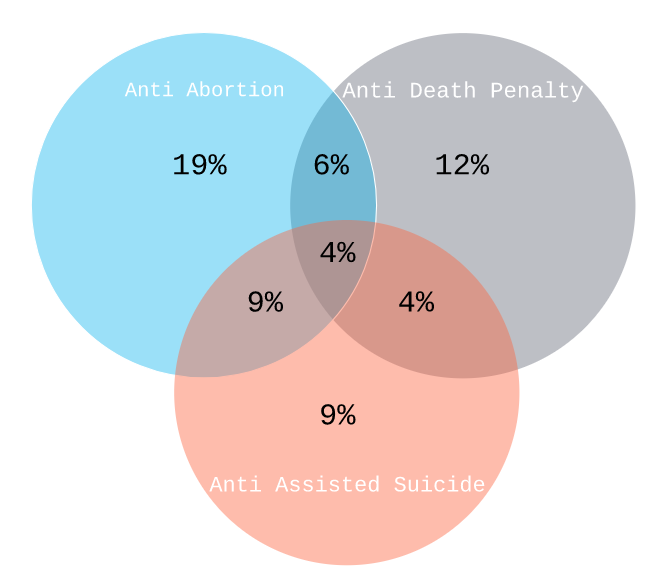
Prior to our societal and personal experience of COVID, Ryan P. Burge researched attitudes in the United States about social movements supporting anti-abortion, anti-death penalty, and anti-assisted suicide policies.


Public opinion has shifted over time. Opposition to the death penalty was relatively consistent over the last 30 years; since the early 2000s, it has reached almost 40 percent. The other two issues saw a significant shift between 1977 and 2000. Though opposition in both cases has been increasing again in the new millennium, overall the American public has become more supportive of allowing a woman to receive an abortion for any reason as well as allowing terminally ill individuals to end their lives (both by 20 to 25 points more). (Burge, 2017)


Survey of Attitudes in the United States


The overturning of Row v Wade by the Supreme Court of the United States has made “we” versus “them” conflicts more prominent as the “culture wars” challenge our attempts to discern courses of action that provide health care and social supports for women discerning a potential birth in their future.


Justice Systems deal in the three R’S, Retribution, Restitution, and Rehabilitation. The process initiated by a sentence of Capital Punishment needs to respond with ethical treatment respecting the dignity of the person and the benefits to society of recognizing rehabilitation.


Perhaps the utilitarian view of care for people approaching death has allowed loneliness, neglect, or lack of financial or comfort resources to outweigh the social and psychological benefits to the dying person and the people who care for them by fully experiencing the mystery of death.


Reducing the human experiences of birth, reconciliation, and death to individual decisions with utilitarian outcomes, in accord with “my truth”, denies the deeply social meaning of the connection of our lives to the lives of others and the opportunity of community to enrich our life. The “consistent ethic of life” emphasises our responsibilities to other individuals and to society. This emphasis has been essential in our progress against COVID in recent years and may introduce some common ground for support for people in search of a better life.


References


Burge, R. P. (2017, September 12). Almost No One in the US Believes in a 'Consistent Ethic of Life'. Christianity Today. Retrieved June 27, 2022, from https://www.christianitytoday.com/ct/2017/september-web-only/consistent-ethic-life-abortion-euthanasia-death-penalty-gss.html 


HAMEL, R. (n.d.). Twenty-Five Years Later: Cardinal Bernardin's Consistent Ethic of Life. Catholic Health Association. Retrieved June 27, 2022, from https://www.chausa.org/publications/health-progress/article/november-december-2008/twenty-five-years-later-cardinal-bernardin%27s-consistent-ethic-of-life 

Friday, May 6, 2022

Overturning Roe isn't the answer

Madison Chastain comes from a place of intense nuance that she believes undergirds a truly consistent life ethic.


Agenda for Change
 

She does not think criminalizing abortions will stop them, because having access to abortions isn't what causes them.


Things that cause abortions: lack of comprehensive sex education, inaccessible health care, violence against women, religious shame and exclusion, familial rejection or coercion, and workplace inequalities including but not limited to barriers for advancement, disparities in pay and lack of paid parental leave or child care. (Chastain, 2022)


She comments that making abortion illegal before addressing these injustices is going to kill women, because women will continue to have abortions, secretively and unsafely.


References

Chastain, M. (2022, May 6). I'm an anti-abortion disability advocate. Overturning Roe isn't the answer. National Catholic Reporter. Retrieved May 6, 2022, from https://www.ncronline.org/news/opinion/im-anti-abortion-disability-advocate-overturning-roe-isnt-answer

Wednesday, May 4, 2022

Consistent Life Ethic, Nuance, and Mercy

An article by John Gehring, Catholic program director at Faith in Public Life and author of The Francis Effect: A Radical Pope's Challenge to the American Catholic Church, caught my eye recently as I pondered the problems, moral, political, and social that surround attempts to overturn Roe vs Wade in the Supreme Court of the United States. (SCOTUS).


Gehring quotes professors of theology and bioethics and a "pro-life ethicist," to present the point of view that Catholic moral tradition is more nuanced than anti-abortion slogans or extreme bills. M.T. Dávila, a visiting associate professor of practice at Merrimack College and a past president of the Academy of Catholic Hispanic Theologians of the United States, argues that something fundamental is often lost in Catholic discussions of abortion.


"Human dignity in Catholic social teaching often seems not to include respect for the autonomy and personhood of women," she said. "We have failed to build in the Catholic and pro-life tradition a robust understanding of the personhood of women. It's a failure of thought and imagination."... 'You can be pro-life and also highlight the way these measures are very clearly anti-woman.'... Dávila finds it telling that none of the most restrictive anti-abortion legislation includes social supports for women and children such as child care funding or prenatal and postnatal health care. (Gehring, 2022)


In the past few years I have curated articles in my Ponder Patterns blog that present opinions on the treatment of abortion in the context of a consistent ethic of life. The individual articles are listed below.


Discerning Benefits for all in Culture Wars


Some Common Ground for the Common Good


Abstract of Legal safe and rare


Legal safe and rare


Cooperation and Culture Wars


The gradualism of Pope Francis applied with the virtue of mercy is a process to encourage communication and co-operation to address the needs of women. Working together is a worthy goal that is made very difficult in the politically energized “culture war” that diverts our attention and efforts from supporting women in need now.


References

Gehring, J. (2022, March 31). Catholic moral tradition more nuanced than anti-abortion slogans or extreme bills. National Catholic Reporter. Retrieved May 3, 2022, from https://www.ncronline.org/news/opinion/catholic-moral-tradition-more-nuanced-anti-abortion-slogans-or-extreme-bills 


Wednesday, January 5, 2022

Virtues Selflessness and Children

The three theological virtues, faith, hope, and charity, are practiced in some form by most people regardless of any affiliation with spirituality or religious organizations. Perhaps these virtues may provide some common ground for discussion of the polarizing topics of the culture wars. These virtues may be a foundation for our selfless actions. I recently reflected that my grandchildren belong to the face of hope for future generations.


Hope for the future
 

The colours in the table represent the three theological virtues: Green - hope; White - faith; Red - charity. The top row is a suggested definition of each virtue that may be more applicable to our time than definitions from religious tradition.


Faith: Trust the people who are caring for you and for whom you care

Hope: Contributing to the vision we work towards for the future

Charity: Action that is directed to love that works to support the needs of others.


Abortion

Trust there are several caring choices for yourself and to know care and support from others

A seed has been planted. We may be starting to be the change we seek.

Action that gives love to others reveals a supporting community for you.

Capital Punishment

Sincere efforts to change lives need trust in a process of transformation

Rehabilitation is hope that good can triumph

Acting to address the needs of victim and offender is a way to reduce retribution and revenge

Euthanasia 

Trust that each day of life is an opportunity to deepen our humanity and allow others to be agents of our comfort.

Our hopes for the future may transmit to others as we live fully in our last days.

Our life is made full by relationships with others. Give them time to complete the story with you.


An article on the Al Jazeera web site reported that Pope Francis suggested people who substitute pets for kids exhibit ‘a certain selfishness’. In the article, the Pontiff urges easing of adoption procedures to increase possibilities for parents to experience one of the highest forms of love, fatherhood and motherhood.

In 2014, the 85-year-old told Il Messaggero daily that having pets instead of children was “another phenomenon of cultural degradation”, and that emotional relationships with pets was “easier” than the “complex” relationship between parents and children. On Wednesday, while inviting couples who are unable to have children for biological reasons to consider adoption, he urged potential parents “not to be afraid” in embarking on parenthood. “Having a child is always a risk, but there is more risk in not having a child, in denying paternity,” he said. “This kind of choice is among the highest forms of love, and of fatherhood and motherhood,” he said of adoption. “How many children in the world are waiting for someone to take care of them!” The Argentinian pontiff has in the past denounced the “demographic winter”, or falling birth rates in the developed world.1 

When common ground in the most confrontational issues in the culture wars, abortion, capital punishment, and euthanasia, is sought in the context of trust, future potential, and addressing needs of the people involved as kin in our broader human family, we may find selfless action for the common good results.

 1 (2022, January 5). Having pets instead of kids robs us of 'humanity', pope says. Retrieved January 5, 2022, from https://www.aljazeera.com/news/2022/1/5/having-pets-instead-of-kids-robs-us-of-humanity-pope-says

Thursday, September 9, 2021

Some Common Ground for the Common Good

I am stuck by many paradox in the political battles concerning our ethical and legal approach to “life issues” like abortion, capital punishment, euthanasia, and war. I have worked with some folks on one side of some of these issues and then have found the same people on the opposite side of another of these issues. Sometimes those most concerned about government control of their lives are strong advocates of a legal solution to these issues. Within Christianity, I suggest that the model of surrender of our rights, possessions, and life for the good of the other is well presented by Jesus. Many thoughtful Christians have worked to educate and provide witness in action to help those in need while attempting to formulate and practice a consistent ethic of life.

Working for the Common Good


Discerning Benefits for all in Culture Wars ( http://tinyurl.com/y223u2hh ) offers support for the idea that opportunity for more common ground than difference in the Culture Wars may lead to replacement of dualistic confrontation with mutual appreciation and understanding.


Charles C. Camosy, associate professor of theological and social ethics at Fordham University, affirms a consistent life ethic in the strongest possible terms. This includes not only considering many more issues than abortion, but also focusing on the well-being of women and families.


We urge all Catholics to resist the false choice between “supply” and “demand” approaches to abortion; that is, between opposing the practice of abortion (the supply side) and addressing the root causes that lead to abortion (the demand side). But an authentically Catholic consistent life ethic means treating prenatal children as the equivalent of every other human being. When we do that, and then simply “do the math,” it is easy to see why fundamental justice for prenatal children is the pre-eminent justice issue of our time.1


Deacon William T. Ditewig, Ph.D. was speaking recently with a fellow Catholic who is against mandates concerning vaccinations or masks during this time of COVID-19. The language was interesting. “It’s all about my personal freedom. As Catholics, we have free will and as Americans we have individual rights. I should be able to make my own decisions without anyone else (especially the government) taking that freedom away. “It’s my body; it’s my choice.”


Do I have a right to refuse to take the vaccine? The answer is not an absolute yes or no, but maybe. Does society have a right to regulate my behavior despite my personal freedom? “My body, my choice” is again insufficient. My personal freedom extends only as far as the personal freedom of others. At some point, the moral choice is to surrender a measure of personal freedom for the common good of all. Consider how we veterans are often greeted: “Thank you for your service!” It is acknowledged that, as a class of people, military personnel put their own personal freedom aside to a degree in order to benefit their comrades and the country. Taking the vaccination, even under a mandate, is less about one’s personal good than it is about the good of others. For people of faith, we need only look to St. Paul, who reminded the Philippians: “Do nothing from selfish ambition or conceit, but in humility regard others as better than yourselves. Let each of you look not to your own interests, but to the interests of others.” (Philippians 2:3-4). The bottom line is that “my body, my choice” is an inadequate and flawed argument no matter who makes it.2


Renée Darline Roden, holds a bachelor’s and master’s degree from the University of Notre Dame and currently works as an editor for FaithND and as a playwright in New York City. Her writing has appeared in Howlround, Church Life Journal, and Image Journal’s Good Letters, is suggesting that pro-life Catholics think as much about mores and social structures as they do about legislation. In order to achieve full justice on the issue of abortion, the moral discussion has to explore the personal and theological relationships that laws incarnate and reflect but cannot dictate.


To attempt to outlaw abortion without caring whether or not abortions will occur illegally or without caring why so many women see abortion as so essential to their freedom, health and happiness is shortsighted. And it is that blindspot that makes the pro-life political apparatus appear so misogynist and cruel to its political counterparts. A movement that wants to end abortions has to listen to the voices of women demanding change. It has to seriously consider why women—particularly impoverished women—see abortion as a necessity. Until all economic and social structures of sexism are transformed and the patriarchal mores in our hearts and relationships are converted, there will always be unwanted pregnancies. And if there are unwanted pregnancies, there will be abortions. To think otherwise is wishful thinking.3


The possibility of common ground for the common good in the culture wars may, as a beginning, lie in working for the well being of women and families, discussion of benefits to society from limiting some personal choice, and working to transform economic and social structures of sexism. Our real overlap with people who disagree with some of our efforts is our ability to respect and work with them on other ethical and moral aspects that improve life in our common home.


References

1

(2021, July 8). Consistent-life-ethic Catholics can (and should) treat abortion as .... Retrieved July 9, 2021, from https://www.americamagazine.org/faith/2021/07/08/abortion-politics-us-bishops-eucharist-ethics-240991 


2

(2021, August 21). The Limits of Choice: Personal Freedom and the Common Good. Retrieved August 22, 2021, from https://billditewig.blog/2021/08/21/the-limits-of-choice-personal-freedom-and-the-common-good/ 


3

(2021, September 8). Pro-life Catholics: You can't end abortion ... - America Magazine. Retrieved September 9, 2021, from https://www.americamagazine.org/politics-society/2021/09/08/texas-sb-8-heartbeat-abortion-women-241365