Showing posts sorted by relevance for query consistent. Sort by date Show all posts

Friday, July 1, 2022

Consistent Ethic of Life in COVID and Culture Wars

Some recent research has brought to mind that an ethical approach that offers the view of the individual as possessing inherent dignity and as inherently social with responsibilities to other individuals and to society was at play during our battle with the Covid epidemic.


Challenges in Health Care


People chose to wear masks, practice social distancing, and be vaccinated for self protection and more significantly for the health and safety of others, especially the most vulnerable in society. Attempts to foster this type of ethical behaviour in society include those of Cardinal Joseph Bernardin, who in a lecture at Fordham University, on Dec. 6, 1983, first articulated what he referred to as the "consistent ethic of life." 


The following statements attempt to present some non-controversial truths about life processes that concern people who consider making ethical decisions about human life and well being.


  • Abortion interupts a process that is very likely to result in birth.
  • A sentence of capital punishment initiates a process that is likely to end in an execution.
  • Medical Assistance in Death approval initiates a process that is likely to end in an early death.


Dr. Ron Hamel, senior director, ethics, Catholic Health Association, St. Louis writes about problematic personal and social attitudes in medical health that he feels the "consistent ethic of life" may help correct.


Fourth, the consistent ethic of life is corrective in that it brings to light problematic personal and social attitudes — individualism, a utilitarian assessment of persons, privatization of moral choices, excess autonomy, the commodification and commercialization of health care, the technological imperative, and the like — often associated with various technologies and aspects of the health care system. These attitudes are threats to human life and dignity and are, therefore, unacceptable. In their place, as an alternative, the consistent ethic offers a view of the individual as possessing inherent dignity and as inherently social with responsibilities to other individuals and to society.


In sum, Bernardin's consistent ethic of life as a moral vision underscores the fundamental importance of human dignity and human life, sensitizes to threats to human life and well-being, brings these threats to the foreground, inspires alternative attitudes, approaches and practices, and motivates for profound change. (HAMEL, n.d.)


During COVID, the individualism that declared “my body, my choice” around infection precautions and vaccination, fortunately, had less acceptance than the decision by the majority to protect society and reduce hospitalisation and death by adhering to COVID restrictions.


The most vulnerable in our society, thankfully, continue to remind us that an utilitarian assessment of persons, based perhaps on their usefulness to the maintenance and increase of our GNP, is a direction we have rejected in our condemnation of autocratic regimes and atrocities against human life.


We have wrestled with the impact of our moral choices more intensely in COVID times as we have moved to understanding the limits of our freedom and autonomy come into play when we negatively impact the life and health of others. 


An epidemic may also bring into view the economic costs of sustaining human life. The requirement that we try to base treatment on medical need rather than the ability of the patient to contribute to the cost of treatment mandated that money be injected by the government into the care of COVID patients.


Prior to our societal and personal experience of COVID, Ryan P. Burge researched attitudes in the United States about social movements supporting anti-abortion, anti-death penalty, and anti-assisted suicide policies.


Public opinion has shifted over time. Opposition to the death penalty was relatively consistent over the last 30 years; since the early 2000s, it has reached almost 40 percent. The other two issues saw a significant shift between 1977 and 2000. Though opposition in both cases has been increasing again in the new millennium, overall the American public has become more supportive of allowing a woman to receive an abortion for any reason as well as allowing terminally ill individuals to end their lives (both by 20 to 25 points more). (Burge, 2017)
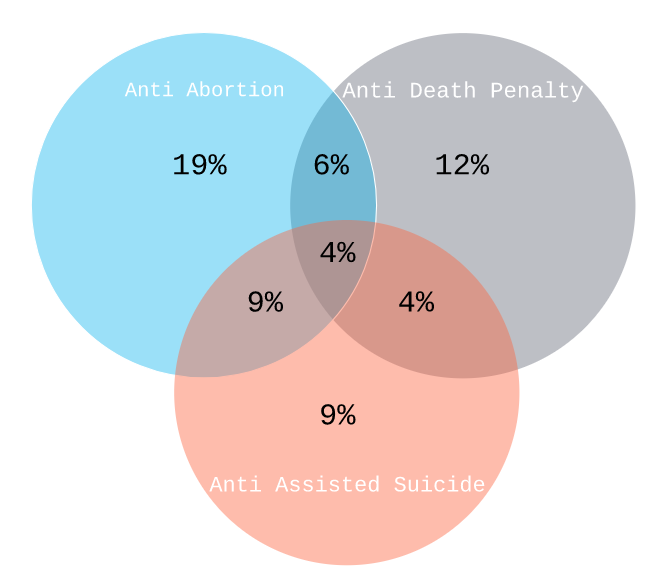

Survey of Attitudes in the United States


The overturning of Row v Wade by the Supreme Court of the United States has made “we” versus “them” conflicts more prominent as the “culture wars” challenge our attempts to discern courses of action that provide health care and social supports for women discerning a potential birth in their future.


Justice Systems deal in the three R’S, Retribution, Restitution, and Rehabilitation. The process initiated by a sentence of Capital Punishment needs to respond with ethical treatment respecting the dignity of the person and the benefits to society of recognizing rehabilitation.


Perhaps the utilitarian view of care for people approaching death has allowed loneliness, neglect, or lack of financial or comfort resources to outweigh the social and psychological benefits to the dying person and the people who care for them by fully experiencing the mystery of death.


Reducing the human experiences of birth, reconciliation, and death to individual decisions with utilitarian outcomes, in accord with “my truth”, denies the deeply social meaning of the connection of our lives to the lives of others and the opportunity of community to enrich our life. The “consistent ethic of life” emphasises our responsibilities to other individuals and to society. This emphasis has been essential in our progress against COVID in recent years and may introduce some common ground for support for people in search of a better life.


References


Burge, R. P. (2017, September 12). Almost No One in the US Believes in a 'Consistent Ethic of Life'. Christianity Today. Retrieved June 27, 2022, from https://www.christianitytoday.com/ct/2017/september-web-only/consistent-ethic-life-abortion-euthanasia-death-penalty-gss.html 


HAMEL, R. (n.d.). Twenty-Five Years Later: Cardinal Bernardin's Consistent Ethic of Life. Catholic Health Association. Retrieved June 27, 2022, from https://www.chausa.org/publications/health-progress/article/november-december-2008/twenty-five-years-later-cardinal-bernardin%27s-consistent-ethic-of-life 

Monday, May 27, 2019

Discerning Benefits for all in Culture Wars


Recently, I have been troubled by “we” versus “them” divisions marking the declining
Dualism

discourse in politics, care of the planet, culture wars, poverty, inequality, and religion.
The action and reaction around the new anti-abortion legislation in the United States coincided with some research I was doing into the ethics included in Pope Francis encyclical “Laudato Si”, Care of Our Common Home1
and the process attributed to the "Who Am I to Judge” Pontiff for reconciling viewpoints of “liberal” and “conservative” factions within the Church of Rome.
 This process has been described as discernment, gradualness, and mercy.2
When the process favoured by the Pope is combined with a recollection of the long standing efforts within Catholic Social Teaching to live a Consistent Ethic of Life there may be a format that can improve discourse in the Cultural Wars on life issues.


Nicholas Austin SJ on 'Discernment charged with merciful love’ Pope Francis’
practice
discernment
principle
gradualness
virtue
mercy
A process for dialogue


Linda Donovan, Campus Minister at Duquesne University, is a contact for the Consistent Ethic of Life (CEL) student group that meets weekly to discuss important life and human dignity issues. In educating themselves on all sides of an issue, the group is able to make informed decisions and take responsible action.
CEL for discussion

This action they take can be in the form of volunteering with organizations in the area, educating the campus community, or advocating for an issue that supports human dignity.

The Duquesne University CEL student group addresses issues of...Stem cell research
Abortion
Poverty
Capital Punishment
Children's Issues
AIDS
War
Euthanasia
Human Trafficking 3 

The Consistent Ethic of Life challenge is to use our ethical understanding to discern the benefits for the future that are likely to be the result of decisions we make in the present. An example from the climate emergency situation is the decision to reduce greenhouse gas today will bring the benefit of a cooler average earth temperature in the future.
Benefits of Action

Each of the topics discussed by the Duquesne students (and more) may be tested by discerning and reporting likely benefits of our decision. “We” and “They” divisions may be reduced when the dualism is replaced by mutual affirmation of some of the benefits that are uncovered. The culture war “top three” areas of conflict are illustrated below.

The decision in the present about abortion will bring benefits in future. Discern these benefits and present them for discussion.
Discern future benefits of decision

Capital punishment is a decision that we most likely requires us to act through the political system to achieve the benefits we discern for the future as a result of our advocacy today.
Discern benefits of political advocacy

Medical assistance in dying (MAID) may be a decision we make concerning our death or that of a loved one. The future benefits of this decision are psychological, physiological, cultural, and often influenced by erroneous understanding of religious expectations.
Discern final benefits

The opportunity for more common ground than difference in the Culture Wars may lead to replacement of dualistic confrontation with mutual appreciation and understanding.

References 

1
(2016, October 4). The consistent ethic of life under Pope Francis - Crux Now. Retrieved May 24, 2019, from https://cruxnow.com/commentary/2016/10/04/consistent-ethic-life-pope-francis/
2
(2016, April 8). 'Discernment charged with merciful love': Pope Francis' Amoris Laetitia .... Retrieved May 24, 2019, from https://www.thinkingfaith.org/articles/discernment-charged-merciful-love-pope-francis%E2%80%99-amoris-laetitia-love-family-0
3
(n.d.). Consistent Ethic of Life | Duquesne University. Retrieved May 27, 2019, from https://www.duq.edu/life-at-duquesne/spiritan-campus-ministry/develop-your-faith/consistent-ethic-of-life

Thursday, September 9, 2021

Some Common Ground for the Common Good

I am stuck by many paradox in the political battles concerning our ethical and legal approach to “life issues” like abortion, capital punishment, euthanasia, and war. I have worked with some folks on one side of some of these issues and then have found the same people on the opposite side of another of these issues. Sometimes those most concerned about government control of their lives are strong advocates of a legal solution to these issues. Within Christianity, I suggest that the model of surrender of our rights, possessions, and life for the good of the other is well presented by Jesus. Many thoughtful Christians have worked to educate and provide witness in action to help those in need while attempting to formulate and practice a consistent ethic of life.

Working for the Common Good


Discerning Benefits for all in Culture Wars ( http://tinyurl.com/y223u2hh ) offers support for the idea that opportunity for more common ground than difference in the Culture Wars may lead to replacement of dualistic confrontation with mutual appreciation and understanding.


Charles C. Camosy, associate professor of theological and social ethics at Fordham University, affirms a consistent life ethic in the strongest possible terms. This includes not only considering many more issues than abortion, but also focusing on the well-being of women and families.


We urge all Catholics to resist the false choice between “supply” and “demand” approaches to abortion; that is, between opposing the practice of abortion (the supply side) and addressing the root causes that lead to abortion (the demand side). But an authentically Catholic consistent life ethic means treating prenatal children as the equivalent of every other human being. When we do that, and then simply “do the math,” it is easy to see why fundamental justice for prenatal children is the pre-eminent justice issue of our time.1


Deacon William T. Ditewig, Ph.D. was speaking recently with a fellow Catholic who is against mandates concerning vaccinations or masks during this time of COVID-19. The language was interesting. “It’s all about my personal freedom. As Catholics, we have free will and as Americans we have individual rights. I should be able to make my own decisions without anyone else (especially the government) taking that freedom away. “It’s my body; it’s my choice.”


Do I have a right to refuse to take the vaccine? The answer is not an absolute yes or no, but maybe. Does society have a right to regulate my behavior despite my personal freedom? “My body, my choice” is again insufficient. My personal freedom extends only as far as the personal freedom of others. At some point, the moral choice is to surrender a measure of personal freedom for the common good of all. Consider how we veterans are often greeted: “Thank you for your service!” It is acknowledged that, as a class of people, military personnel put their own personal freedom aside to a degree in order to benefit their comrades and the country. Taking the vaccination, even under a mandate, is less about one’s personal good than it is about the good of others. For people of faith, we need only look to St. Paul, who reminded the Philippians: “Do nothing from selfish ambition or conceit, but in humility regard others as better than yourselves. Let each of you look not to your own interests, but to the interests of others.” (Philippians 2:3-4). The bottom line is that “my body, my choice” is an inadequate and flawed argument no matter who makes it.2


Renée Darline Roden, holds a bachelor’s and master’s degree from the University of Notre Dame and currently works as an editor for FaithND and as a playwright in New York City. Her writing has appeared in Howlround, Church Life Journal, and Image Journal’s Good Letters, is suggesting that pro-life Catholics think as much about mores and social structures as they do about legislation. In order to achieve full justice on the issue of abortion, the moral discussion has to explore the personal and theological relationships that laws incarnate and reflect but cannot dictate.


To attempt to outlaw abortion without caring whether or not abortions will occur illegally or without caring why so many women see abortion as so essential to their freedom, health and happiness is shortsighted. And it is that blindspot that makes the pro-life political apparatus appear so misogynist and cruel to its political counterparts. A movement that wants to end abortions has to listen to the voices of women demanding change. It has to seriously consider why women—particularly impoverished women—see abortion as a necessity. Until all economic and social structures of sexism are transformed and the patriarchal mores in our hearts and relationships are converted, there will always be unwanted pregnancies. And if there are unwanted pregnancies, there will be abortions. To think otherwise is wishful thinking.3


The possibility of common ground for the common good in the culture wars may, as a beginning, lie in working for the well being of women and families, discussion of benefits to society from limiting some personal choice, and working to transform economic and social structures of sexism. Our real overlap with people who disagree with some of our efforts is our ability to respect and work with them on other ethical and moral aspects that improve life in our common home.


References

1

(2021, July 8). Consistent-life-ethic Catholics can (and should) treat abortion as .... Retrieved July 9, 2021, from https://www.americamagazine.org/faith/2021/07/08/abortion-politics-us-bishops-eucharist-ethics-240991 


2

(2021, August 21). The Limits of Choice: Personal Freedom and the Common Good. Retrieved August 22, 2021, from https://billditewig.blog/2021/08/21/the-limits-of-choice-personal-freedom-and-the-common-good/ 


3

(2021, September 8). Pro-life Catholics: You can't end abortion ... - America Magazine. Retrieved September 9, 2021, from https://www.americamagazine.org/politics-society/2021/09/08/texas-sb-8-heartbeat-abortion-women-241365 


Friday, May 24, 2019

Abstract of Legal safe and rare

I was born prematurely and I was born a twin. Unfortunately, my twin did not survive. I often consider that my twin gave me my life.
Help in need

Richard Rohr and the Center for Action and Contemplation is where faculty member Cynthia Bourgeault writes about an ancient tradition called “wisdom,” sometimes known as sophia perennis. Transformation from a judgmental and dualistic worldview into a nondual acceptingness is a path that offers hope for reconciliation between people who view life issues from different perspectives. Pope Francis remarks in a press conference in 2013, when he asked: "Who am I to judge?" explores the universal theme of mercy. Nicholas Austin SJ writes that Pope Francis’ discernment, gradualness and mercy offers a practice, a principle and a virtue. Discernment of the work of Pope Francis in the encyclical “Laudato Si, Care of our Common Home” brings the theme of a Consistent Ethic of Life (CEL) to the forefront. Charles C. Camosy, a CRUX contributor, reminds us that secular conservatives and progressives have alternatively praised or decried Pope Francis as a liberal. “As I love you” (http://tinyurl.com/y2fsaumu ) is a curation of reflections inspired by having love that gives up life for the other. The greatest gift from God is freedom to choose love. The freedom to choose love for the other and give life for the benefit of the other may be the active motivation in experiencing war and terror attacks, accepting the death penalty, struggling with abortion, and yielding our final time near death for the benefit of others. Lainey Newman comments on the Bill Clinton position on abortion Safe, Legal, and Rare. John Gehring admits to long suffering from what might be called abortion-politics fatigue, Cognitive dissonance plagues good people who are besieged by dualistic, “them” and “us” discord in the culture wars. We continue to gradually grow reducing ego and increasing selflessness in the freedom to choose to give life to others as we are transformed to be the virtues we embrace. (Link to longer article)

References

1
(2019, May 15). Liberalism is constantly under siege but always comes out ... - CBC.ca. Retrieved May 24, 2019, from https://www.cbc.ca/radio/thecurrent/the-current-for-may-16-2019-1.5137392/liberalism-is-constantly-under-siege-but-always-comes-out-on-top-says-author-1.5137434
2
(2016, April 8). 'Discernment charged with merciful love': Pope Francis' Amoris Laetitia .... Retrieved May 24, 2019, from https://www.thinkingfaith.org/articles/discernment-charged-merciful-love-pope-francis%E2%80%99-amoris-laetitia-love-family-0
3
(2019, May 23). Farther than Ever from Common Ground? | Commonweal Magazine. Retrieved May 24, 2019, from https://www.commonwealmagazine.org/farther-ever-common-ground
4
(2018, January 11). Safe, Legal, and Rare: The Democrats' Evolving Stance on Abortion .... Retrieved May 24, 2019, from https://harvardpolitics.com/united-states/safe-legal-and-rare-the-democrats-evolving-stance-on-abortion/
5
(2016, October 4). The consistent ethic of life under Pope Francis - Crux Now. Retrieved May 24, 2019, from https://cruxnow.com/commentary/2016/10/04/consistent-ethic-life-pope-francis/
6
(2019, May 24). Where do abortion rights in Canada stand today? | CBC Radio - CBC.ca. Retrieved May 24, 2019, from https://www.cbc.ca/radio/frontburner/where-do-abortion-rights-in-canada-stand-today-1.5147690

Friday, December 6, 2024

Stop the Genocide

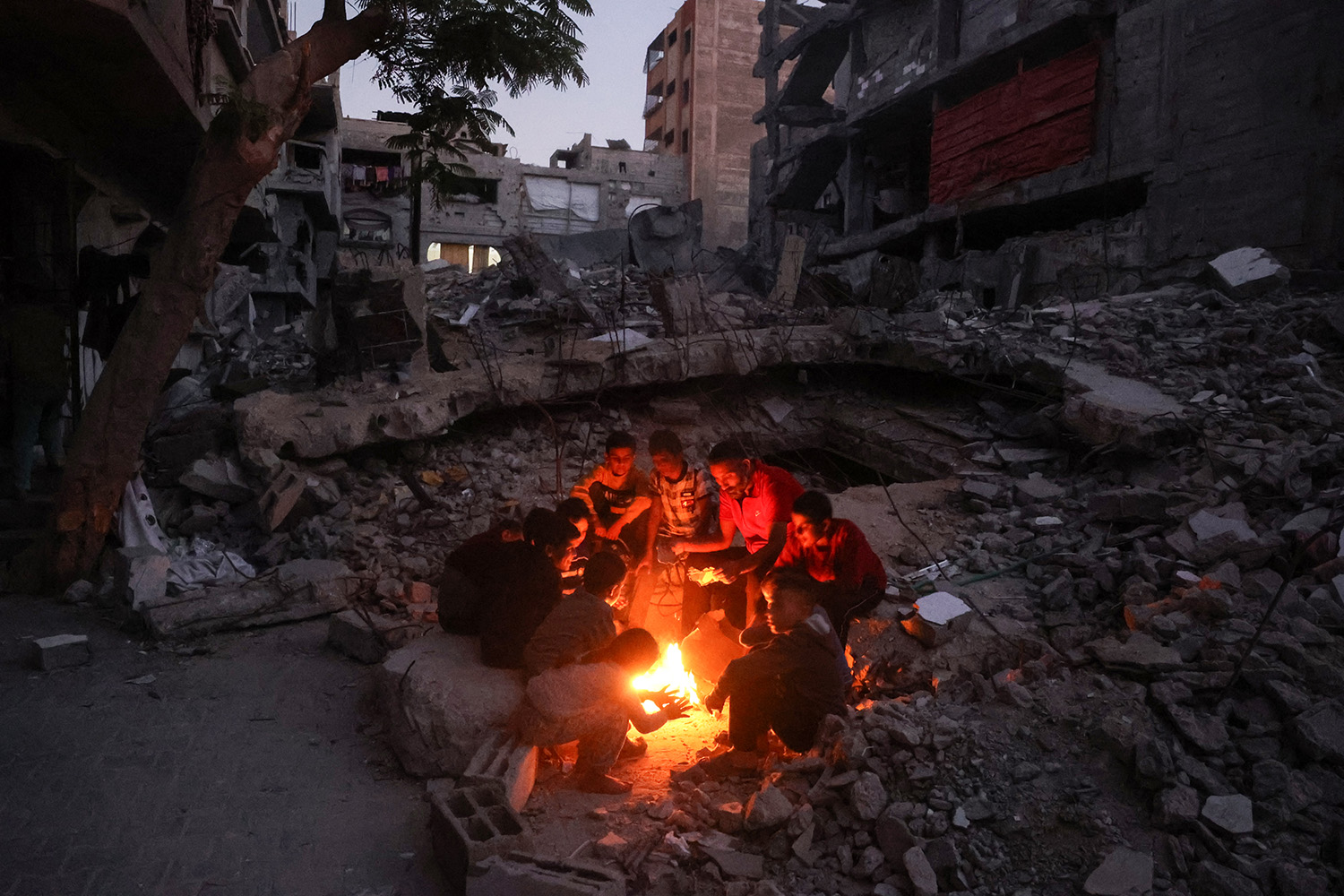
If the IDF is killing Palestinians because they are Palestinians, that action is evidence for a charge of genocide against the State of Israel. If the IDF is ignoring their responsibility to exercise discrimination and proportionality in their attacks in Gaza then there is evidence for violation of International Humanitarian Law and charges of war crimes against those responsible for conducting the war. In recent months, the assessment of some human rights organizations and moral leaders has been leaning to accusations of genocide and war crimes at the hands of the armed forces of Israel.


(
Photo by Eyad BABA / AFP via Getty Images)


Muhammad Abu Salmiya, Director of Al-Shifa Hospital, in an article with supporting references in the Lancet concludes that more than 85% of Gaza’s population have been displaced, at least 33,000 Palestinians have been killed, and 70,000 civilians have been injured.


Since the attacks by Hamas against Israel on Oct 7, 2023,1 the Israeli retaliatory strikes, bombings, and strict sieges have almost never stopped. So far, more than 85% of Gaza's population have been displaced,2 and as of April 13, 2024, at least 33 000 Palestinians have been killed (more than a third of them are children)3 and 70 000 civilians have been injured.4 Approximately 7000 Palestinians are reportedly missing—most are likely dead.3,4 This massacre has taken place in just 180 days and is still ongoing.3 Gaza has now been described as a graveyard of children by the UN.4 According to WHO and Médecins Sans Frontières, hospitals in southern Gaza are at “breaking point” while all the hospitals in northern Gaza have been destroyed and are out of service.5 There is very limited access to ambulances, electricity, and clean drinking water, and injured patients are being transferred to medical institutes by donkey carts.6 The UN announced that the number of health-care workers killed by Israeli strikes is the highest in any single conflict in the organisation's history.7 Josep Borrell, a High Representative for the European Union for Foreign Affairs and Security Policy, has described the destruction in Gaza as being proportionally greater than that which Germany experienced in World War 2.8

A key aspect of this war is the deliberate targeting of civilians by the Israeli military—for example, in just one investigation by Amnesty International, US-made munitions were found to be used by the Israeli military in two deadly, unlawful air strikes on homes containing civilians in Gaza.9 These air strikes were either direct attacks on civilians or civilian objects or indiscriminate attacks and Amnesty International is calling for them to be investigated as war crimes.9

(References cited above are detailed in web article) (Abu Salmiya, n.d.)


Agnès Callamard, Secretary General of Amnesty International, reports that Amnesty International’s research has found sufficient basis to conclude that Israel has committed and is continuing to commit genocide against Palestinians in the occupied Gaza Strip.


The report, ‘You Feel Like You Are Subhuman’: Israel’s Genocide Against Palestinians in Gaza, documents how, during its military offensive launched in the wake of the deadly Hamas-led attacks in southern Israel on October 7, 2023, Israel has unleashed hell and destruction on Palestinians in Gaza brazenly, continuously and with total impunity.


“Amnesty International’s report demonstrates that Israel has carried out acts prohibited under the Genocide Convention, with the specific intent to destroy Palestinians in Gaza. These acts include killings, causing serious bodily or mental harm, and deliberately inflicting on Palestinians in Gaza conditions of life calculated to bring about their physical destruction. Month after month, Israel has treated Palestinians in Gaza as a subhuman group unworthy of human rights and dignity, demonstrating its intent to physically destroy them,” said Agnès Callamard, Secretary General of Amnesty International.


“Our damning findings must serve as a wake-up call to the international community: this is genocide. It must stop now. (Callamard, n.d.)


On 14 November 2024 the UN Special Committee to investigate Israeli practices* said in a new report that Israel’s warfare in Gaza is consistent with the characteristics of genocide, with mass civilian casualties and life-threatening conditions intentionally imposed on Palestinians.


The report documents how Israel’s extensive bombing campaign in Gaza has decimated essential services and unleashed an environmental catastrophe that will have lasting health impacts. By early 2024, over 25,000 tons of explosives—equivalent to two nuclear bombs—had been dropped on Gaza, causing massive destruction and the collapse of water and sanitation systems, agricultural devastation, and toxic pollution.


“By destroying vital water, sanitation and food systems, and contaminating the environment, Israel has created a lethal mix of crises that will inflict severe harm on generations to come,” the Committee said. (UN Special Committee to investigate Israeli practices, n.d.)


The report raises serious concerns about Israel’s use of AI-enhanced targeting systems in directing its military operations, and the impact it has had on civilians, particularly evident in the overwhelming number of women and children among the casualties.


“The Israeli military’s use of AI-assisted targeting, with minimal human oversight, combined with heavy bombs, underscores Israel’s disregard of its obligation to distinguish between civilians and combatants and take adequate safeguards to prevent civilian deaths,” the Committee said. (UN Special Committee to investigate Israeli practices, n.d.)


The concerns of human rights organizations about the possibility of genocide and war crimes being committed by Israel follow similar concern that Giada Zampano from AP Rome reports that Pope Francis has called for an investigation to determine if Israel’s attacks in Gaza constitute genocide, according to excerpts released from an upcoming new book ahead of the pontiff’s jubilee year. 


References

Abu Salmiya, M. (n.d.). Stop the Gaza genocide immediately. thelancet. https://www.thelancet.com/journals/lancet/article/PIIS0140-6736(24)00135-1/fulltext 

Callamard, A. (n.d.). ‘You Feel Like You Are Subhuman’: Israel’s Genocide Against Palestinians in Gaza. Amnesty International investigation concludes Israel is committing genocide against Palestinians in Gaza. https://amnesty.ca/gazagenocide/ 

UN Special Committee to investigate Israeli practices. (n.d.). UN Special Committee finds Israel’s warfare methods in Gaza consistent with genocide, including use of starvation as weapon of war. OHCHR Office of the High Commissioner for Human Rights. https://www.ohchr.org/en/press-releases/2024/11/un-special-committee-finds-israels-warfare-methods-gaza-consistent-genocide