Showing posts with label National Observer. Show all posts

Thursday, June 12, 2025

Responding Seriously to Housing Needs


Erica Alini, reporting for the Globe and Mail, writes that Prime Minister Mark Carney has pledged billions of dollars in financing for makers of prefabricated homes to help end the country’s housing shortage.


Factory Fabricated and Shipped to Site


Mr. Carney has promised to provide $25-billion in loans and $1-billion in equity financing for companies that largely build homes in factories rather than on construction sites. The federal government will also place bulk orders of prefabricated housing to help jump-start a nascent industry, according to the Liberals’ election platform.


“We will create an entirely new Canadian housing industry,” the Prime Minister said in his first press conference since the election win.


It’s a big, bold bet that could make it faster, cheaper and more environmentally friendly to build a chunk of the 3.5 million homes that official estimates show Canada needs to add by 2030 to restore housing affordability, industry insiders and academics say. (Alini et al., 2025)


Sean Silcoff, Technology Reporter and Rachelle Younglai, Real Estate Reporter, at the Globe and Mail, note that the technology is available to make prefab homes faster. And all levels of government are under pressure to create affordable housing, with many Canadians shut out of home ownership or struggling to pay rent.


Prime Minister Mark Carney speaks with Oliver David Krieg during a visit to Intelligent City in Delta, B.C.


“Now is the time to try this again,” said Peter Hass, general manager of the new venture, called Stelumar Advanced Manufacturing Inc., which expects to produce modular components for about 3,000 housing units a year once its factory opens. (Turley, 2025)


Max Fawcett, in an article in Canada’s National Observer, offers the opinion that Canada’s Conservatives still aren’t serious about housing. Jacob Mantle, the newly-elected thirty-something Conservative MP for York-Durham, rose in the House of Commons on Tuesday, June 10, to make a point about housing costs.


“My generation refuses to live in a shipping container,” Mantle said. (Fawcett, n.d.)


Fawcett comments:


For what it’s worth, I suspect many members of his generation (and mine) would be happy to live in the sort of modified shipping containers that are being designed and built right now, including the ones in his own city. But modular housing is so much more than just the use and conversion of shipping containers. It’s an entirely new approach to homebuilding, one that uses factories and their inherent economies of scale to drive down costs. They can be one or two-storey, single or multi-family, and configured in any number of layouts and sizes. In an environment where driving down construction costs is a nearly existential issue for Mantle’s generation, you’d think he would be more open to new ideas and economic innovation — especially when it promises to use more Canadian materials and labour. (Fawcett, n.d.)


George, Joel, Dave and everyone from the Prefab Homes Nova Scotia Team say:


You put the kettle on…

“Of course we handle the permits and site prep. Delivery, utility hook-ups, all the finishing’s too, that’s doing the job right - delivery in 90 days or less” (Prefab Homes Nova Scotia, n.d.)


https://www.prefabhomesnovascotia.ca/studio
 

The Prefabricated home, delivered and quickly made ready for occupancy, is being offered as a way to address our housing needs. Local companies are ready today to respond!


References

Alini, E., Raitt, L., Kelly, C., & McLister, R. (2025, May 5). Mark Carney's bet on prefabricated homes has promise – and big risks. The Globe and Mail. Retrieved June 12, 2025, from https://www.theglobeandmail.com/investing/personal-finance/article-mark-carneys-bet-on-prefabricated-homes-has-promise-and-big-risks/ 

Fawcett, M. (n.d.). Canada’s Conservatives still aren’t serious about housing. Canada's National Observer: Climate News. Retrieved June 12, 2025, from https://www.nationalobserver.com/2025/06/12/opinion/conservatives-still-arent-serious-about-housing?nih=KO9k2fpYhTw9rlRDCmdZHAfFIG6V6Bt1OhCLrUXRVbc&utm_source=National+Observer&utm_campaign=b9cfb40fce-EMAIL_CAMPAIGN_2025_06_12_01_31&utm_medium=email&utm_term=0_cacd0f141f-b9cfb40fce-276932429 

Prefab Homes Nova Scotia. (n.d.). Fastest, Strongest, Most Money Saving Homes. Prefab Homes Nova Scotia. Retrieved June 12, 2025, from https://www.prefabhomesnovascotia.ca/?fbclid=IwY2xjawK3zi5leHRuA2FlbQIxMABicmlkETF4UDVJcTB1UTVWbURrZ3NuAR7vjtpGdmX-wwTABLuNsRrpqoM-CPLutZFfyxWA2TQ3LOPRu0PUpJjIPCQ3ug_aem_cMkxdeRY9KyWTLWnnN_HJg 

Turley, J. (2025, June 10). Mattamy Homes founder Peter Gilgan to start prefab housing factory in Ontario. The Globe and Mail. Retrieved June 12, 2025, from https://www.theglobeandmail.com/business/article-mattamy-homes-peter-gilgan-prefab-housing-factory-ontario/ 


Monday, October 9, 2023

“Laudate Deum,” after “Laudato Si’”

Vincent Miller, the Gudorf Chair in Catholic Theology and Culture at the University of Dayton, and the editor of The Theological and Ecological Vision of “Laudato Si’”: Everything is Connected, comments that in “Laudate Deum,” Pope Francis revisits the themes of “Laudato Si’” after eight years—a clear sign of urgency for a Catholic Church that thinks in centuries.


From Laudato Si to Laudato Deum


Eight years of inadequate progress later, as emissions continue to rise, and atmospheric carbon dioxide levels have risen from 405 parts per million then to 423 .pm this summer. “Laudate Deum” is much more critical, devoting more than a third of its length to the weaknesses of international politics and the U.N. in addressing climate change. Although papal writing is usually known for diplomacy, Francis is shockingly direct: “It is no longer helpful for us to support institutions in order to preserve the rights of the more powerful without caring for those of all” (No. 43).


The pope calls to democratize international decision-making, which would require “spaces for conversation, consultation, arbitration, conflict resolution and supervision” (a call he can make with more legitimacy as the Synod on Synodality gets underway). He defends the actions of climate activist groups that are often negatively portrayed as “radicalized” as “filling in a space left empty by society as a whole,” which is failing to “pressure” decision makers as the future of its “children is at stake” (No. 43). (Miller, 2023)


Laudato Si 2015

Laudate Deum 2023

engage all who live on our planet about “our common home”

my brothers and sisters of our suffering planet

action amidst the hopeful lead up to the Paris climate meeting.

the weaknesses of international politics and the U.N. in addressing climate change

looked with hope to the COP 21 U.N. Climate Change meeting

speaks in apprehension about next month’s COP 28 meeting, which is being hosted by the United Arab Emirates,

spoke forcefully, but diplomatically, to a global governance system that seemed able to address the civilizational challenge of climate change.

Francis is shockingly direct: “It is no longer helpful for us to support institutions in order to preserve the rights of the more powerful without caring for those of all” (No. 43).

“Laudato Si’” spoke of climate change

Francis forcefully recounts its scientific evidence, referencing denial of its overwhelming evidence “even within the Catholic Church” (No. 14).

“Laudato Si’” calls us to listen to the “cry of the earth”

“Laudate Deum” chronicles in detail the already irreversible damage we have done.

what “Laudato Si’” termed the “technocratic paradigm,” which views “nonhuman reality as a mere resource at its disposal”

language is dire: “admiration at progress blinded us to the horror of its consequences” and the “homicidal pragmatism” of the belief that our problems can be solved solely by “technical interventions” (No. 57).


“‘Praise God’ is the title of this letter. For when human beings claim to take God’s place, they become their own worst enemies” (No. 73).

(Miller, 2023)


An email from National Observer Climate correspondent Chris Hatch quotes Pope Francis update to his 2015 encyclical, this one titled Laudate Deum. “‘Praise God' is the title of this letter. For when human beings claim to take God’s place, they become their own worst enemies,”


Pope Francis “shamed and challenged” world leaders while openly confronting climate denial and delay. The Pope issued an update to his 2015 encyclical, this one titled Laudate Deum: “‘Praise God' is the title of this letter. For when human beings claim to take God’s place, they become their own worst enemies,” he wrote.


Francis endorsed African bishops’ description of climate change as “a tragic and striking example of structural sin,” called out the “irresponsible lifestyle” of the developed world and pointedly named the United States, where per capita emissions are twice as high as China and seven times the average in developing countries (Canada’s are higher still but escaped mention).(C. Hatch, personal communication, Sunday, October 8 2023)

More Urgency in Laudato Deum


Pope Francis raises our attention once again to the urgency of a change in our lifestyle and our attitude to the changes necessary to respond to the cry of the earth and the cry of the poor as proclaimed in “Laudato Si’” and  intensified in “Laudate Deum.”


References

Miller, V. J. (2023, October 5). The Catholic Church thinks in centuries. But when it comes to climate change, Pope Francis doesn't. America Magazine. Retrieved October 9, 2023, from https://www.americamagazine.org/faith/2023/10/05/laudate-deum-papal-document-pope-francis-246217


Friday, September 8, 2023

Getting Back to Building Housing

A previous post, Housing Crisis Recent History, touched on the government decisions that have led to social housing austerity in Canada and the need for a large-scale community-based land acquisition strategy based on sustainable living, not returns for investors.


Housing Crisis in the Suburbs


This curation of opinion urges government to get back in the game in one instance and for less restrictions on development in the backyards of our cities.


Building in our Backyard


Max Fawcett, in an opinion piece in the National Observer, argues that the government needs to return to driving housing construction because he concludes that Pierre Poilievre’s housing prescription doesn’t add up.


Rather than government getting “out of the way,” as Poilievre suggests, it needs to find ways to get back in the game. This is where the Liberals and New Democrats have to come in. We need an alternative to Poilievre’s dumbed-down approach that trades in half-truths and gerrymandered data. We need an optimistic vision of the future in which Canadians aren’t forced to choose between urban sprawl and economic survival. And we need solutions that target the real stress points in our housing ecosystem rather than cutting a blank cheque to politically connected developers.


But Ford did manage to transfer more than $8 billion of wealth onto the balance sheets of a small handful of developers, some of whom just happened to be donors to his Ontario PC Party. And that, in the end, is the more likely priority here for conservatives: not affordability or justice for younger Canadians but the elimination of anything that stands between home builders and their profits. Yes, the private sector has a major role to play in addressing the housing crisis, but it’s one that should be very carefully defined by governments. The sooner they get back into this game, the better off we’ll all be. (Fawcett & Logan, 2023)


The Economist has published an article analysing the growing global movement to restrain house prices. “Yes In My Back Yard” (YIMBY) advocates argue that housing shortages are caused largely by laws that control who can build what and where. Zoning and planning laws, they say, are so strict that building new housing is in many places completely illegal, and in almost all it is slow, difficult and expensive.


Not everyone agrees on everything. YIMBYS range from libertarian-leaning tech types through to self-described socialists, such as John Bauters. He is the bicycle-riding mayor of the tiny Californian city of Emeryville, who allows development because it gives him more rich people to tax. Yet all share one belief: more housing needs to be built, especially in the biggest and costliest cities.


At the higher levels of politics at least, Yimbyism is now practically mainstream in California. “Pro-housing policies are pro-job policies,” tweeted London Breed, San Francisco’s mayor, in July. Gavin Newsom, the state’s governor, promised to build 3.5m homes in a speech for his election campaign. Across the state such politicians are engaged in an increasingly pitched legislative battle with local politicians, such as city council members and the leaders of suburbs, who are generally determined not to build more.


Yimbyism abounds elsewhere, too. In New York this year Kathy Hochul, the state governor, (unsuccessfully) proposed a radical “upzoning”, approving a greater density of housing in a particular area. She argued that it would allow the construction of 800,000 more homes over a decade, primarily by letting more apartments be built around railway stations in New York City’s suburbs. In Canada, Pierre Poilievre, who leads the opposition Conservative Party, wants the federal government to be able to force municipalities to allow more housing construction. Both major political parties in Britain say they want more houses built, no doubt mindful of an election expected next year. (The Growing Global Movement to Restrain House Prices, 2023)


YIMBY proposals

more apartments built around railway stations in suburbs.

federal government force municipalities to allow more housing construction.

“Pro-housing policies are pro-job policies,”


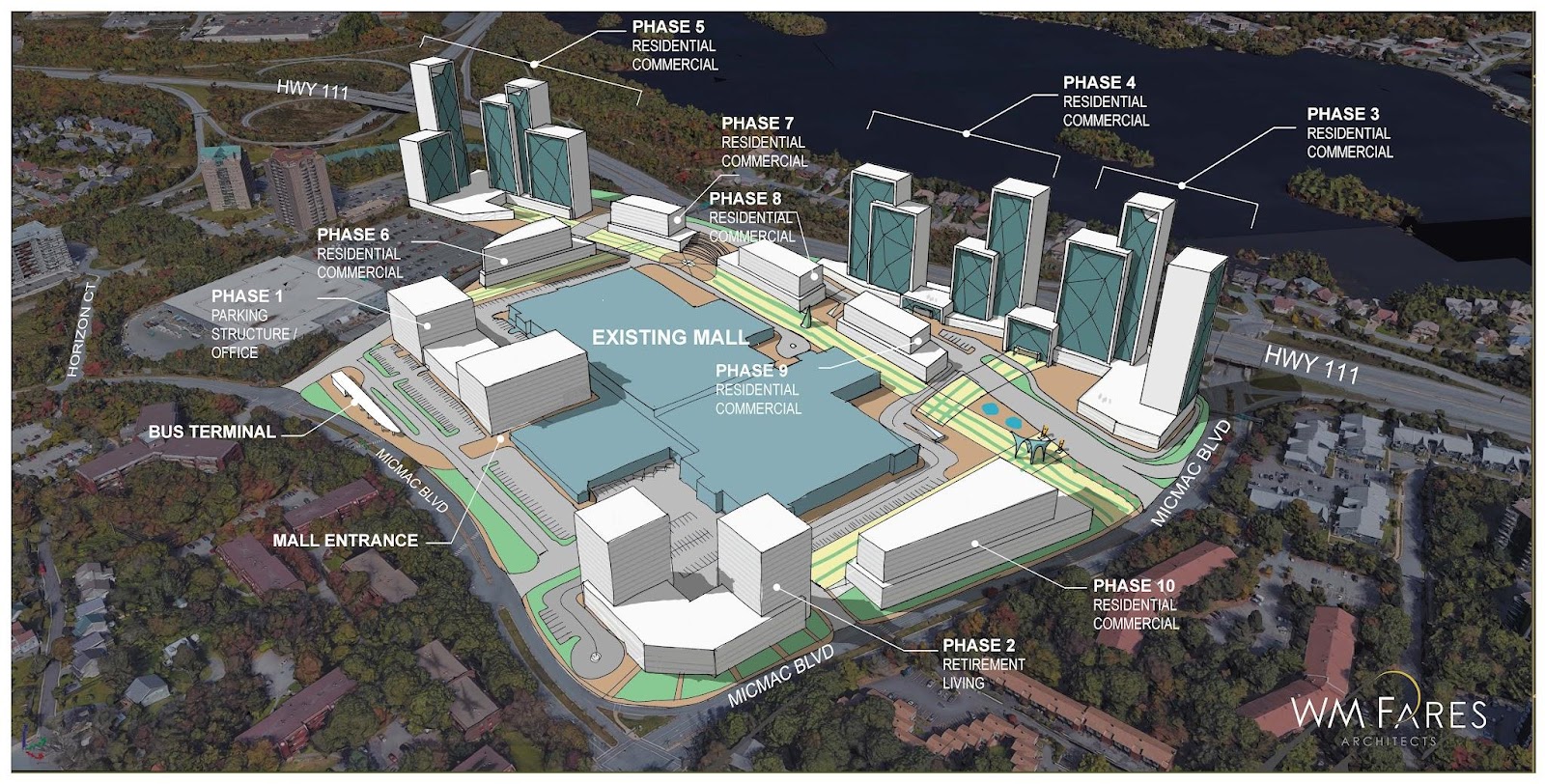
The plans for The M District Future Growth Node in the Halifax Regional Municipality add housing density to redevelopment of a parking area for a shopping centre that is located next to a main transit hub. This plan resonates with the desire to build more apartments near railway stations in New York suburbs. HRM will begin a second phase of public engagement in Fall 2023 once draft planning documents are ready to be presented for comment and feedback. 


WM Fares Architects,on behalf of Rank Inc., has applied to begin a comprehensive planning process to allow the development of the Mic Mac Mall lands bound by Micmac Boulevard, Horizon Court, and Highway 111, identified on the map below. The proposal includes approximately 2,200 new residential units, plus 400 units for retirement living and additional commercial office and retail space built around the existing mall. (The M District Future Growth Node, n.d.)


(The M District Future Growth Node, n.d.) https://s3.ca-central-1.amazonaws.com/ehq-production-canada/e9442aaa2ad3ee97b2fe4ff6f6c6f27a7cd81dc6/original/1684439044/9103f74919d6e082614968facf136e66_3D_Context_View.jpg?1684439044 


An earlier post, Housing and Investment, considers the questions: 


  • Is housing a basic human right or an investment?
  • Can homes and apartments be commodities and at the same time be considered a basic human need?


These concerns need to be included in the development plans for the M District.


Another earlier post, considers the role of Supply or Speculation in the lack of affordable housing.


Supply or Speculation?


The post, Housing and Ideology, suggests the involvement of the government in building housing has been successful in the past and may again offer the possibility of redevelopment of federal land in the centre of HRM that would include non market affordable housing.


Housing and Ideology


The need to address homelessness in HRM will be immediate as winter approaches. The alleviation of the housing crisis is urgent and requires action to maintain the status of HRM as a place to support living and working.


References


Fawcett, M., & Logan, C. (2023, September 7). Pierre Poilievre's housing prescription doesn't add up. National Observer. Retrieved September 8, 2023, from https://www.nationalobserver.com/2023/09/07/opinion/pierre-poilievre-housing-prescription

The growing global movement to restrain house prices. (2023, September 6). The Economist. Retrieved September 8, 2023, from https://www.economist.com/international/2023/09/06/the-growing-global-movement-to-restrain-house-prices

The M District Future Growth Node. (n.d.). Shape Your City Halifax. Retrieved September 8, 2023, from https://www.shapeyourcityhalifax.ca/the-m-district-development

Roberts, J. (2021, September 17). Fixing Canada's housing crisis will require bold socialist politics ⋆ The Breach. The Breach. Retrieved September 5, 2023, from https://breachmedia.ca/fixing-canadas-housing-crisis-will-require-bold-socialist-politics/