Showing posts with label Poilievre. Show all posts

Wednesday, March 27, 2024

Canadian Economists explain Carbon Tax.

Laura Osman of the Canadian Press, in an article in the Globe and Mail notes that every province and territory in Canada has been subject to a carbon price since 2019, with a choice between enacting their own version that meets federal standards or using a federal program. Most use the federal version for consumers and small businesses, while most have their own system for big industry. Conservative Leader Pierre Poilievre has promised to make the carbon price the central issue in the next election.

Canada is number ten for historic GHG

Economist Chris Ragan, director of the Max Bell School of Public Policy at McGill University, who helped draft an open letter defending the policy comments that: 

“The issue has clearly been heating up,... The quality of the debate, I think, is not quite as good as it should be.” (Osman, n.d.)

Ragan said he hopes the economists’ letter better informs that debate, and gives ammunition to politicians who are defending the policy. Ultimately he wants to see the carbon price become politically mainstream.

While the main political criticism of the program is the cost to consumers, the economists say a carbon price is actually the least costly way to lower emissions.


“Other methods, such as direct regulations, tend to be more intrusive and inflexible, and cost more,” the letter states. (Osman, n.d.)

Canadian economists have released an open letter to add professional knowledge to the important discussion of the role of carbon tax in reducing GHG emissions in our efforts to mitigate the effects of climate change. Five claims by carbon tax critics are addressed by presenting evidence.

Claim #1: Carbon pricing won’t reduce GHG emissions.

Evidence shows it reduces GHG emissions at a lower cost than other approaches. The Canadian Climate Institute shows that federal and provincial carbon pricing, for industries and consumers, is expected to account for almost half of Canada’s emissions reductions by 2030. Carbon pricing is the lowest cost approach because it gives each person and business the flexibility to choose the best way to reduce their carbon footprint. Other methods, such as direct regulations, tend to be more intrusive and inflexible, and cost more. (An Open Letter From Economists on Canadian Carbon Pricing, n.d.)

Claim #2:  Carbon pricing drives up the cost of living and is a major cause of inflation.

Evidence shows that Canadian carbon pricing has a negligible impact on overall inflation. According to the Bank of Canada, carbon pricing has caused less than 1/20th of Canada’s inflation in the past two years. Most families receive more money in rebates than they pay in carbon pricing, particularly those with low or medium incomes. (An Open Letter From Economists on Canadian Carbon Pricing, n.d.)

Claim #3:  It makes little sense to have both a carbon price and rebates.

Evidence shows that the price-and-rebate approach provides an incentive to reduce carbon emissions (due to the price), while maintaining most households’ overall purchasing power (due to the rebate). Carbon pricing works by raising the price of carbon-intensive products, so consumers and businesses are incentivized to adopt lower-carbon options, such as smart thermostats, heat pumps, or hybrid/electric vehicles. Those that reduce emissions the most will come out further ahead; they will pay less in carbon fees but still get the full rebate. (An Open Letter From Economists on Canadian Carbon Pricing, n.d.)

Claim #4: Carbon pricing harms Canadian business competitiveness.

The output-based system is designed to maintain industries’ competitiveness: ensuring that the carbon price does not hamper their ability to stay profitable and generate jobs in Canada while competing internationally. In addition, carbon pricing stimulates innovation by encouraging the development and adoption of low-carbon technologies. These incentives help Canadian businesses—in all sectors—stay competitive in the global transition to a low-carbon economy. (An Open Letter From Economists on Canadian Carbon Pricing, n.d.)

Claim #5:  Carbon pricing isn’t necessary.

Canada has many economic challenges to address. In a world of scarce resources, it seems imprudent to abandon carbon pricing, only to replace it with more costly methods of reducing emissions—or, worse still, take no measures to reduce emissions. In short, carbon pricing is the least-cost way to reduce emissions, drive green innovation, and support Canada’s transition to a clean and prosperous economic future. (An Open Letter From Economists on Canadian Carbon Pricing, n.d.)

Skilled tradespeople are employed to do serious construction and maintenance. Health Professionals are charged with our well being. Economists have the expert skill to assess the effect of climate change policy on our financial situation and future well being of Canada in a low carbon economy.


References


An Open Letter from Economists on Canadian Carbon Pricing. (n.d.). Retrieved March 27, 2024, from https://sites.google.com/view/open-letter-carbon-pricing 

Osman, L. (n.d.). Economists defend Liberals’ carbon price as political rhetoric heats up. Wikipedia. Retrieved March 27, 2024, from https://www.theglobeandmail.com/business/article-economists-defend-liberals-carbon-price-as-political-rhetoric-heats-up/ 


Sunday, February 4, 2024

Facts and Four Points

The slogans “Axe the Tax” and “Build the Homes” resonate with major economic concerns of Canadians. The devil is in the details when we study the best way to implement effective taxation that accomplishes our need to address climate change and finance the building of the housing needed to address emergency homelessness in our country.


How to Action The Slogans 


Aaron Wherry of CBC News reports that beneath the back-and-forth over the Liberal government's carbon tax and the Conservative leader's agenda, Justin Trudeau and Pierre Poilievre are also duelling over very different theories of change.


Much of what's wrong with the way things are can be traced, Poilievre suggests, to higher levels of federal spending under Trudeau. For Poilievre, that spending marked a particularly dramatic break with the past and with a historic consensus.


"Balancing the budget to keep inflation and interest rates low was the unanimous policy of all the major political parties at all levels of government for 30 years, right up to the radical departure [in 2015]," he said. 


Wherry points out that if the way things were in 2015 is to be a point of reference, it's equally fair to note how much higher greenhouse gas emissions were projected to be back then, how many more Indigenous communities lacked access to clean drinking water, how many more children were living in poverty and how much higher child care fees were. (Wherry, 2024)


Things are changing — the planet's climate certainly is. And Trudeau can argue that significant parts of his government's agenda have been about meeting the need for change and preparing Canadians for the future.


But it's on his ability to "tackle" the problems of today that he is being challenged — and earlier action on housing would have put him in a better place now, even if provincial and municipal governments deserve significant amounts of blame for the current situation.


Opposite Trudeau, Poilievre is laying the rhetorical groundwork to do things very differently — even if he frames it in terms of simply changing things back to way they were. The more he can convince people that the country is in terrible shape — and that everything currently wrong with it can be blamed on Trudeau — the easier it becomes for him to justify doing something close to the opposite. (Wherry, 2024)


Paul Kershaw, in a special article in the Globe and Mail, comments that if you make a mess, you should help clean it up. That’s a responsibility his Mom taught him.


As the House of Commons returned to session, Pierre Poilievre, the Conservative Leader, betrayed this family value by courting voters with his promise to eliminate responsibility to pay for our pollution.


Whether to pay for pollution isn’t about consumer preferences. It’s a duty we owe to our kids. We need our politicians to recognize as much if they are to identify real solutions to the affordability crisis, and to reduce risks from extreme weather.


A new Abacus poll signals Mr. Poilievre has convinced many Canadians that the price on pollution is a primary source of financial pain. Alas, research from the University of Calgary shows he is pulling the wool over our eyes. (Kershaw & Urback, 2024)


Professors Trevor Tombe and Jennifer Winter in a report for the School of Public Policy, University of Calgary, calculated the direct and indirect costs of the carbon tax to examine the entire financial impact of the tax relative to its absence. They use data from British Columbia, where the carbon price is the same as that levied by the federal plan. They found that carbon pricing adds 0.5 per cent to the cost of food and beverages; 0.29 per cent to rent; 0.2 per cent for clothing and footwear; and less than 0.13 per cent for insurance and financial services.


While some politicians and policymakers are blaming emissions pricing for high costs of living, the figure shows that the actual effect is quite modest for most items.


Emissions pricing is just one of many indirect taxes that households face. Other examples are sales taxes and alcohol levies. We estimate that the combined effect on Canadian consumer prices from all indirect tax increases between January 2015 and October 2023 was 0.6%.

Knowing that much of the present affordability crisis is due to factors other than emissions pricing, the elimination of the carbon tax is unlikely to solve the problem. As Canada slowly recovers from high inflation in 2021 and 2022, policy makers will need to consider alternative solutions. (Tombe & Winter, n.d.)


Geordie Dent, in an article for The Breach, concludes that cheap money and privatization made housing unaffordable, but organizing can reverse the tide


Canada used to build a decent amount of social housing. By ensuring that low-income renters had affordable options, the government kept the market honest and stopped housing speculation from spiraling into feedback loops.


Until around 1993, Canada funded the construction of 10,000 or more social housing units in a typical year. 


So what happened in 1993? That’s the year the federal Liberals were elected on a platform of progressive promises. But once in power, they pivoted to a policy of fiscal austerity. Finance Minister Paul Martin slashed housing spending to almost nothing. 


The construction of housing had been completely privatized. (Dent, 2023)


The recent climate disasters in Canada require a taxation strategy to incentivize transition to a carbon reduced economy. Research shows the additional tax burden adds less than 1% to most of the purchases of Canadians. Because we cannot expect the market to build below market housing, social housing for Canadians living in tents needs to be a Government responsibility.


References

Dent, G. (2023, February 2). The global money pool that soaked Canada's hope of affordable housing ⋆ The Breach. The Breach. Retrieved February 4, 2024, from https://breachmedia.ca/the-global-money-pool-that-soaked-canadas-hope-of-affordable-housing/

Kershaw, P., & Urback, R. (2024, February 2). Pushing to 'Axe the Tax' is unfair to our kids. The Globe and Mail. Retrieved February 4, 2024, from https://www.theglobeandmail.com/investing/personal-finance/young-money/article-pushing-to-axe-the-tax-is-unfair-to-our-kids/ 

Tombe, T., & Winter, J. (n.d.). ENERGY & ENVIRONMENTAL EMISSIONS PRICING AND AFFORDABILITY: LESSONS FROM BRITISH COLUMBIA. The School of Public Policy. Retrieved February 4, 2024, from https://www.policyschool.ca/wp-content/uploads/2023/12/EE-Trends-DEC.pdf 

Wherry, A. (2024, February 3). Trudeau and Poilievre have very different theories of change. CBC. Retrieved February 4, 2024, from https://www.cbc.ca/news/politics/trudeau-poilievre-election-1.7103710


Friday, September 8, 2023

Getting Back to Building Housing

A previous post, Housing Crisis Recent History, touched on the government decisions that have led to social housing austerity in Canada and the need for a large-scale community-based land acquisition strategy based on sustainable living, not returns for investors.


Housing Crisis in the Suburbs


This curation of opinion urges government to get back in the game in one instance and for less restrictions on development in the backyards of our cities.


Building in our Backyard


Max Fawcett, in an opinion piece in the National Observer, argues that the government needs to return to driving housing construction because he concludes that Pierre Poilievre’s housing prescription doesn’t add up.


Rather than government getting “out of the way,” as Poilievre suggests, it needs to find ways to get back in the game. This is where the Liberals and New Democrats have to come in. We need an alternative to Poilievre’s dumbed-down approach that trades in half-truths and gerrymandered data. We need an optimistic vision of the future in which Canadians aren’t forced to choose between urban sprawl and economic survival. And we need solutions that target the real stress points in our housing ecosystem rather than cutting a blank cheque to politically connected developers.


But Ford did manage to transfer more than $8 billion of wealth onto the balance sheets of a small handful of developers, some of whom just happened to be donors to his Ontario PC Party. And that, in the end, is the more likely priority here for conservatives: not affordability or justice for younger Canadians but the elimination of anything that stands between home builders and their profits. Yes, the private sector has a major role to play in addressing the housing crisis, but it’s one that should be very carefully defined by governments. The sooner they get back into this game, the better off we’ll all be. (Fawcett & Logan, 2023)


The Economist has published an article analysing the growing global movement to restrain house prices. “Yes In My Back Yard” (YIMBY) advocates argue that housing shortages are caused largely by laws that control who can build what and where. Zoning and planning laws, they say, are so strict that building new housing is in many places completely illegal, and in almost all it is slow, difficult and expensive.


Not everyone agrees on everything. YIMBYS range from libertarian-leaning tech types through to self-described socialists, such as John Bauters. He is the bicycle-riding mayor of the tiny Californian city of Emeryville, who allows development because it gives him more rich people to tax. Yet all share one belief: more housing needs to be built, especially in the biggest and costliest cities.


At the higher levels of politics at least, Yimbyism is now practically mainstream in California. “Pro-housing policies are pro-job policies,” tweeted London Breed, San Francisco’s mayor, in July. Gavin Newsom, the state’s governor, promised to build 3.5m homes in a speech for his election campaign. Across the state such politicians are engaged in an increasingly pitched legislative battle with local politicians, such as city council members and the leaders of suburbs, who are generally determined not to build more.


Yimbyism abounds elsewhere, too. In New York this year Kathy Hochul, the state governor, (unsuccessfully) proposed a radical “upzoning”, approving a greater density of housing in a particular area. She argued that it would allow the construction of 800,000 more homes over a decade, primarily by letting more apartments be built around railway stations in New York City’s suburbs. In Canada, Pierre Poilievre, who leads the opposition Conservative Party, wants the federal government to be able to force municipalities to allow more housing construction. Both major political parties in Britain say they want more houses built, no doubt mindful of an election expected next year. (The Growing Global Movement to Restrain House Prices, 2023)


YIMBY proposals

more apartments built around railway stations in suburbs.

federal government force municipalities to allow more housing construction.

“Pro-housing policies are pro-job policies,”


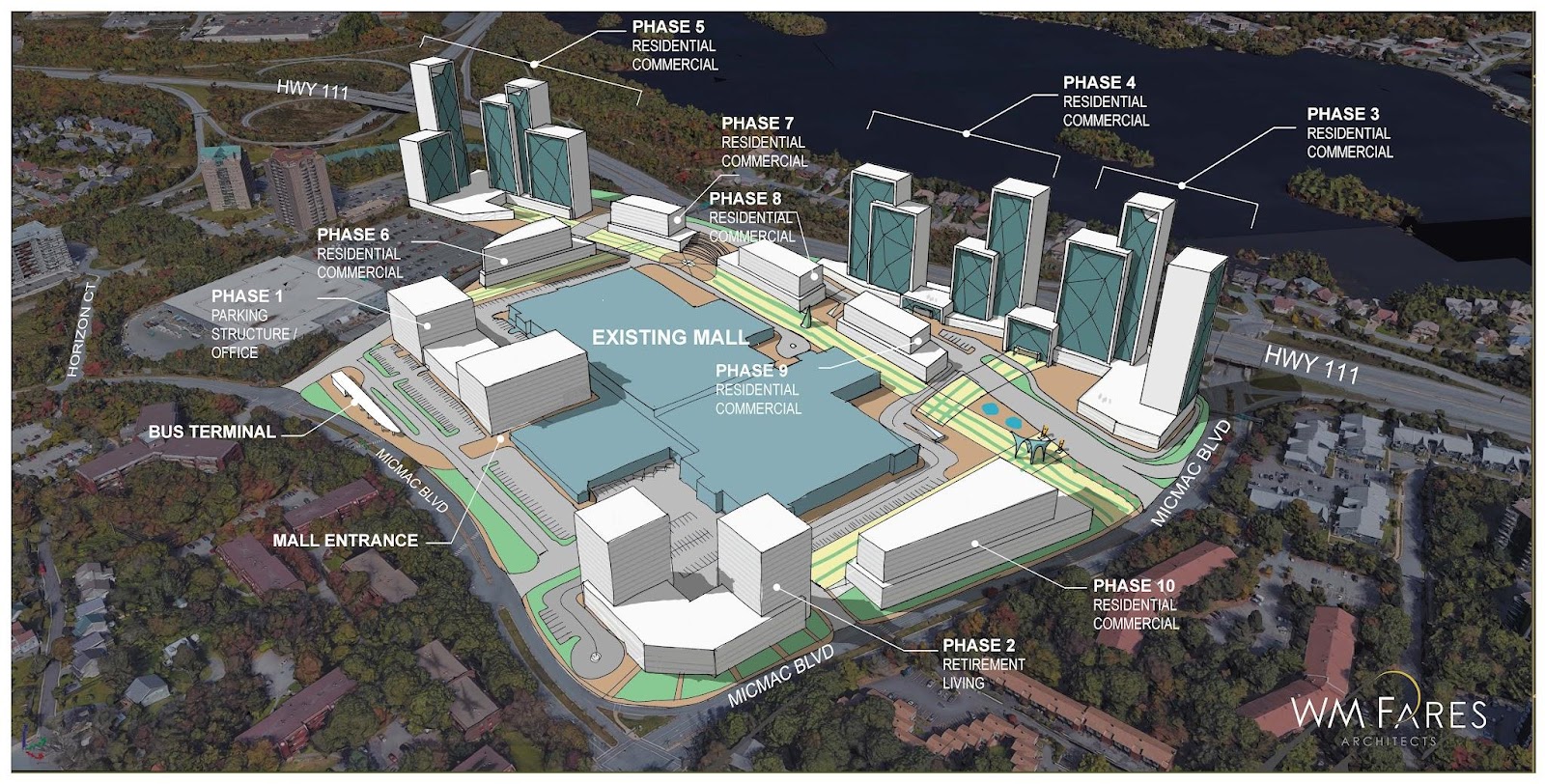
The plans for The M District Future Growth Node in the Halifax Regional Municipality add housing density to redevelopment of a parking area for a shopping centre that is located next to a main transit hub. This plan resonates with the desire to build more apartments near railway stations in New York suburbs. HRM will begin a second phase of public engagement in Fall 2023 once draft planning documents are ready to be presented for comment and feedback. 


WM Fares Architects,on behalf of Rank Inc., has applied to begin a comprehensive planning process to allow the development of the Mic Mac Mall lands bound by Micmac Boulevard, Horizon Court, and Highway 111, identified on the map below. The proposal includes approximately 2,200 new residential units, plus 400 units for retirement living and additional commercial office and retail space built around the existing mall. (The M District Future Growth Node, n.d.)


(The M District Future Growth Node, n.d.) https://s3.ca-central-1.amazonaws.com/ehq-production-canada/e9442aaa2ad3ee97b2fe4ff6f6c6f27a7cd81dc6/original/1684439044/9103f74919d6e082614968facf136e66_3D_Context_View.jpg?1684439044 


An earlier post, Housing and Investment, considers the questions: 


  • Is housing a basic human right or an investment?
  • Can homes and apartments be commodities and at the same time be considered a basic human need?


These concerns need to be included in the development plans for the M District.


Another earlier post, considers the role of Supply or Speculation in the lack of affordable housing.


Supply or Speculation?


The post, Housing and Ideology, suggests the involvement of the government in building housing has been successful in the past and may again offer the possibility of redevelopment of federal land in the centre of HRM that would include non market affordable housing.


Housing and Ideology


The need to address homelessness in HRM will be immediate as winter approaches. The alleviation of the housing crisis is urgent and requires action to maintain the status of HRM as a place to support living and working.


References


Fawcett, M., & Logan, C. (2023, September 7). Pierre Poilievre's housing prescription doesn't add up. National Observer. Retrieved September 8, 2023, from https://www.nationalobserver.com/2023/09/07/opinion/pierre-poilievre-housing-prescription

The growing global movement to restrain house prices. (2023, September 6). The Economist. Retrieved September 8, 2023, from https://www.economist.com/international/2023/09/06/the-growing-global-movement-to-restrain-house-prices

The M District Future Growth Node. (n.d.). Shape Your City Halifax. Retrieved September 8, 2023, from https://www.shapeyourcityhalifax.ca/the-m-district-development

Roberts, J. (2021, September 17). Fixing Canada's housing crisis will require bold socialist politics ⋆ The Breach. The Breach. Retrieved September 5, 2023, from https://breachmedia.ca/fixing-canadas-housing-crisis-will-require-bold-socialist-politics/