Wednesday, March 29, 2023

Help for Health Housing Here

Government budgets have recently provided some attention to the crisis in health and housing that we are experiencing across Canada.


Housing Options in HRM


The challenge of providing primary health care to Nova Scotians is evidenced by over 100,000 people who have no family physician.

Doctor Parking Empty


Some Governments have promised bonus payments to health care professionals to retain them in positions that are becoming increasingly challenging as workload increases.


Bonus for long hours with short staff


The path to timely resolution of these challenges to our assumption that Canada is a wealthy progressive society that can take care of the needs of it’s residents may require us to decide in which ballpark we can expect to find help.


Consider Health and Housing as Human Right


In healthcare, jurisdictions across Canada have sought the help of entrepreneurial enterprises who have provided resources for virtual access to primary care and supplemental diagnostic testing and surgery services. The principals of these organizations use the language of “target market” and “customer” in describing their operations. 


Health and Housing is a Right Here


A nation of 11 Million that is a very popular sun destination for Canadians, the Republic of Cuba, has defined health care and housing as rights for it’s citizens in its constitution. During the Obama administration, the loosening of the US Embargo on Cuba saw the flourishing of a small market economy and increased tourist and economic involvement with the United States. The Trump administration reversed the Obama policy and took aggressive action to severely inhibit economic activity between the US and Cuba.


Canada has a much better relationship with Cuba and many Canadian visitors have encountered well educated Cubans working in the resort industry. Surprisingly, the largest source of government income in Cuba is not from tourism but from export of medical services to countries in the Global South.


Canadians encounter well educated Cubans


The government's responsibility to maintain health and housing as a right for residents in Cuba has necessitated maintaining a high quality education system that supports health and economic development in the country.


On the road to Havana


Health and housing are too essential to the success of a society to be left to the market that best serves profit and short term gain for shareholders rather than community needs that are long term. Healthy, educated people with housing are essential to maintain our health, education, and business infrastructure. 


Canadians can learn from Cuba that government support to create health care and housing as a right for people is a wise investment in creating the healthy educated community that is required to build the infrastructure that is now required in Canada as we prepare to address the transitions required to respond to the climate crisis and the worldwide migration emergency.

Monday, March 13, 2023

Pope Francis 10 years on

An editorial in the National Catholic Reporter comments that looking back from 2023, it is hard even to conjure up the shape of the church at the eve of that conclave in 2013 that elected Cardinal Jorge Bergoglio as “Pope Francis”.


Ten Years Ago


It was a church of secret investigations of theologians. Of unjustified crackdowns on the work of U.S. women religious. Of the atrophy of the vision of the Second Vatican Council, and the comeback of the pre-conciliar Latin Mass. Of bishop after bishop being found to have covered up sexual abuse or misconduct, and being allowed to stay in office.  


It was a church before the call to create a "culture of encounter." Before the vision of a community that is "bruised, hurting and dirty because it has been out on the streets." Before the declaration of "no concession" to those who would walk back Vatican II reforms. Before prioritizing the "ecological commitments which stem from our convictions." Before mandatory reporting of suspicion of abuse or cover-up, worldwide. (Editorial: Over 10 Years, Pope Francis Has Opened the Church Reform Door. Time to Step Through., 2023)


And Today

After ten years, it is important to reflect on the changes and our response.


References

Editorial: Over 10 years, Pope Francis has opened the church reform door. Time to step through. (2023, March 13). National Catholic Reporter. Retrieved March 13, 2023, from https://www.ncronline.org/opinion/editorial/editorial-over-10-years-pope-francis-has-opened-church-reform-door-time-step 


Saturday, February 25, 2023

Life Cycle Emissions ICE or EV

Gasoline car emissions have been reduced in the UK and Norway. Barry Saxifrage reports that their most effective single policy has been a "polluter pays" tax added to new cars. Specifically, they calculate the purchase tax for new cars based on car weight, CO2 emissions and NOx emissions.


Barry Saxifrage's first chart shows the relative climate emissions from fuelling our cars with gasoline and electricity.


Research shows that making a gasoline car is currently a bit less climate-polluting than making an electric car. Around 2 tCO2 less. But this small advantage gets wiped out many times over by the extra emissions from fuelling the car.


A chart showing the latest vehicle registration numbers from Statistics Canada shows that electric cars are a thin green frosting on top of an ever-expanding fleet of burnermobiles. For every new electric car added to our roads over the last five years, we've added 10 more gasoline cars.


The trend in Canada is an increase in purchases of gasoline cars, SUV’s, and trucks as contrasted by decreases in these purchases in Norway, UK, France, Germany, Sweden, and Japan. Barry Saxifrage notes that the most effective single policy in Norway has been a "polluter pays" tax added to new cars. Specifically, they calculate the purchase tax for new cars based on car weight, CO2 emissions and NOx emissions. This can nearly double the cost of buying a polluting gas guzzler. Imagine Canada bringing in an 80 per cent sales tax on big, new gas-guzzling SUVs and you've got the basic idea.


As Canadians switch to electric vehicles in response to the increasing cost of gasoline and concern for the effect of greenhouse gas emission on the increasing frequency and severity of climate events in our country, we may find “polluter pay” taxation to be an effective strategy


References


Saxifrage, B., & Woodside, J. (2023, February 24). Gasoline versus electric cars? Here's how their life cycle emissions compare in Canada. National Observer. Retrieved February 24, 2023, from https://www.nationalobserver.com/2023/02/24/analysis/gasoline-versus-electric-cars-life-cycle-emissions-compared-canada

Friday, February 3, 2023

CST and Papal Positions

Tony Annett's book Cathonomics explores how Catholic tradition can create a more just economy. The encyclicals published during the papacies of recent decades offer a view of economic activity in relation with the pursuit of the common good.


Better world


The rise of neo-liberal attitudes to economic development in recent decades has created a paradigm that threatens the priority of striving for the common good.


John Paul II incorrect as neo-liberal


John Paul II was concerned about some aspects of market ideology.


JPII concern about markets


Profit seeking, self interest and accumulation in the market were concerns of Pope Benedict.


Benedict's concern about profit seeking


Pope Francis identifies a technocratic paradigm that cannibalizes economic and political life.


Pope Francis identifies a technocratic paradigm


From 1978 to 2023, encyclical publications from the Vatican have presented the case for concern about the effect on the common good of the dominant economic policies of our time.


References

Annett, A. M. (2022). Cathonomics: How Catholic Tradition Can Create a More Just Economy. Georgetown University Press.


Friday, January 20, 2023

It’s all over except the shouting

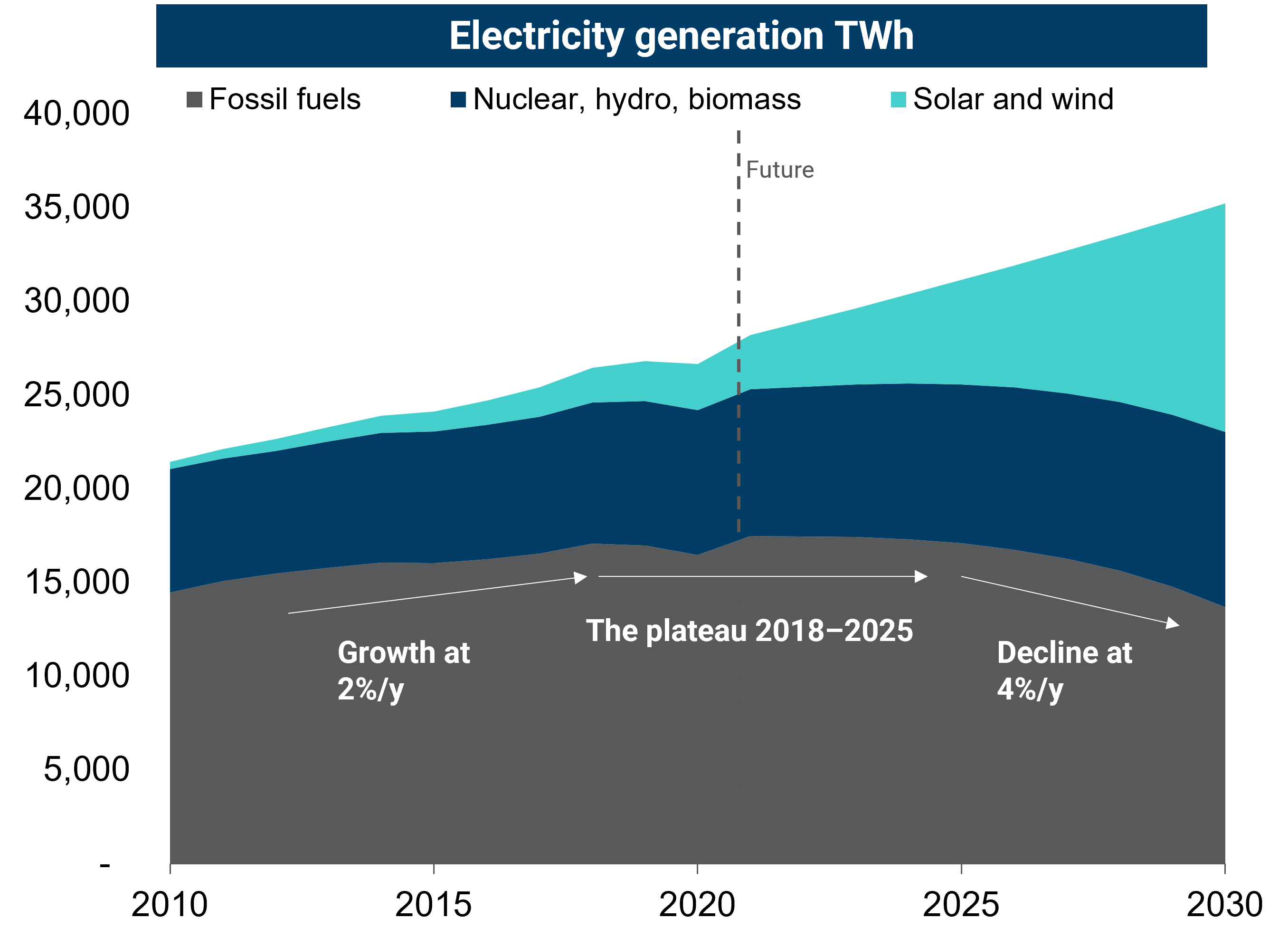
Kingsmill Bond,  Sam Butler-Sloss,  Genevieve Lillis,  and Matt Sugihara highlight a report in the latest installment of The Peaking Series that shows demand for fossil fuels has peaked in the electricity sector. It will plateau for a few years and be in clear decline by the second half of the decade.


Peak of fossil fuel


The key driver of change is the rapid growth of solar and wind electricity generation on typical S-curves, driven by low costs, a shift of global capital, and the rising ceiling of what is possible.


In 2022, solar and wind will produce 600–700 TWh of new electricity. Added to the 100–200 TWh from other clean sources makes it enough to meet projected global electricity demand growth of around 700 TWh. (Bond et al., 2023)


References

Bond, K., Butler, S., Lillis, G., & Sugihara, M. (2023, January 19). Peak Fossil Fuel Demand for Electricity. RMI. Retrieved January 20, 2023, from https://rmi.org/insight/peak-fossil-fuel-demand-for-electricity/ 


Tuesday, January 17, 2023

New Waterford Community Hub sets the bar high for primary care

An update on ideas about a Health Care and Education Community Campus model ( Friday, November 4, 2022) are reflected in the plans for building the New Waterford Community Hub.


 CBRM Health Care Redevelopment Project,


As part of the CBRM Health Care Redevelopment Project, New Waterford and the surrounding area will have a new, modern health centre and a 60-bed long-term care home. Both will be built on the Breton Education Centre school site, along with a new, modern school, creating a community hub. The project also includes 12 (sub-acute) short-stay beds.


The community hub model (health centre, long-term care home, and school) will create hands-on learning opportunities and new programming for students in health-care related fields. It also allows for opportunities to share facilities and maintenance services. (New Waterford Community Hub – Building Tomorrow, n.d.)


This plan that brings primary and secondary health care to communities under an education-like structure will elevate the general health of the province, reduce overall health care cost, and increase equity in access to care.


References

New Waterford Community Hub – Building Tomorrow. (n.d.). Building Tomorrow. Retrieved January 17, 2023, from https://building-tomorrow.ca/projects/new-waterford-community-hub/ 


Thursday, January 12, 2023

Healthcare in Nova Scotia and Kenya

As Nova Scotia prepares to welcome continuing care assistant health care professionals from Kenya to increase the number of primary care workers in our Province, at a time when we are in serious need of more support for our residents, we may, at the same time, be reducing the ability of the healthcare system in Kenya to respond to health needs in that country.


Help for Health Care


The World Population Review website has published rankings of the world’s health care systems by Lisa Brown writing in CEOWORLD magazine, a highly-respected business publication covering everything important to ​CEOs, senior executives, business leaders, and high net worth individuals, from business to finance, politics to economics, lifestyle to travel, both at home in the United States and globally.


Rank

Country

Health Care Index (Overall)

Infrastructure

Professionals

Cost

Medicine Availability

Readiness

1

South Korea

78.72

87.16

14.23

83.59

82.3

87.89

2

Taiwan

77.7

79.05

13.06

78.39

78.99

65.09

3

Denmark

74.11

90.75

30.01

82.59

92.06

96.3

23

Canada

48.64

62.39

16.89

55.73

52.91

89.75

70

Kenya

35.16

69.92

16.86

53.1

51.23

89.62

71

Kuwait

35.09

89.14

15.32

70.55

89.2

88.98

72

Dominican Republic

34.97

66.12

21.08

51.05

62.85

92.5

89

Venezuela

32.42

71.39

17.16

52.53

53.7

89.84


Partial list from Countries With The Best Health Care Systems


Canada is rated at number 23 in this list and Kenya is number 70. Professionals in health care are rated at just below 17 for both countries. (Brown, 2021)


These numbers beg the question about the effect on Kenya by the immigration of skilled and capable health professionals to Nova Scotia.


Lara Yacoub and Solomon Johnson writing for Spheres of Influence, a non-profit digital publication dedicated to highlighting underreported stories in global affairs and amplifying marginalized voices, report on what the closure of the Dadaab and Kakuma refugee camps means for residents.


Health Care, for example, is an area of particular concern due to the loss of services that many refugees rely on. According to Médecins Sans Frontières (MSF), in Dagahaley alone, one of the three divisions of the ​​Dadaab refugee complex, over 300 people require regular medication for “chronic diseases such as HIV/AIDS, tuberculosis, and a variety of cancers, as well as neurological disorders.” 


Additionally in Dagahaley, about 50 people “require continued care for diabetes,” including the supply of insulin, a medication many are likely to not have access to after the closure of these camps. MSF also carries out about 700 “life-saving surgeries per year in this area of the camp, such as vital cesarean sections for mothers. (Yacoub & Johnson, 2022)


The Nova Scotia Office of Healthcare Professionals Recruitment / Labour, Skills and Immigration

has announced that more continuing care assistants will soon be moving to Nova Scotia to work, the result of a recent recruiting trip to Kenya. 


“One of the biggest challenges we face is finding the right healthcare professionals to fill the vacancies we have across Nova Scotia,” said Health and Wellness Minister Michelle Thompson, the Minister responsible for the Office of Healthcare Professionals Recruitment. “There are talented and skilled people around the world who would love to come here, and we would love to have them.”


The Province led the trip to a Kenyan refugee camp in partnership with the United Nations High Commission for Refugees, Health Association of Nova Scotia, and MacLeod Group, which provides senior care across Atlantic Canada, as well as refugee-focused charities The Shapiro Foundation and RefugePoint.


The new continuing care assistants are expected to start arriving in mid-2023 and will work in the continuing care sector in communities across the province. (Healthcare Workers Coming to Nova Scotia From Kenya, 2023)


The details of the possibility of refugee health care personnel to find work in Kenya, the possibility of education and experience in Canada for the refugees to return to Kenya better equipped to serve that country, and the degree to which we value the choice of these refugees to choose life in Canada even if they are in greater need in East Africa, are some of the ethical and moral aspects of this emigration that helps first world Canada and may disadvantage people of the Global South.


References

Brown, L. (2021, April 27). Revealed: Countries With The Best Health Care Systems, 2021. CEOWORLD magazine. Retrieved January 12, 2023, from https://ceoworld.biz/2021/04/27/revealed-countries-with-the-best-health-care-systems-2021/ 

Healthcare Workers Coming to Nova Scotia from Kenya. (2023, January 4). Government of Nova Scotia. Retrieved January 12, 2023, from https://novascotia.ca/news/release/?id=20230104001 

Yacoub, L., & Johnson, S. (2022, February 10). What the Closure of the Dadaab and Kakuma Refugee Camps Means for Residents. Spheres of Influence. Retrieved January 12, 2023, from https://spheresofinfluence.ca/what-the-closure-of-the-dadaab-and-kakuma-refugee-camps-means-for-residents/