Showing posts with label education. Show all posts

Wednesday, June 10, 2026

Higher Education and Leadership

 The Center for American Progress is an independent nonpartisan policy institute that is dedicated to improving the lives of all Americans through bold, progressive ideas, as well as strong leadership and concerted action. Our aim is not just to change the conversation, but to change the country.


The Google AI overview on the topic “The Trump administration has reduced funding for health and education” presented the following summary drawing on information from the Center for American Progress.


The Trump administration (as of mid-2026) has proposed and implemented significant cuts to health and education, aiming to reduce federal spending by billions, targeting agencies like the CDC and NIH while seeking to eliminate specific education grants. Proposed budgets include slashing CDC funding by up to 50% and reducing NIH funding by over 10%.


On April 3, 2026, President Donald Trump submitted his annual budget request to Congress, calling for historic cuts to domestic funding and shifting that money toward historic increases in the military budget. Across steep cuts to education, housing, health, and other priorities, the budget calls for cutting nondefense discretionary funding—the portion of the budget that funds most domestic activities aside from Medicare, Medicaid, Social Security, and the Supplemental Nutrition Assistance Program (SNAP)—to its lowest levels as a percentage of gross domestic product (GDP) since at least the Eisenhower administration. In contrast, the Trump administration’s budget calls for the biggest annual increase in the military budget as a share of GDP outside a ground war in U.S. history—and the largest increase inclusive of ground wars in more than 50 years. Within the context of the war in Iran, the budget should be seen as taking money away from Americans and sinking it into war. (Miller, n.d.)


The Associated Press is the essential global news network, delivering fast, unbiased news from every corner of the world to all media platforms and formats. AP reported that Donald Trump decisively won Nevada's Republican caucuses for his third straight victory in February 2016. Trump told supporters in Las Vegas that he got votes from well educated and poorly educated people, adding "I love the poorly educated." (Feb. 24, 2016).


The leaders in Canada and Mexico may not be recipients of the love of the President for the poorly educated.


References

Miller, A. (n.d.). About Us. Center for American Progress. Retrieved June 10, 2026, from https://www.americanprogress.org/about-us/


Tuesday, January 16, 2024

UBI and Quality Public Services

What needs of the public should be addressed as necessities in our modern urban societies? In Canada, basic levels of healthcare and education are provided as universal public services. In a modern society, we need to consider housing, transport, social care and access to information as necessities that would benefit the whole society if they were provided at some level as a public service.


UBI or Universal Public Service for Housing


Anna Coote is principal fellow at the New Economics Foundation and co-author of Universal Basic Income: A Union Perspective (Public Services International) with Edanur Yazici. 


The report concludes that the money needed to pay for an adequate UBI scheme “would be better spent on reforming social protection systems, and building more and better-quality public services”. Redistributing the personal tax allowance and developing the idea of universal basic services (UBS) could offer a more promising alternative. This calls for more and better quality public services that are free to those who need them, regardless of ability to pay. Healthcare and education are obvious examples, and it is argued that a similar approach should be applied to areas such as transport, housing, social care and information – everyday essentials that should be available to all. Collective provision offers more cost-effective, socially just, redistributive and sustainable ways of meeting people’s needs than leaving individuals to buy what they can afford in the marketplace. (Coote, 2019)


Jaela Bernstien, is a Montreal-based journalist who covers climate change and the environment for CBC's online, radio and TV news programs. With over a decade of experience, her work has won several awards including a 2023 National RTDNA award, a 2023 Gold Digital Publishing Award, and a 2018 CAJ award for labour reporting.


In 2018, the government of British Columbia asked a panel of experts to study the feasibility of a basic income for the province. The resulting report found that "the needs of people in this society are too diverse to be effectively answered simply with a cheque from the government."


Panel chair David Green, a labour economist and a professor at the Vancouver School of Economics at the University of B.C., said the better solution is to reform the programs that already exist.


"If our problem is really, the full heterogeneous, complex issue of poverty — how do we make a more just society — then, in many cases, sending people a cheque and hoping they will do better is not going to answer the problem," 


Green said it would be better to tackle issues head-on, targeting poor working conditions and low wages, reforming the disability assistance program and boosting rent assistance. (Bernstien, 2021)


Guy Standing is professorial research associate at SOAS University of London. His new book is ‘The Blue Commons: Rescuing the Economy of the Sea’ (Pelican, 2022). He is a technical adviser to the basic income pilot being conducted by the government of Wales.


It's time for advocates of ‘Universal Basic Services’ to stop juxtaposing the idea of more and better public services with giving people basic income security.


Psychologists have found that basic security increases people’s IQ, and makes people more altruistic, tolerant, cooperative and productive, as workers and as citizens. Sadly, most economists and policymakers have given no value to basic security. A basic income would do so, whereas the menu of mainly targeted services being offered under the title of UBS would not. An income-insecure person with access to a free bus ride or even childcare or broadband would remain insecure.


Ultimately, there is no contradiction between having some public quasi-universal basic services and a basic income. They address different needs and stem from different rationales. But having cash enhances freedom of choice, is potentially more empowering and can be more transformative. I plead with those advocating ‘Universal Basic Services’ to stop juxtaposing the idea of more and better public services with giving people basic income security. (Standing, 2019)

 Jaela Bernstien reports that like economists, Canada's main parties are also divided on basic income, though none are promising universal basic income. Here's where they stand:
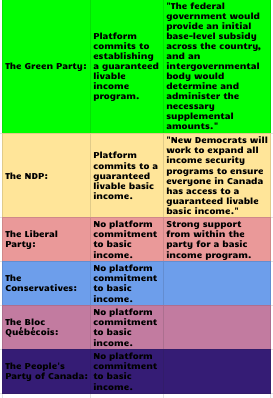
 

(Bernstien, 2021)

There is much to consider in the best approach to provide transport, housing, social care and information as basic necessities for people in an urban information society.


References

Bernstien, J. (2021, September 19). What is basic income and which of Canada's main parties support it? CBC. Retrieved January 16, 2024, from https://www.cbc.ca/news/canada-how-basic-income-works-1.6179760 

Coote, A. (2019, May 6). Universal basic income doesn't work. Let's boost the public realm instead | Anna Coote. The Guardian. Retrieved January 16, 2024, from https://www.theguardian.com/commentisfree/2019/may/06/universal-basic-income-public-realm-poverty-inequality 

Standing, G. (2019, June 6). Why 'Universal Basic Services' is no alternative to Basic Income. openDemocracy. Retrieved January 16, 2024, from https://www.opendemocracy.net/en/oureconomy/why-universal-basic-services-is-no-alternative-to-basic-income/ 


Tuesday, January 17, 2023

New Waterford Community Hub sets the bar high for primary care

An update on ideas about a Health Care and Education Community Campus model ( Friday, November 4, 2022) are reflected in the plans for building the New Waterford Community Hub.


 CBRM Health Care Redevelopment Project,


As part of the CBRM Health Care Redevelopment Project, New Waterford and the surrounding area will have a new, modern health centre and a 60-bed long-term care home. Both will be built on the Breton Education Centre school site, along with a new, modern school, creating a community hub. The project also includes 12 (sub-acute) short-stay beds.


The community hub model (health centre, long-term care home, and school) will create hands-on learning opportunities and new programming for students in health-care related fields. It also allows for opportunities to share facilities and maintenance services. (New Waterford Community Hub – Building Tomorrow, n.d.)


This plan that brings primary and secondary health care to communities under an education-like structure will elevate the general health of the province, reduce overall health care cost, and increase equity in access to care.


References

New Waterford Community Hub – Building Tomorrow. (n.d.). Building Tomorrow. Retrieved January 17, 2023, from https://building-tomorrow.ca/projects/new-waterford-community-hub/ 


Monday, July 26, 2021

Engineering the Green Transition

Recent articles in the engineering media point to the unique resources and responsibilities that engineering can bring to planning and building our infrastructure in a time of climate change.
Building for Climate Change


David Fork and Ross Koningstein, two Google engineers writing in the IEEE Spectrum claim that engineers can disrupt Climate Change and decarbonization, carbon capture, and solar-radiation management will provide work for decades to come.

Our opening battles in the war on climate change need engineers to work on the many existing technologies that can massively scale up. As already illustrated with wind, solar, and batteries, such scale-ups often bring dramatic drops in costs. Other industrial sectors require technological revolutions to reduce emissions. If you experiment with your own mix of climate-mitigation techniques using the En-ROADS interactive climate tool, you’ll see how many options you have to max out to change our current trajectory and achieve 350 ppm CO2 levels and a global temperature rise of no more than 1.5 °C.1 

The authors have compiled a set of engineering calculations that are important for engineering our response to climate change.

Goals and initial calculations (more detail in the article)[1]

1

We need to remove about 2000 gigatonnes of CO2 from the atmosphere

2

Humans use about 1 zettajoule of energy per year

3

To supply 1 zettajoule (ZJ) of energy per year with photovoltaic solar panels, we’d need to cover 1.6 percent of the planet’s land surface

4

To supply 1 ZJ of energy per year with nuclear power, we’d have to build three 1-gigawatt plants per day for 30 years

5

A 50-pound bag of concrete mix will cost about 42 cents more if the emissions from cement manufacturing are captured and stored

6

Removing 2,000 gigatonnes (Gt) of CO2 would account for roughly 2.8 percent of global GDP for 80 years

 Table of Engineering Considerations

Engineers Canada asks why is climate change important for engineers? Climate change is a significant and lasting change in weather patterns over periods ranging from decades to millions of years. It includes changes to temperature, precipitation and other climate parameters and changes in the frequency and severity of extreme weather events such as hurricanes, tornadoes and flash storms. In northern Canada climate effects on permafrost, ice-cover and snow loads are already apparent.

Much of Canada’s infrastructure has been in place for many years with designs based on existing climate patterns. With the effects of a changing climate, these designs need to be revisited to improve safety and protection for Canadians. Engineers, under their professional code of ethics, need to be involved in addressing the impacts of changing climate on infrastructure design and operations because it affects public safety and public interest.2 

Engineers are held to a higher standard of reasonable care than the average layperson. By virtue of the professional’s training and experience, they are expected to apply a high level of expertise to issues that affect their professional practice.

Professionals are expected to be aware of the limitations of their professional scope and access other qualified professionals to augment those areas where they may not be fully qualified to express professional judgment. Through extensive media coverage, the average layperson is cognizant of the climate change issue and its potential for disruptive and serious impacts. Similarly, the average engineer must also be sensitive to the potential for changing climate conditions and appropriately apply these sensitivities to their professional practice. Given the level of public awareness of the climate change issue, a professional cannot make the argument that they were unaware that climate change could potentially affect their professional work. 3 

Darrel Danyluk is a past president of Engineers Canada and of the Association of Professional Engineers and Geoscientists of Alberta. He is also a previous chair of the World Federation of Engineering Organizations Committee on Engineering and the Environment. David Lapp is a member of the WFEO Committee on Engineering and the Environment. They ask what are the key priorities for climate action within engineering? Some priorities for engineering should be:
  • Education of existing practitioners, students and educators;

  • Updating of existing codes, standards and guidelines or the creation of new ones where there are gaps;

  • Better evidence of costs and benefits of adaptation and building climate resilience, particularly for civil infrastructure and buildings; and

  • Developing multi-stakeholder concurrence on the need for adaptive and mitigative actions.


The main barrier is in implementation, which is often caused by a lack of financial commitment by decision-makers. Costs to mitigate and adapt to climate change are still uncertain and it’s difficult to obtain effective cost-shared agreements and division of responsibilities among stakeholders. In Canada, it’s sometimes difficult to coordinate and agree on actions between all three levels of government as there are jurisdictional and institutional limits to action. Some infrastructure owners aren’t prepared to invest in climate action measures, especially for designs that are outside of existing codes and standards that are becoming increasingly outdated as the climate changes. There’s also a reluctance to implement measures outside of existing guidelines and practices that often haven’t taken climate change into account.4

Calculating the material, workforce, and economic requirements to adapt and build resilience in our infrastructure is the traditional role of engineers. Now the costs and benefits of mitigative and adaptive measures need to be confirmed and included in building codes and construction practice.

References

1

(2021, June 28). Energy Engineers: You Can Disrupt Climate Change - IEEE Spectrum. Retrieved July 25, 2021, from https://spectrum.ieee.org/energy/renewables/engineers-you-can-disrupt-climate-change 

2

(n.d.). Climate Change and Engineering | Engineers Canada. Retrieved July 25, 2021, from https://engineerscanada.ca/public-policy/climate-change-and-engineering 

3

(n.d.). Principles of Climate Change Adaptation for Engineers. Retrieved July 25, 2021, from https://engineerscanada.ca/sites/default/files/01_national_guideline_climate_change_adaptation.pdf 

4

(2021, March 25). WFEO climate stories: Canada - International Coalition for .... Retrieved July 25, 2021, from https://sustainability-coalition.org/wfeo-climate-stories-canada/ 

Monday, January 11, 2021

Education creativity and chaos

 The challenges facing human society in the next few decades will require a great deal of creativity be exercised by those who work to remove pandemic threats, provide security for basic needs of food and shelter, mitigate effects of the climate crisis, and reduce the systemic racism and tribal conflict in our organizations.


Scott Barry Kaufman, a psychology professor at the University of Pennsylvania, scientific director of the Imagination Institute, and co-author of Wired to Create: Unraveling the Mysteries of the Creative Mind writes, in The Atlantic, that curiosity is underemphasized in the classroom, but research shows that it is one of the strongest markers of academic success.

The power of curiosity to contribute not only to high achievement, but also to a fulfilling existence, cannot be emphasized enough. Curiosity can be defined as “the recognition, pursuit, and intense desire to explore, novel, challenging, and uncertain events.” In recent years, curiosity has been linked to happiness, creativity, satisfying intimate relationships, increased personal growth after traumatic experiences, and increased meaning in life. In the school context, conceptualized as a “character strength,” curiosity has also received heightened research attention. Having a “hungry mind” has been shown to be a core determinant of academic achievement, rivaling the prediction power of IQ.1
 

Harold Jarche suggests that curiosity is a connection that needs more emphasis in our education system.

Why do students often ask — will this be on the test? It’s because they have figured out the game called education. They are told what to study, what is important, and for how long. Each school year they play the game anew. Why are some — a significant percentage — employees not motivated to work? They too have figured out the game. Venkatesh Rao, in The Gervais Principle describes this large base of most companies — the losers.2 

John Naughton, professor of the public understanding of technology at the Open University and author of From Gutenberg to Zuckerberg: What You Really Need to Know About the Internet, looks, in the Guardian, at the history of science and the work of Thomas Kuhn. He was a man who changed the way the world looked at science.


Kuhn's central claim is that a careful study of the history of science reveals that development in any scientific field happens via a series of phases. The first he christened "normal science" – business as usual, if you like. In this phase, a community of researchers who share a common intellectual framework – called a paradigm or a "disciplinary matrix" – engage in solving puzzles thrown up by discrepancies (anomalies) between what the paradigm predicts and what is revealed by observation or experiment. Most of the time, the anomalies are resolved either by incremental changes to the paradigm or by uncovering observational or experimental error. As philosopher Ian Hacking puts it in his terrific preface to the new edition of Structure: "Normal science does not aim at novelty but at clearing up the status quo. It tends to discover what it expects to discover." The trouble is that over longer periods unresolved anomalies accumulate and eventually get to the point where some scientists begin to question the paradigm itself. At this point, the discipline enters a period of crisis characterised by, in Kuhn's words, "a proliferation of compelling articulations, the willingness to try anything, the expression of explicit discontent, the recourse to philosophy and to debate over fundamentals". In the end, the crisis is resolved by a revolutionary change in world-view in which the now-deficient paradigm is replaced by a newer one. This is the paradigm shift of modern parlance and after it has happened the scientific field returns to normal science, based on the new framework. And so it goes on.3

Fr. Richard Rohr, OFM, cites Thomas Kuhn’s book The Structure of Scientific Revolutions that popularized the term “paradigm shift.” The shift in thinking which might have felt threatening at one time now appears as the only way forward and as a real lifeline. Brian McLaren, a former English teacher, uses the language of a “framing story” to describe the same phenomenon Kuhn observed.

Brian says a framing story “gives people direction, values, vision, and inspiration by providing a framework for their lives. It tells them who they are, where they come from, where they are, what’s going on, where things are going, and what they should do.” [2] While we all have stories that answer those questions on a personal level, a “framing story” dictates the general beliefs of a culture, nation, religion, and even humanity as a whole.4 

Developing curiosity as a pathway to creative learning is a necessary strategy to transition to the paradigm change in which the existential threats of the near future will be addressed.


References

1

(2017, July 24). Curiosity Is a Unique Marker of Academic Success - The Atlantic. Retrieved January 11, 2021, from https://www.theatlantic.com/education/archive/2017/07/the-underrated-gift-of-curiosity/534573 

2

(n.d.). connecting the curious - Harold Jarche. Retrieved January 11, 2021, from https://jarche.com/2019/10/connecting-the-curious/ 

3

(2012, August 18). Thomas Kuhn: the man who changed the way the world .... Retrieved January 11, 2021, from https://www.theguardian.com/science/2012/aug/19/thomas-kuhn-structure-scientific-revolutions 

4

(n.d.). A New Framing Story — Center for Action and Contemplation. Retrieved January 11, 2021, from https://cac.org/a-new-framing-story-2021-01-11/