Showing posts with label government intervention. Show all posts

Tuesday, March 8, 2022

War Like Struggle for Peace and Health

A review of encyclical and letters from the Vatican in the past decades to determine the position of the Church on war may show an approach that is in transition to abolition of war.
Navy in Harbour


David Carroll Cochran writes that  that Catholicism’s call to abolish war, like its call to abolish the death penalty, is far from foolish.

Those who study trends in warfare find that greater economic development, more participation in international trade, and deeper involvement in regional intergovernmental bodies all significantly reduce a country’s risk of war. So too does democracy, the rule of law, and effective governance. The research also shows that there is much that the international community can do to promote these economic and political trends in countries most at risk of war. The use of mediation and peace agreements to resolve disputes between and within countries has been increasingly effective. Meanwhile, international peacekeeping missions and peace-and-reconciliation initiatives have significantly reduced the risk of conflict breaking out again in places where it has recently ended. Those who study armed conflict have also shown the effectiveness of diplomacy and sanctions in influencing state behavior without resort to war. Finally, studies show that in the past century nonviolent civil resistance has been twice as effective as armed struggle against both domestic dictators and foreign oppressors—and this effectiveness gap has grown even greater in the past few decades. The church’s ideas about peacemaking turn out to be pretty realistic after all.1
 

Some critics dismiss the church’s peacemaking commitments as more unrealistic sentimentality. George Weigel, for example, has described faith in greater international governance and multilateral cooperation as “inexplicably stupid” and lamented that this “fantasy” continues to appear in papal encyclicals. It is remarkable how much social-scientific research on armed conflict supports the effectiveness of the very tools Catholic teaching emphasizes.

1

alleviate poverty, inequality, protect human rights, promote democracy and the rule of law

2

conflicts resolved through nonviolent negotiation and mediation

3

robust international peacekeeping commitments

4

rely on diplomacy, sanctions, and incentives to uphold international norms

5

methods of nonviolent direct action as effective alternatives to armed struggle

Ref 

(2016, January 4). A World Without War | Commonweal Magazine. Retrieved March 8, 2022, from https://www.commonwealmagazine.org/world-without-war


Douglas P. Fry, Chair of the Department of Peace and Conflict Studies at the University of North Carolina at Greensboro, and  Geneviève Souillac, Associate Professor in the Department of Peace and Conflict Studies at the University of North Carolina at Greensboro, report that peaceful societies are not utopian fantasy. They exist. They comment that skeptics might respond that there is no need to eliminate war from the planet. But such thinking is flawed in many respects.

Peace systems” are clusters of neighboring societies that do not make war with each other and sometimes not at all. That means some peace systems are completely non-warring, whereas others only engage in acts of war outside the boundaries of the system. A systematic study of peace systems may hold valuable lessons about how to promote transborder cooperation desperately needed to meet the threats of climate change, pandemics, ecological collapse, and ticking nuclear catastrophe.2
 

Overblown military expenditures not only fail to deliver true security but also divert funding from sustainable development, education, healthcare, and other human necessities. Wars destroy the lives of combatants and civilians alike. The very presence of nuclear arsenals imperils the entire species, if not all forms of life on Earth. Wars distract attention, divert resources, and impede the concerted action required to successfully address plummeting biodiversity, soiling of the seas, displacement of peoples, ethnocide of indigenous peoples, pandemics, cataclysmic wildfires, and global warming itself. Waging of wars and oversized militarism hinder concerted “all hands on deck” responses to existential threats.


Charlie Smith, editor of the Georgia Straight Vancouver writes that author Seth Klein wants us all to wage A Good War to prevent a climate catastrophe.

The war effort made great use of posters, public radio, and the National Film Board to generate public support. Klein discovered in his research that the King government modified its message over time to woo more Canadians to fight fascism. Initially, government officials relied on traditional propaganda, with messages like ”Go get Hitler!” “Then they realized in ’41 that they actually had to shift gears,” Klein says. “If they were going to get the enlistment numbers that they needed, they had to engage people in a conversation about what kind of society they were going to come back to.” That led to economist Leonard Marsh’s 1943 Report on Social Security for Canada, which called for social insurance and public-welfare supports. It formed a blueprint for the creation of a welfare state after the war. Klein points out that the first income transfers occurred during the Second World War. And Tommy Douglas was elected premier of Saskatchewan in 1944, putting that province on the road toward creating the country’s first public health-insurance program.3
 

Some of the actions of a government at war have been experienced during the Covid epidemic.
Shift to Emergency Mode


War time like government involvement is likely to be required to implement the policy required to reduce the tremendous impact that the climate crisis will have on the world.


References


1

(2016, January 4). A World Without War | Commonweal Magazine. Retrieved March 8, 2022, from https://www.commonwealmagazine.org/world-without-war 

2

(2021, March 22). Peaceful societies are not utopian fantasy. They exist.. Retrieved March 8, 2022, from https://thebulletin.org/2021/03/peaceful-societies-are-not-utopian-fantasy-they-exist/ 

3

(2020, September 9). Vancouver author Seth Klein wants us all to wage A Good War to .... Retrieved March 8, 2022, from https://www.straight.com/living/vancouver-author-seth-klein-wants-us-all-to-wage-a-good-war-to-prevent-a-climate-catastrophe 


Tuesday, February 9, 2021

Capitalism Taxes and COVID


Stephan Richter and Uwe Bott, January 26, 2021 are no fans of neo-liberalism.
Rising tide floats all yachts


In an article for the globalist they look who is now suddenly disavowing it. Klaus Schwab and the World Economic Forum are running away from their past 50 years of tax cuts for the rich that failed to trickle down, an economics study says.


It also means tackling global mega corporations, especially those based in the United States. Beginning with their often-grotesque tax shenanigans, they are the real free riders in a troubled world. Their systematic effort to avoid paying their fair share — and thereby to contribute to preserving democracy and fairness in our societies — can no longer be tolerated. Holding these mega corporations to account firmly — even breaking them up — is in their own collective self-interest. For unless this happens, the essence of what these companies ultimately depend on the most — i.e., a consensus in favor of continued global integration — will vanish. It is already brittle enough.1

Aimee Picchi reports for CBS news that a paper, by David Hope of the London School of Economics and Julian Limberg of King's College London, that examines 18 developed countries — from Australia to the United States — over a 50-year period from 1965 to 2015. The study compared countries that passed tax cuts in a specific year, such as the U.S. in 1982 when President Ronald Reagan slashed taxes on the wealthy, with those that didn't, and then examined their economic outcomes.

Per capita gross domestic product and unemployment rates were nearly identical after five years in countries that slashed taxes on the rich and in those that didn't, the study found.  But the analysis discovered one major change: The incomes of the rich grew much faster in countries where tax rates were lowered. Instead of trickling down to the middle class, tax cuts for the rich may not accomplish much more than help the rich keep more of their riches and exacerbate income inequality, the research indicates. "Based on our research, we would argue that the economic rationale for keeping taxes on the rich low is weak," Julian Limberg, a co-author of the study and a lecturer in public policy at King's College London, said in an email to CBS MoneyWatch. "In fact, if we look back into history, the period with the highest taxes on the rich — the postwar period — was also a period with high economic growth and low unemployment."2 

Patrick Foulis writes in the Economist about a new type of creative destruction as Covid-19 is up-ending capitalism. Business top dogs will face a new climate in which three tenets of modern business—the primacy of shareholders, globalisation and limited government—are in flux.
A stakeholder capitalism


Firms will be under pressure to pay less attention to shareholders and more to workers. The pace of global buybacks almost halved in mid-2020 and won’t bounce back fully even as profits recover. The stagnation of globalisation means that more multinationals will have to operate as federations of national businesses and will be unable to reap the full efficiency gains from being run as a single globally integrated organisation. And as the size of government expands everywhere, the levels of regulation and taxes will inevitably rise. For the top 3,000 global firms the median effective tax rate paid has dropped from 33% two decades ago to just 22% now; the only way is up. At the end of this recession the world of business will have been shaken up—and so will the rules of capitalism.3 

The business that survives COVID 19 will likely increase responsibility to stakeholders, balance global trade with local production, and work in greater partnership with government policy objectives.


References

1

(2021, January 26). Klaus Schwab and the World Economic Forum Run Away from .... Retrieved January 26, 2021, from https://www.theglobalist.com/world-economic-forum-klaus-schwab-neoliberalism-capitalism-corporate-responsibility/ 

2

(2020, December 17). 50 years of tax cuts for the rich failed to trickle down, economics .... Retrieved February 8, 2021, from https://www.cbsnews.com/news/tax-cuts-rich-50-years-no-trickle-down/ 

3

(2020, November 17). The World in 2021 - Covid-19 is up-ending capitalism | The World .... Retrieved February 9, 2021, from https://www.economist.com/the-world-ahead/2020/11/17/covid-19-is-up-ending-capitalism 


Wednesday, February 12, 2020

Progress in tension with climate action

The nature of what progress means in Canada is interpreted differently by investors in energy projects...
Looking for the cheapest and cleanest?

workers facing loss of employment as GHG emitting industry is phased out, indigenous people who are concerned that colonialism by government towards the use of unceded territory that may reduce their quality of life and ability to survive in their homeland, and young people with a plan to provide quality jobs in the low carbon economy needed within a decade to ensure their future quality of life.
Coastal erosion in Nova Scotia

A current question is should Teck’s Frontier Mine get the green light, despite finding it will have significant and permanent impacts on the environment?
Teck's estimate of the future WTI oil price

The predicted economic benefits of the project are based on oil prices not seen in years.
In projections for the economic benefits of the project, the company used “an average long-term real oil price of US$95 per barrel for West Texas Intermediate” — a price not seen since 2014 — to calculate its base case for the economic impact of the project.

“Prices are forecast to be US$80 to US$90 per barrel by 2020, and increasing thereafter,” Teck said in a 2016 submission. 

In its low-price scenario, Teck assumed an average WTI price of $76.51 per barrel and a high-price scenario of $115 per barrel. As of this writing, the price for WTI crude oil was under $60 per barrel — and has only reached $75 once since November 2014.1
Should lack of action on climate change be understood by many indigenous people as a continuation of colonialism.

In late January, the Indigenous Saami reindeer-herding community, Girjas, won a significant legal battle against the Swedish state. The Swedish Supreme Court legally recognised the Indigenous community's ancestral claim to the land they live on and awarded Girjas Saami Village in Gallivare the right to manage hunting and fishing in its territories without the Swedish state's approval.

This landmark ruling comes amid a climate emergency which threatens the lives and livelihoods of billions of people. Indigenous governance of lands and biodiversity are key measures that can help address the climate crisis. As such, Girjas' fight to take back the control of their lands should be seen as urgent climate action, too.2
The close relationship of some indigenous peoples and minorities with their natural environments makes them especially sensitive to the effects of global warming. In some cases, peoples’ ways of life and even their very existence are being threatened by climate change.

This briefing sets out some of the evidence on how minorities and indigenous people are being affected by climate change. It shows how discrimination against them means that they are not getting the help they need, or influence over governments’ plans for combating and adapting to climate change.

The IPCC’s latest impacts report also clearly acknowledges that some groups are especially vulnerable, although it rarely uses the term ‘minority’. For example, it
states:‘Impacts of climate change are like to be felt most acutely not only by the poor, but also by certain segments of the population, such as the elderly, the very young, the powerless, indigenous peoples, and recent immigrants, particularly if they are linguistically isolated, i.e. those most dependent on public support. Impacts will also differ according to gender.’ 3
In a CBC interview with Professor John Sterman, he says burning wood for energy or heat accelerates climate change, even as this is being discussed in Nova Scotia as a means to keep employment in the forestry sector after the closure of the Northern Pulp Mill.
Source: https://shawglobalnews.files.wordpress.com/2019/12/cpt12135305-1.jpg?quality=70&strip=all&w=720
John Sterman MIT  Sloan School of Management  explains that burning biomass is making climate change worse in Europe. It helps national governments achieve more aggressive IPCC targets yet the calculations do not allow for the time it takes for forests to regrow. Governments not listening.. Powerful government subsidies and positives for GHG emission calculation have a lot of profit to lose.. Fossil fuel needs to be cut. The answer is in renewable energy and energy efficiency on buildings. For example LEED Gold building construction means 70% less energy for heating and cooling 4
The advocacy of Premier Jason Kenney around reducing GHG emissions per barrel of oil (“greening non-renewable energy”) does have merit, these unit reductions are unfortunately dwarfed by soaring production. Even with the “greening” so far, the end result is that annual GHG emissions in the oil sands have soared over the last decade in the opinion of Gerald Kutney.
Moving away from our commitments 
Mr. Kenney, as a champion for the future of Alberta, addressing the climate crisis must be an important part of your agenda. So far, your actions have not been reassuring, to say the least. If you want to be taken seriously about going green and reducing GHG emissions, you must begin by accepting the science:

Climate change is mainly caused by humankind, largely from the burning of fossil fuels (as recognized in the reports of the IPCC, the acknowledged source of the scientific consensus on climate change).

There is a sense of urgency because we have waited too long to do anything meaningful to reduce GHG emissions, resulting in a climate crisis (the impacts of climate change can be found in the SR15 report of the IPCC).

Accepting these basics is mandatory and applies to all politicians in Canada (CPC leadership hopefuls, please take note), but there is one more special task just for you, sir:

It seems that the Calgary Herald, owned by Postmedia which has a cozy relationship with the Premier, has taken creative license to characterize Mr. Kenney’s new strategy as going “green.”
You must get rid of that oil propaganda agency known as the Canadian Energy Centre, aka Energy War Room. This waste of Albertan tax dollars is simply an affront to free speech and Canadian democracy. The continued existence of this organization, which you created, makes you look like a lobbyist for the oil industry.5
.
More “greening” will reduce annual GHG emissions only if production is strictly controlled. In other words, “greening non-renewable energy” cannot be used as an excuse to endlessly expand oil sands production, as is currently taking place.

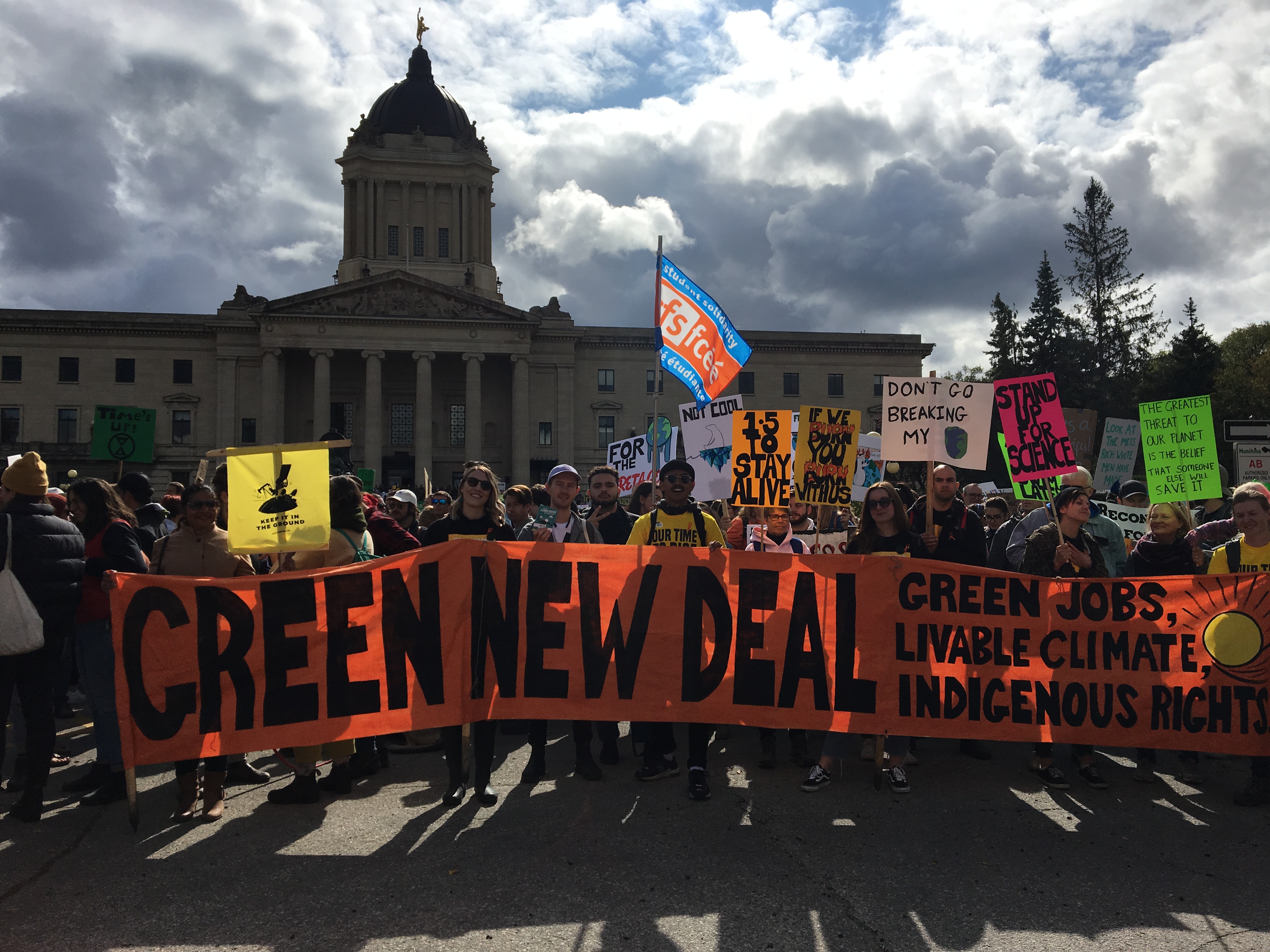
Separate from these political moves, non-governmental members organizations of the Pact for a Green New Deal will release their plan in early 2020. Importantly, it will be based on the priorities of the 150 communities visited during last year’s GND tour, and emphasize the needs of Indigenous, low-income, newcomer, racialized, and young people.

A minority Liberal government creates potential for bolder climate action with support from the NDP and Greens, while conservative-led provinces are bound to push back no matter what the federal government proposes. It’s incumbent on us, in this political moment, to reject half-measures and push for the most expansive and inclusive just transition possible.

It’s time for us to get behind what people around the world are calling a Green New Deal.

As a framework for climate legislation, the Green New Deal arose in response to the environmental wreckage and growing inequality that are a direct product of fossil-fuelled capitalism. The only way to meet our climate obligations is to transform our economy—not just away from fossil fuels, but also to be more equitable and inclusive.

The GND therefore combines financial help for transitioning energy workers with secure universal pensions for all, good quality housing, high-wage job creation, expanded public services (health care, child care, elder care and transit), restored public and natural spaces, and a new internationalism based on solidarity and true development. Absolutely central to the Canadian Green New Deal movement is decolonization and Indigenous rights.

“We will not achieve climate justice without Indigenous human rights. UNDRIP and the right to free and informed prior consent are central to our struggle,” says Leah Gazan, newly elected NDP MP for Winnipeg Centre, and one of Our Time’s Green New Deal champions.

The social policy piece of the GND is crucial for two reasons. First, making a job guarantee and expansion of public services part of our demands is how we build support for the mass movement we need to make this happen. Second, an economy centered on care work, along with sustainable food production, housing, and transportation, is what a low-carbon economy looks like.6
.


Source: https://www.policyalternatives.ca/sites/default/files/uploads/publications/IMG_5717.JPG
The last thing we need is for the language and spirit of the Green New Deal to be co-opted to appease calls from the Alberta and Saskatchewan governments for more pipelines and corporate handouts for the fossil fuel industry. “Jason Kenney had a “I love Oil and Gas” jersey on at the Grey Cup.

People don’t love oil and gas, they love working, working themselves out of poverty, having a roof over their head,” says Leah Gazan, a fierce Indigenous rights advocate running for the NDP. “We need to change the rhetoric from an ‘oil and gas’ issue to ‘I need to have a job’ issue."
Canadian climate crisis values as example

The balance between continuing employment for workers in GHG emitting industry and Canada meeting commitments for emission reduction suggested by the IPCC is a “CANDO” for a nation that “punches above its weight” in setting examples of climate change adaptation values for other nations to emulate.

References


1 (2019, July 26). 10 things you need to know about the massive new oilsands .... Retrieved February 11, 2020, from https://thenarwhal.ca/10-things-you-need-to-know-about-the-massive-new-oilsands-mine-that-just-got-a-green-light/
2 (2020, February 12). A victory over Sweden's colonialism | Climate Change | Al .... Retrieved February 12, 2020, from https://www.aljazeera.com/indepth/opinion/victory-sweden-colonialism-200205092318758.html
3 (n.d.). The Impact of Climate Change on Minorities and Indigenous .... Retrieved February 12, 2020, from https://minorityrights.org/wp-content/uploads/old-site-downloads/download-524-The-Impact-of-Climate-Change-on-Minorities-and-Indigenous-Peoples.pdf
4 (n.d.). ‎Information Morning from CBC Radio Nova Scotia (Highlights .... Retrieved February 12, 2020, from https://podcasts.apple.com/us/podcast/information-morning-from-cbc-radio-nova-scotia-highlights/id290164958
5 (2020, February 11). Kenney is hardly going 'green' | National Observer. Retrieved February 12, 2020, from https://www.nationalobserver.com/2020/02/11/opinion/kenney-hardly-going-green
6 (2020, January 2). The future is in our hands—not theirs | Canadian Centre for .... Retrieved February 12, 2020, from https://www.policyalternatives.ca/publications/monitor/future-our-hands%E2%80%94not-theirs

Monday, December 30, 2019

Two ways of hope in climate change

Don Pittis of CBC News reports that Mark Jaccard, energy economist and adviser to world leaders, known in global climate circles as a leading architect of British Columbia's successful climate struggle, wants to tell the world there is hope.
Two effective political actions

He admits that in fossil fuel-producing areas of the world like Australia and Alberta, there are many who will remain impossible to sway.


"It is difficult to get a man to understand something when his salary depends on his not understanding it."1

While business can perform a valuable role, with fossil fuels so cheap and easy to use, the economic pressure to act must come from government regulation. Without government rules, the free market would simply continue to use the atmosphere as a free garbage dump for carbon.


That's why the first step of Jaccard's strategy is to put the immediate effort on two areas that mostly affect a country's domestic markets.

Those two areas, energy production and transport — essentially power plants and cars and trucks — are responsible for the majority of most countries' greenhouse gas emissions. At the same time, that transition will lay foundations that will make later industrial decarbonization easier.


Jaccard recommends… donating… to a pro-climate group that can identify and support climate-sincere politicians and point a finger at the majority of those who are "faking it."


Because in the long run, getting carbon out of world's atmosphere cannot be completed by a few individuals doing good, it must instead be a project of people using politics to transform regional and national rules about carbon. Jaccard says those regions and countries will then combine to put carbon tariffs on the world's free riders, not a project for 2020.1
 1 (2019, December 30). What you can do in 2020 to keep the world from ... - CBC.ca. Retrieved December 30, 2019, from https://www.cbc.ca/news/business/climate-change-failure-1.5400663

Tuesday, April 9, 2019

Auditing progress with climate responsibility

Religious leadership is providing the moral case to take care of our planet and qualified climate experts are auditing the initiatives of government to assess their action.
Source: https://www.ncronline.org/sites/default/files/styles/article_full_width/public/Pilgrims%20CROP_0.jpg?itok=_cDFAI-5

Mallory McDuff wasn’t expecting to weep at a conference. Something about this gathering was different. Maybe it was the venue in the historic Ebenezer Baptist Church in Atlanta, Ga., the sanctuary filled with 2,000 people — brown, black, white, indigenous, and immigrant. Maybe it was the Rev. William Barber II’s preaching that touched me with the moral call to climate justice, in partnership with Al Gore, whose organization Climate Reality Project brought this audience together for a three-day training.
Source https://sojo.net/sites/default/files/styles/hero_breakpoints_theme_sojod7_tablet_1x/public/blog/priscilla-du-preez-341138-unsplash_1.jpg?itok=KhOYqxhY&timestamp=1553864619
 “The right time to do good is right now,” Barber repeated, interspersing history lessons as a compass. He reminded us of the moral costs as fossil fuel industries have been allowed to poison people and places: “This is the wrong use of our humanity. It’s not good. It’s sin. It’s wrong, and we must challenge it, because the right time to do good is right now.” And everyone repeated that refrain with him, jumping to their feet with a public joy I’d never witnessed at any environmental meeting in the past 30 years. It might take the force of a revival to wake us to our present reality.

“Don’t you forget it’s always been about fusion,” he bellowed, leaning into the podium, elaborating on his theory of fusion politics that avoided labels like liberal and conservative, left or right. He urged us to reclaim the narrative and build a movement of solidarity in order to face the enormity of the climate crisis.
As I drove, I thought of the retired Lt. General Russel Honoré, founder of the GreenARMY in Louisiana, who told us, “Do you like drinking polluted water? Eating polluted fish? Nobody wants dirty water and air. That’s how you find common ground.”1
Carl Meyer asks: “Are you skeptical that the Trudeau government’s price on carbon pollution is the best way to lower emissions?”
Ontario Environment Minister Rod Phillips and Ontario Energy Minister Greg Rickford apply a "gasoline transparency sticker" to a gas pump in Oakville, Ont. on April 8, 2019. Rickford Twitter Photo

Blair Feltmate has a solution for you. The head of the Intact Centre on Climate Adaptation at the University of Waterloo is chairing an arm of a new independent watchdog that will hold Ottawa to account on its climate change commitments and policies.
Feltmate said in an interview that the new institute, which is being called the Pan-Canadian Expert Collaboration, will help Canadians see if their federal government is making decisions in their best interests when it comes to tackling global warming.
The institute will be a multimillion dollar organization, funded by government but expected to set its own agenda and operate independently. It will have three main areas of focus: clean energy, carbon pricing and adaptation...
The Trudeau government’s climate plan, the Pan-Canadian Framework “sets out the goals and the aspirations,” said Feltmate, and “what this organization will do, is apply the intellectual framework to execute on that commitment.”
“How do we actually proceed to put an optimal price on carbon, to minimize carbon emissions? How do we proceed to embrace energy efficiency and renewable power, electricity storage? How do we proceed on those fronts, in a manner that will collectively benefit the country well?”2 
Brian Roewe comments that so far, science alone has not been able to provide the spark to overcome political inertia that has resisted such massive change. More and more, a prevailing belief is that a moral force is needed.
 Despite all that energy, there's still a feeling, with scientific forecasts firmly in mind, that the church has the potential to do more in how the world responds to climate change.
Perhaps a lot more.
"There's a lot of education that needs to happen still," said Dan Misleh, executive director of Catholic Climate Covenant, which has driven much of the encyclical's implementation in the United States. "Laudato Si' has been out there for going on four years, but there's still not enough Catholics or Catholic leaders who are paying attention to this."
Francis himself offered somewhat of a stock take in remarks at an early March interreligious Vatican conference in support of the United Nations' sustainable development goals, adopted three months after his encyclical's release.
"After three and a half years since the adoption of the sustainable development goals, we must be even more acutely aware of the importance of accelerating and adapting our actions in responding adequately to both the cry of the earth and the cry of the poor — they are connected," he said.3
Individual citizens make a significant contribution to mitigation of climate change effects by being knowledgeable of what has to be done and working to see that the people we elect to government are committed to implementing the measures recommended by climate experts and endorsed by the people.

References

1
(2019, March 29). Toward a New Conversation on Climate Justice | Sojourners. Retrieved March 30, 2019, from https://sojo.net/articles/toward-new-conversation-climate-justice
2
(2019, April 9). Skeptical of Trudeau's carbon pricing? There's an institute for that .... Retrieved April 9, 2019, from https://www.nationalobserver.com/2019/04/09/news/skeptical-trudeaus-carbon-pricing-theres-institute
3
(2019, April 8). Where science warnings fail, can moral force push us out of climate .... Retrieved April 9, 2019, from https://www.ncronline.org/news/environment/where-science-warnings-fail-can-moral-force-push-us-out-climate-inertia