 |
| Looking for the cheapest and cleanest? |
workers facing loss of employment as GHG emitting industry is phased out, indigenous people who are concerned that colonialism by government towards the use of unceded territory that may reduce their quality of life and ability to survive in their homeland, and young people with a plan to provide quality jobs in the low carbon economy needed within a decade to ensure their future quality of life.
 |
| Coastal erosion in Nova Scotia |
A current question is should Teck’s Frontier Mine get the green light, despite finding it will have significant and permanent impacts on the environment?
Teck's estimate of the future WTI oil price

Should lack of action on climate change be understood by many indigenous people as a continuation of colonialism.The predicted economic benefits of the project are based on oil prices not seen in years.In projections for the economic benefits of the project, the company used “an average long-term real oil price of US$95 per barrel for West Texas Intermediate” — a price not seen since 2014 — to calculate its base case for the economic impact of the project.“Prices are forecast to be US$80 to US$90 per barrel by 2020, and increasing thereafter,” Teck said in a 2016 submission.
In its low-price scenario, Teck assumed an average WTI price of $76.51 per barrel and a high-price scenario of $115 per barrel. As of this writing, the price for WTI crude oil was under $60 per barrel — and has only reached $75 once since November 2014.1
In late January, the Indigenous Saami reindeer-herding community, Girjas, won a significant legal battle against the Swedish state. The Swedish Supreme Court legally recognised the Indigenous community's ancestral claim to the land they live on and awarded Girjas Saami Village in Gallivare the right to manage hunting and fishing in its territories without the Swedish state's approval.
This landmark ruling comes amid a climate emergency which threatens the lives and livelihoods of billions of people. Indigenous governance of lands and biodiversity are key measures that can help address the climate crisis. As such, Girjas' fight to take back the control of their lands should be seen as urgent climate action, too.2
This briefing sets out some of the evidence on how minorities and indigenous people are being affected by climate change. It shows how discrimination against them means that they are not getting the help they need, or influence over governments’ plans for combating and adapting to climate change.
In a CBC interview with Professor John Sterman, he says burning wood for energy or heat accelerates climate change, even as this is being discussed in Nova Scotia as a means to keep employment in the forestry sector after the closure of the Northern Pulp Mill.The IPCC’s latest impacts report also clearly acknowledges that some groups are especially vulnerable, although it rarely uses the term ‘minority’. For example, itstates:‘Impacts of climate change are like to be felt most acutely not only by the poor, but also by certain segments of the population, such as the elderly, the very young, the powerless, indigenous peoples, and recent immigrants, particularly if they are linguistically isolated, i.e. those most dependent on public support. Impacts will also differ according to gender.’ 3
 |
| Source: https://shawglobalnews.files.wordpress.com/2019/12/cpt12135305-1.jpg?quality=70&strip=all&w=720 |
John Sterman MIT Sloan School of Management explains that burning biomass is making climate change worse in Europe. It helps national governments achieve more aggressive IPCC targets yet the calculations do not allow for the time it takes for forests to regrow. Governments not listening.. Powerful government subsidies and positives for GHG emission calculation have a lot of profit to lose.. Fossil fuel needs to be cut. The answer is in renewable energy and energy efficiency on buildings. For example LEED Gold building construction means 70% less energy for heating and cooling 4The advocacy of Premier Jason Kenney around reducing GHG emissions per barrel of oil (“greening non-renewable energy”) does have merit, these unit reductions are unfortunately dwarfed by soaring production. Even with the “greening” so far, the end result is that annual GHG emissions in the oil sands have soared over the last decade in the opinion of Gerald Kutney.
More “greening” will reduce annual GHG emissions only if production is strictly controlled. In other words, “greening non-renewable energy” cannot be used as an excuse to endlessly expand oil sands production, as is currently taking place.
Moving away from our commitments Mr. Kenney, as a champion for the future of Alberta, addressing the climate crisis must be an important part of your agenda. So far, your actions have not been reassuring, to say the least. If you want to be taken seriously about going green and reducing GHG emissions, you must begin by accepting the science:Climate change is mainly caused by humankind, largely from the burning of fossil fuels (as recognized in the reports of the IPCC, the acknowledged source of the scientific consensus on climate change).There is a sense of urgency because we have waited too long to do anything meaningful to reduce GHG emissions, resulting in a climate crisis (the impacts of climate change can be found in the SR15 report of the IPCC).Accepting these basics is mandatory and applies to all politicians in Canada (CPC leadership hopefuls, please take note), but there is one more special task just for you, sir:It seems that the Calgary Herald, owned by Postmedia which has a cozy relationship with the Premier, has taken creative license to characterize Mr. Kenney’s new strategy as going “green.”You must get rid of that oil propaganda agency known as the Canadian Energy Centre, aka Energy War Room. This waste of Albertan tax dollars is simply an affront to free speech and Canadian democracy. The continued existence of this organization, which you created, makes you look like a lobbyist for the oil industry.5.

Separate from these political moves, non-governmental members organizations of the Pact for a Green New Deal will release their plan in early 2020. Importantly, it will be based on the priorities of the 150 communities visited during last year’s GND tour, and emphasize the needs of Indigenous, low-income, newcomer, racialized, and young people.
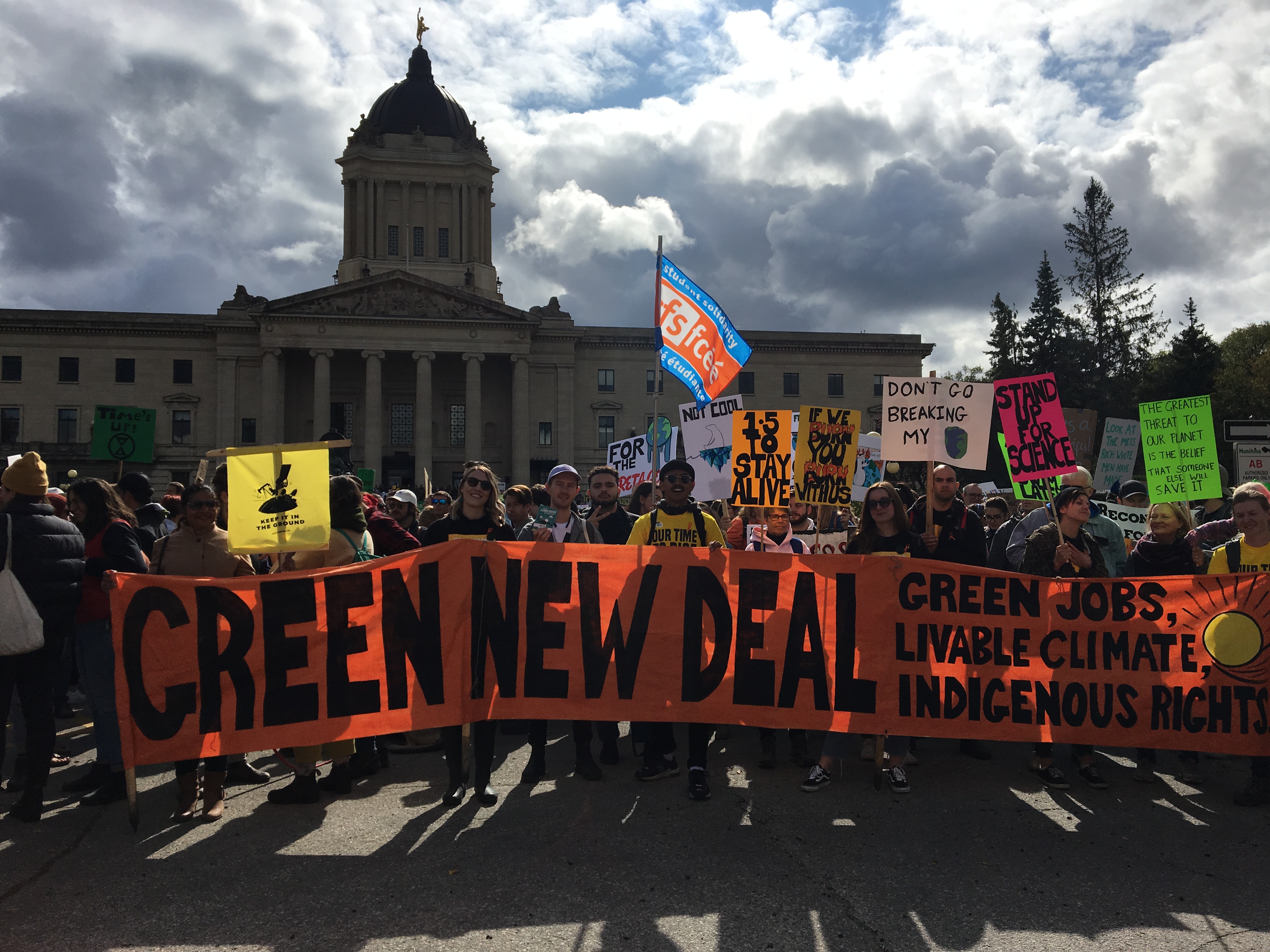
A minority Liberal government creates potential for bolder climate action with support from the NDP and Greens, while conservative-led provinces are bound to push back no matter what the federal government proposes. It’s incumbent on us, in this political moment, to reject half-measures and push for the most expansive and inclusive just transition possible.It’s time for us to get behind what people around the world are calling a Green New Deal.As a framework for climate legislation, the Green New Deal arose in response to the environmental wreckage and growing inequality that are a direct product of fossil-fuelled capitalism. The only way to meet our climate obligations is to transform our economy—not just away from fossil fuels, but also to be more equitable and inclusive.The GND therefore combines financial help for transitioning energy workers with secure universal pensions for all, good quality housing, high-wage job creation, expanded public services (health care, child care, elder care and transit), restored public and natural spaces, and a new internationalism based on solidarity and true development. Absolutely central to the Canadian Green New Deal movement is decolonization and Indigenous rights.“We will not achieve climate justice without Indigenous human rights. UNDRIP and the right to free and informed prior consent are central to our struggle,” says Leah Gazan, newly elected NDP MP for Winnipeg Centre, and one of Our Time’s Green New Deal champions.
The social policy piece of the GND is crucial for two reasons. First, making a job guarantee and expansion of public services part of our demands is how we build support for the mass movement we need to make this happen. Second, an economy centered on care work, along with sustainable food production, housing, and transportation, is what a low-carbon economy looks like.6.
 |
| Source: https://www.policyalternatives.ca/sites/default/files/uploads/publications/IMG_5717.JPG |
People don’t love oil and gas, they love working, working themselves out of poverty, having a roof over their head,” says Leah Gazan, a fierce Indigenous rights advocate running for the NDP. “We need to change the rhetoric from an ‘oil and gas’ issue to ‘I need to have a job’ issue."
 |
| Canadian climate crisis values as example |
The balance between continuing employment for workers in GHG emitting industry and Canada meeting commitments for emission reduction suggested by the IPCC is a “CANDO” for a nation that “punches above its weight” in setting examples of climate change adaptation values for other nations to emulate.
References
1 (2019, July 26). 10 things you need to know about the massive new oilsands .... Retrieved February 11, 2020, from https://thenarwhal.ca/10-things-you-need-to-know-about-the-massive-new-oilsands-mine-that-just-got-a-green-light/
2 (2020, February 12). A victory over Sweden's colonialism | Climate Change | Al .... Retrieved February 12, 2020, from https://www.aljazeera.com/indepth/opinion/victory-sweden-colonialism-200205092318758.html
3 (n.d.). The Impact of Climate Change on Minorities and Indigenous .... Retrieved February 12, 2020, from https://minorityrights.org/wp-content/uploads/old-site-downloads/download-524-The-Impact-of-Climate-Change-on-Minorities-and-Indigenous-Peoples.pdf
4 (n.d.). Information Morning from CBC Radio Nova Scotia (Highlights .... Retrieved February 12, 2020, from https://podcasts.apple.com/us/podcast/information-morning-from-cbc-radio-nova-scotia-highlights/id290164958
5 (2020, February 11). Kenney is hardly going 'green' | National Observer. Retrieved February 12, 2020, from https://www.nationalobserver.com/2020/02/11/opinion/kenney-hardly-going-green
6 (2020, January 2). The future is in our hands—not theirs | Canadian Centre for .... Retrieved February 12, 2020, from https://www.policyalternatives.ca/publications/monitor/future-our-hands%E2%80%94not-theirs


