Showing posts with label Russia. Show all posts

Friday, September 27, 2024

Discrimination Proportionality and Pagers


Connor Hartigang, an O'Hare Fellow and former editorial intern at America Media, writing for America Magazine summarizes an interview with Maryann Cusimano Love, associate professor of International Relations at the Catholic University of America; and Richard A. Love, a professor in the College of Information and Cyberspace at National Defense University, about the ethics in the light of international law of the pager attack in Lebanon.
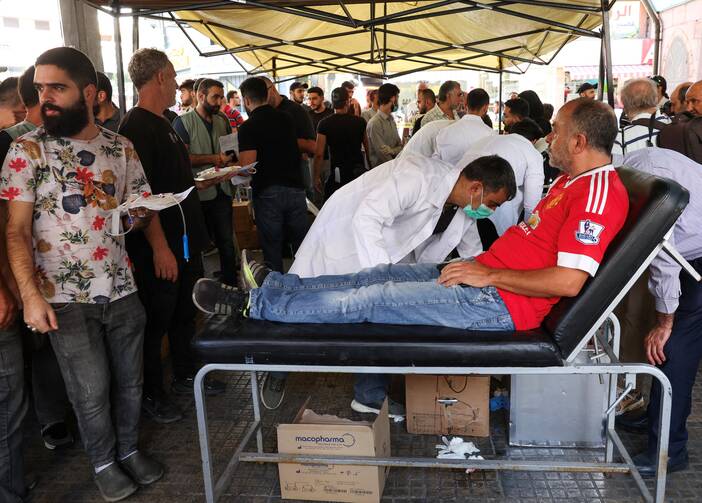

People gather as a man donates blood in Beirut Sept. 18, 2024, following pager detonations across Lebanon. The pagers exploded nearly simultaneously in Lebanon and Syria in an apparent Israeli operation targeting Hezbollah's communications network, killing at least 12 people and wounding nearly 3,000. (OSV News photo/Mohamed Azakir, Reuters)


America Media interprets the church for the world and the world for the church. It is a forum for discussion of religion, society, politics and culture from a Catholic perspective.


The apparent deployment of remotely detonated explosive devices in pagers and two-way radios used by Hezbollah members in Lebanon has raised concerns over the ethics and legality of the tactic, particularly given the civilian casualties among Lebanese resulting from these explosions. No party has claimed credit for the pager attack, but Hezbollah blames Israel, and U.S. officials on background have said that Israeli intelligence intercepted a shipment of pagers and inserted explosives into them.


Maryann Cusimano Love agrees that Israel has a right to self defense, and civilians have a right to protection. Israel’s self defense actions are limited by ethics and law. After suffering a horrific terrorist attack, there is pressure to “respond in kind.” Many argue that since terrorists fight dirty, the “gloves should come off” in response.


This approach is self-defeating. You can’t argue that terrorism is wrong, that killing civilians in terrorist attacks is immoral, illegal, and that the world should come together against terrorism, while engaging in attacks that kill civilians. (Hartigan, n.d.)


Richard Love notes that Hezbollah is a designated terrorist organization by the United States and many other states, but Israel and Lebanon are signatories to the 1983 Convention on Certain Conventional Weapons, which bans remotely delivered mines. Many academics include booby traps in this definition, which arguably makes Israel’s use of explosives in pagers and walkie-talkies illegal.


But perhaps the most concerning aspect of the attack was in how it was targeted, since non-combatants were certainly injured in great numbers and some noncombatants were killed. A fundamental tenet of humanitarian law rests on distinction, the requirement to distinguish combatants from non-combatants and not target non-combatants with military assets.


After the September 11 attacks, the United States faced similar questions in assessing how to respond. These are challenges governments face in conducting counterterrorism and counterinsurgency operations. (Hartigan, n.d.)


Maryann Cusimano Love comments that the U.S. general who was in charge of the war in Afghanistan, General David Petraeus, repeatedly noted that “every civilian death diminishes our cause,” and “you can’t kill your way out” of this conflict.


If the United States were engaged in a conflict with a state adversary, an attack like this would raise a lot of questions about whether this was a targeted assassination.


Richard Love comments that by policy, the United States prohibits the assassination of political leaders in a country with which we are not at war. Whether you assassinate a political leader in times of war is largely a matter of politics because once you do that, you open your side to reprisals. (Hartigan, n.d.)


Connor Hartigan asks how might the Catholic tradition of just war theory be applied to this case?


Maryann Cusimano Love allows that Just war tradition is necessary, but insufficient, in describing the ethical terrain.


Just war tradition is institutionalized in the Geneva Conventions, in international law of war and in domestic codes of military justice. The tradition requires the right intention of seeking a positive peace, rather than revenge, but it also requires positive actions to protect noncombatants, the criteria of discrimination and proportionality.


The Biden administration has spent a lot of time and energy trying to get the two parties to negotiate an end to this conflict, so when Israelis say, “escalate to de-escalate,” they’re signaling to the Biden administration that they’re trying to get to the table.


Richard Love comments “But I don’t see any evidence of that happening. All the evidence that I’ve laid out points to an escalation that’s not going to de-escalate. There is a real fear within Washington that this thing could get out of control.”


I suspect there’s a lot of pressure within Israel to use this dominance while they still have it. We’ve seen this play out in Gaza, where I don’t believe anyone believed that the I.DF. was going to bulldoze and blow up the entire Gaza Strip before they did it. Where we are now, as far as the humanitarian crisis and catastrophe Gaza has become is almost unbelievable. (Hartigan, n.d.)


The problem is confronting Hezbollah is a far more risky proposition. It is a far more savvy adversary; it’s funded and armed by Iran and Hezbollah will be a much more difficult target. You’re not just going into the Gaza Strip; this would require an invasion of Lebanon, and you can draw on the history of how that’s played out in the past. It’s been very risky, it’s been very bloody, and it’s always resulted in an indeterminate outcome.


Richard Love asks: “But is the Israeli strategic objective here to make Hezbollah incapable of delivering their missile strikes?” Part of that would be to look at what they’ve done: on Sept. 17, they went after pagers; on Sept. 18, walkie-talkies; on Sept. 20, you have airstrikes. Are they preparing the battlespace for an invasion? Is their strategic goal to go in and conduct operations similar to what they’re doing in Gaza? Because I’m here to tell you: that is very risky. Every time the I.D.F. has tried a ground invasion in Lebanon, they’ve gotten mired down and were not able to achieve their strategic objectives. (Hartigan, n.d.)


A final observation is an invasion would be catastrophic both for the people of Lebanon, for the people of Israel who are fighting a hidden organization which has vastly greater capabilities than Hamas. So don’t fall under the illusion that the next step for Israel is just to replicate what they did in the Gaza Strip. It will be a far greater, bloodier and riskier campaign.


Who’s standing behind Hezbollah? Iran.


And who’s standing behind Iran? Russia.


References


Hartigan, C. (n.d.). Did Israel’s pager attack break international law? America Magazine | The Jesuit Review of Faith & Culture. Retrieved September 27, 2024, from https://www.americamagazine.org/politics-society/2024/09/26/maryann-cusimano-love-richard-love-israel-lebanon-pager-explosions 

Monday, August 15, 2022

Backsliding on Climate Action

Even as the world is enduring another season of wildfires, droughts, floods, and intense storms, there is political and economic pressure to return to oil and gas projects that may be applied to compensate for the reduction of Russian exports of these products to Europe while the war in Ukraine continues.


More gas and oil production?


Frances Willick of CBC News reports on renewed signs of interest in Goldboro and Bear Head gas projects in our region.


"The world has changed a lot since then," Pieridae CEO Alfred Sorensen told CBC News Tuesday. "We have to take advantage of all the work we've done already and try and see if we can move the project forward very quickly."


The company is now shifting its attention back to a land-based project because it would be able to produce more gas than a barge-based facility, and the federal government is interested in maximizing output, Sorensen said.


Asked what type of supports Ottawa is offering to Pieridae, Sorensen said, "hopefully more than prayers and hugs."


"I think it is going to be a combination of regulatory and financial support. There's no doubt about that." (Willick, 2022)


Cloe Logan of the National Observer reports on calls by environmental groups to require a proposed LNG facility in Nova Scotia to undergo environmental assessment. Mike Sawyer, executive director of the Citizens’ Oil & Gas Council, said it needs a federal assessment.


“The proposed Pieridae LNG export scheme is part of the Big Lie that natural gas, and therefore LNG, is environmentally friendly and will help combat climate change…” said Mike Sawyer, executive director of the Citizens’ Oil & Gas Council. (Logan & Fawcett, 2022)


Kenny Sharpe of CBC News notes that as Russian military aggression in Ukraine reaches the six-month mark, governments and energy industry lobbyists, including Canada's, are floating the idea that adding LNG capacity could help circumvent Europe's reliance on Russia's oil and gas supply. But there's backlash to the idea, with one demonstrator in Hamburg suggesting that to invest more in LNG would be "climate suicide," exacerbating already high levels of carbon in the atmosphere.


"In general there's the idea that Europe needs LNG to stay warm in the winter and this is really a lie," Toni Lux told CBC News from the site of a protest camp set up this week in northwest Hamburg.


Other Canadian oil and gas suppliers also say they're eager to expand further into Europe, with GNL Quebec saying it could help "Europe to diversify its energy sources."


Alberta-based Pieridae Energy has proposed a multibillion-dollar pipeline to ship natural gas from Western Canada to Nova Scotia, where it could then be sent across the Atlantic. (Sharpe & Burns, 2022)


The price we pay for increasing gas and oil production may include a more dangerous and  less habitable world for our children and grandchildren as the average earth temperature rises.


References


Logan, C., & Fawcett, M. (2022, August 12). Environmental groups call on feds to review proposed LNG facility in Nova Scotia. National Observer. Retrieved August 13, 2022, from https://www.nationalobserver.com/2022/08/12/news/environmental-groups-call-feds-review-proposed-lng-facility-nova-scotia 

Sharpe, K., & Burns, A. F. (2022, August 14). Worried about a warming world, thousands of Germans reject using LNG — including Canada's. CBC. Retrieved August 15, 2022, from https://www.cbc.ca/news/world/germany-lng-energy-crisis-1.6549991 

Willick, F. (2022, May 11). 2 stalled LNG projects in Nova Scotia may be on the brink of revival. CBC. Retrieved May 11, 2022, from https://www.cbc.ca/news/canada/nova-scotia/2-lng-proposals-could-move-forward-bear-head-goldboro-1.6447671 


Friday, March 18, 2022

Fossil Fuel Dependency Cost and Climate

Bill McKibben, writing in the New Yorker, comments that this year, we may need to compensate for banning the importation of Russian oil with American hydrocarbons.


The only way, however, to eliminate Putin’s and every other producing country’s ability to use oil as an economic weapon is to reduce our dependence on oil. New numbers turn the economic logic we’re used to upside down.


A few years ago, at a petroleum-industry conference in Texas, the Canadian Prime Minister, Justin Trudeau, said something both terrible and true: that “no country would find a hundred and seventy-three billion barrels of oil in the ground and leave them there.” He was referring to Alberta’s tar sands, where a third of Canada’s natural gas is used to heat the oil trapped in the soil sufficiently to get it to flow to the surface and separate it from the sand. Just extracting the oil would put Canada over its share of the carbon budget set in Paris, and actually burning it would heat the planet nearly half a degree Celsius and use up about a third of the total remaining budget. (And Canadians account for only about one half of one percent of the world’s population.)1


Mark Jacobson showed a gift for science, and also for tennis. He travelled for tournaments to Los Angeles and San Diego, where he was shocked by how dirty the air was. He eventually wound up at Stanford as a professor of civil and environmental engineering, It was clear that visible air pollution was only part of the problem. It was understood that the unseen gas produced by combustion—carbon dioxide—posed an even more comprehensive threat.


Accepting nuclear power for a while longer is not the only place environmentalists will need to bend. A reason I supported shutting down Vermont’s nuclear plant was because campaigners had promised that its output would be replaced with renewable energy. In the years that followed, though, advocates of scenery, wildlife, and forests managed to put the state’s mountaintops off limits to wind turbines. More recently, the state’s public-utility commission blocked construction of an eight-acre solar farm on aesthetic grounds. Those of us who live in and love rural areas have to accept that some of that landscape will be needed to produce energy. Not all of it, or even most of it— Mark Jacobson’s latest numbers show that renewable power actually uses less land than fossil fuels, which require drilling fifty thousand new holes every year in North America alone. But we do need to see our landscape differently—as Ezra Klein wrote this week in the Times, “to conserve anything close to the climate we’ve had, we need to build as we’ve never built before.”1


Renewable energy is now cheaper than fossil fuel, and becoming more so.  Some analysts calculate a “decisive transition” to renewable energy would save the world twenty-six trillion dollars in energy costs in the coming decades. This is precisely the opposite of how we have viewed energy transition. It has long been seen as an economically terrifying undertaking: if we had to transition to avoid calamity (and obviously we did), we should go as slowly as possible.


 Bill Gates, just last year, wrote a book, arguing that consumers would need to pay a “green premium” for clean energy because it would be more expensive. But Emily Grubert, a Georgia Tech engineer who now works for the Department of Energy, has recently shown that it could cost less to replace every coal plant in the country with renewables than to simply maintain the existing coal plants. You could call it a “green discount.”1


For Americans, the best part of the Build Back Better bill may be that it tries to target significant parts of its aid to communities hardest hit by poverty and environmental damage, a residue of the Green New Deal that is its parent. Advocates are already pressing to ensure that at least some of the new technology is owned by local communities—by churches and local development agencies, not by the solar-era equivalents of Koch Industries or Exxon.


Amy Cardinal Christianson, who works for the Canadian equivalent of the Forest Service, is a member of the Métis Nation. Her family kept trapping lines near Fort McMurray, in northern Alberta, but left them for the city because the development of the vast tar-sands complex overwhelmed the landscape. (That’s the hundred and seventy-three billion barrels that Justin Trudeau says no country would leave in the ground—a pool of carbon so vast the climate scientist James Hansen said that pumping it from the ground would mean “game over for the climate.”) The industrial fires it stoked have helped heat the Earth, and one result was a truly terrifying forest fire that overtook Fort McMurray in 2016, after a stretch of unseasonably high temperatures. The blaze forced the evacuation of eighty-eight thousand people, and became the costliest disaster in Canadian history.1


The invasion of Ukraine by Russia has required Western nations to rework energy supply arrangements. Unfortunately, a number of corporations, organisations and politicians have attempted to use this crisis in an attempt to restart fossil fuel exploration and production. The opportunity that aligns with the scientific data from the IPCC is to begin now to increase production of energy from sources with low fossil fuel use.


Reference

 [1] (2022, March 18). In a World on Fire, Stop Burning Things | The New Yorker. Retrieved March 18, 2022, from https://www.newyorker.com/news/essay/in-a-world-on-fire-stop-burning-things


.

Thursday, March 3, 2022

War, Energy Demand, and Climate Crisis

The war launched by Russia against Ukraine has brought economic sanctions against gas and oil previously imported to Europe.
Oil and gas


The increase in the price of these fossil fuels has stoked the embers of sunset industries of eastern Canada’s oil and gas production and heated up the pressure to build pipelines to export western resources to Europe. CBC News reports that Newfoundland and Labrador Premier Andrew Furey says his government is promoting the province's oil to NATO countries, as the war in Ukraine rages. He said his government is pushing Newfoundland and Labrador oil as an alternative to Russian fossil fuels.

"We have right here what the world needs as well, and that is to relieve some of our NATO partners of the tyranny of Russia and their stranglehold on the energy around the world," he said, when asked about the provincial government's efforts regarding the war. Furey said they're not trying to capitalize on what he noted is a humanitarian crisis, but did say his government is "making sure that our voice is heard internally and externally" with regard to the province's offshore oil industry.1
 

Michael Gorman of CBC News reports that the Goldboro Nova Scotia LNG project could be revived as a floating barge while demand grows for non-Russian gas.
Goldboro Nova Scotia


Pieridae Energy abandoned the land-based project last summer amid cost concerns.

There would not be a need for a 5,000-person work camp, for example, during construction, although Millar said the full-time workforce would be similar — about 150 people. He said the company would build a "small hotel" by the site to provide lodging. The construction that would be required includes a jetty and a spur of a pipe to connect the vessel to the Maritimes and Northeast Pipeline. While some barges have their own power supply, Millar said Pieridae has talked with officials at Nova Scotia Power about requirements if the barge it leases does not have its own power source.2
 

A report in the Economist asserts that climate change must be adapted to as well as opposed even as efforts to reduce its impact on lives and ecosystems are falling ever shorter.


Previous reports on impacts, vulnerabilities and adaptation relied on prediction. In this one the authors need only to look around them to catalogue increased flooding, more heatwaves, stressed ecosystems and millions of lives that have become harder to live. The “emissions gap” that dogs climate policy is well known. Though the reductions in emissions that the world’s countries have pledged themselves to make are steeper than they used to be, they still fall well short of those needed to give the world a good chance of keeping the rise in average temperature relative to pre-industrial levels well below 2°C. The new report highlights a parallel adaptation gap. Though efforts to reduce the impact of climate change on lives and ecosystems are greater than they once were, the extent to which they fall short of what circumstances require is increasing, as impacts pile up apace.3

Natasha Bulowski, News, Energy, Politics, Ottawa Insider with the National Observer writes that Steven Guilbeault, Minister of Environment and Climate Change Canada, is rebuking Alberta Premier Jason Kenney’s assertion Canada must “get some pipelines built” to help “defang” the Russian President.

“The solution to global energy problems is not to increase our dependency on fossil fuels,” said Guilbeault. The best way to improve the energy security of European countries is to simply reduce dependence on oil and gas “regardless of where it's coming from,” he said. Even if Canada could build more pipelines to increase oil and gas capacity, this would take “a number of years” and wouldn’t address the crisis people in Ukraine and Europe are now facing, he added. The real solution, he says, is to “quickly deploy renewables and cleantech” to reduce dependence on Russian oil and gas.4
 

Kathryn Harrison, a professor of political science at the University of British Columbia, reviews the idea that Europe will want to replace Russian oil and gas with fossil fuels from elsewhere.

If Europe does face a gas shortage, immediate solutions are needed and costly investments for new liquefied natural gas (LNG) terminals and similar projects will take years to get approved and built, she added. “Making investments in new fossil fuel facilities that won't be built in the time they need and then will be white elephants as the continent shifts away from fossil fuels is not an obvious solution for Europe,” said Harrison, referring to the European Union’s pledge to reduce emissions 55 per cent below 1990 levels by 2030.4
 

A press release from the Climate Action Network asserts that Canada’s oil and gas industry's current attempt to lobby for fossil fuel expansion should be recognized as the desperate ploy of an outdated industry that has never failed to capitalize on a crisis.

In the spring of 2020, Canada’s oil and gas industry used the pandemic as an excuse to press the federal government to water down or suspend environmental regulations and to delay the introduction of UNDRIP legislation. Its current attempt to lobby for fossil fuel expansion should be recognized as more of the same: the desperate ploy of an outdated industry that has never failed to capitalize on a crisis. This week’s IPCC report, cataloguing an “atlas of suffering,” underscored the dire consequences of the world’s addiction to fossil fuels and the urgent need to break the habit. As Svitlana Krakovska, the climate scientist heading Ukraine’s delegation to the IPCC, said when her team was forced to withdraw from the negotiations to move to bomb shelters: “Human-induced climate change and the war on Ukraine have the same roots: fossil fuels, and our dependence on them.”5
 

Cloe Logan, writing in the National Observer, reports that environmentalists, citizens and academics are urging the federal government to reject Newfoundland offshore oil project known as Bay du Nord.

“The Bay du Nord project poses significant environmental risks and it would undermine the urgent global effort to reduce emissions and protect climate stability. Instead of expanding oil production, our priority challenge right now is managing a wind-down of oil production that allows workers and communities to seize the benefits of the low-carbon energy transition,” said Carter. “Approving Bay du Nord would take Newfoundland and Labrador in the wrong direction — both in terms of the climate crisis and long-term economic security.”6
 

The time frame for building new LNG facilities and pipelines is long and the “just transition” for workers in Canada’s GHG producing industries needs immediate retraining for green energy careers. To delay GHG reduction action may eliminate the existing workforce from transition and exacerbate the consequences in more intense storms, fires, and floods in Canada.


References

1

(2022, March 3). Furey promotes NL oil as Russian invasion drives up fuel prices - CBC. Retrieved March 3, 2022, from https://www.cbc.ca/news/canada/newfoundland-labrador/nl-oil-russian-invasion-1.6370127 

2

(2022, March 3). Goldboro LNG project could be revived as floating barge while .... Retrieved March 3, 2022, from https://www.cbc.ca/news/canada/nova-scotia/goldboro-lng-energy-project-gas-pieridae-1.6370827 

3

(2022, March 5). Climate change must be adapted to as well as opposed. Retrieved March 3, 2022, from https://www.economist.com/leaders/2022/03/05/climate-change-must-be-adapted-to-as-well-as-opposed 

4

(2022, March 2). Environment minister rebukes claims Canadian oil and gas can fix .... Retrieved March 3, 2022, from https://www.nationalobserver.com/2022/03/02/news/environment-minister-rebukes-claims-canadian-oil-and-gas-can-fix-europes 

5

(n.d.). Climate Action Network. Retrieved March 4, 2022, from https://climateactionnetwork.ca/ 

6

(n.d.). Environmentalists, citizens and academics urge feds to reject .... Retrieved March 5, 2022, from https://www.nationalobserver.com/2022/03/03/news/environmentalists-citizens-and-academics-urge-feds-reject-newfoundland-offshore-oil