Showing posts with label Iran. Show all posts

Friday, June 12, 2026

Cuba and Trump Fear or Control?

 The relationship of the United States with Cuba over 200 years has been examined from the point of view of both fear and imperialism. 

Fear of Cuban Life and Health?


Some observers cite fear of Cuba that may have originated in the time of the Monroe Doctrine of the “imminent domain of the United States” or the abolition of slavery in Cuba as a threat to the economy of the Southern States.


In the sixty years since the Cuban Revolution, the contrast between the health and education systems of Cuba and the United States is most visible in the priority that the Cuban administration puts in a health system that focuses on state paid care that places medical professionals in the communities and focuses on preventive health care, helping people be well, as opposed to “sick” care curing disease. At the same time, Cuban medical research centres have focused on developing vaccines for the many diseases that are particularly prevalent in tropical regions.


A small but growing number of U.S. citizens are travelling to Havana for a breakthrough new treatment for Alzheimer’s, Cuba’s NeuralCIM. Alzheimer’s is a disease that systematically destroys a person's memory, personality, and ability to function.


Cuban medical schools train medical personnel for Cuba and many countries of the Global South. Cuban medical professions assist in providing health care in many other countries. The metrics of live births and life expectancy have continuously improved in Cuba until the recent genocidal blockade of Cuba by the Trump Regime that has denied oil for generating electricity for refrigerators, water pumps, schools, and hospitals. Some of the increased deaths since the embargo have been in the neo-natal wards of hospitals.


The argument that the “Private Enterprise” health care favoured by many, including “Big Pharma” in the United States, may feel threatened by a lower cost, innovation focused, universally accessible, internationally celebrated, research and development based health system focused on the ideal that “health is a human right” deserves careful consideration.


The military strategists advising the Trump regime have renewed the 19th Century imperialism that the United States is the proper and destined governing influence in the American Hemisphere (Western Hemisphere) and that includes the Gulf of America (Gulf of Mexico). Under this imperialist resurgence, Cuba (and Canada) are territories that may exert influence on access to the United States much like Iran can influence access to Middle East countries by controlling the Strait of Hormuz. Unlike Iran, Canada and Mexico, have trade, social, commercial, resource, and military alliances with the United States that would make life more expensive for Americans if a “rupture” in relationships continues. 


The imperialist promoters of American exceptionalism need to recall that the “melting pot” of the American Republic owes its exceptional position to the integration of people and ideas from all nations of the world. The history of empires that tried to reign from power and false notions of superiority is one of “Rise and Fall”. 


Tuesday, April 7, 2026

Trump and War Crimes


Annie Crabill, Senior digital editor at the Economist, reports:


If Donald Trump goes ahead with his latest threats against Iran—every bridge “will be decimated”, he promised on Monday, and every power plant “out of business, burning”—he will probably violate the laws of war. Strikes on civilian infrastructure may also fail to achieve their primary objective: to rob Iran’s regime of funding. The civilian economy has long been in a dire state. The regime relies on other sources of income, and war has been good for business. (Crabill, n.d.)
International Criminal Court in The Hague, Netherlands.

(International Criminal Court, n.d.)


Jayme Poisson, correspondent with CBC Front Burner, broadcast, on April 7, 2026, a check-in on Israel’s expanding wars in Iran and Lebanon, violence in the West Bank and details of a new law that could see the death penalty for Palestinians convicted of deadly attacks. Meron Rapoport returns to the show. Meron has been reporting on Israel for over 30 years, and was formerly the head of news at Israel's Ha’aretz newspaper. He’s now an editor with the Hebrew-language news site Local Call. Israel cannot conquer Lebanon and Iran, certainly not at the same time, even as Netanu claims that Israel is going to be a “Super Sparta” CBC transcripts (Poisson, n.d.)


Canada is a member of the International Criminal Court. The United States and Israel are not. If President Donald Trump or Prime Minister Benjamin "Bibi" Netanyahu were to find themselves in one of the member countries of the ICC (125 countries are States Parties to the Rome Statute of the International Criminal Court.) does that country have the power or responsibility to arrest them and charge them with war crimes and retain them in custody prior to trial at the International Court of Justice at the Hague, charged to bring justice to leaders of Nazi Germany.


References

Crabill, A. (n.d.). Trump and War Crimes. The Economist | Go beyond breaking news. Retrieved April 7, 2026, from https://www.economist.com/ 

International Criminal Court. (n.d.). Wikipedia. Retrieved April 7, 2026, from https://en.wikipedia.org/wiki/International_Criminal_Court 

Poisson, J. (n.d.). Front Burner. Trump and War Crimes. Retrieved April 7, 2026, from https://www.cbc.ca/radio/frontburner 


Friday, September 27, 2024

Discrimination Proportionality and Pagers


Connor Hartigang, an O'Hare Fellow and former editorial intern at America Media, writing for America Magazine summarizes an interview with Maryann Cusimano Love, associate professor of International Relations at the Catholic University of America; and Richard A. Love, a professor in the College of Information and Cyberspace at National Defense University, about the ethics in the light of international law of the pager attack in Lebanon.


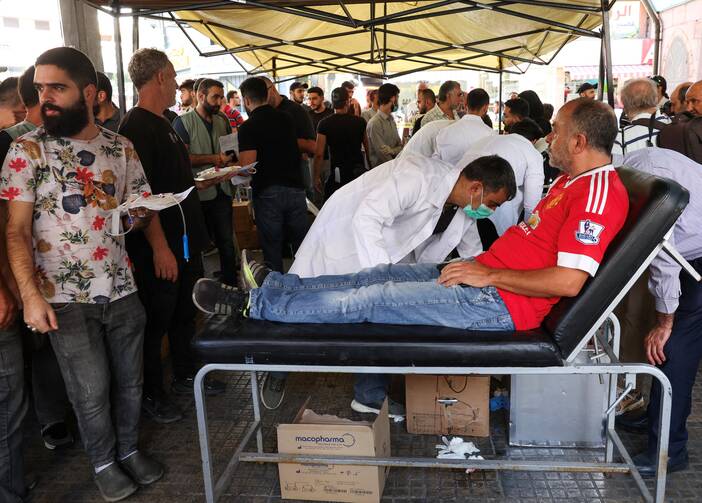
People gather as a man donates blood in Beirut Sept. 18, 2024, following pager detonations across Lebanon. The pagers exploded nearly simultaneously in Lebanon and Syria in an apparent Israeli operation targeting Hezbollah's communications network, killing at least 12 people and wounding nearly 3,000. (OSV News photo/Mohamed Azakir, Reuters)


America Media interprets the church for the world and the world for the church. It is a forum for discussion of religion, society, politics and culture from a Catholic perspective.


The apparent deployment of remotely detonated explosive devices in pagers and two-way radios used by Hezbollah members in Lebanon has raised concerns over the ethics and legality of the tactic, particularly given the civilian casualties among Lebanese resulting from these explosions. No party has claimed credit for the pager attack, but Hezbollah blames Israel, and U.S. officials on background have said that Israeli intelligence intercepted a shipment of pagers and inserted explosives into them.


Maryann Cusimano Love agrees that Israel has a right to self defense, and civilians have a right to protection. Israel’s self defense actions are limited by ethics and law. After suffering a horrific terrorist attack, there is pressure to “respond in kind.” Many argue that since terrorists fight dirty, the “gloves should come off” in response.


This approach is self-defeating. You can’t argue that terrorism is wrong, that killing civilians in terrorist attacks is immoral, illegal, and that the world should come together against terrorism, while engaging in attacks that kill civilians. (Hartigan, n.d.)


Richard Love notes that Hezbollah is a designated terrorist organization by the United States and many other states, but Israel and Lebanon are signatories to the 1983 Convention on Certain Conventional Weapons, which bans remotely delivered mines. Many academics include booby traps in this definition, which arguably makes Israel’s use of explosives in pagers and walkie-talkies illegal.


But perhaps the most concerning aspect of the attack was in how it was targeted, since non-combatants were certainly injured in great numbers and some noncombatants were killed. A fundamental tenet of humanitarian law rests on distinction, the requirement to distinguish combatants from non-combatants and not target non-combatants with military assets.


After the September 11 attacks, the United States faced similar questions in assessing how to respond. These are challenges governments face in conducting counterterrorism and counterinsurgency operations. (Hartigan, n.d.)


Maryann Cusimano Love comments that the U.S. general who was in charge of the war in Afghanistan, General David Petraeus, repeatedly noted that “every civilian death diminishes our cause,” and “you can’t kill your way out” of this conflict.


If the United States were engaged in a conflict with a state adversary, an attack like this would raise a lot of questions about whether this was a targeted assassination.


Richard Love comments that by policy, the United States prohibits the assassination of political leaders in a country with which we are not at war. Whether you assassinate a political leader in times of war is largely a matter of politics because once you do that, you open your side to reprisals. (Hartigan, n.d.)


Connor Hartigan asks how might the Catholic tradition of just war theory be applied to this case?


Maryann Cusimano Love allows that Just war tradition is necessary, but insufficient, in describing the ethical terrain.


Just war tradition is institutionalized in the Geneva Conventions, in international law of war and in domestic codes of military justice. The tradition requires the right intention of seeking a positive peace, rather than revenge, but it also requires positive actions to protect noncombatants, the criteria of discrimination and proportionality.


The Biden administration has spent a lot of time and energy trying to get the two parties to negotiate an end to this conflict, so when Israelis say, “escalate to de-escalate,” they’re signaling to the Biden administration that they’re trying to get to the table.


Richard Love comments “But I don’t see any evidence of that happening. All the evidence that I’ve laid out points to an escalation that’s not going to de-escalate. There is a real fear within Washington that this thing could get out of control.”


I suspect there’s a lot of pressure within Israel to use this dominance while they still have it. We’ve seen this play out in Gaza, where I don’t believe anyone believed that the I.DF. was going to bulldoze and blow up the entire Gaza Strip before they did it. Where we are now, as far as the humanitarian crisis and catastrophe Gaza has become is almost unbelievable. (Hartigan, n.d.)


The problem is confronting Hezbollah is a far more risky proposition. It is a far more savvy adversary; it’s funded and armed by Iran and Hezbollah will be a much more difficult target. You’re not just going into the Gaza Strip; this would require an invasion of Lebanon, and you can draw on the history of how that’s played out in the past. It’s been very risky, it’s been very bloody, and it’s always resulted in an indeterminate outcome.


Richard Love asks: “But is the Israeli strategic objective here to make Hezbollah incapable of delivering their missile strikes?” Part of that would be to look at what they’ve done: on Sept. 17, they went after pagers; on Sept. 18, walkie-talkies; on Sept. 20, you have airstrikes. Are they preparing the battlespace for an invasion? Is their strategic goal to go in and conduct operations similar to what they’re doing in Gaza? Because I’m here to tell you: that is very risky. Every time the I.D.F. has tried a ground invasion in Lebanon, they’ve gotten mired down and were not able to achieve their strategic objectives. (Hartigan, n.d.)


A final observation is an invasion would be catastrophic both for the people of Lebanon, for the people of Israel who are fighting a hidden organization which has vastly greater capabilities than Hamas. So don’t fall under the illusion that the next step for Israel is just to replicate what they did in the Gaza Strip. It will be a far greater, bloodier and riskier campaign.


Who’s standing behind Hezbollah? Iran.


And who’s standing behind Iran? Russia.


References


Hartigan, C. (n.d.). Did Israel’s pager attack break international law? America Magazine | The Jesuit Review of Faith & Culture. Retrieved September 27, 2024, from https://www.americamagazine.org/politics-society/2024/09/26/maryann-cusimano-love-richard-love-israel-lebanon-pager-explosions 

Wednesday, April 17, 2024

Bite the Hand that Feeds You

Julian Borger reporting for the Guardian writes that a hastily assembled coalition including the US and UK has helped Israel shoot down Iranian drones over Jordan, Iraq and Syria in an effort to blunt the attack and prevent an uncontrollable escalation.


Biting the hand that feeds


Joe Biden said the US had built up its forces in the run-up to the widely telegraphed attack, and that the reinforcements had paid off.


“At my direction, to support the defense of Israel, the US military moved aircraft and ballistic missile defense destroyers to the region over the course of the past week,” Biden said in a written statement. “Thanks to these deployments and the extraordinary skill of our servicemembers, we helped Israel take down nearly all of the incoming drones and missiles. “ (Borger, n.d.)


Royal Air Force fighter jets and refuelling aircraft were also involved, taking off from bases in Cyprus.


“In response to increased Iranian threats and the growing risk of escalation in the Middle East, the UK government has been working with partners across the region to encourage de-escalation and prevent further attacks,” a defence ministry statement said.


Reuters quoted two regional security sources as saying Jordanian jets had downed dozens of Iranian drones flying across northern and central Jordan heading towards Israel.


The report said the drones had been brought down over the east bank of the Jordan river, and had been heading in the direction of Jerusalem, while others were intercepted close to the Iraqi-Syrian border. (Borger, n.d.)


As well as fulfilling US defence commitments to Israel, the Biden administration is seeking to prevent out-of-control escalation leading to a regional war. US officials have said that their ability to restrain Israel’s response would depend a lot on what was hit inside Israel and the number of casualties from the Iranian attack.


James Mackenzie and Nidal Al-Mughrabi reporting on the Reuters web site note Prime Minister Benjamin Netanyahu said that “Israel will make its own decisions about how to defend itself,” as Western countries pleaded for restraint in responding to a volley of attacks from Iran.


The United States, European Union and G7 group of industrialised nations all announced plans to consider tighter sanctions on Iran, seen as aimed at mollifying Israel and persuading it to rein in its retaliation for the first ever direct Iranian strikes after decades of confrontation by proxy.


Netanyahu met the German and British foreign ministers, who both travelled to Israel as part of a coordinated push to keep confrontation between Israel and Iran from escalating into a regional conflict fueled by the Gaza war.


Netanyahu's office said he thanked David Cameron and Annalena Baerbock for their support, while telling them: "I want to make it clear - we will make our own decisions, and the State of Israel will do everything necessary to defend itself."


Baerbock said escalation "would serve no one, not Israel's security, not the many dozens of hostages still in the hands of Hamas, not the suffering population of Gaza, not the many people in Iran who are themselves suffering under the regime, and not the third countries in the region who simply want to live in peace." (Mackenzie & Al-Mughrabi, n.d.)


Western countries, including the United States, which initially strongly backed Israel's campaign against Hamas, have grown increasingly uncomfortable with the high civilian death toll and have called for a ceasefire.


Israel says it will discuss a pause to free hostages but will not stop fighting until Hamas is wiped out; Hamas says it will not release hostages without a truce leading to an end to the war.

The prime minister of Qatar, which has served as mediator, said negotiations were at a delicate phase. The Hamas leader, Ismail Haniyeh, three of whose sons were killed in an Israeli strike in Gaza this month, is set to visit Turkey in coming days for talks with President Tayyip Erdogan.

With the prospect of famine looming, the United States and Israel say access for aid has improved this month. Aid agencies say supplies of food and medicine are still too paltry to stave off humanitarian disaster. (Mackenzie & Al-Mughrabi, n.d.)


Reports curated as early as Monday, November 13, 2023 note that the policies of Prime Minister Binyamin Netanyahu have come under scrutiny since the horrible attack of Hamas terrorists on Israeli citizens on October 7 2023. At least “three strikes” against Netanyahu have been the subject of news commentary.

Netanyahu's early three strikes

The reluctance of Netanyahu to accept the advice of the leaders of the United States, United Kingdom, European Union and G7 nations begs the question of how much military support is prudent for these countries to provide while seeking to not escalate the conflict with Iran.


References

Borger, J. (n.d.). US and UK forces help shoot down Iranian drones over Jordan, Syria and Iraq. the Guardian. Retrieved April 17, 2024, from https://www.theguardian.com/world/2024/apr/14/us-and-uk-forces-help-shoot-down-iranian-drones-over-jordan-syria-and-iraq 

Mackenzie, J., & Al-Mughrabi, N. (n.d.). Israel will defend itself, Netanyahu says, as West calls for restraint. Reuters. Retrieved April 17, 2024, from https://www.reuters.com/world/middle-east/us-allies-plan-more-iran-sanctions-israel-war-cabinet-meet-again-2024-04-17/