Thursday, August 30, 2018

Politics Popes and Pipelines

Recently the media has presented discussion on political intrigue, allegations of improper handling of the abuse scandal by Pope Francis and tensions between proponents and protesters connected to the Trans Mountain Pipeline.
Pipeline proponents

The depth to which politics has become pursuit of election or reelection, regardless of the truth or practicality of the promises, has pushed ethical considerations and fair treatment to the background.


The real agenda of many promises is solely to attract votes.

Attacks that attempt to demonize individuals struggling to reform abusive practices is not about support for the abused, but it is an attempt to replace a status quo critical reform agenda with a more conservative leadership supportive of existing socio-economic systems. Elizabeth Dias and Laurie Goodstein, writing in the New York Times, about “Letter Accusing Pope Leaves U.S. Catholics in Conflict” share an observation about the history of the tension between Archbishop Viganò and Pope Francis.
The battle lines were being drawn even before Archbishop Viganò issued his stunning 11-page letter calling for the pope’s resignation over allegations that he covered up an abusive cleric, former Cardinal Theodore E. McCarrick.
Two weeks ago, Archbishop Viganò privately shared his plan to speak out with an influential American friend: Timothy Busch, a wealthy, conservative Catholic lawyer on the board of governors of the media network in which Archbishop Viganò ultimately revealed his letter.
The declaration that all investment in the country is in jeopardy because of a court decision regarding the failure of government to faithfully undertake their constitutional responsibility to protect the environment and consult meaningfully with First Nations in a very specific case is hyperbole. Jesse Snyder writes, in the Financial Post, that the tide of investment is set to recede from oilpatch amid more pipeline delays. Unfortunately the quote in the article and other media seems to extend investment decline to other sectors.
Christopher Ragan, an economics professor at McGill University and chair of Canada’s Ecofiscal Commission, said investors are “one notch less likely to commit capital toward large-scale investment in Canada” following the decision.
Investment in Canada in many sectors does not have the potential of drastic environmental consequence nor would it require consideration of the Constitutional obligations to First Nations. If the investment may have drastic environmental consequence or involves the territorial or treaty rights of First Nations, then the investor can expect that it will be in the national interest of Canada to truthfully and sincerely address these issues.

Reform of the political system includes support of politicians, like the late Senator John McCain, who speak truth to power and operate from an ethical base that is open to discussion and compromise. The electorate will need to demand that the political parties risk running candidates who use their intelligence, their ethical compass, their desire for seeking common ground, and common good to represent their constituents. The party leader will probably have to abandon the practice of “approving” candidates who have been chosen by constituent processes and “party whips” need to stop trying to force voting as “yes” people in party group think. The conservative who needs to change the liberal agenda, or vice versa, needs to approach the issues seeking common ground with a true appreciation that the “opponent” is also motivated to do the best for the people, too.


The sloganeering about “projects in the National interest”, or “this will be the death of collective bargaining” are news bytes that are usually half-truths that have the effect of dividing the camps into “us: and “them”, ensuring conflict and delaying real action for the common good. So much conflict and so little resolution appear to be haunting our democratic society. The collapse of half-truth political promises, political groupthink, and disruptive strategies that disguise real agenda create an opportunity for reformation and real progress.

References

(2018, August 30). Federal Court of Appeal quashes construction approvals for Trans .... Retrieved August 30, 2018, from https://www.cbc.ca/news/politics/tasker-trans-mountain-federal-court-appeals-1.4804495

(2018, August 27). Letter Accusing Pope Leaves U.S. Catholics in Conflict - The New .... Retrieved August 31, 2018, from https://www.nytimes.com/2018/08/27/us/catholic-church-pope-francis-letter.html

(2018, August 30). Tide of investment set to recede from oilpatch amid more pipeline delays. Retrieved August 31, 2018, from https://business.financialpost.com/commodities/tide-of-investment-set-to-recede-from-oilpatch-amid-more-pipeline-delays

Wednesday, August 22, 2018

Truth, Beauty and Wealth

Three pursuits have stirred people for millennia. This curation of ideas is connected to a method to advance needed public discourse based on discipline that recognizes a common basic desire to pursue truth, beauty and wealth.
Immigration truth

 Michael Sandel, Harvard University political philosopher, delivered the 2017 LaFontaine-Baldwin lecture on the topic “Does Democracy Have a Future?” It was broadcast on the CBC Program Ideas in Nov 2017. He cites two tendencies at work in western society that threaten democratic ideals. (1) We have become a market society where everything is up for sale. (2) Our public discourse is such that the participants are not listening to each other nor engaging in real argument.
Discuss the important issues

He argues that citizens want to engage big questions of justice, equality, and inequality and are frustrated with politicians who avoid discussing more consequential concerns.

Ayun Halliday, writing about The Hobo Ethical Code of 1889, claims that hoboes prided themselves on their self-reliance and honesty, as well as their compassion for their fellow humans.
1. Decide your own life; don’t let another person run or rule you.
2. When in town, always respect the local law and officials, and try to be a gentleman at all times.
3. Don’t take advantage of someone who is in a vulnerable situation, locals or other hobos.
4. Always try to find work, even if temporary, and always seek out jobs nobody wants. By doing so you not only help a business along, but ensure employment should you return to that town again.
5. When no employment is available, make your own work by using your added talents at crafts.
6. Do not allow yourself to become a stupid drunk and set a bad example for locals’ treatment of other hobos.
7. When jungling in town, respect handouts, do not wear them out, another hobo will be coming along who will need them as badly, if not worse than you.
8. Always respect nature, do not leave garbage where you are jungling.
9. If in a community jungle, always pitch in and help.
10. Try to stay clean, and boil up wherever possible.
11. When traveling, ride your train respectfully, take no personal chances, cause no problems with the operating crew or host railroad, act like an extra crew member.
12. Do not cause problems in a train yard, another hobo will be coming along who will need passage through that yard.
13. Do not allow other hobos to molest children; expose all molesters to authorities…they are the worst garbage to infest any society.
14. Help all runaway children, and try to induce them to return home.
15. Help your fellow hobos whenever and wherever needed, you may need their help someday.
David A. Zubik comments that we need to recapture the sacredness of language. It is through words that we express life, that we express all that we love, all that we fundamentally believe. He suggests “Nine Rules for Civility and Integrity for Faith Communities and Everyone Else.” They come from his  experience in ecumenical and interfaith dialogues, from which he has learned much and has formed treasured friendships with faith leaders of other traditions. We can disagree on profound theological and social issues but love what we see in each other’s hearts.


In a healthy, civil dialogue, we listen to one another
Civil conversation presumes that we are each working for the common good
Any civil public discussion recognizes the validity of contending groups in society
Civility shows respect for the person with whom I differ
Civility works for the inclusion of all members of society
Civility distinguishes between facts and opinions
The flip side to this rule is that facts can only take us so far
We should not assume or impugn motives
We must be willing to be self-critical
The audio of the discussion led by Michael Sandel is an example of people of differing views on immigration advancing public discourse to reveal truth to all participants.

References
(2017, November 28). Michael Sandel - CBC. Retrieved June 27, 2018, from https://www.cbc.ca/radio/ideas/why-democracy-depends-on-how-we-talk-to-each-other-michael-sandel-1.4423076
(2016, November 18). The Hobo Ethical Code of 1889: 15 Rules for Living a ... - Open Culture. Retrieved August 22, 2018, from http://www.openculture.com/2016/11/the-hobo-ethical-code-of-1889.html
(2018, June 26). 9 rules for civility from the Catholic tradition | America Magazine. Retrieved June 27, 2018, from https://www.americamagazine.org/faith/2018/06/26/9-rules-civility-catholic-tradition

Tuesday, August 21, 2018

Why so many people practice 'denialism’


A segment of the CBC “The Sunday Edition” program, broadcast on August 19, 2018, inspired this curation of articles by asking the question “ Why so many people practice 'denialism’ ?”.
Denial

Keith Kahn-Harris, a lecturer at Birkbeck College, University of London and at Leo Baeck College, and an associate fellow at the Institute for Jewish Policy Research, offers ideas from his latest book, called Denial: The Unspeakable Truth. Keith Kahn-Harris has a theory about why so many people reject scientific consensus and documented historical fact.
Some issues

He calls it denialism and argues that it is making the practice of politics and public policy more difficult and divisive.
Truth seeking

Statements that are backed by denialism include:
  • The Holocaust never happened. 
  • The planet isn’t warming. 
  • Vaccines cause autism. 
  • There is no such thing as AIDS. 
  • The Earth is flat. 
The BBC recently reported that measles cases hit a record high in Europe.
Dr Nedret Emiroglu, from the WHO, said: "This partial setback demonstrates that every under-immunised person remains vulnerable no matter where they live and every country must keep pushing to increase coverage and close immunity gaps."
Italy's upper house of parliament recently voted through legislation to abolish the law that makes vaccination mandatory for children before they start school. The amendment will mean parents of unvaccinated children will no longer face fines.
Jeremy Hance, a leading environmental reporter, and occasional contributor to ALERT, reports a trend in temperature that predicts it will be “unseasonably hot till 2022”.
While the prediction for the next 5 years is anything but good, it may provide a political opportunity to convince leaders and the public of the urgency of combating global warming.  Perhaps unsurprisingly, humans are more easily convinced of the reality of global warming when it happens to be hot outside.
Keith Kahn-Harris writes in the Guardian, about trends in recent years where the term ‘denialism” has been used to describe a number of fields of “scholarship”, whose scholars engage in audacious projects to hold back, against seemingly insurmountable odds, the findings of an avalanche of research.
https://ichef.bbci.co.uk/news/320/cpsprodpb/781D/production/_103094703_measles-spl.jpg

They argue that the Holocaust (and other genocides) never happened, that anthropogenic (human-caused) climate change is a myth, that Aids either does not exist or is unrelated to HIV, that evolution is a scientific impossibility, and that all manner of other scientific and historical orthodoxies must be rejected.
Not all denialists are taking these steps towards open acknowledgment of their desires. In some fields, the commitment to repressing desire remains strong. We are not yet at a stage when a climate change denier can come out and say, proudly, “Bangladesh will be submerged, millions will suffer as a result of anthropogenic climate change, but we must still preserve our carbon-based way of life, no matter what the cost.” Nor are anti-vaxxers ready to argue that, even though vaccines do not cause autism, the death of children from preventable diseases is a regrettable necessity if we are to be released from the clutches of Big Pharma.
The work to develop denialist arguments involves action to produce “scientific facts” that support anti-orthodox claims. The “pursuit of truth” may be available as a common starting point for co-operation between opposing “scholarship”. Let’s hope so.

References

(2018, August 17). Why so many people practice 'denialism' | CBC Radio - CBC.ca. Retrieved August 19, 2018, from https://www.cbc.ca/radio/thesundayedition/the-sunday-edition-august-19-2018-1.4784795/why-so-many-people-practice-denialism-1.4788057
(2018, May 1). Denial: The Unspeakable Truth - Keith Kahn Harris. Retrieved August 19, 2018, from http://www.kahn-harris.org/books/denial-unspeakable-truth/
(2018, August 3). Denialism: what drives people to reject the truth | News | The Guardian. Retrieved August 19, 2018, from https://www.theguardian.com/news/2018/aug/03/denialism-what-drives-people-to-reject-the-truth
(2018, August 20). Measles cases hit record high in Europe - BBC News - BBC.com. Retrieved August 20, 2018, from https://www.bbc.com/news/health-45246049
(2018, August 19). Tonight's Weather Forecast: Unseasonably Hot Till 2022 — ALERT. Retrieved August 21, 2018, from http://alert-conservation.org/issues-research-highlights/2018/8/19/tonights-weather-forecast-unseasonably-hot-till-2022

Saturday, August 11, 2018

Temperatures rise and science helps industry and ecology

This small collection of articles on the patterns of discussion about climate change raises questions about capitalists who knew and did not act and ecosocialists who aim high for social and economic justice yet have difficulty engaging the people who they claim will most benefit from their approach.
Mitigate coastal erosion

This seemingly stalling initiatives are set against a background of temperature evidence that is not cool.
https://www.this-is-italy.com/wp-content/uploads/2018/08/Europe-Temperatues-map.jpg

The CBC Day 6 interview of Nathaniel Rich, who wrote a New York Times Magazine cover story, "Losing Earth: The Decade We Almost Stopped Climate Change." The article traces the efforts of scientists and politicians to tackle climate change between 1979 and 1989. The work of Humble Oil and Exxon scientists was in recognition that there's going to be policy coming down the line on this, and if the oil industry is going to be part of that conversation, it needs to have a strong understanding of the science.
They had a whole carbon dioxide program, as did the American Petroleum Institute, in the early 'Eighties. By 1984, you have the head of Exxon's research division sponsoring a symposium held by James Hansen, the NASA scientist, and he's talking about how Exxon is going... away from fossil fuels to renewable energy and how Exxon has all of these programs set up to do that. They dropped that shortly thereafter. And when they take it up again in '88, there's sort of different people involved. It's more of the business side that starts to get involved and they begin to formulate what will ultimately become a much vaster effort to propagate this denialism campaign.
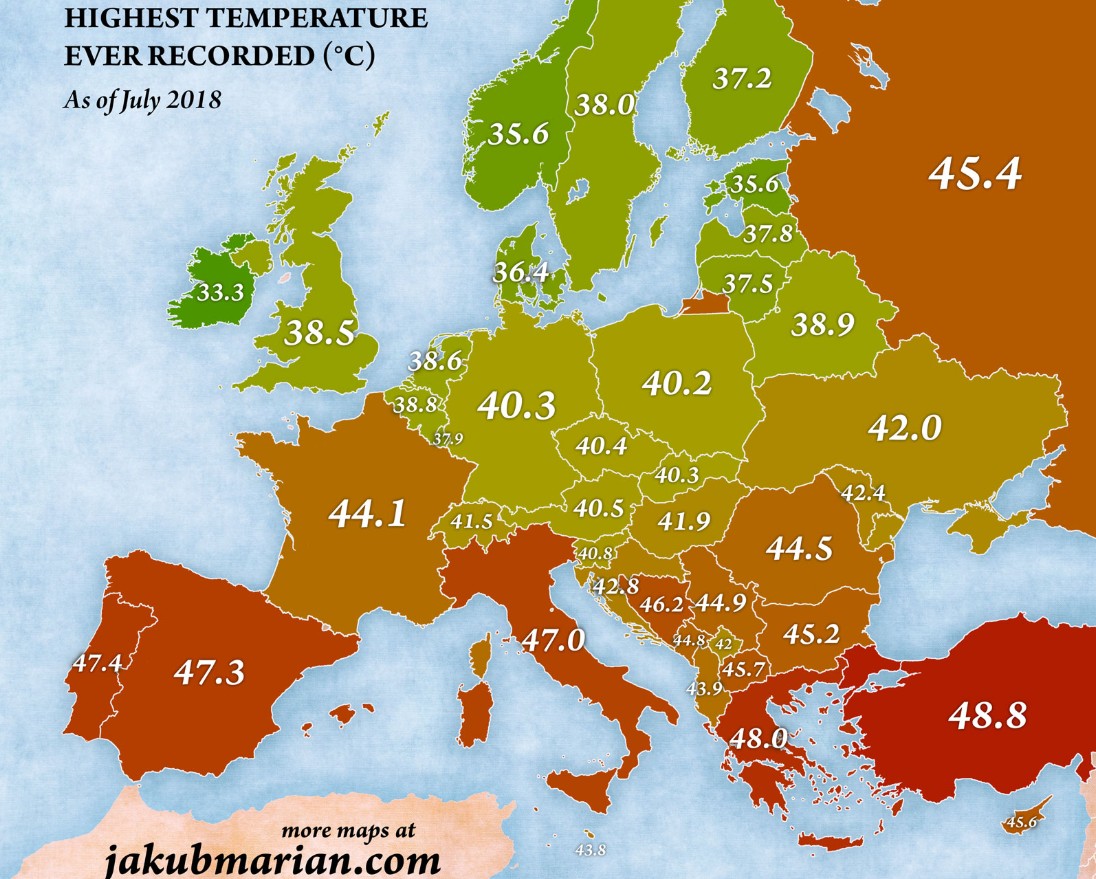
The Magical Earth web site has collected data that shows the highest officially (not anecdotally) recorded temperature in all European countries.
The highest officially recorded temperature in the world is 56.7 °C (134.1 °F), which occurred on 10 July 1913 in Furnace Creek, California, USA. Other continents also have some really hot places: 55.0 °C in Africa (Tunisia), 53–54 °C in Asia, 50.7 °C in Australia, and 48.9 °C in South America (Argentina). In comparison, the climate in Europe is fairly mild. The highest temperature was recorded in Athens, Greece, on 10 July 1977, with a measly 48.0 °C. This European map below shows the highest officially (not anecdotally) recorded temperature in all European countries…
System Change not Climate Change, an anti-capitalist, ecosocialist network advocates for workers’ power and sustainability; for a society that is free, just, and equitable; that fosters human creativity and productivity while healing the rifts generated by capitalism among people and between human society and the earth’s ecology. The battle against climate change may need a new system to redistribute wealth.
In order to address the environmental crisis, workers will need to create a new system that redistributes wealth and restructure the economy so it prioritizes people and the planet over profit. The scale of this task is such that workers will need to socialize the energy sector and expand renewable energy, expand mass transit, plan production and agriculture within ecological cycles, reduce the workweek with no loss in pay, and defund the US military and much more.
Neither the neo-liberalism that has dominated our economy in the 21st century nor the ideas of socialism from the 19th century seem to fit a problem of raising money to mitigate the effects of the floods, storms, fires, and coastal erosion that comes with rising temperature.


Global News on extreme weather August 2018

Action will need to be based on science, known to industry and independent ecologists, and political cooperation that puts the planet before populism.

References
(2018, August 10). 'Losing Earth': Do we have a collective moral responsibility to fight .... Retrieved August 11, 2018, from https://www.cbc.ca/radio/day6/episode-402-saudi-trolls-vs-canada-alex-jones-s-precarious-empire-losing-earth-pampered-poultry-and-more-1.4777781/losing-earth-do-we-have-a-collective-moral-responsibility-to-fight-climate-change-1.4777798

(2018, August 4). The Highest heatwave Temperatures in Europe (map) | This is Italy. Retrieved August 11, 2018, from https://www.this-is-italy.com/the-highest-heatwave-temperatures-in-europe-map/

(n.d.). Working-class power | System Change Not Climate Change. Retrieved August 11, 2018, from https://systemchangenotclimatechange.org/workingclass

Thursday, August 9, 2018

Climate Change and Communities

This curation of articles focuses on the way people in communities are experiencing climate change.
Temperature rising

Brian Kennedy, a research associate focusing on science and society at Pew Research Center writes that, in a new survey, the Center asked people who said climate change is affecting their local community to describe those effects in an open-ended format.
http://assets.pewresearch.org/wp-content/uploads/sites/14/2018/05/11095105/PS.05.10.18_report-12.png


Roughly six-in-ten Americans (59%) say climate change is currently affecting their local community either a great deal or some, according to a new Pew Research Center survey.
Some 31% of Americans say the effects of climate change are affecting them personally, while 28% say climate change is affecting their local community but its effects are not impacting them in a personal way.
Patrick Barkham reports on the concerns of Mayer Hillman, an 86-year-old social scientist, who says accepting the impending end of most life on Earth might be the very thing needed to help us prolong it. Mayer Hillman is amazed that our thinking rarely stretches beyond 2100.
https://i.guim.co.uk/img/media/7069f766c026db06db7c44b9426e0feaf28adf1e/0_29_3011_1807/master/3011.jpg?w=380&q=55&auto=format&usm=12&fit=max&s=3b91ce8d79ef7977b1fe2120d853af52


“This is what I find so extraordinary when scientists warn that the temperature could rise to 5C or 8C. What, and stop there? What legacies are we leaving for future generations? In the early 21st century, we did as good as nothing in response to climate change. Our children and grandchildren are going to be extraordinarily critical.”
Our society’s failure to comprehend the true cost of cars has informed Hillman’s view on the difficulty of combating climate change. But he insists that I must not present his thinking on climate change as “an opinion”. The data is clear; the climate is warming exponentially. The UN Intergovernmental Panel on Climate Change predicts that the world on its current course will warm by 3C by 2100. Recent revised climate modelling suggested a best estimate of 2.8C but scientists struggle to predict the full impact of the feedbacks from future events such as methane being released by the melting of the permafrost.
On a more hopeful note, Bruce Mohl writes that Sen. Michael Barrett of Lexington said putting a price on carbon “is the single most effective thing a state government can do to fight” climate change. He said the vote on carbon pricing makes the Senate of Massachusetts the first legislative body in the country to approve revenue-neutral fees as a carbon pricing option.
Putting a price on carbon got a big boost when National Grid, one of New England’s largest utilities, called for  putting an economy-wide price on carbon and rapid electrification of the transportation sector. The utility said both initiatives, as well as a host of others, are needed if the region is going to have a chance of meeting its carbon emission goals for 2030 and 2050.
https://commonwealthmagazine.org/wp-content/uploads/2017/04/Electric-vehicle.jpg?_t=1529097242

People in American communities, a long serving social scientist and environmental activist, and the Government of the Commonwealth of Massachusetts present experiences that underline our need to act now because there is no Planet B.

References

(2018, May 16). Most Americans say climate change affects their local community. Retrieved August 9, 2018, from http://www.pewresearch.org/fact-tank/2018/05/16/most-americans-say-climate-change-affects-their-local-community-including-two-thirds-living-near-coast/

(2018, April 26). 'We're doomed': Mayer Hillman on the climate reality no one else will .... Retrieved August 9, 2018, from https://www.theguardian.com/environment/2018/apr/26/were-doomed-mayer-hillman-on-the-climate-reality-no-one-else-will-dare-mention

(2018, June 15). Putting a price on carbon gains momentum in Mass. - CommonWealth .... Retrieved August 9, 2018, from https://commonwealthmagazine.org/energy/putting-a-price-on-carbon-gains-momentum-in-mass/

Climate Change and Communities http://tinyurl.com/ycjz9h2u

Thursday, July 26, 2018

Breaking News needs to cover work of Economy, Environment, and Ecclesia on climate change


The “breaking news” of the past week has included heat waves, flash floods, huge fires, severe drought, and record breaking temperatures. These events tragically contribute to large numbers of fatalities. The mitigation of the effects of these events costs large quantities of money. Certainly these events connect with our economy, environment and ecclesia.
A storm view

[intact] insurance, the largest provider of property and casualty insurance in Canada is a sponsor of the Centre on Climate Adaptation which is a University of Waterloo research centre. One of the economic concerns studied at the centre is mass migration due to inhospitable conditions: Canada is likely to be an attractive destination for climate refugees in the next few decades.

Emily Atkin writes in The New Republic about The Media’s Failure to Connect the Dots on Climate Change. She asks “Why are some major news outlets still covering extreme weather like it's an act of God?”
A record-breaking heat wave killed 65 people in Japan this week, just weeks after record flooding there killed more than 200. Record-breaking heat is also wreaking havoc in California, where the wildfire season is already worse than usual. In Greece, fast-moving fires have killed at least 80 people, and Sweden is struggling to contain more than 50 fires amid its worst drought in 74 years. Both countries have experienced all-time record-breaking temperatures this summer, as has most of the rest of the world.
Her article contains quotes from MSNBC host Chris Hayes on the effect of climate change reporting on ratings.
“almost without exception. every single time we've covered it's been a palpable ratings killer. so the incentives are not great”
Rafi Letzter, a staff writer at LiveScience, commented on the level of public disinterest in the topic.
Covering climate change, with few exceptions, is a traffic killer *for Live Science*, a website for people who like science. We do it anyway, and figure out how to squeeze water out of the rock. But the level of public disinterest in the subject is hard to overstate
Pope Francis suggests that we now consider some elements of an integral ecology, one which clearly respects its human and social dimensions in Chapter 4, Environmental, Economic and Social Ecology, of his encyclical letter “Laudato Si”.
138. Ecology studies the relationship between living organisms and the environment in which they develop. This necessarily entails reflection and debate about the conditions required for the life and survival of society, and the honesty needed to question certain models of development, production and consumption. It cannot be emphasized enough how everything is interconnected. Time and space are not independent of one another, and not even atoms or subatomic particles can be considered in isolation. Just as the different aspects of the planet – physical, chemical and biological – are interrelated, so too living species are part of a network which we will never fully explore and understand. A good part of our genetic code is shared by many living beings. It follows that the fragmentation of knowledge and the isolation of bits of information can actually become a form of ignorance, unless they are integrated into a broader vision of reality.
Economy, Environment, and Ecclesia form important overlapping roles in our efforts to prepare Canada for climate change...

Economy, Environment, and Ecclesia

migration and forming the ethical will to report the climate change effects and develop economic plans to address these drastic changes in our environment.

References

(n.d.). Climate Adaptation in Canada – Intact Centre | Home. Retrieved July 26, 2018, from https://www.intactcentreclimateadaptation.ca/

(2018, July 25). The Media's Failure to Connect the Dots on Climate Change | The .... Retrieved July 26, 2018, from https://newrepublic.com/article/150124/medias-failure-connect-dots-climate-change

(2015, May 24). Laudato si' (24 May 2015) - La Santa Sede. Retrieved July 26, 2018, from http://w2.vatican.va/content/francesco/en/encyclicals/documents/papa-francesco_20150524_enciclica-laudato-si.html

Friday, July 20, 2018

Economy, Environment, and Ecclesia present plans for Climate action

Reports of storms, floods, fires and coastal erosion appear more frequently in our media.
Coastal erosion

The cost of mitigating the effects of these events and restoring infrastructure is very high. This article identifies the plans of some economists, politicians and Church leaders to convert us to action to reduce future costs.

The Guardian reports that eleven teams in a recent Stanford Energy Modeling Forum found that carbon tax is effective at reducing carbon pollution.
Economic analyses consistently show that cutting carbon pollution will benefit the economy, and that a revenue-neutral carbon tax is an efficient way of accomplishing that goal. That’s why there’s a 95% consensus among economists that the US government should commit to cutting carbon pollution, with 81% favoring a market-based solution like a carbon tax.
In an interview on the CBC program, As It Happens, Catherine McKenna calls out politicians who don’t have a climate plan.
Look, I'm here to work with Canadians to find solutions to one of the biggest challenges we face, which is climate change. Unfortunately, it seems that Conservative governments are not committed to climate action.
The Catholic Climate Covenant has prepared resources to assist people interested in the Church plans for the process of conversion called for by Pope Francis in our attitude and action in relation to our Common Home, the Earth.
Catholic Climate Covenant is dedicated to helping all answer the Church's call to care for creation, both through prayer and through action. This resource library contains prayers, study guides, and inspiring videos for your perusal. We ask that you use them to better understand the Church's stance on climate change, and to create your own plan of action for making changes in your day-to-day life. Choose from one of the categories below to see the resources in that section.
Economy, Environment, and Ecclesia form important overlapping roles in our efforts to provide sustainable living for future generations.
Economy, Environment, and Ecclesia

References


(2018, July 16). Comprehensive study: carbon taxes won't hamper the economy .... Retrieved July 19, 2018, from https://www.theguardian.com/environment/climate-consensus-97-per-cent/2018/jul/16/comprehensive-study-carbon-taxes-wont-hamper-the-economy

(2018, July 19). 'They don't have a climate plan': Catherine McKenna calls out new .... Retrieved July 20, 2018, from https://www.cbc.ca/radio/asithappens/as-it-happens-wednesday-edition-1.4751691/they-don-t-have-a-climate-plan-catherine-mckenna-calls-out-new-ontario-government-1.4751696

(n.d.). Resources - Catholic Climate Covenant. Retrieved July 20, 2018, from http://www.catholicclimatecovenant.org/Resources