The G20 Interfaith Forum works to achieve G20 sustainable goals through community values. Belief empowers people and people achieve change. How are religious leaders uniquely placed to help combat Climate Change? Lauren Williams offers her thoughts.
The Encyclical of Pope Francis “Laudato Si” Care of Our Common Home lays the foundation for action to convert the people of earth to renew our care and concern for the planet. This article presents the some of the psychology of climate change communication. Some contributors share efforts to correct approaches that reinforce human sovereignty and the resulting environmental degradation. Change is proposed in a subjective, inductive, and experiential way without doing damage to the content of the encyclical. We seek common ground in care of the people and living creatures of the planet and our Christian responsibility to care for the poor.
He argues that once we understand what excites, threatens, and motivates us, we can rethink and re-imagine climate change, for it is not an impossible problem. Rather, it is one we can halt if we can make it our common purpose and common ground.
The predominant “stewardship model” of creation is the result of an intentional effort to correct approaches that reinforce human sovereignty and the resulting environmental degradation.
Stewards of creation
However, as All God’s Creatures argues, the stewardship model actually does not offer a correction but rather reinscribes many of the very same pitfalls. After close analysis of the stewardship model, this book identifies scriptural, theological, and philosophical sources to support the adoption of a “community of creation” paradigm.
A "community of creation"
Father Richard Hoganwrites that both Saint Augustine and Saint Thomas Aquinas lived and taught in a culture which might be described as objective, deductive, and principled.
Both Saint Augustine and Saint Thomas Aquinas lived and taught in a culture which might be described as objective, deductive, and principled. The modern world is primarily subjective, inductive, and experiential. Objective means that something is real, i.e., it is true, regardless of whether or not I know it to be true. For example, if a blind man is outside, but cannot see the trees, the trees are still there. Even though he does not perceive them, the trees are truly there. The existence of the trees does not depend on whether the blind man perceives them or not. Objective reality exists independent of one’s perception. The subjective view of reality claims that only that which I perceive to be real is actually real. Generally, the subjective view of reality is not applied to trees and physical objects. However, it is applied to non-physical realities, e.g., truths about the existence of God, truths about morality. The subjective view of reality is clearly captured by the phrase, “That may be true for you, but not for me!” In other words, what is true depends on what I believe or accept, or better phrased, on what I perceive. In the medieval world, such a claim would be utter nonsense. In fact, to most medieval academics, the truths of the faith, both dogmatic and moral truths, were more real than physical objects. The medieval world was objective. We are subjective.
Through the use of a philosophical movement called phenomenology, John Paul II has been able (in particular with the Theology of the Body) to present the content of Christ’s Revelation in a subjective, inductive, and experiential way without doing damage to its content.
Medieval world
Modern world
objective
subjective
deductive
inductive
principled
experiential
Augustine and Plato; Aquinas and Aristotle
Phenomenology of John Paul II
Table 1 Compare ancient and modern presentation Katherine Hayhoe, as part of the Global Weirding Series on YouTube, discusses the topic “The Bible doesn’t talk about climate change, right?” in which she looks at the problem from the point of view of Evangelical Christians and finds common ground in care of the people and living creatures of the planet and our Christian responsibility to care for the poor.
Bill McKibben discusses why decades of climate change discussion hasn't turned into decisive action.
Katharine Hayhoe outlines her "elevator pitch", on how climate is changing and why it matters. She advises don’t start with the science.
Start with the values. I care about X. For example “We don’t have a future without water”.
WATER – FOR ALL AND EVERYONE
The Water Connection
Water is a fundamental human right but water scarcity around the world is causing severe problems and human suffering that are likely to worsen in the future, warns Caritas Internationalis. “All people have a right to safe drinking water…This is a problem that affects everyone and is a source of great suffering in our common home.” – Pope Francis, Laudato Si’
Laudato Si Chapter 6
Displaced by water that was not safe to drink
Caritas’ global 2-year campaign on migration “Share the Journey” promotes Pope Francis’ “culture of encounter”, aiming to build stronger communities. Caritas is mobilizing its organisations in over 160 countries to look at the causes of migration, bust myths about migrants and to bring migrants and communities closer together.
In Laudato Si, Pope Francis declares the questions that need to be asked when assessing environmental impact on people of economic development.
Questions in Economic development
185. In any discussion about a proposed venture, a number of questions need to be asked in order to discern whether or not it will contribute to genuine integral development. What will it accomplish? Why? Where? When? How? For whom? What are the risks? What are the costs? Who will pay those costs and how? In this discernment, some questions must have higher priority. For example, we know that water is a scarce and indispensable resource and a fundamental right which conditions the exercise of other human rights. This indisputable fact overrides any other assessment of environmental impact on a region.
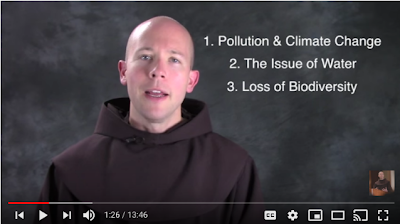
For 50 years the Boat Harbour NS residents witnessed the transformation of Boat Harbour from a once pristine tidal estuary, so frequented by the Mi’kmaq of Pictou Landing that they referred to it as “the other room,” into a brown, frothy, toxic soup containing some of the world’s most dangerous chemicals: carcinogens such as dioxins and furans and heavy metals such as mercury, zinc, cadmium and chromium. Action to address the climate change, water, and loss of biodiversity concerns expressed in “Laudato Si” needs to be focused on responding to the values of people that are threatened as the planet changes and people are displaced from their homes. References
(2018, November 9). CBC Listen | Front Burner | Bridging the climate change divide - CBC.ca. Retrieved November 14, 2018, from https://www.cbc.ca/listen/shows/front-burner/episode/15629854