Showing posts with label polling. Show all posts

Thursday, September 19, 2019

Canadians care about climate, children, and grandchildren

David Suzuki spoke with National Observer on the phone from his cabin on Quadra Island on the coast of British Columbia, where he was spending time with his children and grandchildren. He said he’s doubtful humans can make the changes needed to stop the world’s temperature rising by upwards of 1.5 C before 2030, as the UN Intergovernmental Panel on Climate Change has said is necessary to avoid catastrophic climate change.
Climate changing
He says to vote responsibly, voters must look past party politics and vote according to which local candidates promise to prioritize climate change, rather than focusing on party leaders.
“Whether they’re right-wing or left-wing, to me, that’s not as relevant as their individual positions on climate,” he said.
He said there have been candidates from all parties across the country he would vote for “in a heartbeat.”1

This points to the need to assess some of the “Critical questions in climate politics” curated in this post.
Critical questions for politicians

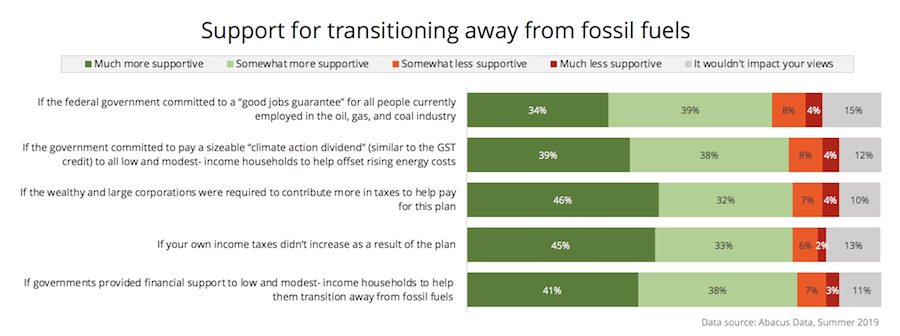
Research by Seth Klein finds that the more a bold and transformative climate plan is seen as linked to an ambitious plan to tackle inequality, economic insecurity, poverty and job creation, the more likely people are to support it.
https://www.policynote.ca/wp-content/uploads/2019/08/Climate-Emergency-Polling-40.png

In addition to people’s concerns about climate change, they are also very worried about inequality and affordability. So, when these social equity issues are tackled as part of a climate action plan, support for bold action to reduce GHG emissions rises dramatically.The poll listed five policy actions that could help with the transition, including extending income and employment supports to those more vulnerable during the transition, and increasing taxes on the wealthy and corporations to help pay for the transition, and asked people if such policies would make them more or less supportive of bold and ambitious climate actions. Those five policy options and the responses are shown below.2
Steve Easterbrook, at the helm of the University of Toronto’s School of the Environment, says the second-most important thing we must do to act on climate change is to get politically active, whether that’s joining a protest group, writing to our MPs or making it a core part of how we vote.
A lot of sources of greenhouse gas emissions don’t come from anything we as individuals have any control over. They come from government policies. So things like: Is the government investing in renewable energy or in fossil fuel energy? Or what standards are being set for cleaner vehicles and greener buildings? If we are not pushing government to act fast to change these kind of policies, we are missing a big piece of the puzzle.3
Katharine Hayhoe, a climate scientist and well-known climate change communicator,


insists that adults need to be upfront with children about our warming planet.

Kids deserve the truth about the earth they will inherit, she says. And the grown-ups need to hear what children have to say about climate change. Their voices, often heartfelt and hopeful, are critical in the search for climate solutions.
“Children look at something and they don’t see impossible, they see possible,” says Hayhoe, director of the Climate Science Centre at Texas Tech University in Lubbock, Texas. “They say: ‘What can we do to fix it?’ We need their perspectives more than ever. Children are what give us hope.”3 

The Guardian presents an editorial view on Pope Francis as a voice in the wilderness.

Pope Francis remains determined to reorient the church towards the global south, where it is still growing at impressive rates, especially in Africa, and to place it on the side of the poor. In Mozambique and Madagascar, he has argued for reconciliation between competing factions. In Mauritius, he has denounced the use of the islands as a tax haven, calling it “an idolatrous economic model”, and appealed to the government to “promote an economic policy focused on people and in a position to favour a better division of income”. However little the church seems to matter in the developed world, there is no spiritual leader making these arguments against unrestrained capitalism and environmental destruction as forcefully and to such an audience as Francis does in the global south today.4
No other spiritual leader is speaking out so clearly for the poor and for the environment in the developing world. Our concern for the planet often begins with the quality of life that we are leaving to the children of the world.

References


1
(2019, September 16). David Suzuki broke down barriers - National Observer. Retrieved September 19, 2019, from https://www.nationalobserver.com/2019/09/16/news/david-suzuki-broke-down-barriers-now-youth-are-rising 
(2019, August 12). When it comes to climate action, the public is ahead of our .... Retrieved September 19, 2019, from https://www.policynote.ca/climate-poll-2019/ 
3
(2019, July 12). What you can do about climate change now | The Star - Projects. Retrieved September 19, 2019, from http://projects.thestar.com/climate-change-canada/what-you-can-do 
4
(2019, September 9). The Guardian view on Pope Francis: a voice in the wilderness .... Retrieved September 10, 2019, from https://www.theguardian.com/commentisfree/2019/sep/09/the-guardian-view-on-pope-francis-a-voice-in-the-wilderness 

Monday, August 19, 2019

Macleans: Where parties stand on Climate Change


Where the political parties stand on climate change is information crucial for Canadians preparing for a federal election in October.
Mitigate Climate Change

Macleans magazine has gathered the data.

Canadians can expect a heated campaign that pits Justin Trudeau’s Liberals against Andrew Scheer’s Conservatives and Jagmeet Singh’s and New Democrats, as well as Elizabeth May’s Greens. This is Trudeau’s second time on the hustings as a leader, and both Scheer and Singh’s first. May has led her party through three campaigns.
Most parties will release their full election platforms during the campaign itself. But they do release some of their plans in advance; we’ll publish any proposal that can reasonably be considered an election promise. We’ll stick to the four main national parties to start, but reserve the right to add other parties’ proposals.1

The Liberal platform declares a ban “harmful” single-use plastics by as early as 2021 [source]

Macleans finds Liberal policy
The Conservative platform is more verbose.

  • Set emissions standards for major emitters that produce more than 40 kilotonnes per year of greenhouse gases, requiring them to invest in private-sector research and development of green technology. [source]
  • Establish a green patent credit that will reduce the tax rate to five per cent on income that is generated from green technology developed and patented in Canada. [source]
  • Incorporate traditional knowledge of First Nations into efforts to address the impacts of climate change. [source]
  • Expand Export Development Canada programs to issue more green bonds that provide financing for the development of emissions-reducing technologies. [source]
  • Create a two-year green homes tax credit for homeowners to help pay for energy-saving renovations. [source]
  • Create a two-year green homes tax credit for homeowners to help pay for energy-saving renovations. [source]
  • Review and update the invasive alien species strategy for Canada, as well as the invasive species action plans. [source]
  • Review and modernize air quality standards and regulations, with a focus on urban airsheds. [source]
  • Re-establish an advisory panel that gave hunting, angling and conservation groups input on policies and programs on conservation. [source]
  • Negotiate regulatory changes that would increase the energy efficiency of cross-border trucking while encouraging research and development in eco-friendly modes of transportation. [source]
CPC Real Plan

The NDP platform offers some plans that resonate with the highest priority directives of the IPCC to (1) stop using coal to generate electricity and (2) stop using gas and diesel in transportation.

  • Ban single-use plastics by 2022 as part of broader waste reduction strategy [source]
  • Set the target to retrofit all housing stock in Canada by 2050, by providing low-interest loans repayable through energy savings to pay for home upgrades like insulation, windows, heat pumps, and other renewable technologies [source]
  • Modernize and expand public transit in communities across Canada and ensure that federal transit funding flows with an emphasis on low-carbon transit projects [source]
  • Set a target to power Canada with net carbon-free electricity by 2030 and move to 100% non-emitting electricity by 2050 [source
NDP plans

The Green platform is most attendant to the emergency nature of the need to mitigate the effects of climate change and meet IPCC goals on emissions.

  • Double Canada’s emissions reduction target to 60 per cent by 2030 [source]
  • Halt all new fossil fuel development projects [source]
  • Implement a nationwide shift toward non-nuclear renewable energy while retrofitting all buildings in Canada over the next 11 years [source
GREEN Plan

The policies of each of the parties can be assessed by comparison to the template created by Clean Energy Canada.
Clean Energy Canada questions

Recent polls from ABACUS Data show increased concern and willingness to have government act on climate change.

References

1
(2019, April 30). 2019 federal election platform guide: Where the parties stand on .... Retrieved August 19, 2019, from https://www.macleans.ca/politics/2019-federal-election-platform-guide-where-the-parties-stand-on-everything/ 
2
(2019, August 12). Is climate change “an emergency” and do Canadians ... - Abacus Data. Retrieved August 13, 2019, from https://abacusdata.ca/is-climate-change-an-emergency-and-do-canadians-support-a-made-in-canada-green-new-deal/