Showing posts with label fear. Show all posts

Tuesday, October 20, 2020

Conflict Fear and Manipulation

 In conflict situations, like that between indigenous and non-indigenous fishers in Nova Scotia, we can often recognize behaviour like circling of the wagons, a propensity to ‘other’ those different from ourselves, and a desire for erecting walls and borders.

Fishing off the coast


This may be evidence of a fear response that stems from anxiety. Our response to fear is an evolutionary mechanism aimed at self-preservation in immediate and dire circumstances. Unfortunately, our anxiety can be manipulated by others to generate an unnatural fear. In a lecture, delivered by Daniel P. Horan, OFM, at Oblate School of Theology's Summer Institute, entitled "Natural and Unnatural Fear; Rational and Irrational Hope," Fr. Horan explores the physiological basis of natural fear and how unnatural fear can be conditioned. Noting that human beings must make decisions in a world for which evolution has given them only a very basic preparation, Fr. Horan warned, “This leaves us especially vulnerable to co-option, something that ancient philosophers recognized in the dangerous shadow side of persuasive rhetoric,” he said.


Political, social and religious leaders can instill fear by harvesting the need to manipulate anxiety or concern that women and men might already have.” For example, they may feel anxious or concerned about legitimate things like their health or future, whether the harvest is going to be enough or whether their retirement savings will get them by, he said, adding, “If political, social or religious leaders can harvest such anxieties for self-serving reasons and turn them into an impending threat, this is a problem.”1


Sociologist Barry Glassner spent five years poring over more than 10,000 newspaper, radio and television accounts of social issues, and he discovered a distinct pattern.


“Scratch the surface of any pseudo-fear and you’ll find a wide array of groups that stand to benefit from promoting the scares, including businesses, advocacy organizations, religious sects and political parties,” Glassner said. No amount of debunking can wipe out a fear as long as someone can still find a way of profiting from it, Glassner found.2


The YouTube video of the lecture of Fr. Daniel P. Horan, OFM to the Oblate School of Theology on "Natural and Unnatural Fear; Rational and Irrational Hope."3 can be viewed about 40 minutes into the talk for some more information on how our anxiety is manipulated into fear by those who desire to gain from the disruption.


Social discord and irrational violence may be rooted in fear. We need to explore the anxieties that may have been manipulated into fear. Action to reduce the anxiety will make it more difficult to fan the embers of legitimate anxiety into fear and the resultant irrational abusive treatment of people and property.


References


1

(n.d.). Fear is the Enemy of Christian Discipleship - OBLATE. Retrieved October 20, 2020, from https://ost.edu/fear-is-the-enemy-of-christian-discipleship/ 

2

(1999, June 7). A Sociologist Explores the 'Culture of Fear' - USC News. Retrieved October 20, 2020, from https://news.usc.edu/8743/A-Sociologist-Explores-the-Culture-of-Fear/ 

3

(2019, June 17). Natural and Unnatural Fear; Rational and Irrational Hope .... Retrieved October 20, 2020, from https://www.youtube.com/watch?v=gWEDeTxmwwg&list=PLNEFMggh1aoSG0_rFFHhfIdrkDnSr7_2r 


Saturday, September 7, 2019

Fear grief and lack of talk on climate change

The answer to the question posed by Canadian climate scientist Katherine HayhoeWhat's the big deal about a few degrees anyway?”


includes exploration of our possible fear and denial even as expert scientists, economists, and psychologists present their study of the effect of the climate emergency on people and our planet.
the effect of the climate emergency on people and our planet1
Annette Dubreuil explores the question of why we stop talking about climate change.
 This “spiral of silence” is itself a big problem: “People concerned about the climate avoid voicing their worry because they rarely hear others discussing the topic, and thus the spiral continues.” But collective silence is dangerous, especially for a problem as large and urgent as climate change. How do we pull out of this spiral? According to Hayhoe, we have to talk about it. But that can be hard to do. Humans are social creatures. Belonging is a fundamental and universal human need, and as a result, we often choose to conform to our group. That’s why our friends and family have far more influence on our view than do experts. Research suggests that the silencing effect is most powerful when talking to family, friends, or neighbours about obtrusive issues. So, the need for belonging makes overcoming the spiral of silence with friends and family even harder. But in fact, we have much more common ground on climate change than expected: in a research project using dialogue between people of opposing views, participants agreed on key points, and in each case there was at least one topic where the two took positions contrary to what they predicted of the other.Even when we do talk about climate change, our instinct on what to talk about is typically unhelpful. Rather than starting with the science and facts as we’re apt to do, Hayhoe suggests that we find that common ground by looking for shared values. For example, maybe you’re both parents, or maybe you both have the same hobby. Second, don’t use fear, but rather rational hope. Talk about solutions that are “practical, viable, accessible and attractive”.2
Katherine Hayhoe recently gave a TED talk titled “The most important thing you can do to fight climate change: talk about it.


In it, she cites the Yale Program on Climate Change Communication, which finds that two-thirds of Americans never talk about climate change even though 70% believe it is a real problem.

Jennifer A Dlouhy comments that an all-star lineup of economists, from Alan Greenspan to Paul Volcker, is endorsing a plan to combat climate change
Common ground on Climate

by slapping a tax on greenhouse gas emissions and then distributing the revenue to American households.

All living former Federal Reserve chairs, several Nobel Prize winners and previous leaders of the president’s Council of Economic Advisers have signed on to a statement asserting that a robust, gradually rising carbon tax is “the most cost-effective lever to reduce carbon emissions at the scale and speed that is necessary.”
“A carbon tax will send a powerful price signal that harnesses the invisible hand of the marketplace to steer economic actors towards a low-carbon future,” the 45 economists say in the opinion piece, published by the Wall Street Journal late Wednesday.3 

Olivia Goldhill asks if therapists have a duty to confront climate change denial. The research of Dr. Renee Lertzman, an expert in the psychosocial aspects of climate change communications has inspired a video. There are various psychoanalytical theories as to why we might be psychologically resistant to addressing climate change, notes philosopher and psychoanalyst Donna Orange, an adjunct professor at New York University. Social scientist Renee Lertzman, who works on the psychology of environmental communications, believes that people are suffering from “environmental melancholia.”
Freud believed that melancholia reflected a sense of loss that is not fully conscious and so cannot be fully mourned, and Lertzman argues this state describes our response to climate change. That many are aware of the effects of climate change but do little about it suggests dissociation, the Freudian concept explaining how we bury traumatic memories in the unconscious, and regression, Freud’s explanation for why people show childlike rather than adult behavior as a defense mechanism for coping with stress, argues Orange.4 
Sara E. Gorman, PhD, MPH, a public health specialist working on mental health and Jack M. Gorman, MD, former Professor and Chair of Psychiatry and Professor of Neuroscience at the Mount Sinai School of Medicine, faculty of Columbia University's Department of Psychiatry for 25 years, find there are at least two psychological reasons that encouraging people to adopt climate protection activities in their daily lives may help promote action on the larger scale.

First, denial is a response to something we fear, and we know from animal and human studies that fear induces freezing and passivity. But studies also demonstrate that giving a fearful animal or human a task that even symbolically addresses what is feared can minimize freezing and promote action. Thus, recommending tasks that we can perform in our daily lives may help us overcome our feeling that mitigating climate change is a hopeless enterprise and motivate us join the voices insisting on ending burning fossil fuels.
Second, these quotidian activities can be the basis for the formation of committees and communities that bring people together with the common goal of addressing climate change. Being part of a group with a common goal may help people overcome denial and have the courage to face the realities of climate change, however grim they may be. It may be easier and more effective for groups of people to demand that countries impose carbon taxes and spend heavily on sustainable energy than it is for individuals.5 
Being frozen in fear and presenting symptoms of grief
Climate stages of grief

at our loss are delaying the relief we will find in beginning to seek common ground with others as we speak about our concerns.

References


(n.d.). Global Weirding with Katharine Hayhoe - YouTube. Retrieved February 22, 2019, from https://www.youtube.com/channel/UCi6RkdaEqgRVKi3AzidF4ow 
(n.d.). Annette Dubreuil, Author at Canada's Ecofiscal Commission. Retrieved September 7, 2019, from https://ecofiscal.ca/author/adubreuil/ 
(2019, January 16). From Greenspan to Yellen, Economic Brain Trust Backs .... Retrieved September 7, 2019, from https://www.bloomberg.com/news/articles/2019-01-17/from-greenspan-to-yellen-economic-brain-trust-backs-carbon-tax 
(2019, February 21). Do therapists have a duty to confront climate change denial. Retrieved September 7, 2019, from https://qz.com/1554808/fighting-climate-change-with-psychoanalysis/ 
(2019, January 12). Climate Change Denial | Psychology Today. Retrieved September 7, 2019, from https://www.psychologytoday.com/us/blog/denying-the-grave/201901/climate-change-denial 

Wednesday, September 4, 2019

Critical thinking required about political proclamations

Recently the CBC reported that a child - killer story revealed some dubious news activity to push election campaign messages.
Some manipulation techniques

The British tabloid The Daily Mail published a story claiming convicted child murderer Jon Venables would soon be released and sent to Canada. Conservative Leader Andrew Scheer tweeted a link to the Daily Mail story and said it was "disturbing that this pedophile child killer might come to Canada."

"As Prime Minister I won't let him come here. Where does Trudeau stand?" Scheer wrote. "Our country should not be a dumping ground for murderers, terrorists, and perverts."
Barbara Jo Caruso, an immigration lawyer and the founder of the Corporate Immigration Law Firm, said there are some exemptions to inadmissibility but added that it would be "unlikely" for someone like Venables to be approved to come to Canada.
As with another recent story in the British press — about the U.K. stripping citizenship from a dual Canadian-British national held by the Kurds and accused of aiding ISIS in Syria — the Daily Mail story played into a Conservative narrative that the Liberal government would be soft on crime.1

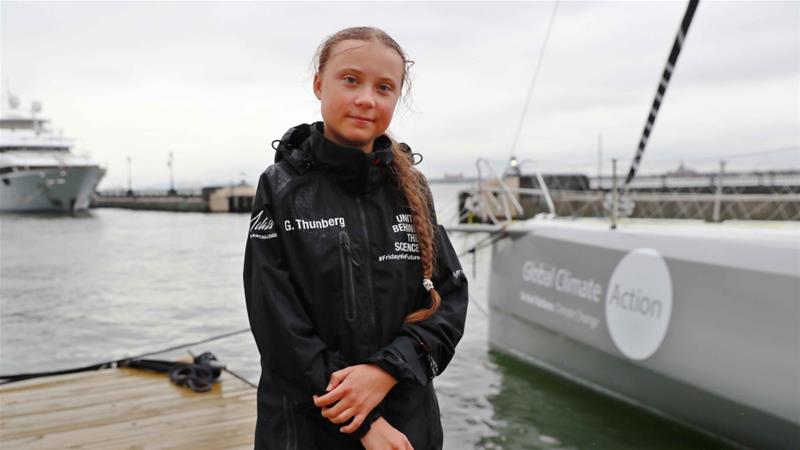
In words and deeds, Gerta Thunberg is the embodiment of philosopher Howard Zinn's admonition: "We don't have to engage in grand, heroic actions to participate in the process of change. Small acts, when multiplied by millions of people, can quietly become a power no government can suppress, a power that can transform the world."
https://www.aljazeera.com/mritems/imagecache/mbdxxlarge/mritems/Images/2019/9/1/2da385a645ed41c7bf025c054504b976_18.jpg

Al Jazeera reports.
Of course, the marauding swarm of vitriolic right-wing climate-change deniers see Thunberg - not how the prophetic Zinn envisioned her - but as a tiny, pretentious zealot who threatens the existing order. Their order. Their comforts. Their traditional "way of life".
De rigueur, they have set out to discredit and, if possible, to destroy Thunberg with their, by now, familiar and crass modus operandi.
They have mocked her. They have belittled her. They have denigrated her. They have insulted her. They have dismissed her. They have questioned her motives. They have suggested she is anti-democratic. They have, in the fetid recesses of the internet, even threatened her.2
The National Observer writes that Greta Thunberg is winning hearts and minds. Some old men hate it. The piece by Matthew Klippenstein cautions that climate advocates would also do well to recognize that some of Thunberg’s critics’ core concerns do have merit. As Langley chemist Blair King noted in an articulate recent blog post.

"It is easy for climate strikers and their activist supporters, who go to bed well-fed and warm in Canada and Europe, to tell the world they should use less energy. But the governments of China and India still have deep poverty and hardship to fight and will ignore those cries because they are dealing with louder and more pressing cries of citizens who need food and shelter today."
There is also the challenge of affirming the need to transition beyond fossil fuels while discouraging boasting by those naively believing they’ve already done so. I can think of few things more counterproductive than my fellow early adopters extolling their electric cars’ carbon chastity as if they’d been fitted for vehicular purity rings.
These boasts won’t only annoy the oilpatch but public transit and cycling advocates as well, given that climate nudges may reduce support for truly transformative change. As Green Leader Elizabeth May has noted, the enemy of climate action right now (which in cities means housing density, cycling and vastly expanded public transit) is incrementalism: the belief that switching from combustion to electric vehicles is magically adequate. Zero-emission vehicles are absolutely necessary, yet still insufficient as a complete climate solution.3 

These articles underline the importance of disciplining our mind to avoid easy and lazy decision making, like the too common confirmation bias, and use our mental ability to critically think about the motives behind proclamations we read and see


particularly if we perceive an attempt to generate a fear response to their message.

References

1
(2019, September 3). Child-killer story shows how parties use dubious news to ... - CBC.ca. Retrieved September 4, 2019, from https://www.cbc.ca/news/technology/scheer-tweet-bulger-venables-story-1.5269306 
2
(2019, September 1). Who is afraid of Greta Thunberg? | US & Canada | Al Jazeera. Retrieved September 4, 2019, from https://www.aljazeera.com/indepth/opinion/afraid-greta-thunberg-190901191445655.html 
3
(2019, September 3). Greta Thunberg is winning hearts and minds — and some old men .... Retrieved September 4, 2019, from https://www.nationalobserver.com/2019/09/03/opinion/greta-thunberg-winning-hearts-and-minds-and-some-old-men-hate-it 

Thursday, August 29, 2019

Using fear to manipulate our voting decision

As we approach a fall election we need to assess political claims that have been psychologically designed to manipulate our voting decision. Three methods of manipulation are identified by sociologist Barry Glassner.
Attention to these strategies

There is a difference between post-truth and plain old lying, says professor and author Lee McIntyre.
"I see post-truth as a little bit darker in motive. It's manipulation for a political purpose that has less to do with convincing someone and more to do with ruling that person."1 
Kendra Cherry shares an important cognitive bias that can distort our thinking.
Confirmation Bias: This is favoring information that conforms to your existing beliefs and discounting evidence that does not conform.2 
Daniel P. Horan, OFM speaks on how we can be manipulated by people who play on our fear in his address on “Natural and Unnatural Fear Rational and Irrational Hope” to the Oblate School of Theology's Summer Institute where he cites work, on “fear mongering” by Barry Glassner who demonstrates in his book, The Culture of Fear, that it is our perception of danger that has increased, not the actual level of risk.
At minute 49 Horan refers to Glassner on fear and three contributing factors in manipulation.4

Our psychological response to fear may be “fight, flight or freeze” and we become focused on immediate threats to our security. This primitive mind space is not the attitude that selects the best long term political policy for our society.

References


1
(2018, April 27). How “post-truth” entered the political mainstream - CBC.ca. Retrieved April 29, 2018, from http://www.cbc.ca/listen/shows/sunday-edition/segment/15540579 
2
(2018, January 4). How Cognitive Biases Influence How You Think and Act - Verywell Mind. Retrieved April 29, 2018, from https://www.verywellmind.com/what-is-a-cognitive-bias-2794963 
3
(n.d.). The Culture of Fear: Why Americans Are Afraid of the ... - Amazon.com. Retrieved August 28, 2019, from https://www.amazon.com/Culture-Fear-Americans-Minorities-Microbes/dp/0465003362 
4
(2019, June 17). Natural and Unnatural Fear; Rational and Irrational Hope | Daniel P .... Retrieved August 28, 2019, from https://www.youtube.com/watch?v=gWEDeTxmwwg 

Tuesday, June 18, 2019

Canada declares Climate Emergency

The motions of governing parties about climate action have an effect in raising the profile and perhaps the anxiety around this issue.
Coastal erosion and flooding

Hannah Jackson, of Global News, reports the House of Commons passed a motion to declare a national climate emergency in Canada on Monday June 16. The motion was put forward by Environment and Climate Change Minister Catherine McKenna, and it passed with 186 votes to 63. It declares a national climate emergency, and supports the country’s commitment to meeting the emissions targets outlined in the Paris Agreement.
 “The science shows that Canada is warming at twice the global average and that we need to meet our international obligations,” she wrote.
“That’s why I’m voting for the motion and that’s why Canada’s already taking action.”1
Jolson Lim, of ipolitics, reports that Conservative leader Andrew Scheer opposes the Liberal motion on declaring ‘climate emergency’. Scheer told CTV’s Question Period a year ago that the Conservatives’ climate plan would “of course” meeting the 2030 Paris targets, but told the same show in December that his plan would have “meaningful reductions.”

Scheer also accused the Liberals today of wasting precious time in the House, with less than five sitting weeks left for Parliament, in order to score political points.
“We’re in the dying days of a scandal-plagued Liberal government and they’re using precious House time on a symbolic gesture rather than taking real action,” he said, who added that it serves as a distraction from recent controversies such as the SNC-Lavalin and Mark Norman affairs.2 

Clinical psychologist and climate emergency campaigner, Jane Morton, has created a 24-page booklet and a 45-minute presentation on the topic of how we get more people to listen and take action on climate issues.


When an emergency situation confronts a nation, our ability to work together and pursue common ground efficiently is crucial to address the threat.

References

1
(2019, June 18). National climate emergency declared by House of ... - Global News. Retrieved June 18, 2019, from https://globalnews.ca/news/5401586/canada-national-climate-emergency/
2
(2019, May 15). Scheer to oppose Liberal motion on declaring 'climate emergency .... Retrieved June 18, 2019, from https://ipolitics.ca/2019/05/15/scheer-to-oppose-liberal-motion-on-declaring-climate-emergency/
3
(n.d.). Climate Emergency Declaration - Call to declare a climate emergency. Retrieved June 18, 2019, from https://climateemergencydeclaration.org/