A previous post, Housing Crisis Recent History, touched on the government decisions that have led to social housing austerity in Canada and the need for a large-scale community-based land acquisition strategy based on sustainable living, not returns for investors.
.jpg)
Housing Crisis in the Suburbs
This curation of opinion urges government to get back in the game in one instance and for less restrictions on development in the backyards of our cities.

Max Fawcett, in an opinion piece in the National Observer, argues that the government needs to return to driving housing construction because he concludes that Pierre Poilievre’s housing prescription doesn’t add up.
Rather than government getting “out of the way,” as Poilievre suggests, it needs to find ways to get back in the game. This is where the Liberals and New Democrats have to come in. We need an alternative to Poilievre’s dumbed-down approach that trades in half-truths and gerrymandered data. We need an optimistic vision of the future in which Canadians aren’t forced to choose between urban sprawl and economic survival. And we need solutions that target the real stress points in our housing ecosystem rather than cutting a blank cheque to politically connected developers.
But Ford did manage to transfer more than $8 billion of wealth onto the balance sheets of a small handful of developers, some of whom just happened to be donors to his Ontario PC Party. And that, in the end, is the more likely priority here for conservatives: not affordability or justice for younger Canadians but the elimination of anything that stands between home builders and their profits. Yes, the private sector has a major role to play in addressing the housing crisis, but it’s one that should be very carefully defined by governments. The sooner they get back into this game, the better off we’ll all be. (Fawcett & Logan, 2023)
The Economist has published an article analysing the growing global movement to restrain house prices. “Yes In My Back Yard” (YIMBY) advocates argue that housing shortages are caused largely by laws that control who can build what and where. Zoning and planning laws, they say, are so strict that building new housing is in many places completely illegal, and in almost all it is slow, difficult and expensive.
Not everyone agrees on everything. YIMBYS range from libertarian-leaning tech types through to self-described socialists, such as John Bauters. He is the bicycle-riding mayor of the tiny Californian city of Emeryville, who allows development because it gives him more rich people to tax. Yet all share one belief: more housing needs to be built, especially in the biggest and costliest cities.
At the higher levels of politics at least, Yimbyism is now practically mainstream in California. “Pro-housing policies are pro-job policies,” tweeted London Breed, San Francisco’s mayor, in July. Gavin Newsom, the state’s governor, promised to build 3.5m homes in a speech for his election campaign. Across the state such politicians are engaged in an increasingly pitched legislative battle with local politicians, such as city council members and the leaders of suburbs, who are generally determined not to build more.
Yimbyism abounds elsewhere, too. In New York this year Kathy Hochul, the state governor, (unsuccessfully) proposed a radical “upzoning”, approving a greater density of housing in a particular area. She argued that it would allow the construction of 800,000 more homes over a decade, primarily by letting more apartments be built around railway stations in New York City’s suburbs. In Canada, Pierre Poilievre, who leads the opposition Conservative Party, wants the federal government to be able to force municipalities to allow more housing construction. Both major political parties in Britain say they want more houses built, no doubt mindful of an election expected next year. (The Growing Global Movement to Restrain House Prices, 2023)
The plans for The M District Future Growth Node in the Halifax Regional Municipality add housing density to redevelopment of a parking area for a shopping centre that is located next to a main transit hub. This plan resonates with the desire to build more apartments near railway stations in New York suburbs. HRM will begin a second phase of public engagement in Fall 2023 once draft planning documents are ready to be presented for comment and feedback.
WM Fares Architects,on behalf of Rank Inc., has applied to begin a comprehensive planning process to allow the development of the Mic Mac Mall lands bound by Micmac Boulevard, Horizon Court, and Highway 111, identified on the map below. The proposal includes approximately 2,200 new residential units, plus 400 units for retirement living and additional commercial office and retail space built around the existing mall. (The M District Future Growth Node, n.d.)
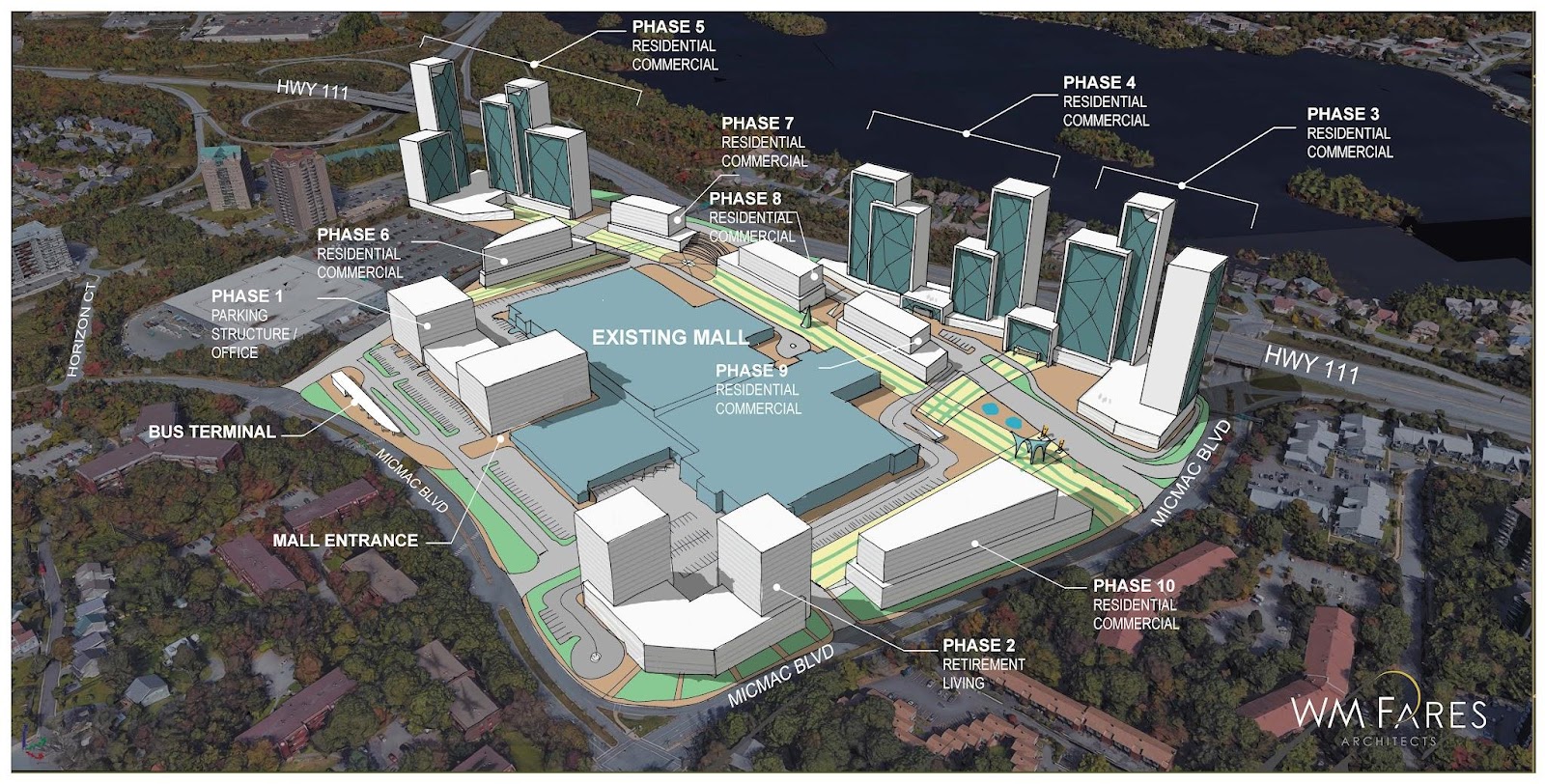
(The M District Future Growth Node, n.d.) https://s3.ca-central-1.amazonaws.com/ehq-production-canada/e9442aaa2ad3ee97b2fe4ff6f6c6f27a7cd81dc6/original/1684439044/9103f74919d6e082614968facf136e66_3D_Context_View.jpg?1684439044
An earlier post, Housing and Investment, considers the questions:
- Is housing a basic human right or an investment?
- Can homes and apartments be commodities and at the same time be considered a basic human need?
These concerns need to be included in the development plans for the M District.
Another earlier post, considers the role of Supply or Speculation in the lack of affordable housing.

The post, Housing and Ideology, suggests the involvement of the government in building housing has been successful in the past and may again offer the possibility of redevelopment of federal land in the centre of HRM that would include non market affordable housing.

The need to address homelessness in HRM will be immediate as winter approaches. The alleviation of the housing crisis is urgent and requires action to maintain the status of HRM as a place to support living and working.
References
Fawcett, M., & Logan, C. (2023, September 7). Pierre Poilievre's housing prescription doesn't add up. National Observer. Retrieved September 8, 2023, from https://www.nationalobserver.com/2023/09/07/opinion/pierre-poilievre-housing-prescription?
The growing global movement to restrain house prices. (2023, September 6). The Economist. Retrieved September 8, 2023, from https://www.economist.com/international/2023/09/06/the-growing-global-movement-to-restrain-house-prices?
The M District Future Growth Node. (n.d.). Shape Your City Halifax. Retrieved September 8, 2023, from https://www.shapeyourcityhalifax.ca/the-m-district-development
Roberts, J. (2021, September 17). Fixing Canada's housing crisis will require bold socialist politics ⋆ The Breach. The Breach. Retrieved September 5, 2023, from https://breachmedia.ca/fixing-canadas-housing-crisis-will-require-bold-socialist-politics/


