Showing posts with label US. Show all posts

Monday, February 10, 2025

Trump or Truth

Trump Lost the Trade War He Started With Canada


Patricia Lopez, a Bloomberg Opinion columnist, reports:


Trump has similarly exaggerated Canada’s trade deficit, which he said is at an “unfair” amount of $250 billion, amounting to a subsidy. (It’s not.) The actual trade deficit stood at $40 billion in 2023, according to the US Bureau of Economic Analysis, and mostly exists because the US buys a lot of Canadian oil. Again, to heat those Midwestern homes. (Lopez, n.d.)


References

Lopez, P. (n.d.). Trump Lost the Trade War He Started With Canada. Bloomberg Opinion. Retrieved February 10, 2025, from https://www.bloomberg.com/opinion/articles/2025-02-05/tariffs-trump-lost-the-trade-war-he-started-with-canada 


Monday, May 20, 2024

War Crime Charges make a Difference

Kenneth Roth, former executive director of Human Rights Watch, and a visiting professor at Princeton’s School of Public and International Affairs, offers an opinion for the Guardian on whether war crime charges make any difference in the conflict in Gaza.


ICC prosecutor requests arrest warrants for Netanyahu, Gallant and three Hamas leaders – video


The Israeli government is not about to surrender Netanyahu or his deputies for trial. But their travel would suddenly be limited. Although the US never joined the court, European governments have, meaning that suddenly Europe and much of the rest of the world would be out of bounds for those charged without risking arrest. It would also make it more difficult for Washington and London to pretend that their ongoing arming of the Israeli military is not contributing to war crimes.


In addition, an initial round of charges would be an implicit threat of more. As Netanyahu contemplates a potential invasion of Gaza’s southernmost city of Rafah despite 1.4 million Palestinians sheltering there, he must worry about whether more civilian deaths would spur Khan to intensify investigation of Israel’s apparently indiscriminate and disproportionate attacks on civilians. The ICC thus may live up to its potential not only to provide retrospective justice, but also to deter future war crimes. (Roth, 2024)


Barak Ravid reports two Israeli officials told Axios that Israeli Prime Minister Benjamin Netanyahu asked President Biden to help prevent the International Criminal Court from issuing arrest warrants for senior Israeli officials in connection with the war in Gaza, The officials said Netanyahu expressed his concern to Biden in a phone call on Sunday April 28, where the two leaders also discussed hostage negotiations, Israel's defense against Iran's missile attack, and the need to increase humanitarian aid to Gaza, according to a White House readout.

  • The ICC, which is based in The Hague, Netherlands, has been investigating possible war crimes by both Israeli forces and Palestinian militants dating back to the 2014 Israel-Hamas war.

  • U.S. officials said they do not have a clear indication whether the ICC is going to issue arrest warrants, but said the prosecutor's office is under pressure from NGOs and several ICC member states to do so. (Ravid, 2024)


Patrick Wintour and Julian Borger report to the Guardian that G7 diplomats argue any move now in an investigation launched in 2021 could disrupt current ceasefire talks.


Israeli politicians including the prime minister, Benjamin Netanyahu, have suggested that the ICC could press charges imminently after an investigation launched in 2021 that covers events starting in 2014. The inquiry has also been looking at Israel’s construction of settlements in occupied territory. (Wintour & Borger, 2024)


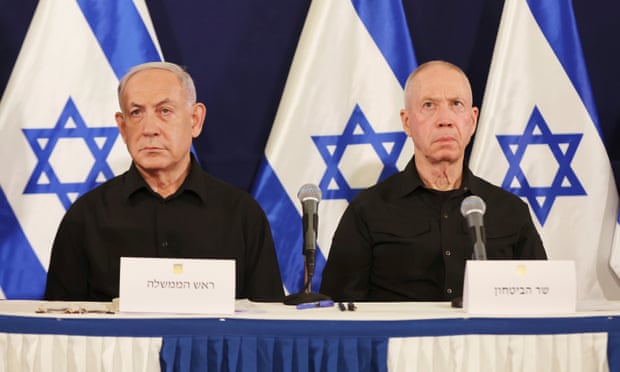
Bethan McKernan in Jerusalem reports for the Guardian on the Karim Khan application for warrants relating to alleged crimes committed during the 7 October attack and the ensuing war in Gaza. The chief prosecutor of the international criminal court has said he is seeking arrest warrants for senior Hamas and Israeli officials for war crimes and crimes against humanity, including the Israeli prime minister, Benjamin Netanyahu, and his defence minister, Yoav Gallant, a move that puts the post-second world war rules-based order to the test and presents new challenges for Israel’s western allies.


He named Yahya Sinwar, the Hamas chief in the Gaza Strip, and Mohammed Deif, the commander of its military wing, considered to be the masterminds of the 7 October assault, as well as Ismail Haniyeh, the leader of the group’s political bureau, who is based in Qatar, as wanted for crimes of extermination, murder, hostage-taking, rape, sexual assault and torture.


Netanyahu and Gallant are accused of extermination, causing starvation as a method of war, the denial of humanitarian relief supplies and deliberately targeting civilians. (McKernan, n.d.)


The Economist article comments that in The Hague, the International Criminal Court (ICC) is considering war-crimes prosecutions against Israeli leaders, including Binyamin Netanyahu, the prime minister, over the conflict in Gaza.

The ICC, more like a criminal court, investigates people rather than states. But it can prosecute a broader range of offences—not only genocide but also crimes against humanity and war crimes. Independent prosecutors decide whether to issue arrest warrants, but rely on states to enact them. They can charge anyone involved in crimes committed on the territory of countries that have ratified the ICC’s statute, or by their citizens. The ICC can investigate a fourth crime, of “aggression”—regarded as the “supreme international crime” that leads to other atrocities—but only if suspects are citizens of state parties. The ICC's work is thus limited because dozens of countries have declined to join the court—among them America, Russia, China, India and Israel.


A finding of genocide would be grievous to Israel, a country born from the ashes of the Holocaust. Israel is said to be threatening retaliation against the Palestinian Authority (which, in effect, granted the court jurisdiction in Gaza). Israel’s supporters in Congress call for sanctions against the ICC. Mr Khan, in turn, has demanded an end to “all attempts to impede, intimidate or improperly influence officials”.


All of which is a quandary for the Biden administration. America is not a signatory but has supported the ICC in Ukraine. Yet it says the court lacks jurisdiction in Gaza. America urges Israel to do more to protect Palestinian civilians, but has for months supplied it with weapons. On May 8th America confirmed it had suspended a shipment of heavy munitions out of concern that they might be used in Rafah, where more than 1m Palestinians are sheltering. Despite an international outcry, Israel is starting to push into that city. Talks about a ceasefire continue. (The World's Rules-Based Order Is Cracking, 2024)

The difference that pressure from International Courts and advice from traditional allies of Israel can make is to clarify to Israel that failure to attend to violations of humanitarian law, particularly in the areas of civilian famine, loss of medical services, lack of distinction of civilians, and lack of proportionality in pursuit of military objectives has consequence most immediately in loss of military support and ultimately in possible arrest of war criminals.


References

McKernan, B. (n.d.). ICC prosecutor seeks arrest warrants for Israeli PM and Hamas officials for war crimes. the Guardian. Retrieved May 20, 2024, from https://www.theguardian.com/law/article/2024/may/20/icc-prosecutor-seeks-arrest-warrants-israeli-pm-netanyahu-hamas-officials-war-crimes 

Ravid, B. (2024, April 29). Netanyahu asks Biden to help stop ICC arrest warrants over Gaza war. Axios. Retrieved May 20, 2024, from https://www.axios.com/2024/04/29/netanyahu-biden-icc-arrest-warrants-war-crimes 

Roth, K. (2024, April 29). What will happen if the ICC charges Netanyahu with war crimes? | Kenneth Roth. The Guardian. Retrieved May 20, 2024, from https://www.theguardian.com/commentisfree/2024/apr/29/netanyahu-icc-war-crimes 

Wintour, P., & Borger, J. (2024, April 29). ICC urged to delay possible war crimes charges against Israel and Hamas. The Guardian. Retrieved May 20, 2024, from https://www.theguardian.com/law/2024/apr/29/icc-possible-war-crimes-charges-israel-hamas-g7 

The world's rules-based order is cracking. (2024, May 9). The Economist. Retrieved May 20, 2024, from https://www.economist.com/international/2024/05/09/the-worlds-rules-based-order-is-cracking 


Wednesday, May 8, 2024

Report on Israel's campaign due in U.S. Congress

In a report from the Associated Press, published on the CBC Website, about the resumption of aid deliveries to Gaza a reference is made to the report on Israel’s campaign that is due in the U.S. Congress.


violating international humanitarian law in Gaza


The Biden administration also faces a deadline Wednesday to report to Congress on whether Israel is violating international humanitarian law in Gaza.


A National Security Memorandum, known as NSM-20, that Biden issued in February requires the State Department to report to Congress by May 8 on whether it finds credible Israel's assurances that its use of U.S. weapons does not violate U.S. or international law.


"I've had a lot of conversations … with folks in the administration, really urging them to make sure that this report is credible, that it's seen to be based on facts and law and not based on what they would wish it would be," Democratic Senator Chris Van Hollen told reporters.


Washington's provision of military assistance to Netanyahu's government has prompted protests across the U.S. demanding that universities and Biden withdraw support for Israel, including sending weaponry. (The Associated Press, n.d.)


The United States reportedly paused a shipment of bombs to Israel last week over concerns that Israel was approaching a decision on launching a full-scale assault on Rafah, in a further widening of divisions between the two close allies. The U.S. has historically provided Israel enormous amounts of military aid, which has only accelerated since the start of the war. 


The U.S. says it is concerned over the fate of around 1.3 million Palestinians crammed into Rafah, most of whom fled fighting elsewhere. Israel says Rafah is Hamas's last stronghold and that a wider offensive there is needed to dismantle the group's military and governing capabilities.


U.S. President Joe Biden has repeatedly warned Netanyahu against launching an invasion of Rafah. But Netanyahu's far-right coalition partners have threatened to bring down his government if he calls off an offensive or makes too many concessions in the ceasefire talks.(The Associated Press, n.d.)


The assertion of Prime Minister Benjamin Netanyahu that  “If Israel is forced to stand alone, Israel will stand alone.” (Ward et al., n.d.) may become closer to reality as the concerns of allies continue to be ignored.


References

The Associated Press. (n.d.). Israel military say it's reopened key Gaza border crossing. Wikipedia. Retrieved May 8, 2024, from https://www.cbc.ca/amp/1.7197445 


Ward, A., Seligman, L., & Banoc, E. (n.d.). US fears Israel speeding up Rafah invasion timeline after deadly Hamas attack. Politico. Retrieved May 7, 2024, from https://www.politico.com/news/2024/05/06/us-israel-rafah-invasion-hamas-attack-00156256 

Wednesday, April 17, 2024

Bite the Hand that Feeds You

Julian Borger reporting for the Guardian writes that a hastily assembled coalition including the US and UK has helped Israel shoot down Iranian drones over Jordan, Iraq and Syria in an effort to blunt the attack and prevent an uncontrollable escalation.


Biting the hand that feeds


Joe Biden said the US had built up its forces in the run-up to the widely telegraphed attack, and that the reinforcements had paid off.


“At my direction, to support the defense of Israel, the US military moved aircraft and ballistic missile defense destroyers to the region over the course of the past week,” Biden said in a written statement. “Thanks to these deployments and the extraordinary skill of our servicemembers, we helped Israel take down nearly all of the incoming drones and missiles. “ (Borger, n.d.)


Royal Air Force fighter jets and refuelling aircraft were also involved, taking off from bases in Cyprus.


“In response to increased Iranian threats and the growing risk of escalation in the Middle East, the UK government has been working with partners across the region to encourage de-escalation and prevent further attacks,” a defence ministry statement said.


Reuters quoted two regional security sources as saying Jordanian jets had downed dozens of Iranian drones flying across northern and central Jordan heading towards Israel.


The report said the drones had been brought down over the east bank of the Jordan river, and had been heading in the direction of Jerusalem, while others were intercepted close to the Iraqi-Syrian border. (Borger, n.d.)


As well as fulfilling US defence commitments to Israel, the Biden administration is seeking to prevent out-of-control escalation leading to a regional war. US officials have said that their ability to restrain Israel’s response would depend a lot on what was hit inside Israel and the number of casualties from the Iranian attack.


James Mackenzie and Nidal Al-Mughrabi reporting on the Reuters web site note Prime Minister Benjamin Netanyahu said that “Israel will make its own decisions about how to defend itself,” as Western countries pleaded for restraint in responding to a volley of attacks from Iran.


The United States, European Union and G7 group of industrialised nations all announced plans to consider tighter sanctions on Iran, seen as aimed at mollifying Israel and persuading it to rein in its retaliation for the first ever direct Iranian strikes after decades of confrontation by proxy.


Netanyahu met the German and British foreign ministers, who both travelled to Israel as part of a coordinated push to keep confrontation between Israel and Iran from escalating into a regional conflict fueled by the Gaza war.


Netanyahu's office said he thanked David Cameron and Annalena Baerbock for their support, while telling them: "I want to make it clear - we will make our own decisions, and the State of Israel will do everything necessary to defend itself."


Baerbock said escalation "would serve no one, not Israel's security, not the many dozens of hostages still in the hands of Hamas, not the suffering population of Gaza, not the many people in Iran who are themselves suffering under the regime, and not the third countries in the region who simply want to live in peace." (Mackenzie & Al-Mughrabi, n.d.)


Western countries, including the United States, which initially strongly backed Israel's campaign against Hamas, have grown increasingly uncomfortable with the high civilian death toll and have called for a ceasefire.


Israel says it will discuss a pause to free hostages but will not stop fighting until Hamas is wiped out; Hamas says it will not release hostages without a truce leading to an end to the war.

The prime minister of Qatar, which has served as mediator, said negotiations were at a delicate phase. The Hamas leader, Ismail Haniyeh, three of whose sons were killed in an Israeli strike in Gaza this month, is set to visit Turkey in coming days for talks with President Tayyip Erdogan.

With the prospect of famine looming, the United States and Israel say access for aid has improved this month. Aid agencies say supplies of food and medicine are still too paltry to stave off humanitarian disaster. (Mackenzie & Al-Mughrabi, n.d.)


Reports curated as early as Monday, November 13, 2023 note that the policies of Prime Minister Binyamin Netanyahu have come under scrutiny since the horrible attack of Hamas terrorists on Israeli citizens on October 7 2023. At least “three strikes” against Netanyahu have been the subject of news commentary.

Netanyahu's early three strikes

The reluctance of Netanyahu to accept the advice of the leaders of the United States, United Kingdom, European Union and G7 nations begs the question of how much military support is prudent for these countries to provide while seeking to not escalate the conflict with Iran.


References

Borger, J. (n.d.). US and UK forces help shoot down Iranian drones over Jordan, Syria and Iraq. the Guardian. Retrieved April 17, 2024, from https://www.theguardian.com/world/2024/apr/14/us-and-uk-forces-help-shoot-down-iranian-drones-over-jordan-syria-and-iraq 

Mackenzie, J., & Al-Mughrabi, N. (n.d.). Israel will defend itself, Netanyahu says, as West calls for restraint. Reuters. Retrieved April 17, 2024, from https://www.reuters.com/world/middle-east/us-allies-plan-more-iran-sanctions-israel-war-cabinet-meet-again-2024-04-17/ 


Tuesday, April 2, 2024

Concern and Warning for Support of Israel

Amnesty International reminds that the ruling issued by the International Court of Justice ordered six provisional measures including for Israel to refrain from acts under the Genocide convention, prevent and punish the direct and public incitement to genocide, and take immediate and effective measures to ensure the provision of humanitarian assistance to civilians in Gaza. Crucially, the Court also ordered Israel to preserve evidence of genocide and to submit a report to the Court, within one month, of all measures taken in line with its order.


Warning of Famine


Julian Borger in Washington, Toby Helm, Lorenzo Tondo and Quique Kierszenbaum in Jerusalem, writing for the Guardian, report that when the US allowed a ceasefire resolution to pass at the UN, the warning was clear – and concern is rising elsewhere. 


Gilad Erdan, the Israeli envoy to the UN, sat before the security council to rail against the ceasefire resolution it had just passed, he cut a lonelier figure than ever in the cavernous chamber. The US, Israel’s constant shield at the UN until this point, had declined to use its veto, allowing the council’s demand for an immediate truce – even though it contained, as Erdan furiously pointed out, no condemnation of the Hamas massacre of Israelis that had begun the war.


A red line for the US until Monday, had made a ceasefire conditional on a release of hostages. 

But after nearly six months of constant bombing, with more than 32,000 dead in Gaza and a famine imminent, those red lines were allowed to fade, and the American ambassador, Linda Thomas-Greenfield, kept her hand still when the chair called for votes against the resolution. (Borger et al., 2017)


There were other signs that the west was changing its position, at least in terms of its rhetoric. 


On Tuesday, Germany’s foreign minister, Annalena Baerbock, announced that Berlin would be dispatching a delegation to remind Israel pointedly of its obligations under Geneva conventions, and warned the country not to proceed with a planned offensive on the city of Rafah, in the very south of Gaza. It was a notable change in tone from a country that has been Israel’s second biggest supporter and arms supplier.


UK, foreign secretary David Cameron has been ratcheting up his criticism of Israel – particularly over its blocking of aid into Gaza – while at the same time being ultra-careful to deflect questions as to whether the Foreign Office now believes Benjamin Netanyahu’s government has been breaching international humanitarian law. Trying to strike that balance has created real and increasingly obvious strains within the British government, and the Tory party.


The number of trucks crossing into Gaza rose slightly to about 190 a day – less than half the peacetime daily total. Israeli inspectors were still turning back 20 to 25 each day, NBC News reported, citing an Egyptian aid official, on grounds as arbitrary as the wooden pallets bearing the food not being exactly the right dimensions. Israel has banned UNRWA, the main UN relief agency in the region, from using the crossing. A US state department official told Reuters on Friday that famine had already taken hold in some parts of Gaza, echoing a similar finding last week by the International Court of Justice (ICJ) in The Hague. (Borger et al., 2017)


Alicia Kearns – a former employee of the Foreign Office and Ministry of Defence – told a Tory fundraising event in north London on 13 March that Cameron’s department has been given legal advice that Israel has broken international humanitarian law, but has chosen not to make it public.


Indeed, even if the legal advice suggested there was a “risk” of Israel having been in breach, it would have to stop exports. Some say the UK would even have to cease sharing intelligence with the US because the US might hand it on to Israel.


In a recent letter to Cameron, the shadow foreign secretary, David Lammy, homed in on this same point about arms exports, referring to criterion 2c of the UK’s Strategic Export Licensing Criteria, which requires the government to “not grant a licence if it determines there is a clear risk that the items might be used to commit or facilitate a serious violation of international humanitarian law”. (Borger et al., 2017)


The Leaders Brief in the Economist recommends that America should help Israel find a better strategy.


Today Israel has destroyed perhaps half of Hamas’s forces. But in important ways its mission has failed.


There is still a narrow path out of the hellscape of Gaza. A temporary ceasefire and hostage release could cause a change of Israel’s government; the rump of Hamas fighters in south Gaza could be contained or fade away; and from the rubble, talks on a two-state solution could begin, underwritten by America and its Gulf allies. It is just as likely, however, that ceasefire talks will fail. That could leave Israel locked in the bleakest trajectory of its 75-year existence, featuring endless occupation, hard-right politics and isolation. Today many Israelis are in denial about this, but a political reckoning will come eventually. It will determine not only the fate of Palestinians, but also whether Israel thrives in the next 75 years. (At a Moment of Military Might, Israel Looks Deeply Vulnerable, 2024)


If you are a friend of Israel this is a deeply uncomfortable moment. In October it launched a justified war of self-defence against Hamas, whose terrorists had committed atrocities that threaten the idea of Israel as a land where Jews are safe. Today Israel has destroyed perhaps half of Hamas’s forces.


First, in Gaza, where its reluctance to help provide or distribute aid has led to an avoidable humanitarian catastrophe, and where the civilian toll from the war is over 20,000 and growing. The hard-right government of Binyamin Netanyahu has rejected plans for post-war Gaza to be run by either the Palestinian Authority (pa) or an international force. The likeliest outcome is a military reoccupation. If you add the West Bank, Israel could permanently hold sway over 4m-5m Palestinians.


Israel has also failed at home. The problems go deeper than Mr Netanyahu’s dire leadership. A growing settler movement and ultra-Orthodox population have tilted politics to the right and polarised society. Before October 7th this was visible in a struggle over judicial independence. The war has raised the stakes, and although the hard-right parties of the coalition are excluded from the war cabinet they have compromised Israel’s national interest by using incendiary rhetoric, stoking settler violence and trying to sabotage aid and post-war planning. Israel’s security establishment is capable and pragmatic, but no longer fully in charge. (At a Moment of Military Might, Israel Looks Deeply Vulnerable, 2024)


Julian Borger in Washington and Ruth Michaelson in Istanbul, writing for the Guardian, report on an Israeli proposal to disband the Palestinian relief agency, UNRWA, even as Aid officials warn that transferring UNRWA’s functions to other bodies with famine looming would be disastrous


Some UN officials see the Israeli plan as an attempt to portray the UN as unwilling to cooperate if there is famine in Gaza, which humanitarian organisations have warned is impending. On Thursday the international court of justice, which is examining genocide charges against Israel, ordered the Israeli government to take “all necessary and effective measures” to ensure the large-scale delivery of aid to Gaza “in full cooperation with the United Nations”. (Borger & Michaelson, 2017)


Some inside the UN, other aid agencies and human rights groups also see the Israeli proposal as the culmination of a long Israeli campaign to destroy UNRWA.


Israel has claimed that up to 11% of UNRWA employees are affiliated with Hamas or Islamic Jihad, and that as many as 30 took some part in the 7 October attack on Israel, in which 1,200 people were killed.


Israel has yet to provide evidence for the allegations, which led to the suspension of $450m in funding by 16 major donors at a time when the 2.3 million people in Gaza were sliding towards famine.


Earlier this month, the US Congress voted for a spending bill that included a clause blocking future US financing of UNRWA, but other national donors have resumed their funding in the weeks since the UN launched two inquiries. One is an investigation of the specific Israeli allegations, which reported a month ago that it was yet to receive evidence from Israel for its allegations but was hopeful about future cooperation.


The second inquiry, chaired by the former French foreign minister Catherine Colonna and supported by three Nordic research agencies, is a broader review of the agency’s integrity. An interim report by the Colonna inquiry on 20 March said UNRWA had a “significant number of mechanisms and procedures” to ensure its neutrality but that critical areas still needed to be addressed.


The IDF halted cooperation with UNRWA as Australia, Canada and Sweden, Finland and Japan said they would resume funding the agency. (Borger & Michaelson, 2017)


The Economist explains post reports that some parts of the Gaza strip are already experiencing “catastrophic hunger.”


On March 18th the Integrated Food Security Phase Classification (ipc), a UN-backed initiative responsible for a scale that measures hunger, said that 30% of Gaza’s population is experiencing catastrophic food insecurity. It was able to analyse 95% of the population, about 2.1m people, and concluded that none of them were “food secure”. Since it was established 20 years ago the IPC has declared only two famines: in Somalia in 2011, and in South Sudan in 2017. Unless there is a ceasefire and faster supplies of aid, the ipc believes it will have grounds to declare a third in Gaza’s northern governates by May, and in southern Gaza by July. (Gaza Could Face a Famine by May. What Does That Mean?, 2024)


Since more than forty years, Médecins Sans Frontières has delivered emergency aid to people affected by armed conflict, epidemics, natural disasters and exclusion from healthcare. MSF's work is based on humanitarian principles and they offer a practical guide to humanitarian law.


In internal or international armed conflicts, humanitarian law authorizes relief actions that are of an exclusively humanitarian and impartial nature if civilians are suffering undue hardship owing to a scarcity of supplies essential for their survival, such as foodstuffs and medical supplies (APII Art. 18.2; GCIV Arts. 17, 23, and 59; API Art. 70).


This right to relief and supply has also become an obligation in customary international humanitarian law. Rule 55 of the customary IHL study provides that “parties to the conflict must allow and facilitate rapid and unimpeded passage of humanitarian relief for civilians in need, which is impartial in character and conducted without any adverse distinction, subject to their right of control.” (Doctors Without Borders, n.d.)


Many nations, including the United States, who have been long time supporters of Israel are increasingly wary of the military action by the IDF, and political moves against UNRWA that may intensify the starvation of civilians in Gaza and bring Israel and nations supporting the war into violation of International Humanitarian Law and the possible consequences in the International Court of Justice. 


References


At a moment of military might, Israel looks deeply vulnerable. (2024, March 21). The Economist. Retrieved April 2, 2024, from https://www.economist.com/leaders/2024/03/21/at-a-moment-of-military-might-israel-looks-deeply-vulnerable 

Borger, J. (n.d.). Israel-Gaza live: UN security council passes resolution calling for immediate ceasefire, as US abstains. the Guardian Live. Retrieved March 25, 2024, from https://www.theguardian.com/world/live/2024/mar/25/israel-gaza-live-unrwa-aid-north-gaza-un-security-council-vote-ceasefire-middle-east-latest#top-of-blog 

Borger, J., Helm, T., Tondo, L., & Kierszenbaum, Q. (2017, November 9). Israel alone? Allies’ fears grow over conduct – and legality – of war in Gaza. the Guardian. Retrieved April 2, 2024, from https://www.theguardian.com/world/2024/mar/31/israel-alone-allies-fears-grow-over-conduct-and-legality-of-war-in-gaza 

Borger, J., & Michaelson, R. (2017, November 9). Israel lodges proposal with UN for dismantling of Palestinian relief agency. the Guardian. Retrieved April 2, 2024, from https://www.theguardian.com/world/2024/mar/31/israel-plan-un-dismantle-palestinian-relief-agency-unwra 

Doctors without borders. (n.d.). Doctors without borders | The Practical Guide to Humanitarian Law. Retrieved April 2, 2024, from https://guide-humanitarian-law.org/content/article/3/famine-1/ 

Gaza could face a famine by May. What does that mean? (2024, March 26). The Economist. Retrieved April 2, 2024, from https://www.economist.com/the-economist-explains/2024/03/26/gaza-could-face-a-famine-by-may-what-does-that-mean 

Israel-Gaza live: UN security council passes resolution calling for immediate ceasefire, as US abstains. (n.d.). the Guardian Live. Retrieved March 25, 2024, from https://www.theguardian.com/world/live/2024/mar/25/israel-gaza-live-unrwa-aid-north-gaza-un-security-council-vote-ceasefire-middle-east-latest#top-of-blog