Sunday, October 6, 2024

Arms and Armistice

As the one year anniversary of the brutal Hamas attack on Israel approaches, we are reminded of how Hussein Ibish of the Arab Gulf States Institute, defined Hamas in this way.


International Arms For Israel


A millenarian group, apocalyptic, believing a divine mandate with a religious imperative.

(CBC the Current Oct16, 2023)


The Washington Post published an article on line by Niha Masih, Bryan Pietsch and Ellen Francis that outlined French President Emmanuel Macron’s call to stop delivering weapons to Israel as the war in Gaza grinds on and Israel’s conflict with Hezbollah escalates farther into Lebanon.


At a summit for French-speaking leaders in Paris on Saturday, Macron appeared to take a jab at the United States, by far Israel’s largest supplier of weapons: “If we call for a cease-fire, consistency is to not provide weapons of war,” he said. “And I think that those who provide them cannot every day call for a cease-fire alongside us and continue to supply them.”


The United States has supplied more than $3 billion worth of military aid per year to Israel in recent years, and Israel is the largest beneficiary of U.S. military aid since World War II. Last month, Britain suspended some arms exports to Israel over concerns about potential violations of international humanitarian law, joining several other nations that have taken similar actions in the wake of the war in Gaza. (Macron Urges Countries to ‘Stop Delivering Weapons’ to Israel for War in Gaza, n.d.)


In an article for the Arms Control Organization, earlier in October, Michael T. Klare reports that in what appears to be a growing trend, Canada and the United Kingdom recently joined several other NATO members in banning or otherwise restricting arms transfers to Israel due to its military operations in Gaza.


Belgium, Italy, and Spain already had imposed such measures, claiming that Israel’s relentless air and artillery strikes on Gaza, which have killed an estimated 40,000 people and flattened most residential areas, have violated international law.


The addition of Canada and the UK to this list suggests a growing policy rift with the United States, which is Israel’s major arms provider, responsible for 69 percent of the country’s imports over the past five years, according to the Stockholm International Peace Research Institute.


The UK decision to constrain arms transfers to Israel was announced Sept. 2 by Foreign Secretary David Lammy, who told Parliament that, under the UK Export Control Act of 2002, military gear cannot be exported to any country in which “there is a clear risk that the items might be used to commit or facilitate a serious violation of international humanitarian law.” (Klare & Al-Qattaa, 2024)


An explainer published by Al-Mayadeen Media Network, an independent Arab satellite news channel, launched on June 11, 2012, and based in the Lebanese capital Beirut, has compiled lists of countries restricting weapons to Israel and countries arming Israel.


This explainer provides a brief summary of Western countries that have restricted or banned their arms exports to "Israel," while highlighting the governments that continue to be complicit in the occupation's ongoing genocide in Gaza. (Countries Restricting Weapons to and Arming 'Israel': Explainer, 2024)


Posts are cited below that provide some background discussion with references that have been previously posted. Next US President and Relationship to Israel reports on how Gaza has accelerated the social and political forces driving America and Israel apart. Resolve and Rafah reviews how many Western countries, traditionally supportive of Israel, oppose a military operation in Rafah that would have catastrophic consequences on the civilian population. Tactics and Terrorism explores if the tactics authorized by Prime Minister Benjamin Netanyahu to "do what is necessary" to protect its north may be closer to terrorism than military action that respects International Humanitarian Law.


A Google search of the International Rule of Law reveals that academic institutions are studying whether acceptance of this concept is in rising or declining acceptance. When the leading nation states question the war conduct of one of the most influential nations, Israel, the meaningful application of the rule of law may be in jeopardy.


References

Countries restricting weapons to and arming 'Israel': Explainer. (2024, September 4). Al Mayadeen English. Retrieved October 6, 2024, from https://english.almayadeen.net/news/politics/countries-restricting-and-arming-weapons-to--israel---explai 

Klare, M. T., & Al-Qattaa, O. (2024, October 1). Canada and UK Restrict Arms Sales to Israel Over Gaza War. Arms Control Association. Retrieved October 6, 2024, from https://www.armscontrol.org/act/2024-10/news/canada-and-uk-restrict-arms-sales-israel-over-gaza-war 

Macron urges countries to ‘stop delivering weapons’ to Israel for war in Gaza. (n.d.). The Washington Post - Breaking news and latest headlines, U.S. news, world news, and video - The Washington Post. Retrieved October 6, 2024, from https://www.washingtonpost.com/world/2024/10/05/macron-france-stop-arms-israel-gaza-war/ 


Friday, September 27, 2024

Discrimination Proportionality and Pagers


Connor Hartigang, an O'Hare Fellow and former editorial intern at America Media, writing for America Magazine summarizes an interview with Maryann Cusimano Love, associate professor of International Relations at the Catholic University of America; and Richard A. Love, a professor in the College of Information and Cyberspace at National Defense University, about the ethics in the light of international law of the pager attack in Lebanon.


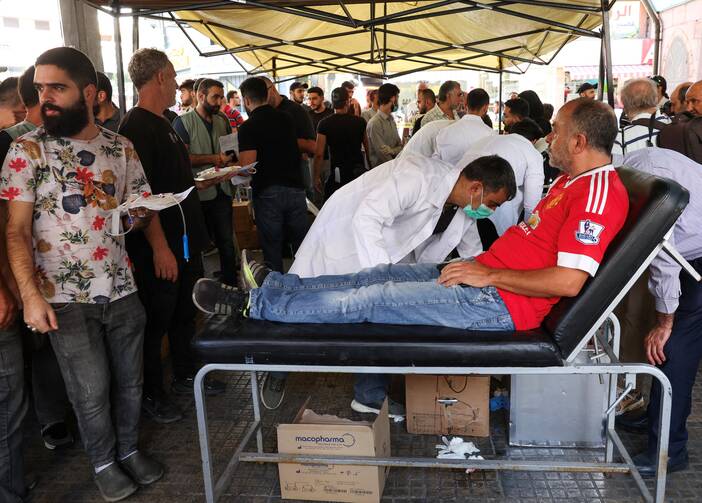
People gather as a man donates blood in Beirut Sept. 18, 2024, following pager detonations across Lebanon. The pagers exploded nearly simultaneously in Lebanon and Syria in an apparent Israeli operation targeting Hezbollah's communications network, killing at least 12 people and wounding nearly 3,000. (OSV News photo/Mohamed Azakir, Reuters)


America Media interprets the church for the world and the world for the church. It is a forum for discussion of religion, society, politics and culture from a Catholic perspective.


The apparent deployment of remotely detonated explosive devices in pagers and two-way radios used by Hezbollah members in Lebanon has raised concerns over the ethics and legality of the tactic, particularly given the civilian casualties among Lebanese resulting from these explosions. No party has claimed credit for the pager attack, but Hezbollah blames Israel, and U.S. officials on background have said that Israeli intelligence intercepted a shipment of pagers and inserted explosives into them.


Maryann Cusimano Love agrees that Israel has a right to self defense, and civilians have a right to protection. Israel’s self defense actions are limited by ethics and law. After suffering a horrific terrorist attack, there is pressure to “respond in kind.” Many argue that since terrorists fight dirty, the “gloves should come off” in response.


This approach is self-defeating. You can’t argue that terrorism is wrong, that killing civilians in terrorist attacks is immoral, illegal, and that the world should come together against terrorism, while engaging in attacks that kill civilians. (Hartigan, n.d.)


Richard Love notes that Hezbollah is a designated terrorist organization by the United States and many other states, but Israel and Lebanon are signatories to the 1983 Convention on Certain Conventional Weapons, which bans remotely delivered mines. Many academics include booby traps in this definition, which arguably makes Israel’s use of explosives in pagers and walkie-talkies illegal.


But perhaps the most concerning aspect of the attack was in how it was targeted, since non-combatants were certainly injured in great numbers and some noncombatants were killed. A fundamental tenet of humanitarian law rests on distinction, the requirement to distinguish combatants from non-combatants and not target non-combatants with military assets.


After the September 11 attacks, the United States faced similar questions in assessing how to respond. These are challenges governments face in conducting counterterrorism and counterinsurgency operations. (Hartigan, n.d.)


Maryann Cusimano Love comments that the U.S. general who was in charge of the war in Afghanistan, General David Petraeus, repeatedly noted that “every civilian death diminishes our cause,” and “you can’t kill your way out” of this conflict.


If the United States were engaged in a conflict with a state adversary, an attack like this would raise a lot of questions about whether this was a targeted assassination.


Richard Love comments that by policy, the United States prohibits the assassination of political leaders in a country with which we are not at war. Whether you assassinate a political leader in times of war is largely a matter of politics because once you do that, you open your side to reprisals. (Hartigan, n.d.)


Connor Hartigan asks how might the Catholic tradition of just war theory be applied to this case?


Maryann Cusimano Love allows that Just war tradition is necessary, but insufficient, in describing the ethical terrain.


Just war tradition is institutionalized in the Geneva Conventions, in international law of war and in domestic codes of military justice. The tradition requires the right intention of seeking a positive peace, rather than revenge, but it also requires positive actions to protect noncombatants, the criteria of discrimination and proportionality.


The Biden administration has spent a lot of time and energy trying to get the two parties to negotiate an end to this conflict, so when Israelis say, “escalate to de-escalate,” they’re signaling to the Biden administration that they’re trying to get to the table.


Richard Love comments “But I don’t see any evidence of that happening. All the evidence that I’ve laid out points to an escalation that’s not going to de-escalate. There is a real fear within Washington that this thing could get out of control.”


I suspect there’s a lot of pressure within Israel to use this dominance while they still have it. We’ve seen this play out in Gaza, where I don’t believe anyone believed that the I.DF. was going to bulldoze and blow up the entire Gaza Strip before they did it. Where we are now, as far as the humanitarian crisis and catastrophe Gaza has become is almost unbelievable. (Hartigan, n.d.)


The problem is confronting Hezbollah is a far more risky proposition. It is a far more savvy adversary; it’s funded and armed by Iran and Hezbollah will be a much more difficult target. You’re not just going into the Gaza Strip; this would require an invasion of Lebanon, and you can draw on the history of how that’s played out in the past. It’s been very risky, it’s been very bloody, and it’s always resulted in an indeterminate outcome.


Richard Love asks: “But is the Israeli strategic objective here to make Hezbollah incapable of delivering their missile strikes?” Part of that would be to look at what they’ve done: on Sept. 17, they went after pagers; on Sept. 18, walkie-talkies; on Sept. 20, you have airstrikes. Are they preparing the battlespace for an invasion? Is their strategic goal to go in and conduct operations similar to what they’re doing in Gaza? Because I’m here to tell you: that is very risky. Every time the I.D.F. has tried a ground invasion in Lebanon, they’ve gotten mired down and were not able to achieve their strategic objectives. (Hartigan, n.d.)


A final observation is an invasion would be catastrophic both for the people of Lebanon, for the people of Israel who are fighting a hidden organization which has vastly greater capabilities than Hamas. So don’t fall under the illusion that the next step for Israel is just to replicate what they did in the Gaza Strip. It will be a far greater, bloodier and riskier campaign.


Who’s standing behind Hezbollah? Iran.


And who’s standing behind Iran? Russia.


References


Hartigan, C. (n.d.). Did Israel’s pager attack break international law? America Magazine | The Jesuit Review of Faith & Culture. Retrieved September 27, 2024, from https://www.americamagazine.org/politics-society/2024/09/26/maryann-cusimano-love-richard-love-israel-lebanon-pager-explosions 

Sunday, September 22, 2024

Tactics and Terrorism


The tactics authorized by Prime Minister Benjamin Netanyahu to "do what is necessary" to protect its north may be closer to terrorism than military action that respects International Humanitarian Law.


Exploding Pagers https://www.cbc.ca/player/play/video/9.6515789


SaÅ¡a Petricic reporting for CBC News asks “By bruising and humiliating Hezbollah, is Israel playing 'Middle East roulette?'”


In recent days, Israel has made subduing Hezbollah an official war goal — right alongside winning the conflict with Hamas in Gaza — with Prime Minister Benjamin Netanyahu saying Israel would "do what is necessary" to protect its north. Defence Minister Yoav Gallant told U.S. officials this week that means "military action." 


In the hours after the pager attacks, Israel moved its large 98th Division from fighting in Gaza to the northern border. The military vows to return more than 60,000 Israelis to their homes in border communities after a safety evacuation that has lasted since fighting began after Oct. 7.


But many others worry it brings little relief, just more danger from all sides.


"At a time when Netanyahu was promising the Israeli public until not very long ago that we are just a small step from total victory over Hamas, now it seems we are closer than ever to a large-scale war with Hezbollah, too," wrote Haaretz columnist Amos Harel on Wednesday.


U.S. Secretary of State Antony Blinken is working to avoid that, leading a so-far unsuccessful diplomatic push for a ceasefire in Gaza and de-escalation in the north.


"It's imperative that everyone avoid taking steps that could further escalate or spread the conflict," he warned in a Cairo news conference when asked about the pager attack, stressing that Washington was not consulted or told about it in advance.

"It's fairly obvious that Israel did this," Ben Rhodes, a former national security adviser to former president Barack Obama, told the BBC. "This is not what the U.S. wanted."


As a result, Israel may be playing "Middle East roulette," Beirut journalist and author Kim Ghattas said in a BBC interview. "You keep pushing further and further until you actually do ignite a regional war."


Israel's president Isaac Herzog spoke to Sky News this morning, where he rejected Israel had "any connection" to this week's exploding pager attack in Lebanon. He also spoke of Israel's "disappointment" with the British government over its decision to suspend arms export licences. (Petricic, n.d.)


Alistair Bunkall, Middle East correspondent for Sky News reports that  President Herzog's outright denial that Israel was behind the attacks on Hezbollah pagers and walkie-talkies goes further than the official Israel government response which, so far, has been to say nothing at all.


It's not unusual for Israel to remain silent after major attacks on its enemies, and guilt is generally assumed by the absence of comment, but Herzog was definitive, saying he "rejects out of hand any connection to this or that source of operation".


That doesn't square with background conversations I've had with political and security officials here in recent days.


Admittedly no-one has confessed outright, however discussion of the attacks and the potential consequences, are generally framed by a metaphorical nod and wink, and conversations had proceeded along the lines of 'we all know what happened, even if we’re going to dance around it'.


Herzog might be right to suggest Hezbollah has other enemies, but aside from the US, which has repeatedly denied even knowing about the attacks ahead of time, I can not think of another state that would have the capability, will and purpose to carry out those attacks.


As one serving western intelligence official remarked to me a few days ago, "none of us would dare do it because of the collateral damage". 


No one, not even Israel, has come up with an alternative culprit.


The timing of the attacks, were it not Israel, are too coincidental.


'Disappointment' in Israel over UK


Mr Herzog was asked if he is disappointed in the way that the British government has acted in the last few weeks towards Israel.


The UK has suspended arms export licences to the country for use in military operations in Gaza, following a review of Israel's compliance with international humanitarian law. (Wyatt, 2024)


Madeleine Hall writing in Jacobin comments that the rigging of pagers and other electronics that has wounded over 3,000 people in Lebanon is neither “precise” nor “sophisticated.” It is barbaric and it is terrorism.


“Israel has neither confirmed nor denied any role in the explosions,” the New York Times reported, “but 12 current and former defense and intelligence officials who were briefed on the attack say the Israelis were behind it, describing the operation as complex and long in the making.”


Cars and apartments were set alight and hospitals overwhelmed with thousands of casualties. Because the devices in question began beeping repeatedly before they exploded, many victims were holding them close to their faces when they detonated, causing horrifying injuries.


Much of the mainstream Western media has marveled at the so-called “precision” and “sophistication” of the attack, framing it as an operation intended only to target members of Hezbollah. This is patently false, as numerous civilians have been injured and killed.


Israel’s real aim was clear: to stoke fear and mass panic among an entire population. During the second attack on Wednesday, explosions could be heard during the funeral of four people killed the previous day. Unconfirmed reports indicated that solar panels and ATMs detonated during the attacks, too. People across Lebanon have said they are afraid to use any electronic devices.


There’s a word for this: terrorism. (Hall, n.d.)


The Unpacked for Educators website asks Should the IDF Be Held to a Higher Moral Standard? 


Today’s armies are subject to international humanitarian law, national pressure and public scrutiny. Yet they must also uphold themselves to their own specific ethical and moral codes.


For decades, Israel’s military, the Israel Defense Forces (IDF), has fought for the state’s very existence. Over time, many of Israel’s enemies have moved beyond the traditional battlefield and brokered for peace…or political warfare. 


Enemies like Hamas, Islamic Jihad and Hezbollah have tested the IDF’s morality by using unethical tactics beyond the accepted principles of warfare, putting innocent human lives at risk. Israel’s position is that until Israel’s enemies hold themselves to a higher moral code, the IDF will remain prepared and armed to defend Israel from constant threat while striving to maintain its own ethical code.


Big Ideas

Asymmetric warfare, particularly with terrorist groups, challenges the IDF's ability to maintain ethical codes and purity of arms.

The IDF often takes steps to limit civilian casualties, as opposed to Hamas and Hezbollah, who purposely place civilians in harm's way. (Should the IDF Be Held to a Higher Moral Standard?, n.d.)


Hussein Ibish, Arab Gulf States Institute, defines Hamas in this way:

A millenarian group, apocalyptic, believing a divine mandate with a religious imperative.(CBC the Current Oct16, 2023)


In the necessary effort to protect the people of Israel from attacks by Hamas, Islamic Jihad and Hezbollah, the IDF has the resources and expertise to achieve the goal of protection without lowering its ethical codes to that of the enemy and disrespecting the principles of International Humanitarian Law, particularly in the aspects of distinction and proportionality.


References

Hall, M. (n.d.). Israel’s Beeper Attacks Are Terrorism. Jacobin. Retrieved September 22, 2024, from https://jacobin.com/2024/09/lebanon-israel-beeper-attacks-terrorism 

Petricic, S. (n.d.). By bruising and humiliating Hezbollah, is Israel playing 'Middle East roulette? CBC News. Retrieved September 22, 2024, from https://www.cbc.ca/news/world/   

Should the IDF Be Held to a Higher Moral Standard? (n.d.). Unpacked for Educators • The Best of Jewish and Israel Education. Retrieved September 22, 2024, from https://unpacked.education/video/should-the-idf-be-held-to-a-higher-moral-standard/ 

Wyatt, M. (2024, September 22). Middle East latest: Hezbollah now in 'open-ended battle of reckoning' with Israel, deputy leader says. Sky News. Retrieved September 22, 2024, from https://news.sky.com/story/israel-lebanon-pager-walkie-talkie-explosions-middle-east-crisis-hezbollah-hamas-gaza-war-latest-sky-news-live-blog-12978800 


Sunday, September 15, 2024

Lesser of two evils

The BBC has reported that Pope Francis has called both major US presidential candidates "against life" and advised Catholic voters to choose the "lesser evil" when casting their ballots in the November election. This news conference, as he wrapped up a 12-day tour through southeast Asia, has been covered by many world news outlets. Five themes have come to mind in reflection about the Pontiff's advice.


Views and the Vatican


  1. Forgive them, they know not what they do.(Luke 23:34).


Christians are familiar with this admonition of Jesus from the cross that originally referred to the people responsible for His crucifixion. Many of the followers of the political scenarios identified by Francis would do well to understand the grief and suffering that has moved people to the paths “against life” that they polarize for political advantage. An extension of political rhetoric to include “walking in the shoes” of the people concerned about the consequences of political policy is required. 


  1. Misinformation and disinformation disguises the full story.


The loss of truth that accompanies misinformation and disinformation about the actions and consequences of the alternate political policy is extremely dangerous to the operation of a democracy which can only operate at its best motivated by truth, goodness, and beauty as aspirations for all.


  1. Real needs for support and care are present in the cause.


The political effort to achieve policy objectives needs to recognize that people have real needs for support and care that may be denied or reduced by polarized persecution of groups with differing desires.


  1. Demonizing others is a path to destruction. 


There seems to be more than enough evil done against groups that have been demonized in political rhetoric. Death and destruction have too often been the response advocated and actioned by misinformed zealots to the perception intentionally created that the opposition are demons.


  1. Acting in conscience requires freedom to choose. 

Much political rhetoric lauds “freedom”. The conscientious choices that are required to be our best people and create our best society cannot be coerced. We move toward the justice we seek through our freedom to act according to our conscience.


There are tragic results when political polarization leans toward policy that casts the opposing side as “evil” and fails to address the suffering and pain that they may encounter as a consequence.