Showing posts with label creativity. Show all posts

Monday, January 11, 2021

Education creativity and chaos

 The challenges facing human society in the next few decades will require a great deal of creativity be exercised by those who work to remove pandemic threats, provide security for basic needs of food and shelter, mitigate effects of the climate crisis, and reduce the systemic racism and tribal conflict in our organizations.


Scott Barry Kaufman, a psychology professor at the University of Pennsylvania, scientific director of the Imagination Institute, and co-author of Wired to Create: Unraveling the Mysteries of the Creative Mind writes, in The Atlantic, that curiosity is underemphasized in the classroom, but research shows that it is one of the strongest markers of academic success.

The power of curiosity to contribute not only to high achievement, but also to a fulfilling existence, cannot be emphasized enough. Curiosity can be defined as “the recognition, pursuit, and intense desire to explore, novel, challenging, and uncertain events.” In recent years, curiosity has been linked to happiness, creativity, satisfying intimate relationships, increased personal growth after traumatic experiences, and increased meaning in life. In the school context, conceptualized as a “character strength,” curiosity has also received heightened research attention. Having a “hungry mind” has been shown to be a core determinant of academic achievement, rivaling the prediction power of IQ.1
 

Harold Jarche suggests that curiosity is a connection that needs more emphasis in our education system.

Why do students often ask — will this be on the test? It’s because they have figured out the game called education. They are told what to study, what is important, and for how long. Each school year they play the game anew. Why are some — a significant percentage — employees not motivated to work? They too have figured out the game. Venkatesh Rao, in The Gervais Principle describes this large base of most companies — the losers.2 

John Naughton, professor of the public understanding of technology at the Open University and author of From Gutenberg to Zuckerberg: What You Really Need to Know About the Internet, looks, in the Guardian, at the history of science and the work of Thomas Kuhn. He was a man who changed the way the world looked at science.


Kuhn's central claim is that a careful study of the history of science reveals that development in any scientific field happens via a series of phases. The first he christened "normal science" – business as usual, if you like. In this phase, a community of researchers who share a common intellectual framework – called a paradigm or a "disciplinary matrix" – engage in solving puzzles thrown up by discrepancies (anomalies) between what the paradigm predicts and what is revealed by observation or experiment. Most of the time, the anomalies are resolved either by incremental changes to the paradigm or by uncovering observational or experimental error. As philosopher Ian Hacking puts it in his terrific preface to the new edition of Structure: "Normal science does not aim at novelty but at clearing up the status quo. It tends to discover what it expects to discover." The trouble is that over longer periods unresolved anomalies accumulate and eventually get to the point where some scientists begin to question the paradigm itself. At this point, the discipline enters a period of crisis characterised by, in Kuhn's words, "a proliferation of compelling articulations, the willingness to try anything, the expression of explicit discontent, the recourse to philosophy and to debate over fundamentals". In the end, the crisis is resolved by a revolutionary change in world-view in which the now-deficient paradigm is replaced by a newer one. This is the paradigm shift of modern parlance and after it has happened the scientific field returns to normal science, based on the new framework. And so it goes on.3

Fr. Richard Rohr, OFM, cites Thomas Kuhn’s book The Structure of Scientific Revolutions that popularized the term “paradigm shift.” The shift in thinking which might have felt threatening at one time now appears as the only way forward and as a real lifeline. Brian McLaren, a former English teacher, uses the language of a “framing story” to describe the same phenomenon Kuhn observed.

Brian says a framing story “gives people direction, values, vision, and inspiration by providing a framework for their lives. It tells them who they are, where they come from, where they are, what’s going on, where things are going, and what they should do.” [2] While we all have stories that answer those questions on a personal level, a “framing story” dictates the general beliefs of a culture, nation, religion, and even humanity as a whole.4 

Developing curiosity as a pathway to creative learning is a necessary strategy to transition to the paradigm change in which the existential threats of the near future will be addressed.


References

1

(2017, July 24). Curiosity Is a Unique Marker of Academic Success - The Atlantic. Retrieved January 11, 2021, from https://www.theatlantic.com/education/archive/2017/07/the-underrated-gift-of-curiosity/534573 

2

(n.d.). connecting the curious - Harold Jarche. Retrieved January 11, 2021, from https://jarche.com/2019/10/connecting-the-curious/ 

3

(2012, August 18). Thomas Kuhn: the man who changed the way the world .... Retrieved January 11, 2021, from https://www.theguardian.com/science/2012/aug/19/thomas-kuhn-structure-scientific-revolutions 

4

(n.d.). A New Framing Story — Center for Action and Contemplation. Retrieved January 11, 2021, from https://cac.org/a-new-framing-story-2021-01-11/ 


Monday, February 19, 2018

Non collaboration may be a pattern

Teachers, employers, advertisers, and others often deal with the psychological phenomena that people are creatures of habit. Often our present actions are a reliable predictor of our future actions.
Source: https://i.cbc.ca/1.4099945.1493927308!/fileImage/httpImage/image.jpg_gen/derivatives/original_620/liberal-leader-stephen-mcneil.jpg


McNeil acknowledges doctors weren't consulted enough in health-care overhaul.


While much of that change has been well received, McNeil said it's been made clear to him by doctors and the organization that represents them — Doctors Nova Scotia — they've felt left out of the overhaul process.
"I've made it clear that on a go-forward basis that we would continue to make sure that they're a big part of the decision-making process."


It appears that Premier McNeil bravely asserts that he is not a creature of habit. The future decision making process will include the doctors.


I fear that soon we might have a news story on education reform that reads:


While much of that change has been well received, McNeil said it's been made clear to him by teachers and the organization that represents them — NSTU— they've felt left out of the overhaul process.


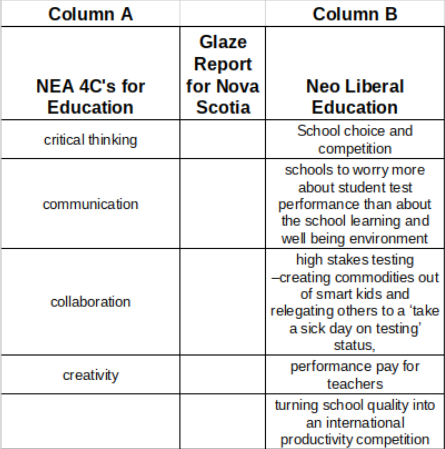
Connections can be shown between the Glaze Report and the ideology of neo-liberal education. In the neo-liberal business model of education there are winners and losers as competition for resources is seen as a strength of this economic philosophy.

Fig 1. NEA Quality Education vs Neo-Liberal Education

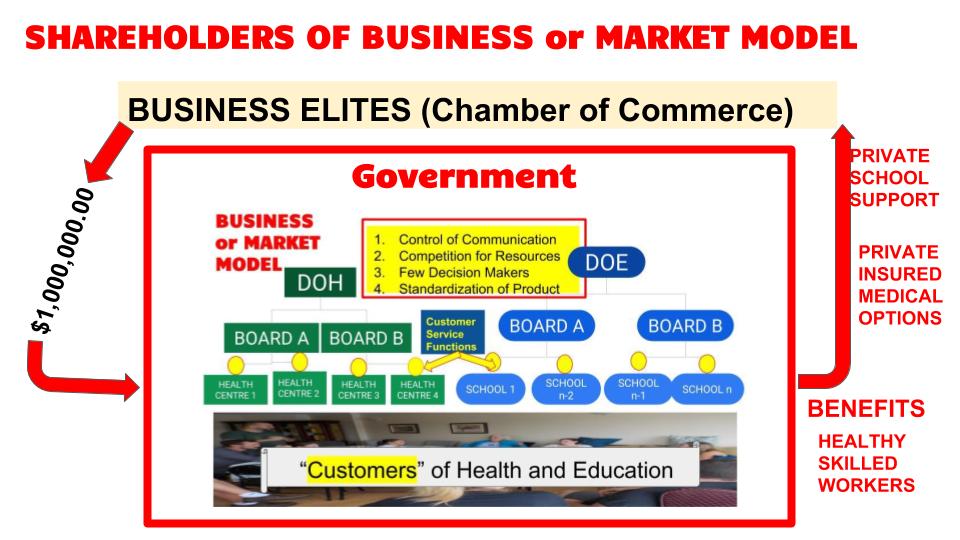
Who are the winners when doctors are left out of making changes in the healthcare system and teachers are ignored when making reforms of the education system?

Unfortunately, the application of neo-liberal economics has coincided with the poor getting poorer while the rich have gotten richer. The winners in application of neo-liberal business models to health and education are those who can afford private health services and private schools. Savvy politicians learn after decades in politics that you should hang with the winners.


Fig 2. The beneficiaries of the business model
References

(2017, May 8). McNeil acknowledges doctors weren't consulted enough in health .... Retrieved February 19, 2018, from http://www.cbc.ca/news/canada/nova-scotia/stephen-mcneil-doctors-recruitment-shortage-cape-breton-1.4104829


Sunday, February 18, 2018

Glaze Report and political ideology

Pauline Lipman (plipman [at] uic.edu) is an education activist and professor of educational policy studies at University of Illinois at Chicago who has studied education as an ideological project.


NEA 4C's for EducationGlaze Report for Nova ScotiaNeo Liberal Education
critical thinkingteaching is driven by standardized tests and performance outcomes
communicationprincipals are managers, and school superintendents are CEOs
collaborationlearning equals performance on the tests with teachers, students, and parents held responsible for “failure.”
creativityEducation, which is properly seen as a public good, is being converted into a private good
Education in an investment one makes in order better to compete in the labor market.

Table 1 4C Education vs neo liberal education
Neoliberalization of public education is also an ideological project, as Margaret Thatcher famously said, to “change the soul,” redefining the purpose of education and what it means to teach, learn, and participate in schooling. Tensions between democratic purposes of education and education to serve the needs of the workforce are longstanding. But in the neoliberal framework, teaching is driven by standardized tests and performance outcomes; principals are managers, and school superintendents are CEOs; and learning equals performance on the tests with teachers, students, and parents held responsible for “failure.” Education, which is properly seen as a public good, is being converted into a private good, an investment one makes in one’s child or oneself to “add value” in order better to compete in the labor market. It is no longer seen as part of the larger end of promoting individual and social development, but is merely the means to rise above others.


National Education Association reports on the 4C’s of education to prepare 21st Century Students for a Global Society.
we interviewed leaders of all kinds to determine which of the 21st century skills were the most important for K-12 education. There was near unanimity that four specific skills were the most important. They became known as the “Four Cs”
The claim that the Glaze report contains elements of the neo liberal education ideology needs to be supported by evidence. The use of business language describing principals as managers is one link between the communication of the Education Minister and the neo liberal education ideology. Collaboration between educators and the government is essential for development of an education system to prepare 21st Century Students for a Global Society.

References
(n.d.). Neoliberal Education Restructuring | Pauline Lipman | Monthly Review. Retrieved February 16, 2018, from https://monthlyreview.org/2011/07/01/neoliberal-education-restructuring/
(n.d.). NEA - An Educator's Guide to the “Four Cs”. Retrieved February 16, 2018, from http://www.nea.org/tools/52217.htm