Showing posts with label Times of Israel. Show all posts

Friday, May 17, 2024

Resolve and Rafah

Israel insists the offensive in Rafah is being conducted as a necessary part of the right of the nation to defend itself. Many Western countries, traditionally supportive of Israel, oppose a military operation in Rafah that would have catastrophic consequences on the civilian population.


Assessing Rafah Incursion


Nidal Al-Mughrabi and Emily Rose report for Reuters that the slow progress of Israel's offensive, more than seven months after it was prompted by Hamas' deadly cross-border raid, highlighted the difficulty of achieving Prime Minister Benjamin Netanyahu's aim of eradicating the militant group.


South Africa asked the top U.N. court to order a halt to Israel's Rafah offensive, saying it was "part of the endgame in which Gaza is utterly destroyed". Israel has denied South African allegations of genocide in Gaza and said it had complied with an earlier court order to step up aid.


The United States State Department said the humanitarian situation in Gaza continued to deteriorate and urged Israel to allow sustained access for aid via the southern and northern parts of the enclave.


Israel's military says its operation in Rafah is meant to kill Hamas fighters and dismantle infrastructure used by the group, which governs the blockaded Palestinian territory. Israel accuses Hamas of diverting aid, something it denies.


Israel said its strikes were targeted at militants.

"We're operating ... where we know Hamas terrorists are hiding, and where we think we can find either tunnel shafts or terror infrastructure or ammunition of many types," military spokesperson Lt. Col. Nadav Shoshani said. (Al-Mughrabi & Rose, n.d.)


The Times of Israel reports that thirteen Western countries, including many traditionally supportive of Israel, appeal to it not to launch a large-scale offensive on Rafah.


“We reiterate our opposition to a full-scale military operation in Rafah that would have catastrophic consequences on the civilian population,” reads the appeal, sent by the countries’ foreign ministers to their Israeli counterpart Israel Katz and made public.


The signatories are Australia, Britain, Canada, Japan, New Zealand, South Korea and EU member states Denmark, Finland, France, Germany, Italy, the Netherlands and Sweden. (Times of Israel, n.d.)


The ministers welcome recent measures adopted by Prime Minister Benjamin Netanyahu’s cabinet to improve the flow of international aid into Gaza, but call for “further steps.”


“We urge the Government of Israel to let the humanitarian aid enter into the Gaza Strip through all relevant crossing points, including the one in Rafah,” they say. (Times of Israel, n.d.)


Emma Graham-Harrison, reporting for the Guardian, comments that South African lawyers urge the international court of justice (ICJ) to issue urgent measures over the assault on Rafah, Gaza’s southernmost city.


South Africa has asked the international court of justice (ICJ) to urgently order Israel to end its assault on Rafah, halt its military campaign across Gaza, and allow international investigators and journalists into the territory.


They argued that seven months into the war, which has killed more than 35,000 people and reduced much of Gaza to rubble, the scale of suffering was now so intense that a total ceasefire was needed to get food, medicine and other aid to its desperate population.


Prof Vaughan Lowe KC told the court that a destructive campaign in Rafah, the last corner of Gaza that has not faced a ground invasion by Israeli forces, would destroy “the foundation of Palestinian life” in the territory.


“If the court does not act now the possibility of rebuilding a viable Palestinian society in Gaza will be destroyed, at least for the lifetime of those who survive the current horrors of Gaza.”


South Africa also demanded access for reporters and war crimes investigators to Gaza, to collect and preserve evidence of potential war crimes.


“The details are not always easy to verify because Israel continues to bar independent investigators and journalists from entering Gaza, and over 100 journalists who were in Gaza have been killed since Israeli attacks began,” Lowe said. “Israel cannot block investigations by independent investigators and then say the court cannot proceed because there is insufficient evidence against it.” (Graham-Harrison, n.d.)


Israel’s foreign ministry said in response that South Africa was “presenting biased and false claims” which “rely on unreliable Hamas sources” and called on the court to reject the appeal.


“Israel acts in accordance with international law and its humanitarian obligations, while implementing measures to minimise harm to civilians and civilian facilities,” the ministry said late on Thursday. (Graham-Harrison, n.d.)


Nick Logan of CBC News reports that women, children still account for more than half of identified victims after the UN agency revises figures.


The breakdown of the casualties, however, only includes 24,686 identified fatalities as of April 30. 


From that figure, OCHA has recorded 10,006 were Palestinian men, accounting for 40 per cent of the identified fatalities, while 4,959 (20 per cent) were women and 7,797 were children (32 per cent). It also listed 1,924 elderly people among the fatalities, but did not differentiate them by gender. (Logan, n.d.) 


Distribution of identified fatalities


Burak Elmali in an article posted to the Anadolu Agency (AA) web site notes that  Israel’s use of advanced software tools underscores a harrowing reality: AI, when misapplied, can facilitate atrocities of catastrophic proportions The TRT World Research Centre reports that the conduct of warfare is among the many domains influenced by AI, and the latter’s impact on this field is no longer theoretical. Gaza is a case in point. This evolution prompts profound questions about human agency and responsibility within AI debates. What if the person wielding the technological prowess harbours a militaristic ideology so extreme that it sanctions genocidal actions?


Over a period exceeding six months, Israel has conducted airstrikes with indiscriminate genocidal intent, as revealed through the candid admissions of numerous military intelligence insiders. Their confession-like statements about Israel’s use of advanced software tools, such as Lavender and Where’s Daddy, underscores a harrowing reality: AI, when misapplied, can facilitate atrocities of catastrophic proportions, and turn out to be as inhumane as possible.


The Israeli Defence Ministry’s communication often follows the path of censorship, obfuscation, and deflection tactics. This time was no different. The spokesperson dismissed the accusations with a mere denial. Yet, the stark reality reflected in the civilian death toll leaves little room to ignore the assertions made about the AI-driven genocidal undertaking attributed to Lavender. The algorithm used indicated the acceptance of 15-20 civilian casualties for one low-ranking Hamas member and up to 100 for one senior Hamas member. 


Such robotisation of inhumanity is very disturbing. Alas, the figures are aligned with the reported death tolls in Gaza. Furthermore, the use of unguided bombs, which cause enormous devastation in heavily populated areas in scenarios involving unconfirmed junior Hamas members, suggests that Israel is conducting more war crimes, this time pretexting the use of AI.


This scenario lays bare a critical issue addressed in a recent controversial piece published by +972 Magazine. 


In essence, the situation boils down to a straightforward logic: Lavender’s method of compiling death lists based on physical traits and affiliations was seemingly acted upon without critical examination. When we factor in the IDF’s apparent indifference to the margin of error in these operations, as evidenced by a list encompassing 37,000 Palestinians, the implications of a potentially deliberate killing strategy become deeply shocking, inhuman, and intentionally genocidal. (Elmalı & Kilavuz, 2024)


The apparent “gray area” between military operations that observe international humanitarian law concerning distinction between civilian and military targets and proportional response with weaponry that limits killing of non-combatants and destruction of civilian infrastructure and killing and destruction that has the genocidal intent of eliminating Palestinian people is an area where war crimes are being committed and need detailed investigation by independent military experts and reported to the International Court of Justice.


References

Al-Mughrabi, N., & Rose, E. (n.d.). Israel moves into north Gaza Hamas stronghold, pounds Rafah without advancing. Reuters. Retrieved May 17, 2024, from https://www.reuters.com/world/middle-east/israel-moves-north-gaza-hamas-stronghold-pounds-rafah-without-advancing-2024-05-16/ 

Elmalı, B., & Kilavuz, İ. F. (2024, May 1). Israel Has Tainted AI with Genocide – TRT World Research Centre. TRT World Research Centre. Retrieved May 17, 2024, from https://researchcentre.trtworld.com/perspectives/israel-has-tainted-ai-with-genocide/ 

Graham-Harrison, E. (n.d.). South Africa calls on ICJ to order Israel to end Rafah offensive. the Guardian. Retrieved May 17, 2024, from https://www.theguardian.com/world/article/2024/may/16/south-africa-icj-international-court-of-justice-israel-rafah-gaza 

Logan, N. (n.d.). Why the UN changed its death tolls of Palestinian women and children killed in Gaza. CBC News. Retrieved May 17, 2024, from https://www.cbc.ca/news/world/gaza-women-children-death-toll-1.7203167 

Times of Israel. (n.d.). 13 countries – including UK, Germany, Canada – urge Israel not to launch ‘full-scale’ Rafah op. Times of Israel. Retrieved May 17, 2024, from https://www.timesofisrael.com/liveblog_entry/13-countries-including-uk-germany-canada-urge-israel-not-to-launch-full-scale-rafah-op/ 


Saturday, April 20, 2024

Biting the Hand Threatens Israel

Professor Yuval Noah Harari, historian, author of "Sapiens," "Homo Deus" and "Unstoppable Us," and cofounder of the social-impact company Sapienship, writes in an opinion piece in Haaretz that Israel is facing a historic defeat, the bitter fruit of years of disastrous policies. If the country now prioritizes vengeance over its own best interests, it will put itself and the entire region in grave danger.


Consider Consequence of Biting the Hand


The Netanyahu government has managed to derail even our relations with the United States, as if we have an alternative source for arms and diplomatic backing. The younger generations in the United States, and around the world now see Israel as a racist and violent country that expels millions from their homes, starves entire populations, and kills many thousands of civilians for no better reason than revenge.


There is no doubt that Hamas is a murderous organization that on October 7 committed heinous crimes. But Israel is supposed to be a democratic country, which even when confronted by such atrocities continues to respect international laws, protect basic human rights and abide by universal moral standards.


But perhaps out of sheer inertia, Netanyahu keeps biting the hands that feed us. Israel's deepening international isolation, and the hatred being expressed toward Israel among academics, artists and young people is not only the product of Hamas propaganda – it is the product of Netanyahu's skewed priorities over the last 15 years.


Nothing more will be gained from continuing the war. It is a dangerous illusion to believe that one more victory, in Rafah, will bring about the collapse of Hamas, the release of all the hostages, and the surrender of Israel's many enemies. Every additional day of war only serves the purposes of Hamas and Iran, and intensifies Israel's international isolation. (Harari, n.d.)


Times of Israel staff and reporter Lazar Berman write that Israel is increasingly worried by the prospect of the International Criminal Court in The Hague issuing arrest warrants against Prime Minister Benjamin Netanyahu and other Israeli political and military leaders for alleged breaches of international law in Gaza. This was reported on Channel 12 news, Israeli television, Thursday April 18, 2024.


Foreign Minister Israel Katz’s office confirmed to The Times of Israel that the meeting took place and said there were also discussions about the possibility that warrants could be issued against IDF officers.


Netanyahu raised the matter in his meetings this week with Britain’s Foreign Secretary David Cameron and Germany’s Foreign Minister Annalena Baerbock, and sought their help, the TV report said. (Berman & Times of Israel, n.d.)


In February, a delegation of relatives of hostages being held by Hamas filed a war crimes complaint with the ICC against the terrorist organization’s leaders. The accusations in the filing included kidnapping, crimes of sexual violence, torture and other serious allegations.


The court’s chief prosecutor, Karim Khan, visited Israel in December on an official trip, as Israel does not consider itself bound by the ICC. After touring some of the towns attacked by Hamas on October 7, 2023, and hearing testimonies from survivors, Khan said he had witnessed “scenes of calculated cruelty” and that it was clear to him the victims had been targeted because of their identities.


He also said he felt duty-bound to work with the court’s prosecutors to open investigations into Hamas’s actions on October 7. (Berman & Times of Israel, n.d.)


Professor Yuval Noah Harari summarizes the situation in which Israel finds itself.


When after October 7, Netanyahu had to decide on the aims of the war, no wonder that security was again placed too low on the list of priorities. Israel obviously had to enter Gaza to disarm Hamas. But the war's long-term aim should have been to create a stable regional order that would keep Israelis safe for years. Such an order could be created only by strengthening the alliance between Israel and the Western democracies, and deepening cooperation with moderate Arab forces. Instead of cultivating these alliances and partnerships, the war aim Netanyahu chose was blind revenge. Like the eyeless Samson in the biblical Book of Judges, Netanyahu chose to collapse the roofs of Gaza on everyone's heads – Palestinians and Israelis – just to exact revenge. (Harari, n.d.)


After a series of airstrikes by the IDF forces of Israel that resulted in the death of seven aid workers of the World Central Kitchen threatened to widen a rift between Biden and Netanyahu, the decisions that Netanyahu may take, about attacking Rafah, may risk even more damage to the willingness of the United States, United Kingdom and G7 countries to support Israel in world assemblies and world public opinion forums.


References

Berman, L., & Times of Israel. (n.d.). Netanyahu’s office hosts emergency talks on feared ICC warrants for PM, ministers. Times of Israel. Retrieved April 20, 2024, from https://www.timesofisrael.com/netanyahus-office-hosts-emergency-talks-on-feared-icc-warrants-for-pm-ministers/ 


Harari, Y. N. (n.d.). From Gaza to Iran, the Netanyahu Government Is Endangering Israel's Survival. Haaretz. Retrieved April 20, 2024, from https://www.haaretz.com/israel-news/2024-04-18/ty-article-magazine/from-gaza-to-iran-the-netanyahu-government-is-endangering-israels-survival/ 


Tuesday, April 9, 2024

AI IDF Gaza IHL

The International Committee of the Red Cross (ICRC) comments that the advance of artificial intelligence (AI) for military purposes raises profoundly worrying questions for humanity. A web article takes a look at some of the key questions and concerns surrounding the use of AI, especially machine learning, in armed conflict.


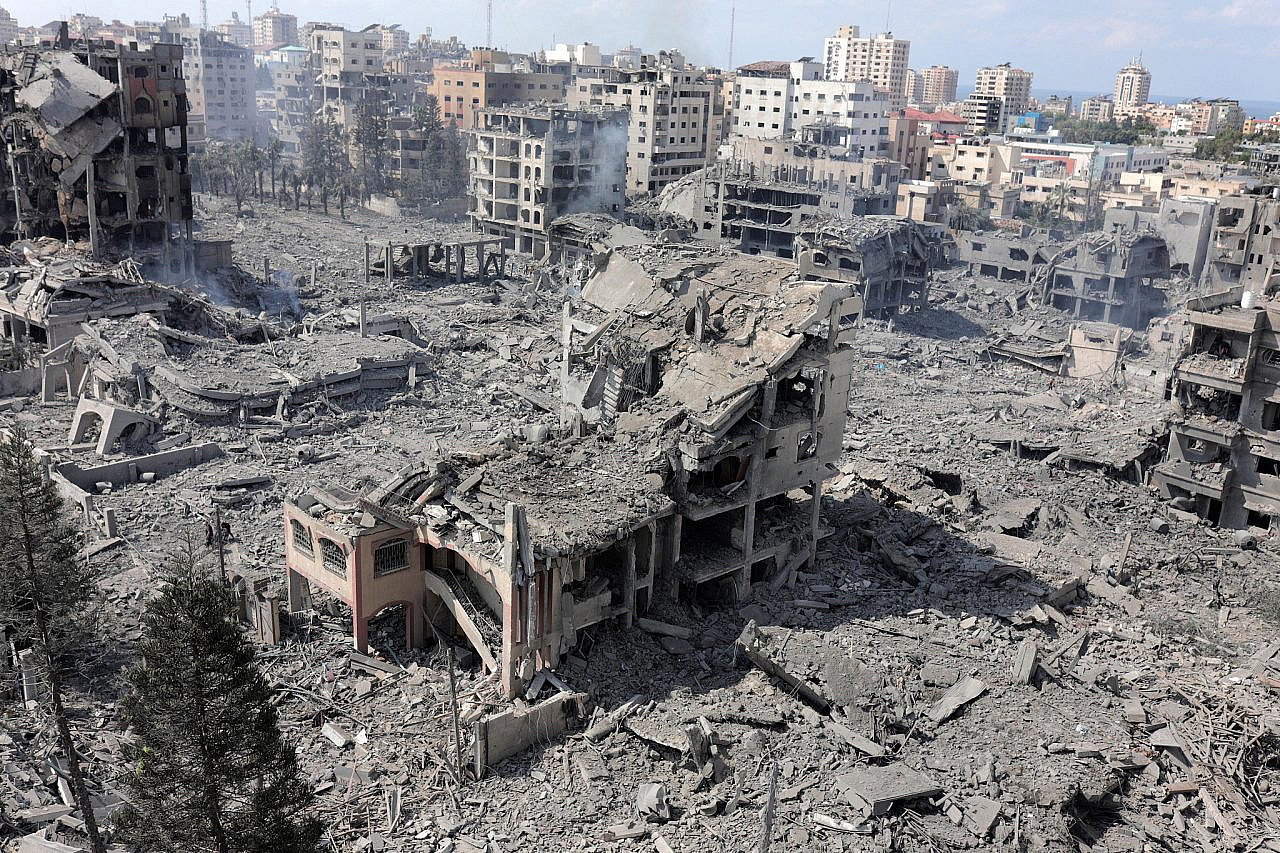
Destruction is seen in Al-Rimal popular district of Gaza City after it was targeted by airstrikes carried out by Israeli forces, October 10, 2023. (Mohammed Zaanoun/Activestills)


Machine learning is a type of AI system that creates its own instructions based on the data on which it is ‘trained’. It then uses these instructions to generate a solution to a particular task. The software writes itself in a way. Recent advances in AI are in machine learning.


The ICRC has highlighted three areas in which AI is being developed for use by armed actors in warfare, which raise significant questions from a humanitarian perspective:


  1. Integration in weapon systems, particularly autonomous weapon systems
  2. Use in cyber and information operations
  3. Underpinning military ‘decision support systems’ (What You Need to Know About Artificial Intelligence in Armed Conflict, 2023)


A decision support system is any computerised tool that may use AI-based software to produce analyses to inform military decision-making.


For example, an AI image recognition system might be used to help identify military objects by analysing drone footage, as well as other intelligence streams, to recommend targets for the military.


In other words, these AI systems can be used to inform decisions about who or what to attack and when.


With rapid developments in AI being integrated into military systems, it is crucial that states address specific risks for people affected by armed conflict.


Although there are a wide range of implications to consider, specific risks include the following:


  • An increase in the dangers posed by autonomous weapons;
  • Greater harm to civilians and civilian infrastructure from cyber operations and information warfare;
  • A negative impact on the quality of human decision-making in military settings. (What You Need to Know About Artificial Intelligence in Armed Conflict, 2023)


Yuval Abraham, a journalist and filmmaker based in Jerusalem, in an article for +972 magazine, in partnership with Local Call, reports that the Israeli army has marked tens of thousands of Gazans as suspects for assassination, using an AI targeting system with little human oversight and a permissive policy for casualties.


A new investigation by +972 Magazine and Local Call reveals that the Israeli army has developed an artificial intelligence-based program known as “Lavender.” 


Formally, the Lavender system is designed to mark all suspected operatives in the military wings of Hamas and Palestinian Islamic Jihad (PIJ), including low-ranking ones, as potential bombing targets. The sources told +972 and Local Call that, during the first weeks of the war, the army almost completely relied on Lavender, which clocked as many as 37,000 Palestinians as suspected militants — and their homes — for possible air strikes.


“We were not interested in killing [Hamas] operatives only when they were in a military building or engaged in a military activity,” A., an intelligence officer, told +972 and Local Call. “On the contrary, the IDF bombed them in homes without hesitation, as a first option. It’s much easier to bomb a family’s home. The system is built to look for them in these situations.”


The Lavender machine joins another AI system, “The Gospel,” about which information was revealed in a previous investigation by +972 and Local Call in November 2023, as well as in the Israeli military’s own publications. A fundamental difference between the two systems is in the definition of the target: whereas The Gospel marks buildings and structures that the army claims militants operate from, Lavender marks people — and puts them on a kill list.


In addition, according to the sources, when it came to targeting alleged junior militants marked by Lavender, the army preferred to only use unguided missiles, commonly known as “dumb” bombs (in contrast to “smart” precision bombs), which can destroy entire buildings on top of their occupants and cause significant casualties. “You don’t want to waste expensive bombs on unimportant people — it’s very expensive for the country and there’s a shortage [of those bombs],” said C., one of the intelligence officers. Another source said that they had personally authorized the bombing of “hundreds” of private homes of alleged junior operatives marked by Lavender, with many of these attacks killing civilians and entire families as “collateral damage.”


B., a senior officer who used Lavender, echoed to +972 and Local Call that in the current war, officers were not required to independently review the AI system’s assessments, in order to save time and enable the mass production of human targets without hindrances.


“Everything was statistical, everything was neat — it was very dry,” B. said. He noted that this lack of supervision was permitted despite internal checks showing that Lavender’s calculations were considered accurate only 90 percent of the time; in other words, it was known in advance that 10 percent of the human targets slated for assassination were not members of the Hamas military wing at all. (Abraham, n.d.)


The abstract of the paper “Machine Learning Weapons and International Humanitarian Law: Rethinking Meaningful Human Control “ authored by Shin-Shin Hua on the Georgetown Law International Law Journal website, comments on the necessity for human control.


But in a machine learning paradigm, human control may become unnecessary or even detrimental to IHL compliance. In order to leverage the potential of this technology to minimize casualties in conflict, an unthinking adherence to the principle of “the more control, the better” should be abandoned. Instead, this Article seeks to define prophylactic measures that ensure machine learning weapons can comply with IHL rules. Further, it explains how the unique capabilities of machine learning weapons can facilitate a more robust application of the fundamental IHL principle of military necessity. (Hua, n.d.)


The AI tools in use by advanced military organizations, like the IDF, are capable of providing the intelligence not only to select targets but to deploy armed devices that can be designed to comply with International Humanitarian Law concepts of discrimination and proportionality that are meant to reduce civilian casualties and use only the amount of force required to achieve military objectives. Recent applications to the International Court of Justice accusing genocide in Gaza and the growing rift between the government of Israel and nations that have traditionally supported that government are a symptom of grievous misuse of AI technology in this war.


References

Abraham, Y. (n.d.). ‘Lavender’: The AI machine directing Israel’s bombing spree in Gaza. +972 Magazine. Retrieved April 9, 2024, from https://www.972mag.com/lavender-ai-israeli-army-gaza/ 


Hua, S.-S. (n.d.). Machine Learning Weapons and International Humanitarian Law: Rethinking Meaningful Human Control. Georgetown Law. Retrieved April 9, 2024, from https://www.law.georgetown.edu/international-law-journal/wp-content/uploads/sites/21/2020/03/GT-GJIL200015.pdf 


What you need to know about artificial intelligence in armed conflict. (2023, October 6). International Committee of the Red Cross. Retrieved April 9, 2024, from https://www.icrc.org/en/document/what-you-need-know-about-artificial-intelligence-armed-conflict 


Friday, April 5, 2024

Another Rift between Biden and Netanyahu

A series of airstrikes by the IDF forces of Israel that resulted in the death of seven aid workers of the World Central Kitchen is the latest tragedy threatening to widen a rift between Biden and Netanyahu.


Palestinians inspect a vehicle with the logo of the World Central Kitchen, wrecked by an Israeli airstrike in Deir al Balah, Gaza Strip, April 2. A series of airstrikes killed seven aid workers from the international charity, leading it to suspend delivery Tuesday of vital food aid to Gaza.Ismael Abu Dayyah/AP


Jacob Magid Follow writing in the Times of Israel reports that US President Joe Biden indicated to Prime Minister Benjamin Netanyahu during a Thursday, April 4, 2024 phone call that Washington’s policy regarding the war in Gaza will fundamentally change if Israel doesn’t implement a series of concrete steps to address the humanitarian crisis and protect aid workers, adding that an immediate ceasefire was essential for meeting those aims.


Biden “made clear the need for Israel to announce and implement a series of specific, concrete and measurable steps to address civilian harm, humanitarian suffering and the safety of aid workers,” according to a White House readout after the leaders held their first call since an accidental IDF strike on a World Central Kitchen convoy on Monday killed seven aid workers.


“He made clear that US policy with respect to Gaza will be determined by our assessment of Israel’s immediate action on these steps,” the White House warned, adding that both recent Israeli strikes on aid workers along with the overall humanitarian situation in the Strip are “unacceptable.” (Follow, n.d.)


The article cites an interview with Sen. Chris Coons who told CNN:


“I think we’re at the point where President Biden has said and I have said… [that] if Prime Minister Benjamin Netanyahu were to order the IDF into Rafah at scale — [if] they were to drop 1,000-pound bombs and send in a battalion to go after Hamas and make no provision for civilians or for humanitarian aid that I would vote to condition aid to Israel,” (Follow, n.d.)


Haroon Siddique, Legal affairs correspondent for the Guardian, reports that the number of signatories warning UK Prime Minister Rishi Sunak over a possible breach of international law in arming Israel rises to more than 750. The 17-page letter and legal opinion, also signed by four former court of appeal judges, more than 70 KCs, more than 100 partners and directors of law firms, and dozens of law professors, has added to already mounting pressure on the government to suspend arms sales in the wake of the Israeli airstrike that killed seven international aid workers, three of them British, on Monday, April 1, 2024.


Citing both the international court of justice’s conclusion that a plausible risk of genocide exists in Gaza, and the UK’s obligations under the 1948 genocide convention, the letter states that halting weapons sales is a “‘means likely to deter’ and/or ‘a measure to prevent’ genocide”.


It also calls for the government to work towards a permanent ceasefire, impose sanctions against those inciting genocide against Palestinians, restore funding to the UN agency for Palestinian refugees, UNRWA. (Siddique, n.d.)


Fatima Al-Kassab and Lauren Frayer, in an article for NPR, report that a majority of Britons want the U.K. to halt arms exports to Israel.


British jurists wrote in a letter to Prime Minister Rishi Sunak:


"The provision of military assistance and material to Israel may render the U.K. complicit in genocide as well as serious breaches of [International Humanitarian Law]." (Al-Kassab & Frayer, n.d.)


Last month, the United Nations Security Council passed a resolution calling for an immediate cease-fire in Gaza. In an NPR interview, the U.N.'s special rapporteur on human rights defenders, Mary Lawlor, said one way to enforce that is to halt weapons sales to Israel.


"The only way to stop the weapons from killing people, while a cease-fire is being negotiated, is to stop the supply of weapons," Lawlor said. "This has done long-term credibility damage to the West." (Al-Kassab & Frayer, n.d.)


If Sunak were to halt U.K. arms exports to Israel, it wouldn't be the first time – nor would Britain be the first Israeli ally to do so. The British government briefly restricted all such sales in 1982, after Israel's invasion of Lebanon. In 2009, it also revoked some licenses.


In recent months, Canada, Belgium, Italy, Spain and the Netherlands have all announced they're suspending arms exports to Israel. Israel's biggest weapons suppliers, the United States and Germany, have not done so. (Al-Kassab & Frayer, n.d.)


On Friday, March 29, 2024, the United Nations' Human Rights Council is scheduled to consider a draft resolution calling for a global arms embargo on Israel, citing the "plausible risk of genocide in Gaza."


Gabrielle Tétrault-Farber, in a Reuters article, reports that the United Nations Human Rights Council adopted a resolution on March 29, 2024 calling for Israel to be held accountable for possible war crimes and crimes against humanity in the Gaza Strip.


The resolution stressed "the need to ensure accountability for all violations of international humanitarian law and international human rights law in order to end impunity".

It also expressed "grave concern at reports of serious human rights violations and grave breaches of international humanitarian law, including of possible war crimes and crimes against humanity in the Occupied Palestinian Territory".


Twenty-eight countries voted in favour of the resolution, 13 abstained and six opposed the resolution, including the United States and Germany. (Tetrault-Farber, n.d.)


The actions of the IDF and the inaction on increasing aid to civilians in Gaza has increased tension between Prime Minister Benjamin Netanyahu and President Biden that is also reflected in dissatisfaction in allied countries and fear of complicity in genocide in connection with a possible future judgement against Israel by the international Court of Justice.


References

Al-Kassab, F., & Frayer, L. (n.d.). Why a majority of Britons want the U.K. to halt arms exports to Israel. NPR. Retrieved April 5, 2024, from https://www.npr.org/2024/04/04/1242745977/uk-israel-arms-sales 


Follow, J. M. (n.d.). Biden warns Netanyahu US policy on Gaza war will shift unless major changes made. Times of Israel. Retrieved April 4, 2024, from https://www.timesofisrael.com/as-netanyahu-holds-call-with-us-president-american-officials-say-biden-is-pissed/ 


Siddique, H. (n.d.). Fourth former UK supreme court judge signs letter over Israeli actions in Gaza. the Guardian. Retrieved April 5, 2024, from https://www.theguardian.com/world/2024/apr/04/another-former-supreme-court-judge-signs-letter-genocide-law-breach-sunak-gaza-catastrophe 

Tetrault-Farber, G. (n.d.). UN rights body demands Israel be held accountable for possible war crimes. Reuters. Retrieved April 5, 2024, from https://www.reuters.com/world/un-rights-body-adopts-resolution-israel-accountability-possible-war-crimes-2024-04-05/