Showing posts with label death. Show all posts

Wednesday, February 16, 2022

COVID Compared in Canada and USA

Bernd Debusmann Jr  reporting for BBC News, asks the question of why is Canada's Covid death rate so much lower than the US?
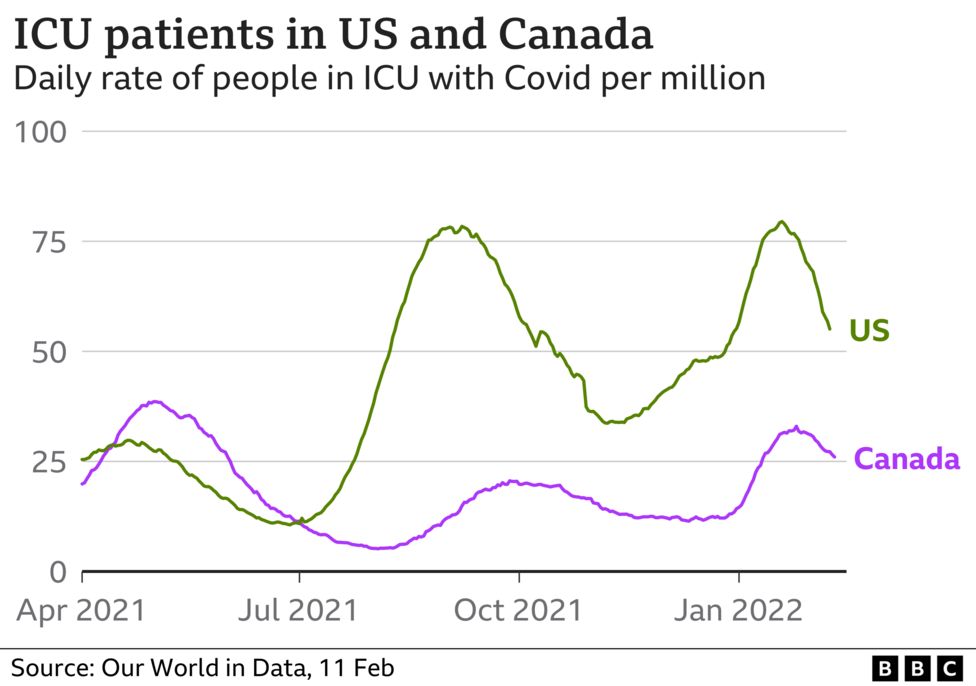


The BBC article has a number of graphic presentations comparing case rates, reported COVID deaths and ICU patients over the past year.


Canadian public health experts and many government officials believe that the more gradual relaxation of these rules - which are dependent on improvements in public heath data - has allowed it to avoid the same the high levels of infections and deaths that have been experienced in the US, where numbers spiked in a number of locations that rushed to ease regulations.1


The categories of data reported by the BBC, especially numbers of ICU patients and deaths, are trends that public health must monitor to modulate our relaxation of COVID restrictions as we move to living with COVID using an abundance of caution.

Watching with abundance of caution


References

1(2022, February 14). Why is Canada's Covid death rate so much lower than US? - BBC. Retrieved February 16, 2022, from https://www.bbc.com/news/world-us-canada-60380317

Sunday, July 25, 2021

Worry About Nightmare Climate Scenarios

What are the risks of not addressing the climate emergency? Scientists, engineers, economists, and politicians must ask this question as they plan programs for the rest of the century.
Engineering a green economy


Gernot Wagner writes for Bloomberg that the economist Martin Weitzman got scientists and politicians to think about the worst-case outcomes of global warming. He comments that we are seeing them happen right now. It is the extreme hot days, droughts, floods, and other weather phenomena made worse through climate change—that the late, great Martin Weitzman thought about when writing about the “fat tails” of climate change, including in our joint book, Climate Shock.

What would happen if an intense hurricane hit Boston? A powerful storm making landfall along the Gulf coast was bad enough—people would lose their jobs, maybe even their lives. But Florida has seen hurricanes before and knows it will see them again. There are emergency plans in place. Highways have marked evacuation routes. In Boston, the consequences would be devastating. Nobody in New England, including Weitzman, was prepared for that. Thus, he focused on climate as an insurance problem. Cutting carbon now, he argued, was valuable not just because it lowered global average temperatures, but more so because it lowered the chance of catastrophic events… Now it increasingly looks like Weitzman’s own mathematical argument might prove right for the wrong reasons. It may not be the link between CO₂ concentrations and temperatures playing out over decades and centuries that shows how the effect of climate extremes could overshadow all else. The droughts, floods and heatwaves sweeping across the globe show how climate is an insurance problem, right here, right now1.
 

Intact Insurance looks at the emerging risk and suggests how to prepare for climate change.


The good news: you can safeguard your home, property, and belongings. Certain programs exist to counteract the effects of climate change and shield Canadians from the potential impact of environmental  shifts, including initiatives from the Intact Centre on Climate Adaptation (Intact Centre), whose resources are available to everyone, regardless of their insurance provider. So, what can homeowners like you do? Two things: find out where you stand and take action.2

The Economist also asks “What’s the worst that could happen?” In a recent article, the author claims three degrees of global warming is quite plausible and truly disastrous. Rapid emission cuts can reduce the risks but not eliminate them. Hot as it is, this year will probably be one of the 21st century's coolest. The extremes of floods and fires are not going away—and urgent action is needed.

A 3°C world is thus both a pretty likely outcome if nothing more gets done and the worst that might still happen even if things go very well indeed. That makes it worth looking at in some detail, and the result is alarming. Those modelling climate impacts have long argued that they do not increase linearly. The further you go from the pre-industrial, the steeper the rate at which damages climb. And as what was rare becomes common the never-before-seen comes knocking (see chart 2). Judging by the results of specific studies, the differences between 2°C and 3°C are, in most respects, far starker than those between 1.5°C and 2°C... Just as today’s world is not uniformly 1.2°C warmer than the pre-industrial, a 3°C world is not uniformly 1.8°C warmer than today (see chart 3). Some regions, chiefly the oceans and parts of South America, will warm less; others will get much hotter. The Arctic, including northern Canada, Siberia and Scandinavia, will receive the brunt of the warming. Some more populated regions are also in for above-average temperatures.3 

The most visible sign of the emergency is the increase in deaths from heat related causes among the people who do not have access to cooling measures. The emergency is real.


References


1

(2021, July 9). We're Right to Worry About Nightmare Climate Scenarios - Bloomberg. Retrieved July 23, 2021, from https://www.bloomberg.com/news/articles/2021-07-09/we-re-right-to-worry-about-nightmare-climate-scenarios 


2

(n.d.). An emerging risk: how to prepare for climate change - Intact Insurance. Retrieved July 23, 2021, from https://www.intact.ca/blog/en/an-emerging-risk-how-to-prepare-for-climate-change.html 

3

(2021, July 23). Three degrees of global warming is quite plausible and truly .... Retrieved July 23, 2021, from https://www.economist.com/briefing/2021/07/24/three-degrees-of-global-warming-is-quite-plausible-and-truly-disastrous 


Tuesday, March 31, 2020

Health-care workers need to have frank conversations when death is imminent.

CBC Radio's Dr. Brian Goldman takes listeners through the swinging doors of hospitals
and doctors' offices, behind the curtain where the gurney lies on White Coat, Black Art on CBC Radio We need to talk more about death, says U.K. palliative author and physician Dr. Kathryn Mannix She says health-care workers have to get comfortable with having frank conversations with patients when death is imminent, so they can be prepared.