Showing posts with label Bernie Sanders. Show all posts

Saturday, November 4, 2023

America and the “day after” plan

Experts with experience in Palestine conflict history have discussed the end game situation in the Israel - Gaza war in various media.

Direction to the Endgame


Matt Galloway on the CBC program, the Current, discussed the Israel-Hamas conflict and its deadly impact on civilians inside Gaza on Nov. 2, 2023  with Rami Khouri, a distinguished fellow at the American University of Beirut; and Omar Rahman, a fellow at the Middle East Council on Global Affairs.


Rami Khouri observes that the situation has been disastrous. He focuses on the Palestinian territories, Middle East geopolitics and American foreign policy in the region.


But, you know, part of it is the Palestinian leadership's fault, and part of it is by design of Israel to divide and conquer the Palestinians. And they've worked that very well, including by helping entrench Hamas in the Gaza Strip. I mean, this is the plan from Netanyahu as well. I mean, it's been leaked and reported in the Israeli press that he found Hamas's governance of Gaza Strip useful to him and useful to the Israelis.


none of Israel's partners, not only do they not hold Israel accountable for its actions, its illegal actions like settlement building and all these things which have made two states impossible, impossible, but they're shielding those actions in the international fora, preventing any kind of pressure to mount on Israel to to come to terms. And if it doesn't, if it doesn't face that pressure, it has no incentive to pull back. Because, again, you have 750,000 settlers now in the occupied West Bank. If you're going to pull those people back in a country in which you have voting rights and those people vote as well, it's pretty much impossible. They're not going to move those back. You know, Israel, its politicians need the incentive to take those kind of actions, and they have no incentive whatsoever to take those kind of actions because, you know, the Western backers of Israel, you know, America, it's driven by its domestic politics when it comes to this issue is not a foreign policy issue in the United States. It is a domestic policy issue. And that severely limits what how the U.S. can operate vis a vis the Israelis. And so it makes peace extremely difficult. (The Current With Matt Galloway | Live Radio, n.d.)


Omar Rahman comments that we are seeing a more accentuated variety of the kind of pain and anguish and anger that we have felt for most of our lives.


I was born in 1948 when this conflict reached its peak. And so we've seen this before. The actions by all concerned parties have seen Hamas attack Israel before. But the incredible unanimity and vehemence of the Western support for Israel to keep going with this attack and killing and killing. But the Western support is really something new and troubling. We're seeing a genocide live on TV. Starving populations and the West mostly, including Canada, has been saying, well, it's not time for a cease fire.


Clearly, attacking civilians is not acceptable, whoever does it. But the Israelis have killed far more civilians than Hamas has killed, as you know. So if people are going to discuss this issue honestly, they have to apply the same criteria to both sides. So the aim is to find the solution that allows the Jewish majority state of Israel and a Palestinian state next to it to live side by side with equal sovereignty and equal rights. The Americans give lip service to it. The Canadians used to be very good at supporting refugee rights. The Canadians were the gavel holders for the refugee issue after the Madrid peace conference. The Europeans have all become much more hard liner. The fundamental idea that Israelis and Palestinians are human beings with the same rights under law and under God is not accepted by Israel. And until it's accepted, there's going to be conflict. And if there's conflict, there's going to be all kinds of terrible things happening. (The Current With Matt Galloway | Live Radio, n.d.)


CBC News on the The National, October 31, 2023, reported on a leaked document that outlines a plan of Israel for Gaza.


Bernie Sanders offers an opinion in the Guardian that there cannot be a return to the status quo that existed in Gaza before the war.


An immediate humanitarian response is vitally important, but it is equally important for Israel to have a political strategy. It cannot bomb its way to a long-term solution. Such a strategy must include, as minimum first steps: a clear promise that Palestinians displaced in the fighting will have the absolute right to safely return to their homes; a commitment to broader peace talks to advance a two-state solution in the wake of this war; an abandonment of Israeli efforts to carve up and annex the West Bank; and a commitment to work with the international community to build genuine Palestinian governing capacity.


The United States, which provides $3.8bn a year in military aid to Israel, should make it clear that these are the conditions of our solidarity. Just as we want Israel to be a vibrant democracy, safe from terrorist attacks, we also want justice and dignity for the Palestinian people. That’s not going to happen with Hamas running the Gaza Strip. It is also not going to happen with continued Israeli domination of Palestinian life. (Sanders, 2023)


An article in the Middle East and Africa section of the Economist about Hamas and Israel suggests that Israel’s prime minister is ill-equipped for war and peace. Inside Israel a political battle is raging over the conduct of the war, its aftermath and who makes decisions. At its heart is Binyamin Netanyahu, the dominant figure in Israeli politics for over two decades, who may now be the wrong man in the wrong place at the wrong time.


he has become a symbol of implacable hostility to a two-state solution at a time when Israeli commitment to it in some form is essential as part of any “day after” plan. That is so as to maintain American support and to sustain the Abraham accords, which established diplomatic links with a group of Arab states. In the absence of clear government direction the Israeli defence establishment is doing all the planning. Its preferred solution is to see the PA ultimately return to Gaza, which it controlled until Hamas’s coup in 2007. The Palestinian leadership is clear that any return to Gaza would require Israeli assurances on reviving a moribund diplomatic process towards a two-state solution. (Bibi Netanyahu Is the Wrong Man in the Wrong Place, 2023)


The political process to move toward a “day-after” where the vicious war is paused and the challenges of the new governments in Gaza and Israel to maintain peace are supported by Arab neighbours and the United States and its allies in NATO and the EU.


References


Bibi Netanyahu is the wrong man in the wrong place. (2023, October 31). The Economist. Retrieved November 4, 2023, from https://www.economist.com/middle-east-and-africa/2023/10/31/bibi-netanyahu-is-the-wrong-man-in-the-wrong-place 


CBC News (Executive Producer). (2023). The National [TV series]. https://youtu.be/Wf_CCuDNsPw?si=CkrYZN1iV_rK4ckg&t=471 

The Current with Matt Galloway | Live Radio. (n.d.). CBC. Retrieved November 4, 2023, from https://www.cbc.ca/listen/live-radio/1-63-the-current 


Sanders, B. (2023, November 2). Gaza needs a humanitarian pause. Then we need a vision of where we go from here | Bernie Sanders. The Guardian. Retrieved November 4, 2023, from https://www.theguardian.com/commentisfree/2023/nov/01/gaza-humanitarian-pause-bernie-sanders?CMP=twt_b-usopinion_c-us 


Friday, February 14, 2020

Bernie Sanders Broken Democracy and Indigenous communities


The conflict in Canada that places the investment in gas pipelines to advance progress in the export of energy at odds with Wet'suwet'en decisions about use of the unceded territory that is their traditional land base invites consideration of the role of capitalism in 2020 in enriching an oligarchy with little concern for the majority of citizens.
https://i.cbc.ca/1.4981127.1560197696!/fileImage/httpImage/image.JPG_gen/derivatives/16x9_780/gidimt-en-checkpoint-jan-7.JPG


  Robert Reich says capitalism is broken and we need to fix it.
 Robert Reich says capitalism is broken and we need to fix it1
Nick Bunker, Policy Analyst, Washington Center for Equitable Growth explains that predistribution, part of capitalism being “rigged” according to Robert Reich, is a rather opaque buzzword. He offers a deeper look at what it means and why it might matter for our thinking efficiency and reducing income inequality.
 The term originated in an essay by Yale University professor Jacob Hacker and has caught on more in the United Kingdom than in the United States. In short, this approach prioritizes policies that more directly intervene in the labor market to reduce income inequality over polices that redistribute incomes after taxes are levied. For policymakers concerned about the incomes of those at the bottom of the income ladder, a predistributionist approach would favor raising wages, perhaps by increasing the minimum wage, over increasing government transfers to those workers in the form of, say, earned income tax credits.2
Bill McGarvey asks “What does Bernie Sanders’ win say about the future of capitalism?” “The American dream is rapidly becoming the American illusion,” said Philip Alston, the United Nations’ special rapporteur on extreme poverty and human rights in a 2018 interview with the Los Angeles Times. “The equality of opportunity, which is so prized in theory, is in practice a myth, especially for minorities and women, but also for many middle-class white workers.” This disconnect between rhetoric and reality is a foundational element in Eric Cheyfitz’s book “The Disinformation Age: The Collapse of Liberal Democracy in the United States”. He is the Ernest I. White Professor of American Studies and Humane Letters at Cornell University. His  teaching focused on literature by and about Native Americans and African Americans that ran counter to traditional American narratives diagnosis.
 In The Disinformation Age he argues that the notion of American exceptionalism has been a dominant narrative since our founding and that after World War II—when there was an expanding middle class, labor unions were strong and there was some movement toward economic inclusion of women and minorities—that narrative still had some credibility. Since the Reagan administration, there has been an exponential increase in income inequality that has skyrocketed through six presidencies, Democratic and Republican alike, right through President Barack Obama and President Donald Trump… Our inability to address the catastrophic issues we face is rooted in the fact that “we have trapped ourselves within the limits of capitalism’s imagination,” he writes. In the United States, the boundary markers of those limits are found in our sacred devotion to the concepts of property, profit, production and progress. “These four terms in conjunction with each other,” he says, “produce and guarantee the perpetuation of wealth inequality and environmental disaster.” The path to breaking free from those limits in Cheyfitz’s analysis can be found in “the theory and practice of Indigenous communities.” The traditional foundation upon which native life is built is “based in the idea of balance (kinship, reciprocity and sustainability)” not competition and productivity. Given what is at stake politically, morally and ecologically, failing to recognize the moment we are in and the opportunities available to us will have consequences far beyond a simple failure of the imagination.3

Two cultures
Andrew Kurjata of CBC News reports the alternate route of the Coastal GasLink was too costly and posed greater environmental risks than a route endorsed by Wet’suwet’en hereditary chiefs. In an interview with reporters on Jan. 27, Coastal GasLink president David Pfeiffer was asked why the company wouldn't move the pipeline's path in order to avoid conflict. "We spent many years assessing multiple routes through the Wet'suwet'en Territory, about six years," Pfeiffer said. "The current route was selected as the most technically viable and one that minimized impact to the environment." Mike Ridsdale, the Office of the Wet'suwet'en's environmental assessment co-ordinator, stated that the alternate route would have followed a path through Wet'suwet'en territory eyed for use by Pacific Northern Gas for an expansion and looping project. The rejected McDonnell Lake route would also run through Wet'suwet'en territory, but would pass farther north, toward Smithers. Mike Ridsdale of the Office of the Wet'suwet'en said Pacific Northern Gas has considered the route for its own pipeline project, depicted in purple. (Pacific Northern Gas/B.C. Oil and Gas Commission) Ridsdale said the route follows "already heavily disturbed areas along the Highway 16 corridor, and away from highly known cultural areas, as well as away from the Skeena headwaters of salmon spawning areas that the Wet'suwet'en rely on." In a letter provided to CBC by the Office of Wet'swuwet'en, Coastal GasLink says it explored the possibility of using the McDonnell Lake route through aerial and computer reviews, and by meeting with representatives of Pacific Northern Gas. The letter — dated Aug. 21, 2014 — also outlines reasons Coastal GasLink rejected the route, including:
 It would increase the pipeline's length by as much as 89 kilometres, upping both the environmental impact and as much as $800 million in capital costs. The pipeline's diameter, at 48 inches (121 cm), is too large to safely be installed along the route. (Pacific Northern's pipeline is between 10 and 12 inches (25-30 cm), and the proposed upgrade would be 24 inches or 60 cm.) The McDonnell Lake route would be closer to the urban B.C. communities of Smithers, Houston, Terrace and Kitimat. Re-routing the pipeline would impact an additional four First Nations who had not already been consulted by Coastal GasLink, which would add up to one year of delays to the construction process."From our perspective, the route was not feasible on the basis of those significant environmental and technical issues and therefore route examination ceased," said Coastal GasLink spokesperson Terry Cunha in a followup email to CBC.4
https://i.cbc.ca/1.5465329.1581744733!/fileImage/httpImage/image.jpg_gen/derivatives/original_1180/mcdonnell-lake-route.jpg


The possibility that capitalism today is rigged in favour of accumulation of wealth by an oligarchy that has little regard for economic inequality may be at the core of investment policies that put profit before people.
Profit priority

This capitalism stands in stark contrast to the traditional foundation upon which native life is built, in the virtues of balance like kinship, reciprocity, and sustainability.

References

1
(2018, November 5). Capitalism for the few | CBC News - CBC.ca. Retrieved February 17, 2020, from https://www.cbc.ca/news/world/capitalism-for-the-few-1.3263904 
2
(2015, June 18). What is predistribution? | World Economic Forum. Retrieved February 14, 2020, from https://www.weforum.org/agenda/2015/06/what-is-predistribution/ 
3
(2020, January 2). The future is in our hands—not theirs | Canadian Centre for .... Retrieved February 12, 2020, from https://www.policyalternatives.ca/publications/monitor/future-our-hands%E2%80%94not-theirs  
4
(2020, February 13). What does Bernie Sanders' win say about the future of .... Retrieved February 14, 2020, from https://www.americamagazine.org/politics-society/2020/02/13/what-does-bernie-sanders-win-say-about-future-capitalism 
5
(2020, February 16). Why Coastal GasLink says it rejected a pipeline route .... Retrieved February 17, 2020, from https://www.cbc.ca/news/canada/british-columbia/wetsuweten-coastal-gaslink-pipeline-alternative-path-1.5464945 

Thursday, February 13, 2020

A Green New Deal to Help Capitalists

A report from The Economist, considers whether professional economists are rethinking the numbers on inequality. Over a decade before thousands of protesters gathered in Zuccotti Park in New York in 2011,to Occupy Wall Street.
Source: https://upload.wikimedia.org/wikipedia/commons/thumb/5/59/Zuccotti_Park_Spring_2015.JPG/325px-Zuccotti_Park_Spring_2015.JPG

a little-known researcher in France sat down to write about income inequality in a new way. “The focus of our study consists in comparing the evolution of the incomes of the top 10%, the top 1%, the top 0.5%, and so on,” Thomas Piketty wrote in a paper in 1998. With his long-term co-author, Emmanuel Saez, Mr Piketty pioneered the use of tax data over survey data, thereby doing a better job of capturing the incomes of the richest. He revealed that “the 1%” had made out like bandits at the expense of “the 99%”. His research gave Occupy Wall Street its vocabulary.
Owners of Capital see wealth grow

In “Capital in the Twenty-First Century”, a bestseller first published in 2013, Mr Piketty argued that under capitalism rising inequality was the normal state of affairs. Mr Piketty’s research, and more like it, became part of the political discourse in America and much of the West. Two leading candidates for the Democratic nomination for the American presidency, Elizabeth Warren and Bernie Sanders, have proposed taxes on wealth to tackle inequality—pledges cheered on by Mr Saez and Mr Piketty’s other co-author, Gabriel Zucman. In a new book, “Capital and Ideology” (currently available only in French) Mr Piketty calls for a 90% tax on wealth, such is the scale of the inequality crisis…
 New methodology introduced by Messrs Piketty, Saez and Zucman in a paper last year ranks by individuals and replaces capital gains with retained corporate earnings. But it still finds the share of pre-tax income of the top 1% to have surged from about 12% in the early 1980s to 20% in 2014. That is because they count a wide array of new income sources. The new methodology tries to trace and allocate every dollar of gdp in order to produce “distributional national accounts”—a project that Mr Zucman hopes will eventually be taken over by government statisticians. It is a tricky exercise because two-fifths of gdp does not show up on individuals’ tax returns. It is either deliberately left untaxed by government or illegally omitted from tax returns by those who file them. 1
And even if inequality has not risen by as much as many people think, the gap between rich and poor could still be dispiritingly high.
Share of national income
Economist Don Pittis writes Bernie Sanders may be just what U.S. capitalism needs. While there are plenty of economists who disdain Sanders, others who believe that capitalism is the hands-down winner in making ordinary people rich, healthy and happy are also convinced that right now U.S. capitalism needs someone like him. Perhaps none have made that clearer than the French bestselling economist Thomas Piketty, currently doing the media rounds in advance of the English version of his newest book, Capital and Ideology.
Piketty's case in that book was that unless capitalism was adjusted in favour of the poor, we should expect a nationalist backlash by those who were losing out and blamed global capitalism for all their problems.

To some critics, the movement in favour of Sanders is just a kind of populism from the other side, a sort of anti-Trumpism, to Make America Great by bringing down the evil rich.
The kind of ideology celebrated in books such as Winners Take All, by former New York Times columnist Anand Giridharadas, has become a key part of the U.S. political opposition that supports Sanders.
There are plenty of credible U.S. economists who agree with the need for capitalist reform. But for dry, intellectual analysis of why capitalism needs the kind of metamorphosis that only someone like Sanders can provide, it is hard to find a better source than Piketty.2
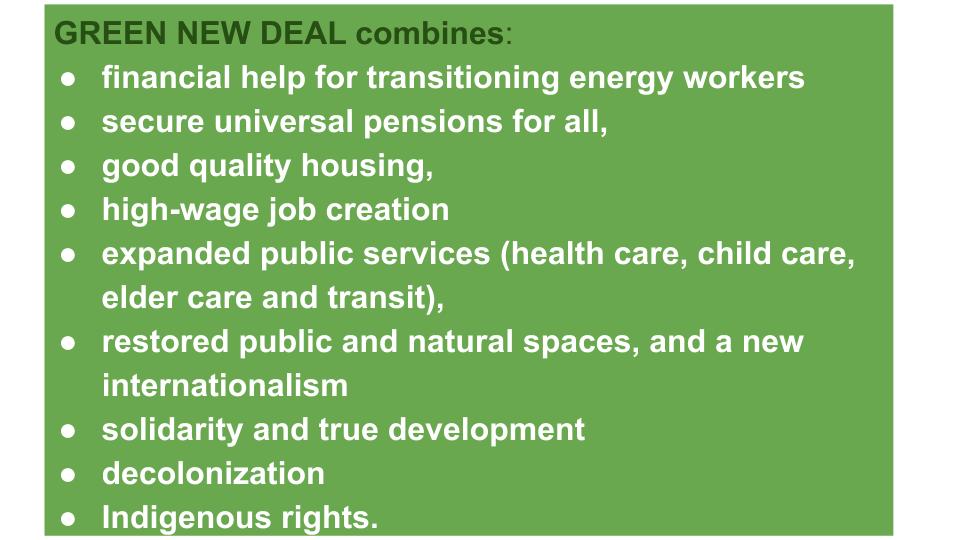
Hannah Muhajarine and Molly McCracken comment that it is incumbent on us, in this political moment, to reject half-measures and push for the most expansive and inclusive just transition possible. It’s time for us to get behind what people around the world are calling a Green New Deal.
 As a framework for climate legislation, the Green New Deal arose in response to the environmental wreckage and growing inequality that are a direct product of fossil-fuelled capitalism. The only way to meet our climate obligations is to transform our economy—not just away from fossil fuels, but also to be more equitable and inclusive.3
Green New Deal and the economy

Jeff McMahon, contributor to Forbes, from Chicago, writes about green technology, energy, and environment. Steve Cicala, an assistant professor in the Harris School of Public Policy, argued that the market for energy operates without accounting for its full costs — without compensating people throughout the world who experience damages caused by the emission of greenhouse gases during the production of energy. He suggests that Milton Friedman would find something unacceptable to the market economy in this scenario.
 But when a third party not participating in that exchange suffers costs without compensation, the market has produced a negative externality."It is theft," Cicala said. "That's a loaded term, but if anyone can come up with a better term for taking something from people without their consent and without compensating them, I'm happy to use that term."The free market solution to this problem would be the creation of another market, Cicala and Greenstone said—a market in carbon.4
The drift of capitalism towards benefiting the privileged living on capital wealth at the expense of the wage earners paying increasing taxes on stagnant incomes is a path to a social discord that the Green New Deal may assist to correct.

References


1
(2019, November 28). Measuring the 1% - Economists are rethinking the numbers on .... Retrieved January 24, 2020, from https://www.economist.com/briefing/2019/11/28/economists-are-rethinking-the-numbers-on-inequality 
2
(2020, February 13). Bernie Sanders may be just what U.S. capitalism needs, says .... Retrieved February 13, 2020, from https://www.cbc.ca/news/business/democrats-sanders-capitalism-1.5460890 
3
(2020, January 2). The future is in our hands—not theirs | Canadian Centre for .... Retrieved February 12, 2020, from https://www.policyalternatives.ca/publications/monitor/future-our-hands%E2%80%94not-theirs 
4
(2014, October 12). What Would Milton Friedman Do About Climate Change? Tax Carbon. Retrieved December 5, 2018, from https://www.forbes.com/sites/jeffmcmahon/2014/10/12/what-would-milton-friedman-do-about-climate-change-tax-carbon/